Gated Content Ladders for Shopify Apps: Only the Engaged Get the Good Stuff
A detailed journey design for Shopify apps to turn a flat 3-part email series into a gated content ladder in Spreeflo, so only genuinely engaged merchants unlock deeper lessons and become higher-intent, higher-LTV customers.
Industry
Niche
Pattern
Loading sequence...
The CartWizard team thought their “Revenue Lab” email series would be a slam dunk.
Three tightly written guides on abandoned cart flows, post‑purchase upsells, and LTV math for Shopify stores. All bundled into a “3‑part masterclass” they promoted on their marketing site and in their app sidebar.
The result: lots of initial sign‑ups, a decent open rate on email #1… and then a cliff. Half the list never touched email #2. By the time they pitched their higher‑tier plan in email #3, only a tiny, self‑selecting group even saw it.
The problem wasn’t the content. It was that everyone got the same sequence at the same pace, regardless of how interested they actually were.
The sequence at the top of this page is the whole journey, end to end. It turns that flat 3‑part series into a gated content ladder:
Everyone gets level 1.
Only people who engage with level 1 unlock level 2.
Only people who engage with level 2 unlock level 3 and the pitch.
We’ll walk through how CartWizard (a fictional but representative four‑person Shopify app at ~$80k MRR, running a stack of Stripe, GA, Intercom, and now Spreeflo) would build this in Spreeflo: which nodes to use, how to configure them, and how to adapt it to your own app.
By the end, you’ll have a reusable pattern for your own “only the engaged unlock the next lesson” series, built as a journey in the campaigns and journeys editor.
Why you should treat your content like levels, not a newsletter
For a Shopify app, your best prospects are busy store owners and operators. They don’t need more content. They need the right next thing, at the exact moment they’re thinking about the problem you solve.
A flat 3‑part sequence fails on three fronts:
You can’t see who’s actually serious. Opens and clicks are buried in aggregate stats, not translated into concrete “this person unlocked level 2” signals on the contact.
You waste attention. People who ignore level 1 still get level 2 and 3, which trains them to ignore you.
You leak lifetime value. The merchants who are engaging don’t get treated any differently from lurkers. You don’t follow up like they’re worth more, even though they are.
A gated content ladder fixes that by:
Capturing detail on every contact: each “unlock” becomes a tag or numeric score you can see and segment on.
Nurturing engagement instead of blasting: only contacts who prove interest see deeper content and stronger pitches.
Spreeflo is wired for exactly this kind of behavior‑driven content: email events power triggers and branching, and tags/attributes capture progression. This journey pattern is how you turn that into revenue.
What this gated content journey actually does
At a high level, this journey does four things:
Starts when a merchant opts into your content series (a “Revenue Lab” form, a checkbox on trial sign‑up, or a tag you apply from your app).
Sends level‑1 content and waits a couple of days.
Checks whether they really engaged (clicked the main link), then:
Repeats the gate for level 2, then waits to see whether they convert (install, upgrade, or activate a key feature) before deciding how to follow up.
If yes, tags them as having unlocked level 1 and sends level‑2 content.
If no, sends a single reminder and then stops pushing deeper content.
All of this lives inside one continuously running Journey in Spreeflo. New contacts drip in whenever they meet the entry condition; the journey handles pacing and gating per‑contact.
Let’s go node‑by‑node.
1. Entry: only start the ladder for people who ask for it
You don’t want every new contact thrown into this series. It’s for merchants who explicitly said “teach me this”.
On the canvas, we anchor the journey with an Added Tag trigger:
Node: Added Tag
Tag:
rev-lab-opted-inRe-enrollment:
false
You apply this tag when someone joins the “Revenue Lab” on your site or inside your app. That might come from:
Your form tool calling the Spreeflo API to add the tag on opt‑in.
Another journey using an Add Tag action after a “downloaded the PDF” event.
A CSV import where you pre‑tag interested merchants.
Why Added Tag and not Add to Audience? Because this series is specific. If you used Add to Audience, every new contact would enter. You’d immediately have to split and filter, and a mistake would quietly enroll the wrong people. The tag keeps the entry tight and explicit.
Immediately after the trigger, we add a couple of setup actions:
Add Tag:
rev-lab-active
This is your “currently in the ladder” flag. Useful later for excluding people from other campaigns.Update Contact Attribute (optional but powerful):
Attribute: custom number attribute
rev_lab_scoreUpdate type:
UPDATEValue:
0
This gives you a simple progression score per contact. We’ll increment it when they unlock each level.
Now you’re ready to send level‑1 content.
2. Send level 1 and give them time to engage
Next, you send your first lesson:
Node: Send Email
Template: “Rev Lab #1 – 7 abandoned cart flows that recover 10–15% more revenue”
“Send only once”: on
Build this email using the email builder. Keep it focused:
One core idea.
One primary CTA link (the content itself: article, video, or in‑depth guide).
Clear subject line that matches what they opted in for.
Then insert a delay:
Node: Time Delay
Duration:
2 days
Why 2 days? It’s enough time for busy merchants to check their inbox on their own rhythm without you feeling pushy. More importantly, it creates a clean measurement window: when we check engagement after this delay, we know we’ve given them a fair shot.
3. Gate level 2 on real engagement with Check Email Activity
Now the key move: use email behavior as your gate.
Node: Check Email Activity
Marketing email: “Rev Lab #1 – 7 abandoned cart flows…”
Activities to branch on:
Branch A:
Link ClickedBranch B:
Not ClickedElse branch: unused (everything falls into A or B)
Two important design choices here:
We gate on clicks, not just opens. An open could be a skim. A click on your main CTA is a much stronger signal they’re actually consuming the content.
We put a Time Delay before this node. Without it, you’d branch instantly, long before most people had a chance to click.
On the clicked branch (your level‑1 unlock), we:
Add Tag:
rev-lab-level-1-unlockedUpdate Contact Attribute:
Attribute:
rev_lab_scoreUpdate type:
INCREMENTValue:
1
Now every contact carries their own progression state. You can see it on the contact record, filter on it in the segment builder, and use it to power other automations.
Then we respect pacing:
Node: Time Delay –
1 dayNode: Send Email – “Rev Lab #2 – Post‑purchase flows that turn one‑time buyers into repeat customers”
Only people who clicked level‑1’s CTA ever see this email. That’s the core of the pattern.
On the not‑clicked branch, we don’t dump them straight away. They did raise their hand once, after all.
A simple fallback:
Time Delay –
2 daysSend Email – “Missed this? Your abandoned cart playbook inside” (a short reminder with a different subject)
Optionally, another Time Delay + Check Email Activity on the reminder if you want to give them a second shot.
What we don’t do: immediately send level‑2 anyway. That would defeat the gate and blur your signal on who’s truly engaged.
4. Repeat the gate for level 3 and your pitch
From the level‑2 send, we repeat the pattern.
First, wait:
Node: Time Delay –
3 days
Level‑2 is probably deeper, maybe with implementation detail or examples from your best merchants. You want to give them a bit more breathing room.
Then gate:
Node: Check Email Activity
Marketing email: “Rev Lab #2 – Post‑purchase flows…”
Activities to branch on:
Branch A:
Link ClickedBranch B:
Not Clicked
On the clicked branch (level‑2 unlock):
Add Tag:
rev-lab-level-2-unlockedUpdate Contact Attribute:
Attribute:
rev_lab_scoreUpdate type:
INCREMENTValue:
1(now score is 2 for fully engaged contacts)
Then:
Time Delay –
1 daySend Email – “Rev Lab #3 – The upgrade blueprint for scaling stores”
This third email carries your strongest product CTA. Examples:
“Book a 20‑minute call where we’ll benchmark your flows.”
“Turn on the ‘High‑intent flows’ pack in CartWizard Pro.”
“Install the app if you’re not already using it; here’s how we onboard stores like yours.”
Because only people who cleared both gates get here, you can assume a much higher level of interest. That justifies more direct language and a clearer ask.
On the not‑clicked branch:
Add Tag:
rev-lab-stalled-at-2(or similar)Optionally: a softer “summary” email after a delay, or just exit the journey.
Again, the point is to listen to behavior instead of forcing content on everyone.
5. Wait for product‑side conversion and react accordingly
Sending content is half the story. The other half is: did they actually move in your app?
Spreeflo’s web tracking and events let you wire product behavior straight into this journey. For a Shopify app, high‑signal events might include app_installed, subscription_upgraded, or feature_used.
After the level‑3 email, we watch for those:
Wait Condition
Condition: Custom event
subscription_upgradedtriggered at least 1 time in the last 7 daysTimeout:
7 days
This node pauses each contact until either:
They upgrade, or
A week passes without that event.
The Wait Condition doesn’t branch by itself, so we follow it with an If/Else:
Node: If/Else
Condition: same as the Wait Condition (has upgraded in the last 7 days)
Then branch: “Upgraded”
Else branch: “Not upgraded”
On the Upgraded path:
Add Tag:
rev-lab-convertedSend Internal Email to your team:
Subject: “Rev Lab contact upgraded”
Body: include the contact’s email, plan, and
rev_lab_scoreso you know they came through this journey.
You might also send one more Send Email to the merchant with “advanced setup tips”. Because the Wait Condition already held them for up to 7 days, this isn’t back‑to‑back with level‑3.
On the Not upgraded path:
Add Tag:
rev-lab-high-intent-no-upgradeOptionally, a Webhook to your backend or CRM if you want to create a follow‑up task elsewhere.
Time Delay –
2 daysSend Email – a short, plain‑text style message asking whether they got stuck and offering help.
This is where the pattern directly hits lifetime value. You’ve created a small, highly qualified subset of merchants to treat like VIPs. They’ve:
Opted into your content.
Engaged with 2+ deep‑dive guides.
Not yet upgraded.
If you’re going to invest founder time anywhere, it’s here.
6. Measuring unlock rate and content progression
This pattern exists to give you sharper signals, so measure them explicitly.
In Spreeflo you can:
Build a segment “Rev Lab Level 1 Unlocked” using either the
rev-lab-level-1-unlockedtag or Email Activity (“clicked Rev Lab #1 over all time”).Do the same for level 2 and for “stalled after level 1”.
Now you can track:
Unlock rate (Level 1 → Level 2):
# in Level 1 Unlocked÷# with rev-lab-opted-inUnlock rate (Level 2 → Level 3):
# in Level 2 Unlocked÷# in Level 1 UnlockedConversion rate from fully unlocked:
# with rev-lab-converted÷# with rev_lab_score ≥ 2
You can also cross these with product metrics powered by web tracking and analytics:
Do fully unlocked contacts have higher activation?
Do they stick around longer?
Does their ARPU trend higher?
Because each gate writes clean data to the contact record (tags and rev_lab_score), you’re not guessing. You’re correlating actual behavior with actual revenue.
And when you want to tweak copy, timing, or gating strictness, it’s easy to run an experiment with a Random Split at the top of the journey: 50% follow the gated ladder, 50% get a traditional flat series. Compare conversion between the two.
7. Variations for your own app
Once you have the basic pattern, there are plenty of ways to adapt it:
Gate on opens for very top‑funnel content, and on clicks for deeper, implementation‑heavy pieces.
Add a fourth “bonus” level for merchants above a certain revenue or with a
rev_lab_scoreof 3, using an If/Else on contact attributes.If you’re on the Professional plan and have push subscribers, add a single Send Web Push nudge after a long delay for people who clicked level‑1 but stalled before level‑2.
Under the hood, it’s all the same mechanics: triggers, waits, and branches built on the same segment builder, fed by behavior data from your app and site.
Treat content as a product, not a broadcast
Founder‑led Shopify apps win on leverage, not headcount. You can’t afford to manually “keep an eye on who seems engaged” and send hand‑crafted follow‑ups.
A gated content ladder built as a journey does that watching for you:
It captures detail on every merchant: who opted in, who unlocked which levels, who engaged but didn’t convert.
It nurtures engagement automatically: only the right people see deeper content and stronger pitches.
It surfaces a tiny, high‑intent slice of your audience that actually deserves your scarce manual attention.
Set it up once in the campaigns and journeys editor, plug in your own content and events via the Spreeflo API, and let it run.
You’ll know it’s working when that tiny group at the end of the ladder quietly turns into some of your best‑converting, best‑retaining customers — without you writing another weekly “newsletter” ever again.
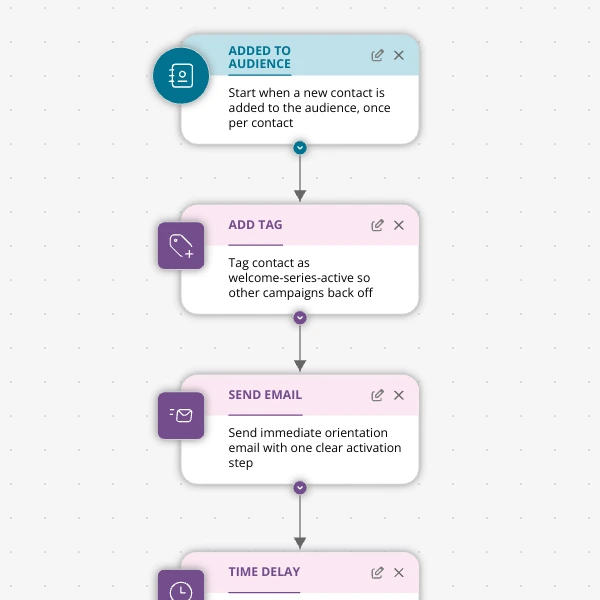
The Shopify app welcome series that turns installs into income
A step-by-step Shopify app welcome email journey for tools like CartSpark, showing how to turn new installs into activated, retained merchants using Spreeflo journeys, tags, and behavioral triggers so fewer trials quietly churn and more trials convert.
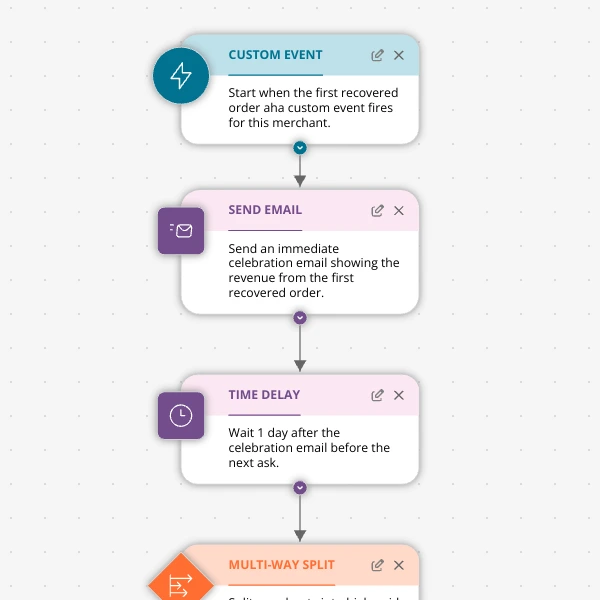
The Aha-Moment Playbook For Shopify Apps: Turn One Magic Action Into Months Of Revenue
A node-by-node playbook for Shopify and e‑commerce apps to center their lifecycle on one aha-moment custom event in Spreeflo, celebrate it, segment merchants by profile and engagement, and turn first recovered value into lasting revenue and retention.
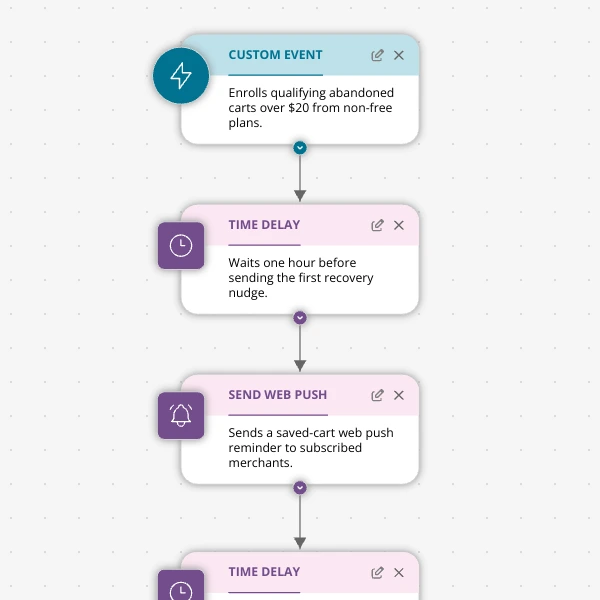
Stop Letting High‑Intent Carts Die: A 3‑Email Recovery Journey for Shopify Apps
A detailed, node-by-node walkthrough of a three-email (plus optional web push) cart-abandonment recovery journey for Shopify apps in Spreeflo, showing how to trigger events, branch on behavior, tag outcomes, and measure recovered carts and revenue.
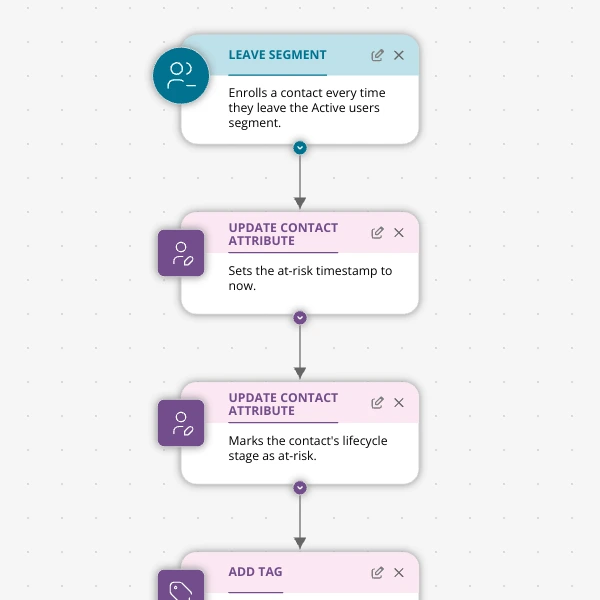
When Active Users Go Dark: A 4‑Touch Win‑Back Journey For Your Shopify App
A detailed, node-by-node Spreeflo journey for winning back previously active Shopify app users who stop engaging, using segment-based triggers, conditional logic, and a four-touch email plus internal alert sequence to recover usage and MRR.