Stop Asking 10 Questions at Once: Progressive Profiling for Your Shopify App
A practical walkthrough of a progressive profiling journey for Shopify and app-store apps, showing how to collect key customer attributes one by one over email without hurting install rates, and then use them for sharp onboarding, segmentation, and retention.
Industry
Niche
Pattern
Loading sequence...
The CartWizard team thought they were being smart.
Trial installs were strong, but churn was ugly. So they added eight new fields to their install form: team size, revenue range, platform mix, niche, role, country, tech stack, marketing budget. The idea was clear. More data, better segmentation, smarter onboarding.
Install rate dropped 27% in a week.
You’ve probably felt this tension. As an e‑commerce app developer, you know the install funnel has to stay frictionless. But you also know that treating a solo founder drop‑shipping from their bedroom the same as a 20‑person DTC brand is leaving money on the table.
Progressive profiling is how you get both: a low‑friction install and the rich profile you need for precise onboarding, upsells, and retention.
The sequence at the top of this page is the whole journey, end to end. It shows how to collect one missing attribute at a time over email, without annoying people or throttling your install rate. In this article, we’ll walk through that journey node by node, and you’ll see exactly how to adapt it for your own Shopify or app‑store product.
We’ll use a fictional app, StorePilot: a Shopify analytics and automation app doing $80k MRR, running Stripe, a basic help desk, and a legacy Mailchimp setup. They switch to the campaigns and journeys builder to tighten trial‑to‑paid conversions and reduce churn from “half‑set‑up” stores.
Why your install form is working against you
For apps like StorePilot, the money is in nuance:
Does this store do 50 or 5,000 orders a month?
Is the buyer a founder, a marketing manager, or an agency?
Are they single‑platform Shopify or also on Amazon, Woo, or custom headless?
Those answers change everything: onboarding flows, feature recommendations, pricing nudges, even whether you should push for annual.
The default move is to ask everything on day one. On a Shopify app listing, that means:
Bloated install UX
Scary forms for merchants who “just wanted to try this thing”
Fuzzy answers because they haven’t seen value yet
Progressive profiling flips that around. You:
Keep the initial install or signup light (often just email and store URL).
Use automation to identify what you don’t know.
Ask for one missing attribute at a time, in context, after you’ve already given value.
The rest of this article unpacks how to do that with journeys, tags, and the segment builder.
The journey you’re about to build
Before we zoom into each node, here’s what the whole pattern does:
Watches for contacts who are good candidates for profiling (engaged, subscribed, and missing key attributes).
Picks exactly one question to ask next, based on which attribute is still blank.
Sends a short, focused email asking only that one thing.
Waits a few days for the answer to come back via your app or a simple form.
Repeats with the next missing attribute until the profile is “complete”.
Tags fully profiled contacts so you can treat them differently going forward.
This is where Brand Message 1 comes alive: capture detail on every customer so you can speak to each uniquely. For an e‑commerce app, “detail” here is not demographic trivia. It’s the handful of attributes that shape your product experience and pricing.
Let’s go step‑by‑step through the sequence at the top of the page.
Step 1: Decide which data actually matters
Before you touch the canvas, decide on 3–5 attributes that genuinely change how you treat a merchant.
For StorePilot, they picked:
store_vertical(fashion, beauty, home, digital, other)monthly_order_volume(0–100, 101–500, 501–2,000, 2,001+)team_size(solo, 2–5, 6–20, 21+)role(founder, marketer, operator, agency)
These are defined as custom contact attributes in the audiences and attributes area. Every install writes email and store URL. Over time, you want every serious user to have values for all four of these.
You’ll also create a simple flag attribute (or tag) to mark when you’re “done”, for example:
Tag:
profile_complete
That tag is the end‑state for this journey.
Step 2: Trigger only when profiling is worth it (Criteria Match)
The journey starts with a Criteria Match trigger.
In the segment builder embedded in that node, StorePilot defines:
Email subscription status is “Subscribed”
AND at least one of the key attributes is blank
AND tag does not contain
profile_complete
You can be explicit about “blank” checks by adding one rule per attribute:
store_verticalis blankOR
monthly_order_volumeis blankOR
team_sizeis blankOR
roleis blank
This Criteria Match trigger has Re‑enrollment: ON.
Why that setting matters:
Journey‑scoped re‑enrollment means if you left it off, a contact could only ever run through this profiling once, even if you add new attributes later.
With re‑enrollment on, the same contact can re‑enter whenever they again match the criteria, as long as they’re not currently mid‑journey.
For StorePilot, that means:
New installs with missing data will get profiled.
Existing customers who were around before this was set up can also enter, once they match the criteria.
Immediately after the trigger, the journey uses an Add Tag action to apply something like profiling_active. This makes it clear in the contact record that this person is currently in the profiling program and can be useful later for suppressing other, conflicting journeys.
Step 3: Decide which question to ask first (Multi‑way Split)
Next is a Multi‑way Split process node. Its job is to decide which single attribute to ask about next.
StorePilot configures branches in priority order, each one checking “is blank” and “have we already asked this?” using tags:
Branch “Ask vertical next”
- Condition:store_verticalis blank AND contact is not tagged withasked_verticalBranch “Ask volume next”
- Condition:monthly_order_volumeis blank AND contact is not tagged withasked_volumeBranch “Ask team size next”
- Condition:team_sizeis blank AND contact is not tagged withasked_team_sizeBranch “Ask role next”
- Condition:roleis blank AND contact is not tagged withasked_roleElse branch “Nothing left to ask”
Why the tags? To avoid re‑asking questions to people who saw them once and never answered. If you leave those out, a contact who ignores your first “what’s your team size?” email will keep getting poked forever.
Handling the else branch:
In the “Nothing left to ask” branch, Add Tag:
profile_complete.Optionally Remove Tag:
profiling_active.End the journey path there.
That gives you a clean, binary state later: profile_complete vs everyone else.
Step 4: Ask for one attribute per email (Send Email + Add Tag)
Each non‑else branch now has its own short flow. Let’s use the “Ask vertical next” branch as the model.
Immediately after the branch, add a Send Email action.
Configuration choices:
Use a concise, expectation‑setting subject:
“Two‑second question about your store”
or
“So we can send you better benchmarks…”Keep body copy focused on value:
“We send different playbooks to fashion stores than to electronics. Which are you closer to?”
Then a few clear buttons or links (each tracked or leading to a preferences page).Build it in the email builder once, then reuse the template.
Critically, this email asks for one thing only. No sneaking in extra questions or mini‑surveys. That’s how you keep completion rates healthy and avoid fatigue.
Immediately after the Send Email node:
Add an Add Tag node to apply
asked_vertical.
This marks that you’ve already put this question in front of the contact at least once.
Note the pacing rule: you must not chain another Send Email right after this one on any path. That’s why the next node will always be a wait of some kind.
Step 5: Wait for the answer without stalling the flow (Wait Condition)
You need a way to give people time to answer, but you can’t let the journey hang forever.
This is exactly what Wait Condition is for.
On the “Ask vertical next” branch, right after you tag asked_vertical, add a Wait Condition node:
Condition:
store_verticalis not blankTimeout: 7 days
What happens:
If the contact answers your question in your app or via a simple form, your backend writes that value to the
store_verticalattribute using the Spreeflo API or identify calls from your SDK.As soon as that attribute is no longer blank, the Wait Condition resolves and the journey continues immediately.
If they never answer, the timeout fires after 7 days and the journey moves on anyway.
Compared with a plain Time Delay, Wait Condition avoids holding people hostage. You move as fast as they give you the data.
Right after the Wait Condition, StorePilot uses an If/Else process:
If
store_verticalis not blank:
- Optionally Add Tagcaptured_verticalor Update Contact Attributeonboarding_stageto a fixed literal like “knows_vertical”.Else (they didn’t answer in 7 days):
- Do nothing. Just let them move on.
Both branches then lead into a Merge node, so the paths reconverge before you decide what to ask next.
You repeat this same pattern on each branch:
Send Email asking for the specific attribute.
Add Tag
asked_….Wait Condition looking for that attribute to become non‑blank or for the timeout.
If/Else + Merge to tidy up.
Step 6: Loop through until the profile is complete
From that Merge node, the sequence routes back to another Multi‑way Split that looks for the next missing attribute.
In the visual flow at the top of the page, you’ll see that loop: from “Which question next?” into the micro‑flow for one attribute, then back to the splitter.
A few design choices matter here:
Order of questions
Ask attributes in the order that most improves your segmentation. For StorePilot, vertical comes first because it drives very different onboarding content. Role comes last because, while useful, it doesn’t change the core product experience as much.Pacing between questions
The Wait Condition already gives you at least some pause. Many teams also add a Time Delay of 2–3 days after the Merge before re‑entering the Multi‑way Split. That way, a merchant who ignores one question is not hit with another immediately.Respecting marketing fatigue
Because profiling emails are “extra” relative to your core onboarding and product updates, put guardrails in place. A simple one is a segment rule in other journeys: “exclude contacts tagged withprofiling_activefrom promos”. You can implement that via tags and the segment builder rather than complicating this journey.
Over a few weeks, engaged users flow through:
2–4 very short profiling emails
Time‑boxed waits for answers
An eventual
profile_completetag once they either answer or age out of questions
You never ask more than one question per email, and you never keep poking about the same thing forever.
How to measure whether this is working
You care about three main metrics for this pattern:
Profile completeness
What percentage of your active, paying accounts have all four (or whatever you choose) attributes filled?
You can track this as a saved segment and watch its size grow over time.Completion rate per touch
For each question email:
- What was the open and click rate?
- More importantly, what proportion of recipients ended up with that attribute filled within the Wait Condition window?
That tells you whether the question itself is clear and whether the timing feels reasonable.Segmentation quality outcomes
This is where value shows up:
- Compare trial‑to‑paid conversion for contacts with complete profiles vs partial.
- Compare churn or downgrade rates for well‑profiled accounts vs unknowns.
- Compare open and click rates for campaigns that target by vertical or order volume against your generic blasts.
Because all of this runs on the same contact record that powers your journeys, you can define segments like:
“Profile complete AND trial user” to test ultra‑targeted activation campaigns.
“High volume AND team size 6–20” for mid‑market expansion offers.
As you improve, those contacts become the default audience for your best campaigns, not a narrow slice.
Why this pattern compounds for small app teams
For a two‑to‑ten‑person Shopify app team, this is exactly the kind of system that earns its keep.
You set it up once in the campaign and journey editor. Your backend writes attribute values whenever someone answers. From then on, every install, every reactivation, every expansion opportunity is backed by a richer profile.
Most apps in your space still batch‑and‑blast. They send the same onboarding to a solo t‑shirt seller and a nine‑figure beauty brand. You don’t have to.
By progressively profiling over multiple touches, you:
Avoid scaring people away at install.
Build up the handful of data points that actually drive product and pricing decisions.
Give yourself room to write emails that feel like they were meant for that specific store.
That’s the core belief behind this pattern: if you capture detail on every customer, you can speak to each uniquely. And once you have that system in place, it keeps working while you ship features, fix bugs, and chase App Store rankings.
Set the journey up once, wire your app to write back answers, and let it run. Your future self — and your MRR — will be glad you did.
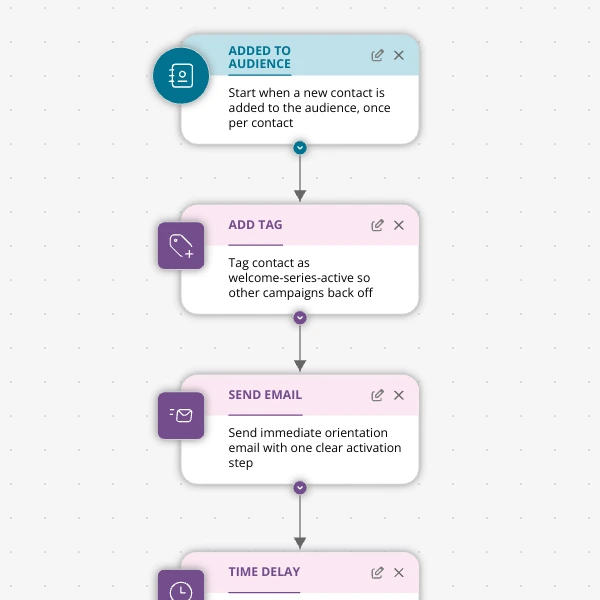
The Shopify app welcome series that turns installs into income
A step-by-step Shopify app welcome email journey for tools like CartSpark, showing how to turn new installs into activated, retained merchants using Spreeflo journeys, tags, and behavioral triggers so fewer trials quietly churn and more trials convert.
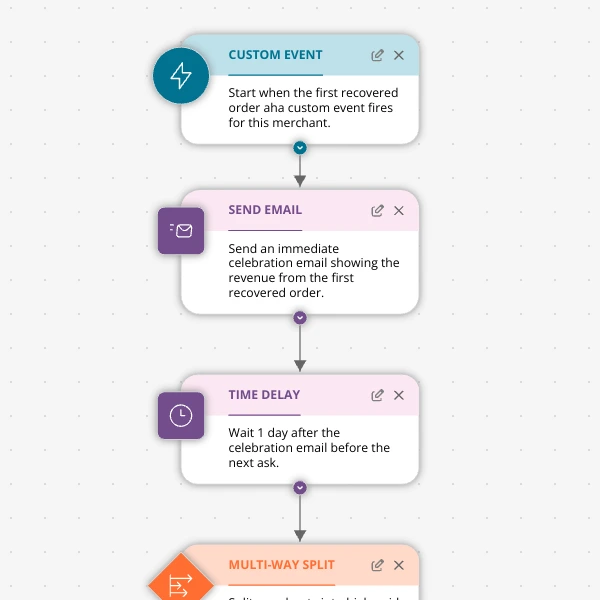
The Aha-Moment Playbook For Shopify Apps: Turn One Magic Action Into Months Of Revenue
A node-by-node playbook for Shopify and e‑commerce apps to center their lifecycle on one aha-moment custom event in Spreeflo, celebrate it, segment merchants by profile and engagement, and turn first recovered value into lasting revenue and retention.
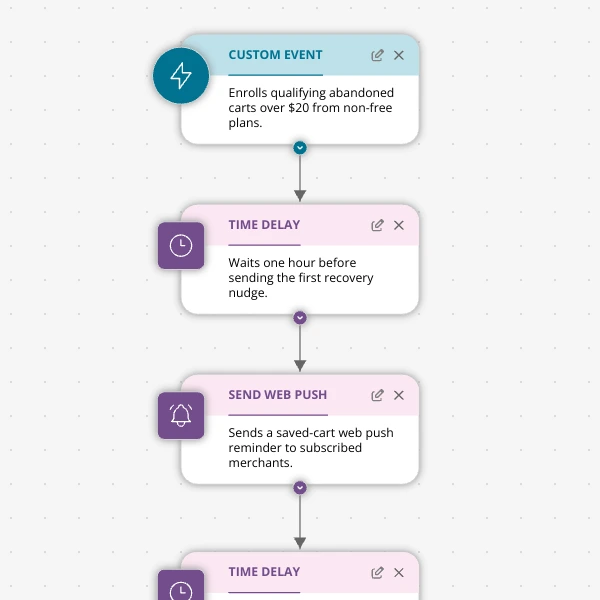
Stop Letting High‑Intent Carts Die: A 3‑Email Recovery Journey for Shopify Apps
A detailed, node-by-node walkthrough of a three-email (plus optional web push) cart-abandonment recovery journey for Shopify apps in Spreeflo, showing how to trigger events, branch on behavior, tag outcomes, and measure recovered carts and revenue.
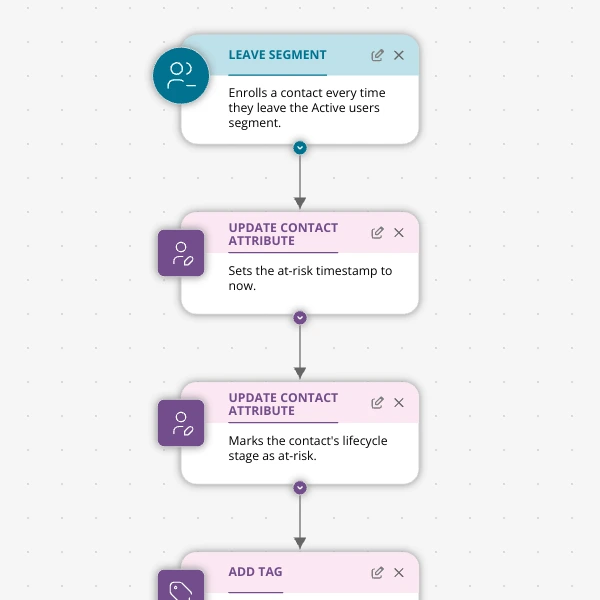
When Active Users Go Dark: A 4‑Touch Win‑Back Journey For Your Shopify App
A detailed, node-by-node Spreeflo journey for winning back previously active Shopify app users who stop engaging, using segment-based triggers, conditional logic, and a four-touch email plus internal alert sequence to recover usage and MRR.