Stop Wasting Your Blog: Build a Monthly Roundup That Actually Moves MRR
This playbook walks through a node-by-node Spreeflo journey that turns your existing ecommerce blog posts into a monthly, automated roundup, personalized by merchant interests to drive higher engagement, retention, and ultimately more expansion MRR.
Industry
Niche
Pattern
Loading sequence...
On the first of the month, the CartWizard team used to have the same Slack conversation.
“Do we have a newsletter ready?”
“Not yet. I can throw something together.”
“Cool, just send it to everyone.”
They were publishing four solid posts a month on abandoned-cart flows, AOV optimization, and case studies from their bigger Shopify merchants. But only a tiny slice of customers ever saw them. Most merchants installed the app, set up the default flow, and never came back.
The result: flat activation, weak upsell, and a blog that might as well have been private.
The sequence at the top of this page is the whole journey, end to end. It’s what CartWizard eventually shipped instead: a monthly, automated content roundup that:
Fires automatically on the first of every month
Curates last month’s best content
Routes each merchant into a branch based on their interests
What changed wasn’t “we send a newsletter now.” It was this: every merchant started getting content that sounded like it was written for them, not for a generic “Shopify store owner” blob.
In this playbook, we’ll walk through that journey node by node so you can build the same thing for your own app.
Why a monthly roundup is perfect for ecommerce apps
If you’re building a Shopify app or headless ecommerce tool, your world looks something like this:
Blog posts about checkout optimization, theme performance, reporting tips
Feature-announcement posts that quietly die after launch week
Customers who install, poke around, then disappear when things get busy
You’re leaking lifetime value because you’re not nurturing engagement between “install” and “I’m bored, uninstall.”
A monthly roundup solves three specific problems:
Content-discovery rate: More of your existing users see the posts you already wrote. One strong case study or “how we added $12k/month for Brand X” can be the nudge that keeps a merchant around.
Return visits: You give merchants a reason to come back to your blog and your app, not just your billing email.
Interest-based personalization: You stop talking to a high-volume DTC brand the same way you talk to a single-product hobby store.
This is exactly where Spreeflo shines: capture detail on every customer so you can speak to each uniquely, and stop leaving LTV on the table by going quiet between installs.
The journey you see at the top uses a Cyclic trigger, some simple segmentation, and a handful of emails to do all of that with almost no ongoing work.
Step 0: Tag what each merchant actually cares about
Before the automation can branch by “interest,” you need a way to know those interests.
For most Shopify apps, three or four buckets are enough:
Growth-focused (AOV, conversion, upsells)
Operational (analytics, reporting, forecasting)
New-store setup (onboarding, best practices)
Enterprise / high-volume (performance, team workflows)
You can capture these as tags on the contact record, fed by:
Signup form choices (“What do you care most about right now?”)
App behavior (which features they use, which settings pages they hit)
Content behavior (which blog topics they click, which webinars they register for)
Anything happening in your app or on your site can come into Spreeflo via the Spreeflo API or the web SDK. From there, you can attach tags or attributes and build segments with the segment builder.
For this playbook we’ll assume you’ve already got tags like:
interest-growthinterest-analyticsinterest-onboardinginterest-enterprise
If you don’t, start there. Even a simple “growth vs analytics” split makes your content dramatically more relevant.
Step 1: Cyclic trigger – first of the month, the right audience only
This is a Journey, not a Campaign. It runs forever, and every month it pulls in whoever currently matches your criteria.
In the sequence at the top, the first node is a Cyclic trigger:
Repeat every: 1 month
Time of day: e.g. 09:00 in your main timezone
Re-enrollment: ON (you want the same contact to run through this every month)
The important part is the trigger’s criteria, powered by the segment builder:
Email subscription status is “Subscribed”
Marketing status is “Marketing” (so you don’t pay to email non-marketing contacts)
Has at least one of your interest tags (
interest-growthORinterest-analyticsOR …)
This does three things for you:
Keeps the list clean. You’re not emailing unsubscribed or non-marketing contacts.
Targets only people you’ve actually profiled. No interest tags yet? They can stay on a generic nurture until you know more.
Makes this truly “set and forget.” New installs that pick a content preference automatically get enrolled on the next monthly tick.
Could you trigger on “Added to Audience” instead? Yes, but that’s a welcome/onboarding flow. For an ongoing monthly cadence, Cyclic is the right node.
Step 2: Multi-way Split – route by interest tags
Directly after the trigger is a Multi-way Split. This is where the “newsletter” stops being generic.
Each branch corresponds to a different interest, using conditions like:
Branch A – Growth: contact is tagged with
interest-growthBranch B – Analytics: contact is tagged with
interest-analyticsBranch C – Onboarding: contact is tagged with
interest-onboardingBranch D – Enterprise: contact is tagged with
interest-enterpriseElse branch – General: everyone else the trigger let in
A few design choices matter here:
Order is evaluated top to bottom. If a merchant has multiple tags, they’ll take the first matching branch. Pick a priority scheme (for example,
interest-enterprisefirst, then others) and stick to it.Keep conditions simple. You don’t need nested logic here; this node’s job is just to map “tag → path.”
Always have an Else branch. New tags, mis-tagged contacts, or future categories will still get a generic roundup.
If you’re not sure how to express those conditions, the segment builder UI is exactly what powers this node. You choose “Contact Tags,” then “contact is tagged with,” then the tag name.
Without this node, you’re back to a single, flat newsletter. With it, your “monthly roundup” turns into four or five distinct experiences, written in the language that each group already uses.
Step 3: Branch-specific roundup emails
Now each branch gets its own Send Email node, wired into a different template.
In your Growth branch, you might send:
“How Brand X added $17k/mo with a simple upsell”
“3 tweaks to your cart that cut abandonment by 12%”
“Replay: Live teardown of 5 high-converting product pages”
In your Analytics branch:
“How to read your revenue by cohort in under 5 minutes”
“What ‘LTV:CAC’ actually looks like for Shopify brands like yours”
“Case study: using our app to justify ad spend to finance”
You don’t have to create these templates from scratch every time. Build master layouts using the email builder, then once a month you:
Swap in last month’s best articles for that audience
Update the intro paragraph with a quick “here’s what we focused on in May”
Hit save
The journey logic doesn’t change. Only the email content does.
A few configuration tips for each Send Email node:
Use “Send only once” ON. If a merchant ever re-enters the journey (for example, you change criteria later), they won’t get the same exact roundup again.
Keep the roundup focused. Three to five links is usually enough. More than that and CTR drops.
Make the primary CTA a visit back to your site or app, not an immediate upgrade pitch. This journey is about nurturing engagement and content discovery, not hard selling.
By this point, a merchant who cares most about analytics has seen “your best analytics posts from last month,” not “whatever marketing felt like highlighting today.” That’s how you stop content from going to waste.
Step 4: Optional, gentle follow-up for non-openers
You don’t want to spam people. You also don’t want a deliverability blip or a busy week to tank your engagement numbers.
The pattern in the sequence uses a light touch:
After the first Send Email, add a Time Delay of 7 days.
Add a Check Email Activity node that looks at that roundup email.
Branch “Opened or Clicked”
Branch “Did Not Open”
Else branch (safety net, same as “Did Not Open”)
For the “Opened or Clicked” branch, you can:
Do nothing further in this journey, or
Add an Add Tag node to apply something like
roundup-engaged
For the “Did Not Open” branch, add a second Send Email node:
Subject: “Did you miss these ecommerce breakdowns last week?”
Body: same links, shorter copy, maybe one headline swapped for the strongest piece
You already inserted a 7-day Time Delay, so you’re respecting pacing: no back-to-back emails on the same path.
Why this structure matters:
It protects your list. People who consistently ignore the roundup are tagged as such; you can later exclude them or reduce cadence.
It maximizes content-discovery without over-emailing. One nudge is enough.
It gives you clearer data. Comparing CTR between the first and second send tells you whether non-opens are content issues or timing issues.
If you’re on Spreeflo’s Professional plan and already use web push, you could even test a Send Web Push nudge for the “Did Not Open” branch instead of a second email. But for most Shopify app teams, keeping this pattern email-only is simple and effective.
Step 5: Feed the signal back into your content strategy
The journey doesn’t need more nodes, but you should absolutely use the data it creates.
A few ways to do that:
Tags like
roundup-engagedvsroundup-ignoredhelp you see who actually cares about education vs who only reacts to in-app prompts.Comparing branch CTRs tells you which interest groups are under-served. If “interest-analytics” has twice the CTR of others, double down on that content.
URL-level tracking from web tracking and analytics shows which specific posts pull merchants back into the app. Those deserve more prominent placement and follow-up flows.
Every monthly send becomes a small experiment:
Does a teardown-style post beat a “5 tips” list?
Do enterprise merchants click more when you mention “teams” and “workflows” in subject lines?
Are growth-focused merchants more likely to open weekday or weekend roundups?
Because everything routes through one journey, you don’t need separate tooling to answer those questions. And if you want to go even deeper, AI personalization options in the editor (covered in personalize with AI variables) can adapt intros or subject lines to each merchant’s plan, geography, or stack.
Most teams never get to this stage because they’re still stuck on “remember to send a newsletter at the end of the month.” Once the automation is doing that job, your attention is free to move up a level: Which content is earning its place? Which merchants become power users after seeing which ideas?
Why this journey fits a lean app team
If you’re a 4-person Shopify app team, you don’t have a content ops department or a marketing analyst watching newsletters full-time. You have:
A blog you update when you can
A roadmap that’s always too full
A sense that “we should be emailing more,” without the hours to do it manually
This monthly roundup journey gives you founder-level leverage:
You design it once in the journey editor, using build this journey.
You plug in your segments and tags.
Each month, you spend 30 minutes swapping in last month’s best posts per branch.
In return, you get:
A steady, predictable touchpoint with every profiled merchant
Higher content-discovery rates for the work you’re already doing
More sessions back into your app from merchants who now see you as a source of useful ideas, not just a line on their invoice
Underneath it all is the core principle Spreeflo is built for: capture detail on every customer so you can speak to each uniquely, and stop leaking lifetime value by going silent after install.
You’re already writing the posts. This journey makes sure the right people actually read them.
If you want a head start, you can even pull a layout from the template library and adapt it to your branches. The logic stays the same; only the content and tags are yours.
A monthly roundup won’t magically fix a weak product or bad support. But for a solid ecommerce app that’s quietly shipping good content, it’s often the missing system between “we blog sometimes” and “our content measurably drives retention and expansion.”
Set up the Cyclic trigger. Split by interests. Send the right posts to the right merchants, every month, without thinking about it.
That’s how a small Shopify app team turns a blog into a compounding retention asset instead of a nice-to-have.
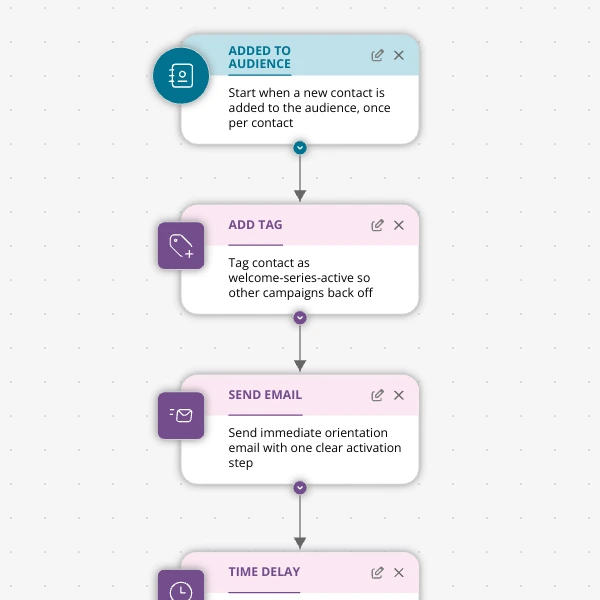
The Shopify app welcome series that turns installs into income
A step-by-step Shopify app welcome email journey for tools like CartSpark, showing how to turn new installs into activated, retained merchants using Spreeflo journeys, tags, and behavioral triggers so fewer trials quietly churn and more trials convert.
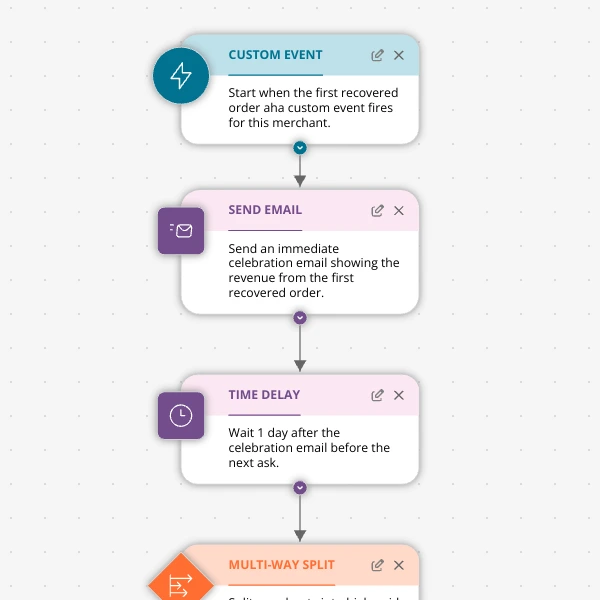
The Aha-Moment Playbook For Shopify Apps: Turn One Magic Action Into Months Of Revenue
A node-by-node playbook for Shopify and e‑commerce apps to center their lifecycle on one aha-moment custom event in Spreeflo, celebrate it, segment merchants by profile and engagement, and turn first recovered value into lasting revenue and retention.
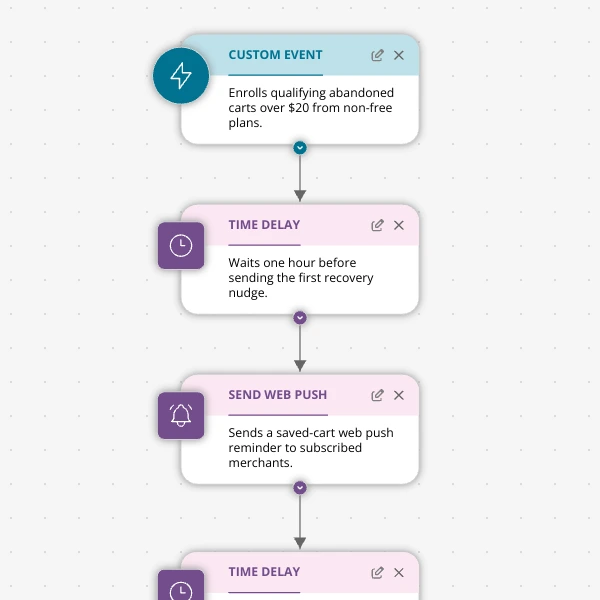
Stop Letting High‑Intent Carts Die: A 3‑Email Recovery Journey for Shopify Apps
A detailed, node-by-node walkthrough of a three-email (plus optional web push) cart-abandonment recovery journey for Shopify apps in Spreeflo, showing how to trigger events, branch on behavior, tag outcomes, and measure recovered carts and revenue.
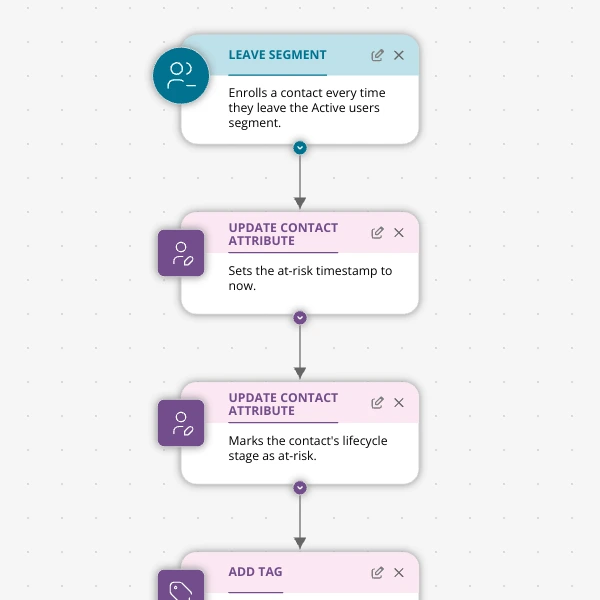
When Active Users Go Dark: A 4‑Touch Win‑Back Journey For Your Shopify App
A detailed, node-by-node Spreeflo journey for winning back previously active Shopify app users who stop engaging, using segment-based triggers, conditional logic, and a four-touch email plus internal alert sequence to recover usage and MRR.