Stop Wasting Your “Contact Us” Leads: A Full-Funnel Follow-Up Journey for E‑commerce Apps
Step-by-step journey for e‑commerce and Shopify apps to turn high-intent “Contact us” form submissions into meetings and customers with instant acknowledgements, internal alerts, short targeted nurture emails, and safeguards to hit response SLAs.
Industry
Niche
Pattern
Loading sequence...
The Shopify store owner finally fills out your contact form.
They’ve been circling your app for a week, reading reviews, opening your pricing page in new tabs. Now they type out a detailed question about whether your app will work with their custom checkout and hit submit.
And then… nothing.
A generic “Thanks, we got your message” screen. Maybe a bland confirmation email. Hours before anyone on your team replies. By the time you do, they’ve already installed a competitor.
For most e‑commerce apps, this is where serious money quietly dies.
This article is about fixing that with a repeatable system: every non-demo form submission gets an instant, personalized acknowledgement, your team is nudged to respond quickly, and the contact is dropped into a short nurture that actually earns the meeting.
The sequence at the top of this page is the whole journey, end to end. We’ll walk through it node by node so you can see how it works and how to adapt it to your own Shopify or e‑commerce app.
To make this concrete, we’ll use a fictional app, UpsellPilot:
A Shopify upsell / cross-sell app
$65k MRR, 5-person team
Stack: Shopify App Store, Stripe, a custom marketing site, basic form on
/contact, and Spreeflo for email + automation.
UpsellPilot noticed a pattern: “Contact us” leads converted to paying customers at 40% when they got a same-day human response… and less than 8% when replies slipped to 24+ hours. The founder didn’t need more traffic. They needed a journey that respected every form submission as the high-intent signal it is.
Let’s build that journey.
What this journey is designed to do (and why it matters)
This pattern is for any non-demo form:
General “Contact us”
“Partner with us”
“Ask a question”
“Request a quote” / “Consultation request”
The goal is threefold:
Acknowledge instantly so they don’t feel ignored.
Alert the right human so replies stay inside your SLA.
Keep the conversation warm with 2–4 targeted emails that address the reason they reached out, instead of a one-off confirmation.
It leans on two of Spreeflo’s core ideas:
Capture detail on every customer so you can speak to each uniquely.
Most businesses leak lifetime value by not nurturing engagement.
A form submission is late-funnel engagement. Treat it like the beginning of a micro-onboarding journey, not a transaction confirmation.
The trigger: catching every form submission cleanly
At the very top of the sequence you’ll see a Custom Event trigger configured for something like:
Event name:
form_submissionProperty condition:
form_id is "contact_us"(or whatever ID you pass)
In practice, you wire this up using the Spreeflo SDK or the Spreeflo API:
When someone submits your form, your site:
Calls
Spreeflo.identify(email, attributes)with their email and any fields (store size, platform, topic).Calls
Spreeflo.track("form_submission", { form_id: "contact_us", topic: "integration", ... }).
Why this trigger, not “Add to Audience” or Criteria Match?
You only want people who submit a specific form, not every new contact.
You want it to fire immediately on that event, without waiting for a nightly sync or segment recalculation.
You can filter by form properties, so the journey is different for “partnership” vs “support” vs “sales” intents.
Configuration detail that matters: leave isReEnrollment off for this journey by default. Most contacts won’t submit that form repeatedly. If you do have a use case where they might (e.g. recurring consultation requests), you can create a separate “repeat consultations” journey with re-enrollment on.
From this Custom Event node, everyone flows straight into instant acknowledgement.
Step 1: Send a confirmation email that sounds human
The first Action node is a Send Email labelled something like “Form acknowledgement”.
Key configuration choices in this node:
Use your main support or sales sender identity, not a no-reply.
Keep “Send only once” turned on (default). You don’t want someone who double-submits to get spammed with confirmations.
Use the email builder to create a template that:
Confirms you got their message.
Sets a clear expectation: “We reply within X business hours.”
Reflects the context you captured (e.g.
{{ contact.store_size }},{{ contact.platform }}if you sync those attributes).Invites reply: “If you have screenshots or details to share before we respond, reply to this email.”
You can optionally use AI personalization (subject lines and body) from the AI variables help doc to vary phrases by store size or topic. But keep it grounded: the single most important job of this email is speed and clarity.
Why put this email first, ahead of internal routing?
From the customer’s perspective, the critical UX moment is “Was I heard?”
Internal routing SLA can be a few seconds slower with zero user impact.
If anything goes wrong downstream (e.g. webhook failure), the customer still has confirmation in their inbox.
After this node, the sequence moves into internal ops.
Step 2: Notify the right human with context
Next, you’ll see a Send Internal Email node, “Notify team – new contact form”.
This is where you decide who should see which kinds of form submissions:
For UpsellPilot, “topic = sales” goes to a sales inbox; “topic = support” goes to support; “topic = partnership” goes to the founder.
Even if you don’t branch yet, send at least one internal email so nobody is relying only on the helpdesk view.
Configuration details:
Use a dedicated identity (e.g.
alerts@upsellpilot.com) as the sender.Keep “Send only once” on (you don’t need multiple alerts per submission).
In the email body, include key contact attributes and event properties:
Email, name
Store URL
Shopify plan or revenue band, if you track it as a contact attribute
Form topic, free-text message, any checkboxes
A link to their profile in your product and in your CRM, if you enrich via webhook
Why an internal email instead of only relying on your existing helpdesk?
Spreeflo is your central source of behavioral truth: it sees form submissions, app usage, pricing-page visits, and more, not just tickets.
You can embed behavior in the alert: “Visited pricing 3+ times in last 7 days” or “Used feature X at least 5 times”.
For a 5-person app team, a simple email alert is often faster to wire up than a full-blown CRM integration.
You can enhance this further with a Webhook node that posts to your CRM or Slack, but this pattern focuses on the email+internal combo to keep it simple and resilient.
From here, the journey diverges slightly depending on whether you want to branch first or wait.
Step 3: Short delay to give humans time to respond
After alerting your team, the sequence introduces a Time Delay node, usually 4–12 hours, depending on your promise.
Example for UpsellPilot:
Time Delay: 6 hours
Why a delay here?
You want to give your team a chance to send a thoughtful, personalized reply before automation piles on more messaging.
But you also don’t want the lead to go cold if that reply slips.
Time Delay nodes in Spreeflo work in hours or days (minimum 1 hour). For a typical B2B app, 6–12 hours is a good window: fast enough to feel responsive across time zones, flexible enough for small-team realities.
After the delay, we check whether a human has engaged.
Step 4: Check for engagement before nudging again
The next section of the sequence uses an If/Else node to decide whether the nurture should proceed.
There are a couple of ways to build this condition using the segment builder:
Simple version: Check if they replied to the acknowledgement email.
Condition group:
Email Activity “replied” to that template at least 1 time in the last 1 day.Slightly richer: Check reply OR any manual touch.
Condition group (AND):
Sub-group (OR):
Email Activity “replied” to acknowledgement at least 1 time in last 1 day
Contact is tagged withmanual_replied(a tag you add via your CRM or support tool sync)
The If/Else is configured with:
Then branch = “Engaged”
Else branch = “Not engaged yet”
Why make this check?
You don’t want to bombard someone who is already in an active thread with more automated proof-point content.
You do want to keep lightly nudging those who have been acknowledged but not yet deep in conversation.
Contacts who match “Engaged” can move to a simple tag-and-exit. Contacts who are “Not engaged yet” go into your multi-step nurture.
Step 5: Merge engaged paths and avoid double-sending
In the sequence, you’ll see:
On the “Engaged” branch:
An Add Tag node: addform_lead_engaged.
Then a Merge node, which flows to the terminal or a final tracking step.On the “Not engaged yet” branch:
The nurture emails.
Eventually, that path also runs into the same Merge node.
The Merge node is important for one reason: it keeps your canvas valid. Spreeflo requires only one incoming edge per node, apart from Merge. If you tried to have both branches go straight into the same Send Email or Add Tag node, the backend would reject the graph.
Conceptually, Merge is just a join: “Regardless of which path you came from, you’ve now finished this micro-journey.” You can attach an Add Tag after it (e.g. completed_contact_nurture) for analytics.
Step 6: Build a follow-up nurture that earns the meeting
Now we get to the emails that most teams skip: the content that helps the lead make a decision while your team is juggling 12 other things.
In the “Not engaged yet” branch, you’ll typically see 2–3 Send Email nodes separated by Time Delays.
A common structure for an e‑commerce app:
Email 2: Social proof and relevance
Send 1 day after form submission.
Case study or quick story aligned with their segment:
“How a Shopify Plus store increased AOV by 18% with UpsellPilot”
Use contact attributes to swap examples (e.g. different case study for <50 orders/month vs >1000).Email 3: Answer the most likely objection
Send 3 days after form submission.
Subject: “How UpsellPilot works with custom themes” or “What about checkout extensions?”
Tailor to thetopicproperty you captured from the form.Email 4: Clear next step and low-friction CTA
Send 5–7 days after.
Offer both options:
“Hit reply with your question.”
Or “Book a quick call” with your calendar link.
Configuration details worth mirroring from the sequence:
“Send only once” for each Send Email node stays on. If the contact somehow re-enters the journey later (e.g. re-enrollment turned on in a variation), they won’t get duplicate nurtures.
You can A/B test subject lines with a Random Split before a Send Email:
Random Split: 50% “A/B subject A”, 50% “subject B”.
Each branch sends a different version of the same content.
Both branches then Merge before continuing.
Why is this nurture short?
These leads already raised their hand. You don’t need a 14-email drip.
Your goal is to keep top of mind for a week or so, giving them reasons to say “yes” while your team does its best to respond manually.
In a Shopify app context, the sales cycle is days, not months.
Every email in this branch should feel like a continuation of their question, not a generic newsletter. That’s where Spreeflo’s personalization and the contact attributes you captured at form time really pay off.
Step 7: Optional – SLA safety net with Wait Condition
Some teams like an additional guardrail: “If nobody from the team has responded in X hours, escalate.”
You can do this right after the initial internal email:
Insert a Wait Condition node:
Condition: Tagmanual_repliedexists OR Email Activity “replied” to acknowledgement.
Timeout: 12 hours.Then follow it with an If/Else:
If condition met: do nothing special.
Else: Send Internal Email to a different recipient (e.g. founder) with subject “SLA risk: Contact form unanswered.”
Wait Condition is smarter than a raw Time Delay because it unblocks as soon as the condition is met. If the team replies in 1 hour, the contact never hits the “SLA risk” branch.
For small Shopify app teams juggling support and sales, this node alone can save deals that would otherwise fall through the cracks on busy launch days.
How to measure whether this journey is working
You don’t set this up for the aesthetics of a nice flowchart. You set it up to move three numbers:
Form-to-meeting rate
Contacts who submit the form → contacts who book a call or start a trial within 7 days.
Compare before vs after journey rollout.Reply rate to your nurture emails
Particularly Email 2 and 3, which should invite “quick reply” interactions.SLA to first human response
Average and 90th percentile time from form submission to first manual reply.
You can approximate this with tags + events inside Spreeflo, or mirror data from your helpdesk.
Most e‑commerce apps see the biggest lift in “form-to-meeting” simply because the lead no longer feels ghosted for 12–24 hours. The nurture flow then becomes incremental upside: more replies, better-qualified conversations, fewer “already went with a different app” responses.
Why this earns its line item in your stack
For a business like UpsellPilot, this one journey took a half-day to set up. They now:
Acknowledge every contact immediately.
Keep their tiny team honest on response SLAs.
Nurture undecided leads with content that speaks directly to store size, platform, and topic.
This is the heart of good marketing automation for founder-led teams: capture detail on every customer, then speak to each uniquely at the moment they care most.
If you’re already capturing events through the web tracking and analytics setup, you have everything you need to wire this journey inside the campaigns and journeys editor. Build it once, let it run quietly in the background, and stop wasting the highest-intent leads you already have.
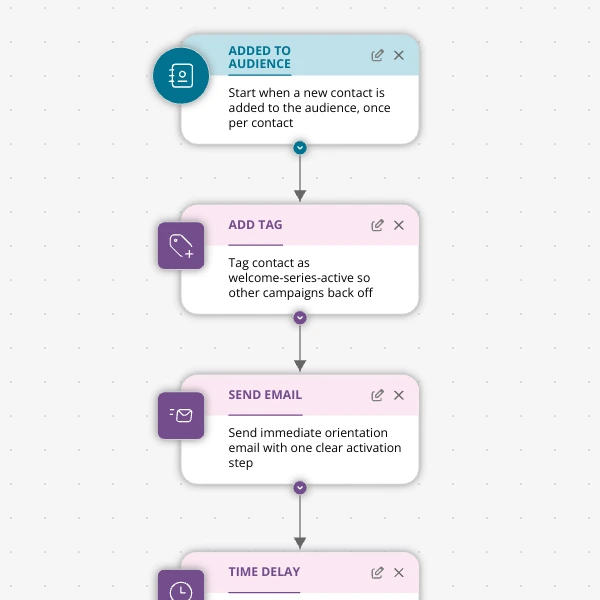
The Shopify app welcome series that turns installs into income
A step-by-step Shopify app welcome email journey for tools like CartSpark, showing how to turn new installs into activated, retained merchants using Spreeflo journeys, tags, and behavioral triggers so fewer trials quietly churn and more trials convert.
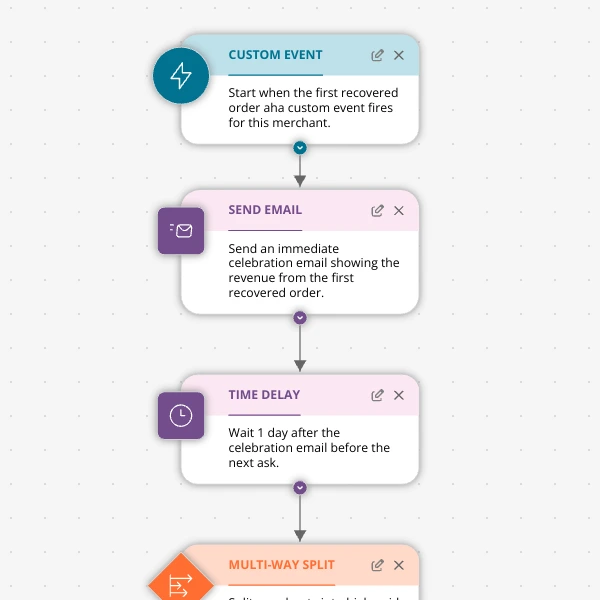
The Aha-Moment Playbook For Shopify Apps: Turn One Magic Action Into Months Of Revenue
A node-by-node playbook for Shopify and e‑commerce apps to center their lifecycle on one aha-moment custom event in Spreeflo, celebrate it, segment merchants by profile and engagement, and turn first recovered value into lasting revenue and retention.
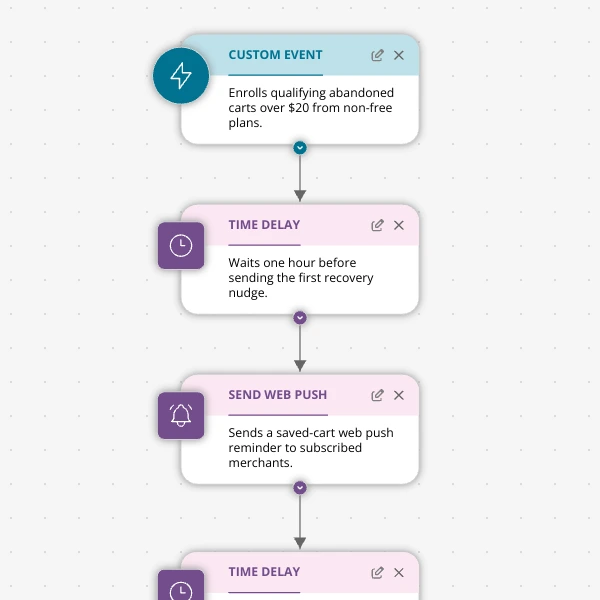
Stop Letting High‑Intent Carts Die: A 3‑Email Recovery Journey for Shopify Apps
A detailed, node-by-node walkthrough of a three-email (plus optional web push) cart-abandonment recovery journey for Shopify apps in Spreeflo, showing how to trigger events, branch on behavior, tag outcomes, and measure recovered carts and revenue.
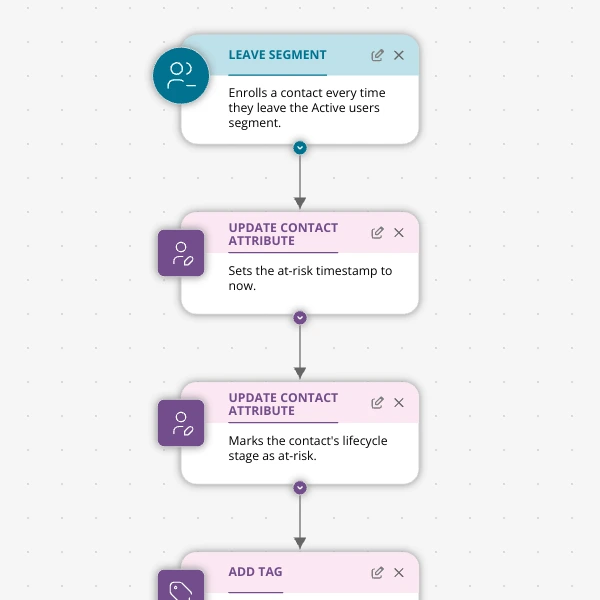
When Active Users Go Dark: A 4‑Touch Win‑Back Journey For Your Shopify App
A detailed, node-by-node Spreeflo journey for winning back previously active Shopify app users who stop engaging, using segment-based triggers, conditional logic, and a four-touch email plus internal alert sequence to recover usage and MRR.