The Aha-Moment Playbook For Shopify Apps: Turn One Magic Action Into Months Of Revenue
A node-by-node playbook for Shopify and e‑commerce apps to center their lifecycle on one aha-moment custom event in Spreeflo, celebrate it, segment merchants by profile and engagement, and turn first recovered value into lasting revenue and retention.
Industry
Niche
Pattern
Loading sequence...
A merchant installs your Shopify app on a Sunday night, pokes around for ten minutes, then disappears.
They never hit “send first campaign,” never complete their first workflow, never launch the first upsell funnel. The trial expires. Churn.
You see this pattern on your dashboard every week. Install rates look fine. Uninstall rates aren’t catastrophic. But activation? That’s where the revenue dies.
This playbook is about fixing that one, specific leak: the gap between “installed” and “actually got value” for your Shopify or e‑commerce app.
The sequence at the top of this page is the whole journey, end to end. It watches for the exact behavior that signals a merchant has truly “got it” (their aha moment), then doubles down: celebrate, expand their usage, and quietly sort them into different tracks based on who hasn’t reached that moment yet.
To make it concrete, we’ll follow a fictional app:
Business: CartWizard, a Shopify cart recovery + upsell app
Stage: ~$100k MRR, 4-person team
Stack: Shopify App Store, Stripe, a basic email tool they’re replacing, plus Spreeflo for automation
For CartWizard, the “aha” is simple: the first recovered checkout using their app’s automated flow. That’s the moment a merchant sees real dollars that wouldn’t exist without them.
This article walks node-by-node through how you turn that single event into a lifecycle system that boosts trial conversion, retention, and upsell — while capturing more detail on every merchant so you can speak to each uniquely.
Why this journey sits on a single Custom Event
The heart of the flow is a Custom Event trigger: something like cartwizard_first_recovery. That event fires from your backend or via the Spreeflo SDK when a store recovers its first order through your app.
In Spreeflo terms, the journey starts with a Custom Event trigger node.
Why Custom Event and not Join Segment or Criteria Match?
This is a precise moment in time, not a fuzzy condition.
You want to react instantly, not on a daily cron.
The properties of that event (order value, plan, store size) are gold for personalization.
In the trigger configuration you:
Set
eventNameto your aha event (e.g.first_recovered_order,first_report_generated,first_automation_published).Leave property conditions off for the main path so every aha event qualifies.
Re-enrollment should be off here (isReEnrollment = false). You only want to celebrate the very first aha moment per contact; every subsequent recovered order is just normal success, handled by other journeys.
This single decision matches a broader Spreeflo philosophy: identify the one moment that proves value, capture it as a clean, named custom event via the Spreeflo API, and wire the rest of the lifecycle around it.
Step 1: Instant celebration with Send Email
From the Custom Event trigger, the next node is a Send Email action: an immediate “You just made money” celebration.
Configuration choices here matter more than people think:
Template: a short, plain-language template, built in the email builder, that calls out the revenue impact explicitly.
From identity: use the founder or success lead’s name (“Hannah from CartWizard”), not “no-reply”.
isSendEmailOnlyOncestays on. If your event plumbing ever glitches and fires twice, you don’t want double celebration emails.
Why email and not in-app messaging or web push?
Email reaches them whether they’re in the app or not.
For Shopify merchants, inbox is still where serious, money-related communication lives.
You can easily thread deeper onboarding from this message over the next days.
You’re not just congratulating them. You’re anchoring:
“Your first recovered order is worth $X. Stores like yours typically recover $Y/month once flows are fully set up.”
This ties directly to Brand Message #3: most businesses leak lifetime value by not nurturing engagement. The celebration email starts to close that gap the minute value is proven.
Step 2: Short Time Delay before the next ask
After the first email, the sequence uses a Time Delay.
Recommended configuration:
1 day delay
Unit: “day” (Spreeflo’s Time Delay supports only hours or days, minimum 1 hour; for this pattern, days are cleaner.)
Why not send a second email immediately?
You want the first message to land on its own.
A 24-hour gap feels respectful while still being close enough to the aha moment that memory and motivation are high.
Skipping this delay often creates a noisy experience: back-to-back system emails right after each other feel transactional, not thoughtful.
Step 3: Multi-way Split on store profile or plan
After the delay, the sequence forks using a Multi-way Split process node. This is where you turn “one aha moment” into three different expansion plays.
For a Shopify app like CartWizard, typical branches might be:
High-revenue stores (e.g. MRR > $200, or custom attribute
shopify_planis “Plus”)Growing mid-market stores (consistent usage but on basic plans)
Small or casual merchants (low order volume, small average order size)
In the Multi-way Split configuration:
Branch A condition: contact attribute
store_monthly_ordersGREATER_THAN 300Branch B condition:
store_monthly_ordersGREATER_THAN 50 AND LESS_THAN_OR_EQUAL 300Else branch: everyone else (low-volume merchants)
Why not use three separate journeys instead of a Multi-way Split?
Journeys are better as long-running “themes.” This one is about aha celebration.
Multiple journeys with overlapping triggers get hard to reason about and are subject to re-enrollment rules.
A single split keeps the behavior clear: same aha event, different downstream asks.
This is brand message #1 in action: you capture detail on every customer so you can speak to each uniquely. The aha is common. The path forward is not.
Step 4: Tailored Send Email per branch
Each branch flows into its own Send Email node.
Branch A (high-revenue):
Goal: expansion and sticky adoption.
Email content: position CartWizard as part of their revenue infrastructure. “Here’s what top 5% stores do after their first recovered order: add X flows, enable multi-currency, A/B test incentives.”
CTA: book a short optimization call or deploy a “pro” play with one click.
Branch B (mid-market):
Goal: deepen feature adoption.
Email content: show one adjacent feature that will 2–3x recovered orders. “You’ve recovered your first cart. Stores like yours next enable post-purchase upsells — average lift 12–18%.”
CTA: links into an in-app checklist or guided setup.
Branch Else (small merchants):
Goal: keep them engaged without overwhelming them.
Email content: celebrate, then give one small next step: “turn on abandoned checkout emails for first-time buyers”.
CTA: step-by-step guide, maybe a short Loom from the founder.
Each Send Email node is configured separately but shares:
isSendEmailOnlyOnce = true(these are milestone emails, not regular campaigns)Their own subject line and body, editable in the campaigns & journeys UI.
Choosing different content here is the cost-effective way for a small team to act like an army of CSMs. You build three versions once, and they run indefinitely.
Step 5: Merge paths back to one lifecycle
Once each branch sends its tailored email, all three paths feed into a Merge process node.
Why Merge instead of sending them to the same node directly?
Spreeflo’s engine enforces a single incoming edge per node (to avoid impossible graphs) except for Merge. So if you want all three branches to converge:
Each branch’s
nextpoints to the Merge node.The Merge node’s
nextpoints to the rest of the flow.
Conceptually, this is where “branch-specific expansion” ends and “global aha tracking” resumes.
Step 6: Tagging aha status for future segmentation
The next node after Merge is usually an Add Tag action.
Configuration:
Tag IDs: e.g.
aha_reached, plus maybe a variant likeaha_cart_recoveryif you have multiple aha definitions across products.isForceTrigger= false, unless you intentionally want to fire other journeys off this tag every time.
Why tag when we already have the event?
Because downstream, you’ll want to filter or trigger on “has experienced aha” without redefining event logic each time. Tags are easy to reason about in:
The segment builder
Other journeys that care about activation state
Campaign audiences for upsells and feature launches
This is how you start tracking the core metrics mentioned in the pattern:
Time-to-aha: time between
app_installedand tagaha_reached.Aha-to-paid conversion: in segments, filter contacts with tag
aha_reachedand subscription status paid vs trial.Retention by aha-status: compare churn for contacts with and without the tag.
Without this tag, you end up writing the same fragile event-based criteria repeatedly.
Step 7: Wait Condition for downstream behavior
From the Add Tag node, many teams make the mistake of stopping. But your job is not only to celebrate the aha; it’s to turn it into long-term behavior.
That’s where a Wait Condition action comes in.
Configuration:
Condition: something like “Custom event
feature_usedtriggered AT_LEAST 3 times in the last 14 days” wherefeature_usedis a core usage event.Timeout: 14 days.
Effect:
If the merchant keeps using key features regularly, they pass the Wait Condition early.
If they don’t, they sit in the wait until timeout, then move on.
Why Wait Condition instead of another fixed Time Delay?
Because you want the journey to be responsive to reality:
Power users shouldn’t be nagged with “come back and try X” emails.
At-risk users do need those nudges, but only after it’s clear behavior has dropped.
The Wait Condition turns your aha celebration journey into a lightweight engagement health monitor, with zero extra analytics setup.
Step 8: If/Else to separate engaged vs. at-risk
After the Wait Condition, the sequence uses an If/Else process node.
Condition example:
“Custom event
feature_usedAT_LEAST 3 times in the last 14 days”“Total visits AT_LEAST 2 in the last 7 days”
(using a ConditionGroup that combines these with OR).
Then-branch: engaged aha users
Else-branch: at-risk aha users
This is the key moment where you refuse to treat all “activated” customers the same. Some flew past aha and stayed. Others had a one-off win and then drifted.
Each branch gets a different treatment:
Engaged: maybe just a subtle Add Tag (
power_user_candidate) and an occasional advanced tips email in another journey.At-risk: a gentle, value-focused reactivation email or an internal alert.
Optional: Send Internal Email for high-value at-risk accounts
For the else-branch (at-risk), you can drop a Send Internal Email action before any external messaging.
Configuration:
Recipient: a shared “success@” inbox or the founder.
Template: pull in the contact’s store name, plan, and last-usage details.
Example subject:
“High-MRR store at risk: {{ store_name }} dropped activity after first recovery”
You keep isSendEmailOnlyOnce enabled so the team doesn’t get spammed if someone bounces around this condition across journeys.
This is where founder-led businesses win on leverage, not headcount. Instead of manually watching dashboards, your system surfaces the 5–10 stores per week where a human touch could save thousands in LTV.
Optional: At-risk nudge email
After the internal alert (or instead of it, if you’re very lean), the at-risk branch can send a targeted Send Email:
Timing: either immediately after the If/Else, or with a small Time Delay (e.g. 1 day).
Tone: empathetic and specific: “You recovered your first order, then things went quiet. Most stores in your position do X next to keep results compounding. Want us to set that up with you?”
Done right, this email doesn’t feel automated. It feels like someone watching their success.
What this pattern buys you in numbers, not feelings
Once you run this journey for a few weeks, three metrics come into focus:
Time-to-aha
Aha-to-paid conversion
Retention by aha-status
Track average days from
app_installed(another Custom Event or Add to Audience trigger in a separate journey) to theaha_reachedtag.If this shrinks after you tune onboarding and docs, you’ll see install-to-paid conversion rise with zero extra traffic.
Among users with
aha_reached, what percentage convert to paid?If that number is low, your pricing or paywall might be misaligned with value. But you now have a clean cohort to analyze.
Compare churn for merchants with the
aha_reachedtag versus those without.In most SaaS apps, the difference is stark. That’s your ammunition when deciding where to invest product and marketing time.
Because all this behavior is captured in one place, on one contact record, it syncs with how Spreeflo’s pricing works: you’re paying for marketing contacts who move through these journeys, not for every anonymous visitor who never activates.
Adapting this pattern to your own Shopify or e‑commerce app
If your product isn’t cart recovery, the aha event and branch criteria change, but the skeleton holds:
Analytics app: aha = first report viewed with > X orders
Review app: aha = first published review
Loyalty app: aha = first points redemption
Search app: aha = first search that leads to a click
Start by asking: “What is the earliest behavior that a retained, high-LTV merchant always does, that unretained ones usually don’t?”
Instrument that as a named custom event. Wire the journey around it exactly as the sequence at the top of this page does:
Custom Event trigger
Immediate celebration email
Short delay
Multi-way Split by store profile
Branch-specific expansion emails
Merge + Add Tag to record aha
Wait Condition + If/Else to separate engaged from at-risk
Internal alerts / targeted nudges for the at-risk
You build this once. You might touch it quarterly to refine copy or branches, but it runs quietly in the background, turning anonymous aha moments into structured, measurable lifecycle stages.
That’s the deeper point.
Most Shopify apps are already generating aha moments. They’re just not listening. When you treat that moment as the centerpiece of your lifecycle, you stop leaking LTV in the most painful place of all: right after you’ve finally proven your product works.
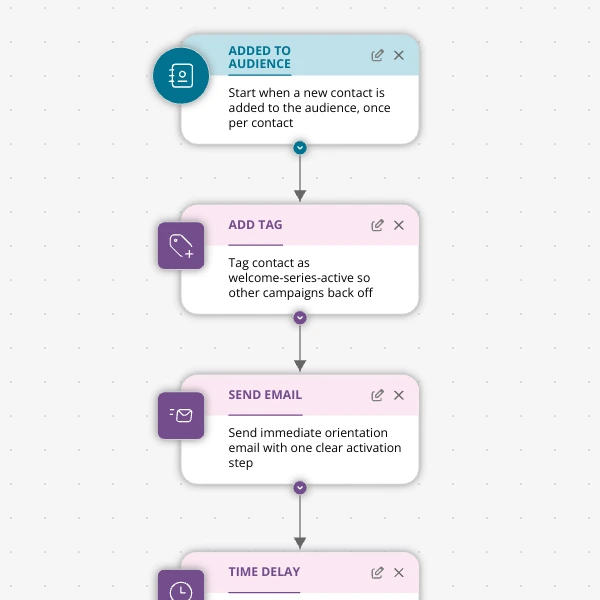
The Shopify app welcome series that turns installs into income
A step-by-step Shopify app welcome email journey for tools like CartSpark, showing how to turn new installs into activated, retained merchants using Spreeflo journeys, tags, and behavioral triggers so fewer trials quietly churn and more trials convert.
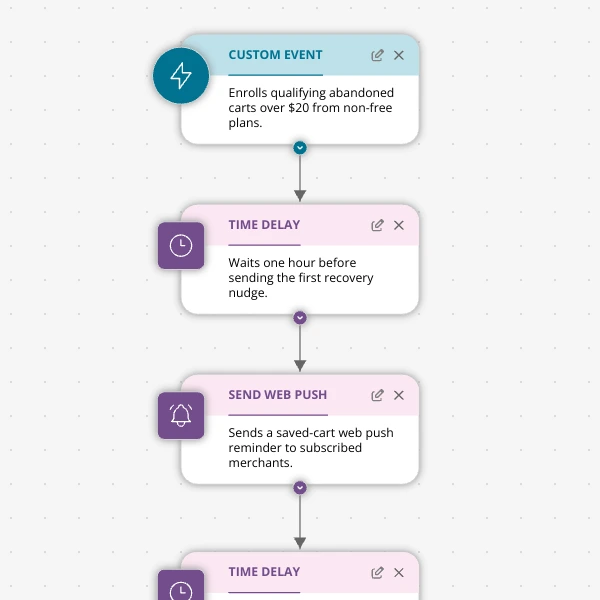
Stop Letting High‑Intent Carts Die: A 3‑Email Recovery Journey for Shopify Apps
A detailed, node-by-node walkthrough of a three-email (plus optional web push) cart-abandonment recovery journey for Shopify apps in Spreeflo, showing how to trigger events, branch on behavior, tag outcomes, and measure recovered carts and revenue.
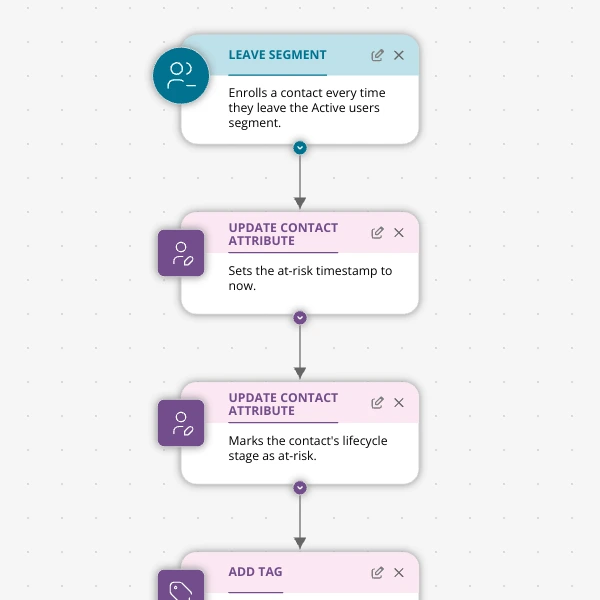
When Active Users Go Dark: A 4‑Touch Win‑Back Journey For Your Shopify App
A detailed, node-by-node Spreeflo journey for winning back previously active Shopify app users who stop engaging, using segment-based triggers, conditional logic, and a four-touch email plus internal alert sequence to recover usage and MRR.