The Newsletter Handshake: Welcome New Shopify App Subscribers and Get Them to the Next Issue
This playbook shows Shopify app teams how to build a Spreeflo journey that welcomes new newsletter subscribers immediately, delivers promised bonuses, and smoothly hands them into a tagged weekly cadence so you can measure engagement and retention through issue five.
Industry
Niche
Pattern
Loading sequence...
On Monday morning, Ana refreshes the analytics for CartWizard, her four-person Shopify app that powers abandoned-cart recovery for 1,800 stores.
Last week, 214 merchants opted in to their “High-Converting Checkout” newsletter from blog posts, the in-app dashboard, and a mini-course signup. But when she looks at the data, half of those new subscribers haven’t opened a single email. Many of them went three, four, even seven days before seeing anything after they gave their email.
They didn’t get a proper “hello.” They just dropped cold into issue #37 of the weekly newsletter with no context and no bonus content they’d been promised.
The sequence at the top of this page is built to fix that exact leak. It sends a welcome email immediately, delivers any promised content, then cleanly hands each new subscriber into your regular publishing cadence so their “first issue” is the very next one you ship.
For a Shopify app or e-commerce platform, this is one of the highest-ROI automations you can set up. It turns one of your best intent signals — “I care enough to subscribe to your content” — into a structured onboarding and nurture path instead of a shrug.
Let’s walk through how the journey works, node by node, and how to adapt it to your own app.
The problem: newsletter signups that go nowhere
If you’re building a Shopify app, your newsletter list isn’t a vanity metric. It’s:
A pool of merchants who are open to hearing from you regularly.
A cheaper acquisition and upsell channel than the App Store search algorithm.
A warm path into trials and higher tiers when you launch new features.
Yet most apps treat newsletter signups as an email dump. A visitor fills a form, maybe sees a “check your inbox” message, then waits. If they signed up right after you sent this week’s issue, they sit in limbo for six days. If they came from a lead magnet (“Get our retention teardown PDF”), they often never see the PDF at all.
Two things get lost:
The moment of peak intent: that first few minutes when they’re curious and willing to click.
The bridge into your ongoing content: their first live issue feels random instead of earned.
The pattern here — “welcome immediately, then the next scheduled issue” — solves both with one journey.
At a high level, you’ll:
Use an Add to Audience trigger so every new subscriber enters the journey.
Gate that trigger so it only runs for newsletter opt-ins, not every new contact.
Send a single, immediate welcome that delivers any promised bonus content.
Tag those contacts as active newsletter readers.
Use a Cyclic trigger to send your weekly issue to everyone with that tag.
Track engagement on the welcome and the first issue so you can improve both.
Under the hood, that’s a small number of well-placed nodes. The power comes from how precisely they define “who” and “when.”
Step 1: Getting subscribers into Spreeflo cleanly
Before any journey can fire, your subscribers need to exist as contacts.
For a Shopify app like CartWizard, you’ll usually have three main opt-in points:
A “Newsletter” or “Playbooks” form on your marketing site
An in-app checkbox in your onboarding flow
Lead magnets on content pages
Wire all of these into the same contact record using the Spreeflo API. When someone submits a form or checks the box:
Call
Spreeflo.identify(email, attributes)with:An attribute like
newsletter_source("blog","in-app","webinar", etc.)A boolean attribute
wants_newsletter = trueOptionally apply a tag like
newsletter-optinat the same time.
That’s the data the journey will use to decide who should receive the welcome.
Step 2: The Add to Audience trigger and gating logic
The first trigger in the sequence at the top of this page is Add to Audience.
Configuration choices:
Trigger: Add to Audience
Re-enrollment: Off
Any time a new contact is added to your workspace, this trigger fires. That includes newsletter signups, app installs, one-off imports, or manual additions. Since you only ever want to send the welcome once per person, you leave re-enrollment off.
Because not every new contact is a newsletter subscriber, the very next node is an If/Else process node that acts as a gate.
Condition for the “yes” branch:
In the segment builder:
Contact Tags
contact is tagged withnewsletter-optinOR
Contact Attribute
wants_newsletteristrue
Everyone who matches goes down the “Newsletter subscriber” path. Everyone else just exits that branch.
Why not use a Criteria Match trigger instead? Because “Add to Audience → If/Else” keeps all your new-contact handling in one place. You can extend the “else” path later (for example, send a different welcome to trial users) without redefining the logic.
This is the first example of a core Spreeflo belief: you capture detail on every customer, then use that detail to speak differently to each one. A simple tag or boolean attribute here decides whether the next step is a newsletter welcome, a product onboarding sequence, or nothing at all.
Step 3: Confirm subscription status explicitly
On the “yes” branch, the first action is usually Update Email Subscription Status:
Set status to
Email subscribed
Why bother if they just opted in? Because in real life you’ll also import historical contacts, customers from other tools, and App Store leads. Some will have their subscription status set to Non-subscribed or Unsubscribed, even if they now re-opted via a form.
Explicitly flipping status to Email subscribed the moment they pass your newsletter gate makes sure they’re eligible for marketing emails going forward.
This node is cheap, fast, and eliminates a class of silent failures where you think someone is in the newsletter, but they never actually receive anything.
Step 4: Sending the immediate welcome email
Next comes the first Send Email action in the journey: your welcome email.
Configuration:
Pick your sender identity (usually your main marketing address).
Create or select a “Newsletter — Welcome” template built in the email builder.
Leave “Send only once” toggled on.
What goes in this email?
For a Shopify app, three things matter more than anything else:
Deliver the promise
If they signed up for a bonus (“7-cart teardown PDF”, “checkout checklist”), put the download link or access instructions above the fold. This is table stakes for trust.Set expectations
In two or three sentences, explain:
- What kind of content they’ll get (“tactical retention breakdowns, not generic growth tips”)
- How often (“every Monday”)
- How it ties back to your product (“examples always include real Shopify stores using CartWizard”)Capture one piece of behavioral data
Give them a very simple choice that maps to future segmentation. For example:
- A button for “Show me ideas for high-volume stores”
- A button for “Show me ideas for new or low-volume stores”
Each button can go to the same page but with different Spreeflo.track events or tagged URLs. Later, you can build segments off those clicks in the segment builder and adapt content or product offers accordingly.
If you want, this is a great place to use AI variables for hyper-personalized subject lines and body copy so the welcome feels tailored to their store type or niche.
Notice what the journey doesn’t do here: it doesn’t immediately send a second email. That would feel like spam. The next step is a metadata update, not more messaging.
Step 5: Marking them as an active newsletter subscriber
Right after the welcome send, add an Add Tag action:
Tag:
newsletter-active
This is the handshake point. The rest of the sequence — including the weekly issues — keys off this tag.
You could use a boolean attribute instead, but tags are:
Easy to inspect manually on a contact record
Reusable in other journeys (“enter if contact is tagged with newsletter-active”)
Simple to manage or clear en masse later
You can also add an Update Contact Attribute node to set a timestamp like newsletter_joined_at to “now” (using the SET_NOW update type on a timestamp attribute). That’s useful for cohort analysis later: for example, “show me everyone who joined more than 90 days ago and is still opening.”
At this point, the welcome path is done. The contact exits the branch. There are no delays, no additional emails. The entire thing happens within seconds of them hitting submit.
Now they’re ready for the ongoing cadence.
Step 6: The Cyclic trigger that sends your weekly issue
The second trigger in the journey is a Cyclic trigger that drives your regular newsletter.
Configuration:
Repeat every:
1 weekTime of day: whatever matches your audience (CartWizard sends Monday 9am in the store’s main timezone)
Re-enrollment: On
Criteria (using the segment builder):
Tag
contact is tagged withnewsletter-activeAND Email Subscription Status
isSubscribed
Re-enrollment is the critical choice here. With it on, the same contact can be processed every week, as long as they still match the criteria. Without it, they would only ever get the newsletter once.
Because the welcome branch finishes quickly (no long Time Delay or Wait Condition nodes), contacts won’t be “mid-journey” when the weekly trigger fires, so they’re eligible to enter the Cyclic branch on the next tick.
You now have a clean definition of “this person should receive the next issue”: they’re subscribed, they’ve received the welcome, and they carry the newsletter-active tag.
Step 7: Building and sending the issue itself
From the Cyclic trigger, the first action is another Send Email node. This is the newsletter issue.
There are two practical ways to manage content here:
Single template, updated weekly
Keep one “Newsletter — Current Issue” template in the email builder. Each week, update its subject and body before the next send. The Send Email node always points at that template.Dedicated campaign per issue
Alternatively, send the newsletter as one-off campaigns targeting the segment “tag is newsletter-active.” In that model, the journey handles welcome + tagging, and campaigns handle the issues.
The sequence at the top of this page assumes the first approach, since it keeps everything inside one journey. It also keeps your automation logic — segmentation, metrics nodes — attached to the same Send Email action.
Whichever approach you choose, respect pacing rules: don’t stack Send Email nodes back to back. Here, the weekly issue is alone on its branch, so you’re fine.
Step 8: Tracking which issue they’re on
To measure retention through issue 5, you need a count of how many issues each contact has been sent.
Right after the weekly Send Email, add an Update Contact Attribute node for a numeric attribute, say newsletter_issue_count:
Update type:
INCREMENTValue:
1
Every time the Cyclic trigger fires and the Send Email node runs, this attribute increments by 1.
Now you have a durable signal you can slice on:
newsletter_issue_count = 0→ people who got the welcome but haven’t been around for an issue yet (maybe paused by criteria)= 1→ they just received their first issue>= 5→ long-term readers
This attribute is static until updated, so it’s ideal for building saved segments later.
Step 9: Treating the first live issue as its own milestone
The next piece in the sequence is an If/Else process node that checks whether this is the contact’s first newsletter issue:
Condition: Contact Attribute
newsletter_issue_countis1“Yes” branch: “First-issue path”
“No” branch: “Regular issue path” (usually just exits or goes to a Merge node).
On the first-issue path, you can now:
Wait a few days for engagement
Insert a Time Delay action:
- Delay:3 daysBranch by behavior
Add a Check Email Activity process node wired to the same newsletter template used in the Send Email step.
Configure branches, for example:
- Branchclicked:Link Clicked
- Branchopened:Opened
- Branchinactive:Not Opened(orNot Clicked)
- Else: catches any unexpected stateTag for future targeting
On each branch, use Add Tag actions:
-newsletter-first-issue-clicked
-newsletter-first-issue-opened
-newsletter-first-issue-inactive
You can then either end the branches there or use a Merge process node to recombine them back into a shared path (for example, a long-term nurture track).
For subsequent issues (where newsletter_issue_count is greater than 1), you probably don’t need this level of instrumentation on every send. The regular path can simply exit after the Update Contact Attribute node, keeping the journey lean.
Step 10: Measuring welcome open rate and retention through issue 5
Most of the metrics for this pattern come from a mix of email analytics and segmentation:
Welcome open rate
Use the analytics attached to the “Newsletter — Welcome” template. That’s the baseline: if it’s underperforming, your handshake is weak, regardless of what happens next.First-issue engagement
Thanks to the Check Email Activity node and tags on the first-issue path, you can see:
- How many new subscribers opened their first live issue
- How many clicked
- How many ignored it
You can also filter the contact list by thenewsletter-first-issue-*tags and run more granular analysis in your SaaS metrics stack.Retention through issue 5
Withnewsletter_issue_countin place, you can create saved segments such as:
- “Issue count at least 5, email subscription status is Subscribed”
- “Issue count at least 5, has opened any newsletter email in the last 30 days”
Build these in the segment builder and track their size and engagement over time. For a Shopify app, this is a strong health indicator: people who stick through five issues are much more likely to start or keep a subscription.
This is where the pattern earns its keep. Instead of a blob of undifferentiated “newsletter subscribers,” you have cohorts, behaviors, and counts you can act on.
Why this matters so much for Shopify apps
For CartWizard and teams like it, the real risk isn’t a low open rate on one email. It’s a slow bleed of lifetime value because they never built a proper content lifecycle.
They invest heavily in blog posts, teardown PDFs, and webinars to capture merchants’ interest. But without an immediate welcome and a structured bridge into an ongoing cadence, those signups sit cold until the next generic blast.
The journey you’ve just seen is small. Two triggers, a couple of Send Email actions, a few tags and attributes. It’s the kind of thing a founder can set up in an afternoon using the campaigns and journeys tools, then refine between support tickets.
Yet the effect is long-lived:
Every new subscriber hears from you within seconds.
They receive the bonus they were promised, framed in your language.
They slot naturally into the next scheduled issue instead of some isolated drip.
You know exactly who engaged with that first issue and who didn’t.
You can see who has made it through five, ten, twenty issues and still cares.
That’s what it looks like to stop leaking lifetime value on the content side. You capture detail about each subscriber, you speak to them based on that detail, and you keep showing up consistently where they said they wanted to hear from you.
For founder-led, product-heavy teams building Shopify apps, that’s the kind of automation that compounds quietly in the background while you ship features. Build the newsletter handshake once. Let it run. Then, when you launch your next big upgrade, you’re not shouting into the void — you’re talking to an engaged, well-onboarded audience who already trusts you.
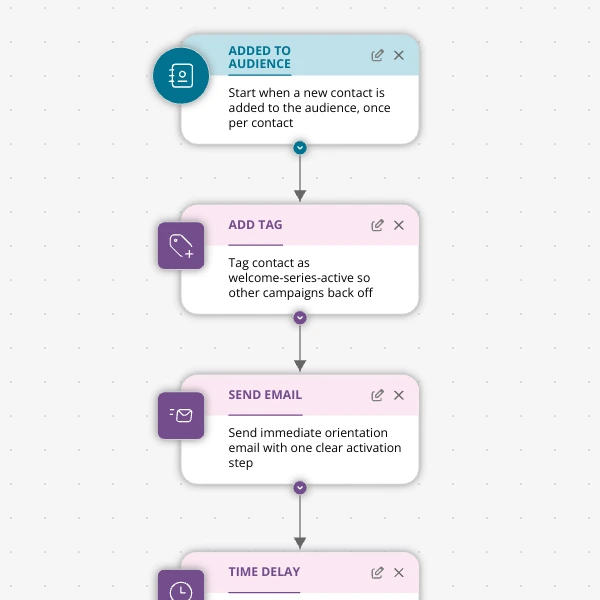
The Shopify app welcome series that turns installs into income
A step-by-step Shopify app welcome email journey for tools like CartSpark, showing how to turn new installs into activated, retained merchants using Spreeflo journeys, tags, and behavioral triggers so fewer trials quietly churn and more trials convert.
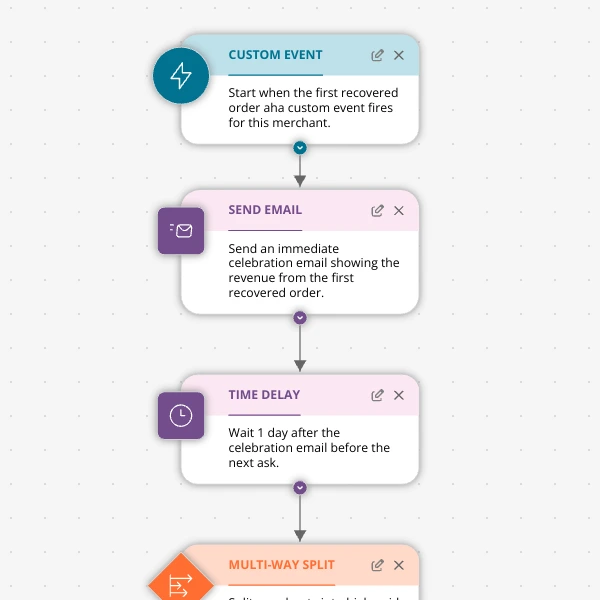
The Aha-Moment Playbook For Shopify Apps: Turn One Magic Action Into Months Of Revenue
A node-by-node playbook for Shopify and e‑commerce apps to center their lifecycle on one aha-moment custom event in Spreeflo, celebrate it, segment merchants by profile and engagement, and turn first recovered value into lasting revenue and retention.
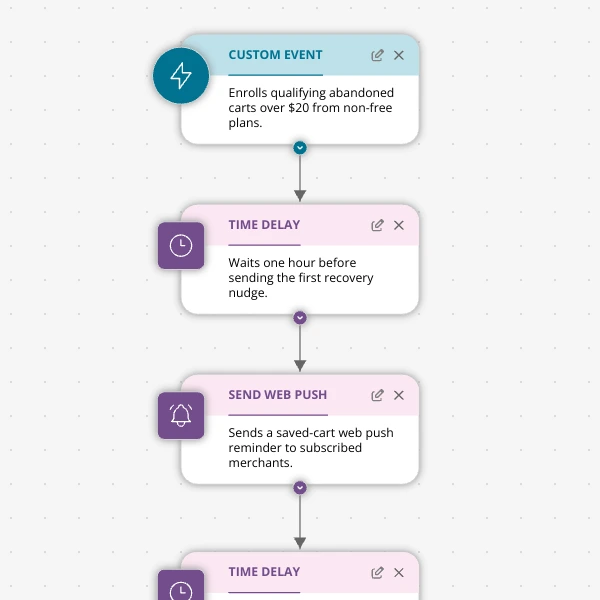
Stop Letting High‑Intent Carts Die: A 3‑Email Recovery Journey for Shopify Apps
A detailed, node-by-node walkthrough of a three-email (plus optional web push) cart-abandonment recovery journey for Shopify apps in Spreeflo, showing how to trigger events, branch on behavior, tag outcomes, and measure recovered carts and revenue.
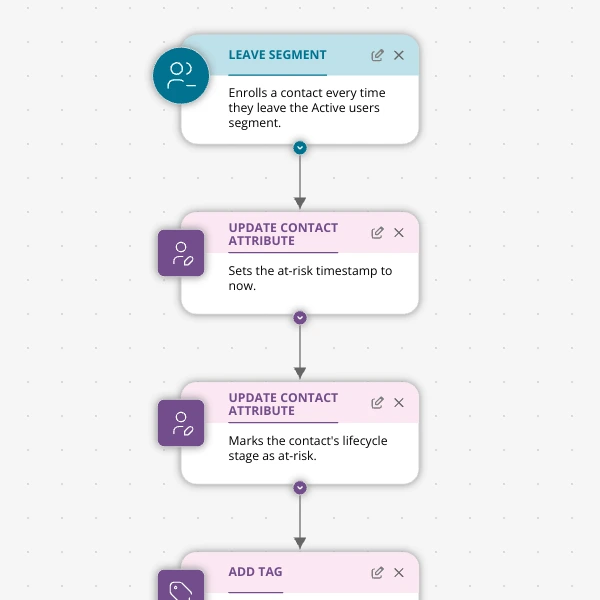
When Active Users Go Dark: A 4‑Touch Win‑Back Journey For Your Shopify App
A detailed, node-by-node Spreeflo journey for winning back previously active Shopify app users who stop engaging, using segment-based triggers, conditional logic, and a four-touch email plus internal alert sequence to recover usage and MRR.