The Quiet Win-Back: How to Turn Cancellations into Your Cheapest Growth Channel
FreeThis playbook walks Shopify app teams through building a respectful, delayed post-cancellation win-back journey in Spreeflo, turning churned stores into a steady, low-effort source of reactivations, feedback, and incremental MRR.
Industry
Niche
Pattern
Loading sequence...
The churn email hits your inbox at 2:13 a.m.
“Hey, I canceled three months ago. I just reinstalled your app. It looks so much better now. Why didn’t you tell me you’d shipped all this?”
For most Shopify app developers, that message is both flattering and painful. Flattering, because the product is clearly improving. Painful, because you realize you only got this customer back by accident.
Now multiply that by everyone who never bothers to come back.
This playbook is about fixing that leak with one of the simplest, highest-ROI journeys you can build: a quiet, delayed, post-cancellation win-back.
The sequence at the top of this page is the whole journey, end to end. We’ll walk it node by node, so you can adapt it to your own app.
To keep things concrete, we’ll anchor on a fictional Shopify app, UpsellPilot:
$85k MRR from 1,700 stores
$39/mo core plan, usage-based add-ons
Stack: Shopify App Store, Stripe, a basic internal admin, and Spreeflo for lifecycle email
UpsellPilot already tracks key events via Spreeflo.track: app_installed, subscription_activated, subscription_canceled, and app_uninstalled. Cancellations hurt: around 6% of paying stores churn each month. The founders are shipping solid improvements, but once a store leaves, they rarely hear about it again.
A lightweight win-back journey that runs behind the scenes can change that, and it doesn’t require a big marketing team. It just requires being deliberate about what happens after the goodbye.
Why a post-cancellation journey is worth the effort
Before we get into the canvas, it’s worth being clear about the job this automation does.
Most Shopify apps obsess over:
install → activation
trial → paid
expansion from core plan → higher tiers
Once someone cancels, the instinct is “they’re gone, focus on the living.” But ex-customers are uniquely valuable:
They already understood your value prop once.
They already went through the install friction.
They’re reachable by email (assuming they didn’t hard-unsubscribe).
They’re often leaving because of a mismatch in timing, features, or budget… all of which can change.
That’s why one of Spreeflo’s core beliefs is that most businesses leak lifetime value by not nurturing engagement. For e‑commerce apps, “engagement” doesn’t end when Shopify marks the app as uninstalled. Those merchants still run stores. Their pain points usually get worse, not better.
A simple, respectful, low-pressure check‑in 30–60 days after cancellation often revives a surprising number of accounts. And because this is automation, you build it once and it runs forever.
Let’s break down how the sequence at the top of this page does that.
Step 1: Use a Custom Event trigger for real cancellations
We start with a Custom Event trigger.
Why this, and not “Leave Segment” or “Removed Tag”?
Because for platform apps, “canceled” needs to map to a precise event in your own system, not a fuzzy change in status. In UpsellPilot’s case, they call:
Spreeflo.track("subscription_canceled", { reason, plan, mrr_lost })
every time a paying store ends their subscription (whether that’s a downgrade to free, a full uninstall, or a pause). That’s the canonical signal you want.
In the journey editor, the trigger is:
Type: Custom Event
Event name:
subscription_canceledRe-enrollment:
false(we only want to run this journey once per store per lifetime)
You could add property conditions (e.g. only if plan = "Pro" or mrr_lost > 49), but I recommend starting broad. You can segment inside the flow.
Design pitfall this avoids: If you tried to trigger off tags (“Removed tag: active-subscriber”), you’d have to keep tags perfectly in sync with billing, which adds failure modes. Directly triggering off the billing-side event is safer.
If you’re not already sending cancellation events into Spreeflo, the Spreeflo API docs walk you through how to wire this up alongside your existing billing logic.
Step 2: Add a Time Delay so you don’t feel clingy
The next node after the trigger is a Time Delay:
Delay: 30 days
Unit: Days
The temptation is to send a “sorry to see you go” email within minutes of cancellation. That’s fine as a separate transactional flow, but that’s not this journey’s job.
This pattern is about “time-distance.” You want:
Enough time for them to miss you (or feel the pain your product used to solve).
Enough time to have actually shipped something meaningfully new.
Enough distance that your message feels like a genuine update, not a last-ditch plea.
For some apps, 30 days is perfect. If your average subscription length is longer (e.g. annual), 60–90 days might make more sense. A good heuristic:
If most stores churn within the first month: 21–30 days
If most stores stay 6+ months: 45–60 days
Why Time Delay instead of a Cyclic trigger?
Because the journey is tied to an individual cancellation event, not a calendar date. Each store gets its own timer starting from when they cancel. Cyclic is better for bulk recurring sends (“on the first of the month, email all past cancellers who match X”).
Step 3: Optional filter — If/Else on whether they’re still a churned user
After the delay, the next node in the sequence is an If/Else process:
Condition: contact is still “churned”
How you express “churned” depends on your data model. Common options:
Contact tag:
is_current_customeris not presentContact attribute:
planisfreeornullSegment membership: not in segment
Active paying stores
In the editor, that might look like:
Condition: Segment Membership “is not member of segment: Active paying customers”
Why bother?
Because some merchants will reinstall or upgrade on their own before the 30 days elapse. You don’t want to hit them with a “we miss you” email after they’ve already come back.
So the branches are:
Then (still churned): send the win-back email.
Else (currently active again): skip win-back, possibly tag them for “returned on their own” and end.
If you haven’t created segments yet, this is a good excuse to define an “Active subscribers” segment using the segment builder. That segment becomes reusable across lots of journeys beyond this one.
Step 4: The core Send Email — a “what’s new since you left” update
On the “still churned” branch, the main action is a Send Email node.
Configuration:
Template: “Post‑cancellation: what’s new”
From: your normal marketing sender
Send only once: On
This email is where you earn your reactivation rate. A few principles that work well for Shopify apps:
Lead with what’s changed, not with “please come back”.
Tie the content to their previous usage if you can.
Make the call-to-action low pressure.
Address the likely churn reasons.
Example structure:
“Since you left, we’ve shipped X, Y, Z”
Each change framed around a clear outcome (e.g. “recover more carts,” “faster reports,” “less manual setup”)
If you store attributes like primary_use_case or know which features they used (feature_used events), you can personalize the email body using Spreeflo’s AI-powered personalization. For instance, merchants who used your “multi-currency” feature get a section that highlights improvements to cross‑border reporting.
“Take another look” or “Preview the latest version”
Offer a short extended trial or a temporary discount, but don’t make it sound like a fire sale.
If you capture a reason property in subscription_canceled (e.g. “too expensive,” “missing feature,” “store closed”), you can branch messaging or at least acknowledge it in the copy.
The Send Email node itself doesn’t do the personalization logic; it just routes them into this message at the right time. The content work happens in your email builder, with dynamic fields and AI-generated variants if you choose.
Step 5: Wait Condition — give them space to respond
After sending the email, we don’t immediately spam them with a sequence of follow‑ups. The pattern here is deliberately light.
Next node: Wait Condition.
Configuration:
Condition: has reactivated
- e.g. Segment Membership “is member of segment: Active paying stores”
- or Custom Event “subscription_activated at least 1 time in the last 30 days”Timeout: 14 days
The behavior:
If, within 14 days, the contact matches the condition (they came back and activated), they proceed out of the Wait Condition immediately.
If they don’t, they proceed after 14 days anyway.
This is effectively a “listen” step. You’re giving them a reasonable window to respond to the email by reinstalling or upgrading. The journey is now watching for that behavior instead of blindly sending more email.
This is where Spreeflo’s “data as live triggers” mindset earns its keep. You’re not just checking click/open. You’re basing your next step on actual business behavior.
Step 6: Multi-way Split — different endings for different outcomes
After the wait, the journey uses a Multi-way Split to branch into three possible outcomes:
Reacti vated as a paying customer
Reinstalled but still not paying (e.g. downgraded to free tier)
Still fully churned
You can build this as three branches, each with a condition:
Branch
reactivated_paying:
- Condition: Segment Membership “is member of segment: Active paying customers”Branch
reactivated_free:
- Condition: Segment Membership “is member of segment: Free/active users” AND “is not member of segment: Active paying customers”Else:
- Everyone else
Why not just two branches (reactivated vs not)? Because “reinstalled on free” and “fully gone” deserve different follow‑ups. A free user has raised their hand again; they’re not a lost cause.
Step 7: On reactivated branches, tag and notify your team
On both the reactivated_paying and reactivated_free branches, we add:
Add Tag action
Send Internal Email (optional but useful)
For example:
Add Tag:
- Tags:winback-reactivated,returned-from-churnSend Internal Email:
- To: your support or success inbox
- Content: short context about who returned, what their plan is now, and link to their Shopify store or internal account page.
Why tags?
They give you a simple way to measure the journey’s impact: you can build a segment of contacts tagged winback-reactivated and track their MRR, churn rate, and feature usage over time.
They enable future journeys. You might build a “welcome back” onboarding series specifically for win‑back users later.
Why internal email?
For small teams, a heads‑up that “store X just came back via win-back flow” creates a natural moment to send a personal note, ask what changed, or capture qualitative feedback.
It reinforces the idea that automation doesn’t replace human touch; it creates more, better‑timed opportunities for it.
Technically, the Send Internal Email node works exactly like a normal Send Email, except the recipient is you, not the contact. You can re‑use templates here too.
Step 8: For still-churned users, end quietly (or offer one last nudge)
On the else branch (no reactivation detected), you have options. In the sequence we’re discussing, we keep it intentionally minimal:
Add Tag:
winback-no-responseEnd journey
That’s it. No 4‑email guilt trip. No “FINAL OFFER!!!” subject line.
You can, of course, insert one more Send Email here — for example, a short one-question survey asking why they didn’t come back, or an invite to reply directly with feedback. If you do that, be explicit in the email that this is the last message they’ll get about their cancellation unless they opt back into your regular list.
The key thing is respecting the relationship. These merchants may come back in six months when their store grows, or when their current solution fails. You want them to remember your app as helpful and calm, not needy.
Making this pattern your cheapest growth lever
Set up like this, your post‑cancellation win‑back journey becomes a quiet machine:
Every cancellation enters once.
Thirty days later, they get a single, well‑timed “here’s what’s new” email.
If they come back, you see it, tag it, and (optionally) say hello.
If they don’t, you log the attempt and move on.
Over a few months, you’ll start to see:
Reactivation rate: % of canceled accounts who re‑subscribe within, say, 60 days of the win‑back email.
Recovered subscriptions: absolute count of stores tagged
winback-reactivated.Win‑back revenue: MRR attached to those recovered stores.
For a business like UpsellPilot, recovering even 10–15 stores per month at $39/mo is an extra $390–$585 MRR. That alone can justify the cost of your automation tool, especially given Spreeflo’s pricing relative to bigger incumbents.
The deeper benefit is cultural. When you start treating cancellation as another lifecycle stage to design for, not an endpoint, you stop leaking value silently. You start collecting richer data on why people leave, what brings them back, and which features matter most post‑churn.
And because Spreeflo is built for founder‑led teams, you don’t need a dedicated lifecycle marketer to keep all this running. You build a journey once, wire it to the events you already track, and let it work in the background while you focus on shipping.
In the end, that’s the real win. Not just more recovered revenue this month, but a system that quietly refuses to let your hard‑won customers disappear without at least hearing what they’re missing.
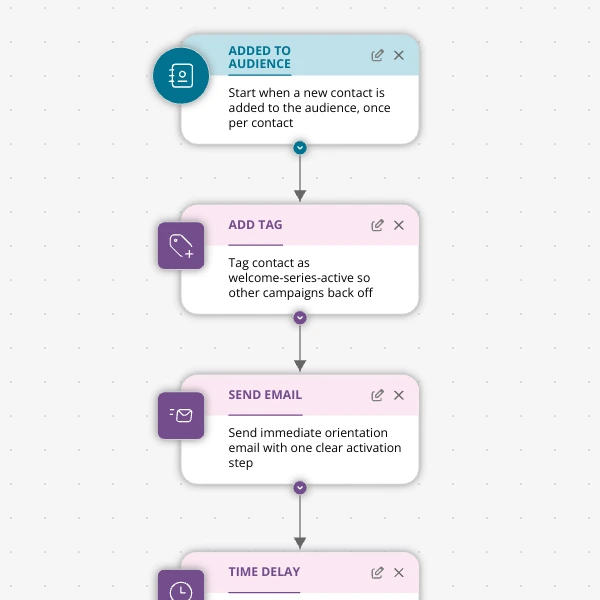
The Shopify app welcome series that turns installs into income
A step-by-step Shopify app welcome email journey for tools like CartSpark, showing how to turn new installs into activated, retained merchants using Spreeflo journeys, tags, and behavioral triggers so fewer trials quietly churn and more trials convert.
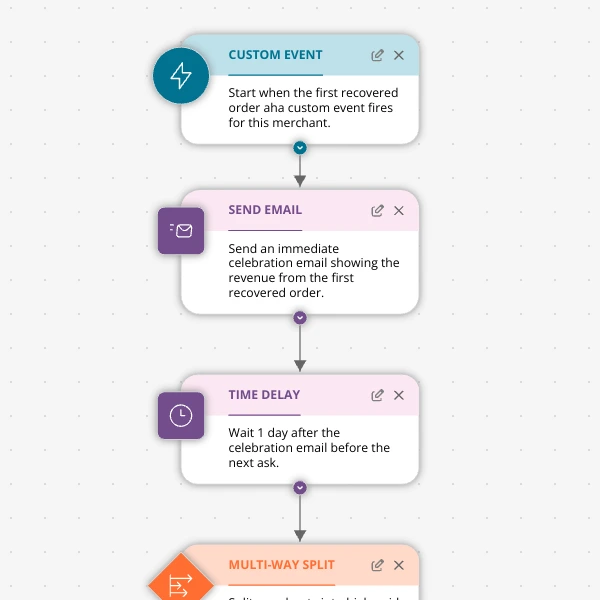
The Aha-Moment Playbook For Shopify Apps: Turn One Magic Action Into Months Of Revenue
A node-by-node playbook for Shopify and e‑commerce apps to center their lifecycle on one aha-moment custom event in Spreeflo, celebrate it, segment merchants by profile and engagement, and turn first recovered value into lasting revenue and retention.
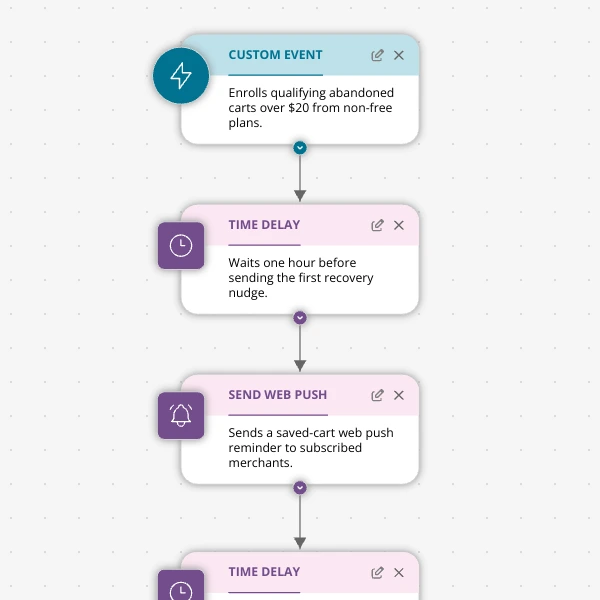
Stop Letting High‑Intent Carts Die: A 3‑Email Recovery Journey for Shopify Apps
A detailed, node-by-node walkthrough of a three-email (plus optional web push) cart-abandonment recovery journey for Shopify apps in Spreeflo, showing how to trigger events, branch on behavior, tag outcomes, and measure recovered carts and revenue.
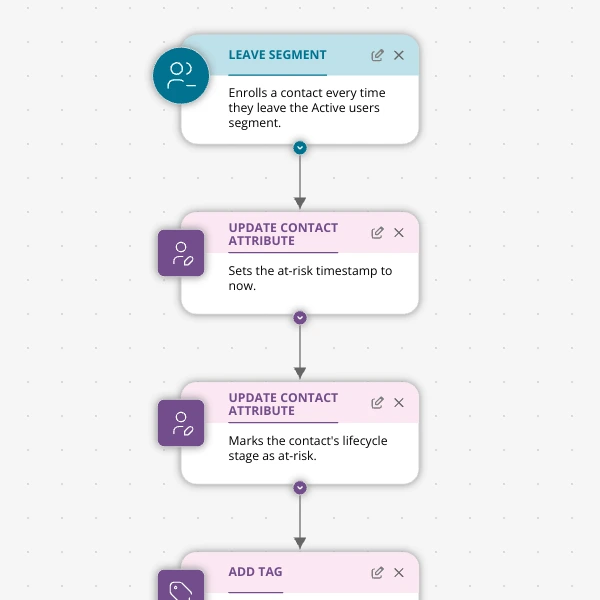
When Active Users Go Dark: A 4‑Touch Win‑Back Journey For Your Shopify App
A detailed, node-by-node Spreeflo journey for winning back previously active Shopify app users who stop engaging, using segment-based triggers, conditional logic, and a four-touch email plus internal alert sequence to recover usage and MRR.