The Tiny Profile Nudge That Makes Every Shopify App Email Smarter
A node-by-node walkthrough of a Spreeflo journey that nudges Shopify app users to complete key profile attributes, so you can turn fuzzy trial audiences into richly segmented cohorts that power sharper onboarding, upsell, and retention flows.
Industry
Niche
Pattern
Loading sequence...
CartWizard had a familiar problem.
They’d nailed acquisition on the Shopify App Store and were sitting around $90k MRR. Trials weren’t terrible. Churn wasn’t catastrophic. But everything in the middle felt fuzzy.
They knew there was a big difference between a solo founder running one store and an agency managing 40 clients. Or between a fashion brand and a subscription coffee box. Yet their onboarding emails, upgrade nudges, and “power user” playbooks were basically the same for everyone.
When they dug into why, the answer was boring but brutal: most users’ profiles were half empty. No team size. No clear use case. Industry blank or nonsense. The data that should drive smart segmentation simply wasn’t there.
The sequence at the top of this page is the whole journey, end to end, that fixes that: a lightweight “profile completion reminder” that quietly fills those gaps and pays you back on every downstream campaign.
This article walks through that journey node by node: how it’s wired in Spreeflo’s editor, why each step exists, and how you can adapt it to your own Shopify or e‑commerce app.
Why a profile completion journey earns its keep
For a typical e‑commerce app developer, three facts collide:
You already send key behavioral events (
app_installed,feature_used,subscription_upgraded).You could send very different onboarding and upsell flows based on industry, role, and team size.
The profile data you need for that often never gets filled in.
So you end up with sophisticated product telemetry but shallow customer context. That’s backwards. The entire point of having events is to speak to people as the kind of business they are.
This journey solves that by doing one simple thing very well: it watches for contacts who are missing critical attributes and nudges them, once or twice, to complete those details. It uses:
A Criteria Match trigger to define “profile is incomplete”
A couple of Wait Condition nodes so you don’t nag people who complete it on their own
One or two short Send Email nudges
Simple tagging and attribute updates to track how profiles get completed
Everything is built with standard Spreeflo building blocks: journeys in the sequence editor, the segment builder, and our email builder.
You build it once. Then every new trial or free user either completes their profile unaided or gets a clean, timely prompt. Over time, your audience stops being “trial users” and starts looking like “solo fashion brands on Shopify, doing $20–50k/mo, using us for post‑purchase upsells.”
That’s the whole brand promise in action: capture detail on every customer so you can speak to each one uniquely.
Let’s go through the journey.
Step 0: Decide what “profile completeness” actually means
Before you touch the canvas, decide what you care about. For a Shopify app, a good starting set is:
industry(e.g., Apparel, Beauty, Subscription boxes)role(Founder, Marketer, Developer, Agency)team_size(1, 2–5, 6–20, 21+)primary_use_case(Cart recovery, Post‑purchase upsell, Analytics, etc.)
These are just Contact Attributes in Spreeflo. You can create them under your audience settings, then populate them at signup (via form fields or the Spreeflo API).
In this journey we’ll treat a contact as “incomplete” if any of these is blank, and “complete” only when they’re all set.
The trigger: Criteria Match on “profile incomplete”
At the far left of the sequence is a Criteria Match trigger. This is what starts the journey. It fires the moment a contact newly matches the criteria you define.
For CartWizard, that criteria looks like:
Group 1 (AND):
Email Subscription Status is “Subscribed” (so you only send to people who’ve agreed to marketing)
Plan attribute is “trial” or “free” (you can model this as a custom TEXT attribute, e.g.
plan = trial)Group 2 (OR):
industryis blankroleis blankteam_sizeis blankprimary_use_caseis blank
In the Criteria Match trigger, you build this using the same criteria UI as the segment builder:
Outer group set to AND
Inside it, your subscription/plan rules plus a nested OR group for each attribute that’s blank
For Re-enrollment, turn it on.
Why? Two reasons:
It future‑proofs you. If you add a new important attribute next quarter (
avg_order_value_band, say) and backfill it as blank, existing contacts who didn’t previously match may now newly match and enter the journey.It means users who uninstall and later reinstall (very common in Shopify land) can still go through the profile prompt if their data is stale on return.
Spreeflo will still respect the mid‑journey lock, so a contact can’t be enrolled twice in parallel.
From this trigger, every path flows into the same next step: a Wait Condition.
Step 1: Wait up to 2 days for self‑serve completion
A lot of users will fill in their profile during the first session. You don’t want to fire a “please complete your profile” email five minutes after they already did it.
So the first node after the trigger is a Wait Condition:
Condition: profile is complete
industryis not blankroleis not blankteam_sizeis not blankprimary_use_caseis not blank (again, built as an AND group in the segment builder)Timeout: 2 days
Semantics:
If the user completes their profile at any point in those 2 days, they immediately move on.
If they don’t, they move on automatically when the 2‑day timeout expires.
We’ll reuse the same “profile complete” condition in later nodes, so it’s worth defining it once and keeping it mentally as a reusable block.
After this Wait Condition comes an If/Else process.
Step 2: Branch on “already complete” vs “still incomplete”
Drop an If/Else node next:
Condition: the same “profile is complete” condition we used in the Wait Condition.
This gives you two branches:
Yes branch: profile is complete (within 2 days, no nudge needed)
Else branch: profile is still incomplete after 2 days
The “already complete” path
On the Yes branch, we don’t need to send any email at all. But we do want to record that these folks completed their profile unaided.
Two simple actions work well here:
Add Tag
- Tags:profile_complete
This makes it trivial later to define segments like “complete profile + in trial + visited pricing page”.Update Contact Attribute
- Attribute: a custom TEXT field, e.g.profile_completion_path
- Update type: Update
- Value:"self_serve"
This gives you analytics on how profiles are getting filled in and lets you slice cohorts by completion path in your own reporting.
After that, this branch can end. The contact has done what you wanted; there’s no message to send.
The “still incomplete” path
On the Else branch, you finally send your first nudge.
Step 3: Nudge #1 – a single, focused reminder email
The first step on the Else branch is a Send Email action.
Configuration:
Choose your sender identity.
Leave “Send only once” turned on (the default) so you never double‑send this template if the contact somehow loops back.
Use the email builder or an existing template to create the content.
Content guidelines that work well for Shopify apps:
Subject: value‑oriented, not nagging.
“Two quick questions so we can customize CartWizard for your store”Body:
- 1–2 lines explaining why you’re asking:
- “Stores like yours see better recovery rates when we tailor flows to your industry and team.”A simple bullet list of what you’ll ask (Industry, Role, Team size, Use case)
One primary call‑to‑action button: “Complete your setup” that deep‑links to your in‑app profile page
Keep it short. This is a utility email, not a newsletter.
After this Send Email, we add another Wait Condition to avoid spamming and to catch those who respond promptly.
Step 4: Give them a chance to respond to the first nudge
Second Wait Condition:
Condition: profile is complete (same block as before)
Timeout: 3 days
So from the time the first nudge lands, the contact has up to three days to click through and complete their profile. If they do, the wait ends immediately. If they don’t, they flow out when the timeout expires.
After this Wait Condition, we drop another If/Else on “profile is complete”.
If completed after first nudge
On the Yes branch:
Add Tag
- Tags:profile_complete(if you want to be defensive, you can still apply it even if they already got it through some other path; tags are idempotent).Update Contact Attribute
- Attribute:profile_completion_path
- Value:"after_first_nudge"
Optionally, you could add a Send Internal Email here to notify success or sales when a high‑value account completes their profile with a certain team size or industry. Keep in mind that’s for you, not the customer.
Then this branch can end.
If still incomplete after first nudge
On the Else branch, we decide whether it’s worth a second reminder. For most Shopify apps, a gentle second nudge a few days later still pays off without feeling naggy.
The key is pacing.
Step 5: Time‑spaced final reminder (optional but effective)
On the “still incomplete” path:
Add a Time Delay of 2 days.
- Unit: Day(s)
- Value: 2
This ensures there is clear spacing between the first and second emails. Combined with the previous 3‑day Wait Condition, you’re a full 5 days out from the first nudge before you send the second.Add a second Send Email.
This one can be framed a bit more bluntly:
- Subject: “Last step to get tailored CartWizard recommendations”
- Body: briefly restate the benefit and remind them it takes under a minute.
You can also mention a concrete downstream perk that depends on profile data:
- “We use your industry and team size to suggest the highest‑ROI automations first.”After this second email, drop a third Wait Condition:
- Condition: profile is complete
- Timeout: 5 daysThen a final If/Else:
- Yes branch (completed after second nudge):
- Add Tagprofile_complete
- Update Contact Attributeprofile_completion_path = "after_second_nudge"
- Else branch (still incomplete):
- Add Tagprofile_incomplete
The profile_incomplete tag is useful for excluding these contacts from more advanced, highly personalized campaigns where missing data would make the message generic or wrong.
At this point, the journey ends for everyone.
How this one journey upgrades the rest of your marketing
Once this is running, two things happen over the next few weeks:
Your profile completeness rate climbs steadily. You can track this by creating a segment where all four attributes are “is not blank” and watching its size over time inside Spreeflo’s audiences view.
You unlock much sharper downstream segments and journeys.
Concrete examples for a Shopify app:
Onboarding:
Segment:
industry = Apparel AND team_size = 1–2 AND primary_use_case = Cart recoveryJourney: after
app_installed, send a focused three‑email sequence about “recovering abandoned checkouts for small fashion brands”, not generic cart‑recovery tips.
Upgrade nudges:
Segment:
role = Agency AND number_of_stores_connected >= 5Journey: use a Custom Event trigger on
subscription_downgradedto send an explanation of why agencies typically use the higher tier, pulling in those attributes for context.
Retention:
Segment:
profile_complete AND active_users_last_30_days < 3Journey: run a re‑engagement sequence using a Cyclic trigger, knowing every contact in it actually has the fields you need for good copy.
You’re no longer stuck with “all trial users” as a monolith. You’re talking to “small cosmetics brands who care about SMS recovery” or “agencies doing analytics for 50+ stores.”
That’s what “capture detail on every customer so you can speak to each uniquely” looks like in practice.
Implementation notes for developer‑led teams
Because you’re likely the kind of founder who still writes API calls:
Make sure your install/sign‑up flow calls
Spreeflo.identifyor the transactional API with these profile attributes whenever the user submits them.If users edit their profile inside your app, send updated attributes again on save. The journey’s Wait Conditions and If/Else nodes will see the new values automatically.
If you’re coming from another tool, use the import workflow in the help center plus this journey to clean up legacy contacts whose profiles are partially filled.
Once the wiring is in place, all of the behavior is handled visually in the sequence editor. You can always revisit and tweak delays or email copy without touching code. The campaigns and journeys view makes it easy to see this profile‑completion flow alongside other lifecycle automations.
What to watch and how to iterate
There are three simple metrics to track here:
Profile completion rate
Percentage of trial/free users who have all required attributes filled. This should rise over time, and you should see a chunk of completions attributed to “after_first_nudge” and “after_second_nudge.”Activation lift
Compare trial‑to‑paid conversion for users with complete profiles vs incomplete. For most apps, complete profiles correlate strongly with higher activation, because those users see more relevant messaging and setups.Email engagement on nudges
Use a Check Email Activity process node in a test fork of this journey if you want to see who opens and clicks the first vs second reminder. You can then A/B test subject lines or layouts using Random Split.
Small tuning changes here (shorter delays, clearer CTA, different benefit framing) can make a real difference in how much usable data you collect.
The quiet compounding effect of better profiles
This profile completion journey won’t show up in your dashboard with fireworks. It just runs quietly, nudging people to answer a few questions they probably meant to answer anyway.
But over months, it changes what your “audience” even means.
You stop writing emails for “everyone who installed in the last 14 days” and start writing for “growth‑minded solo founders in fashion with 1–2 teammates who installed for cart recovery.” Your product events, your web tracking and analytics, and your emails are all looking at the same, well‑described humans.
For a small Shopify app team, that’s the whole game: set up a few smart systems so every new install makes your marketing smarter without adding work.
This journey is one of those systems. Build it once, let it run, and let richer profiles quietly power the rest of your Spreeflo automations.
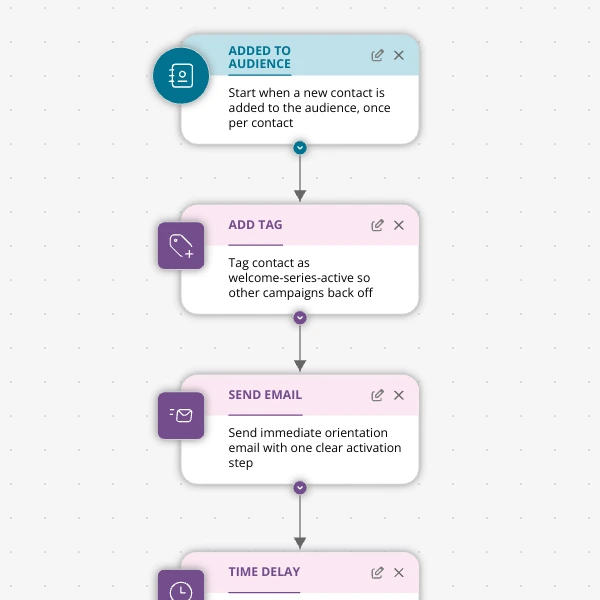
The Shopify app welcome series that turns installs into income
A step-by-step Shopify app welcome email journey for tools like CartSpark, showing how to turn new installs into activated, retained merchants using Spreeflo journeys, tags, and behavioral triggers so fewer trials quietly churn and more trials convert.
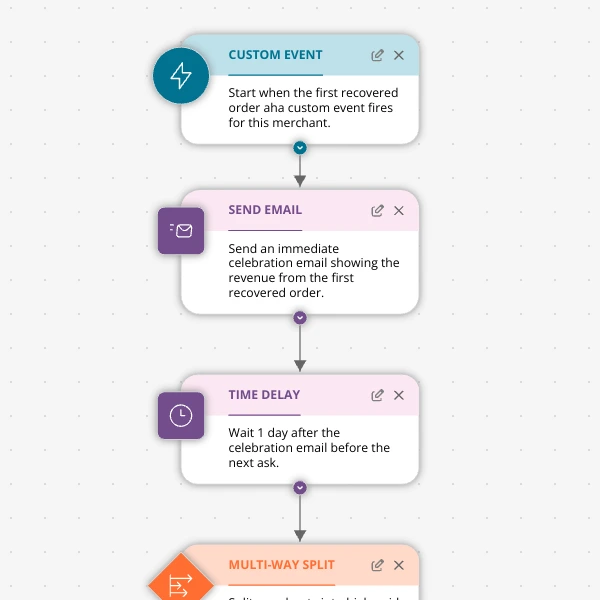
The Aha-Moment Playbook For Shopify Apps: Turn One Magic Action Into Months Of Revenue
A node-by-node playbook for Shopify and e‑commerce apps to center their lifecycle on one aha-moment custom event in Spreeflo, celebrate it, segment merchants by profile and engagement, and turn first recovered value into lasting revenue and retention.
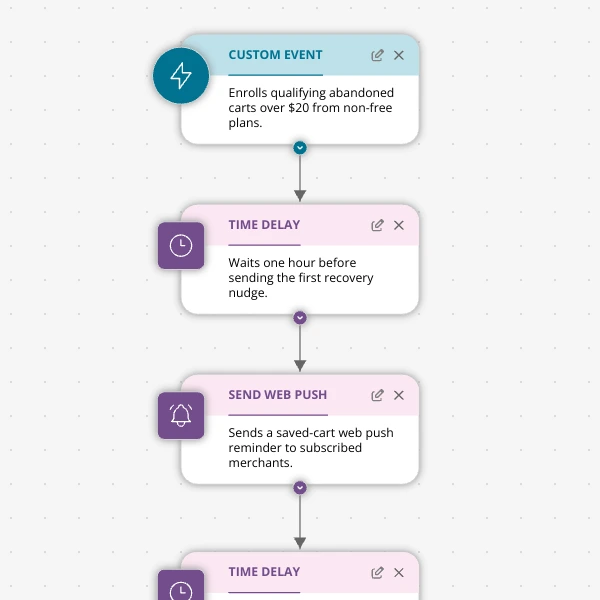
Stop Letting High‑Intent Carts Die: A 3‑Email Recovery Journey for Shopify Apps
A detailed, node-by-node walkthrough of a three-email (plus optional web push) cart-abandonment recovery journey for Shopify apps in Spreeflo, showing how to trigger events, branch on behavior, tag outcomes, and measure recovered carts and revenue.
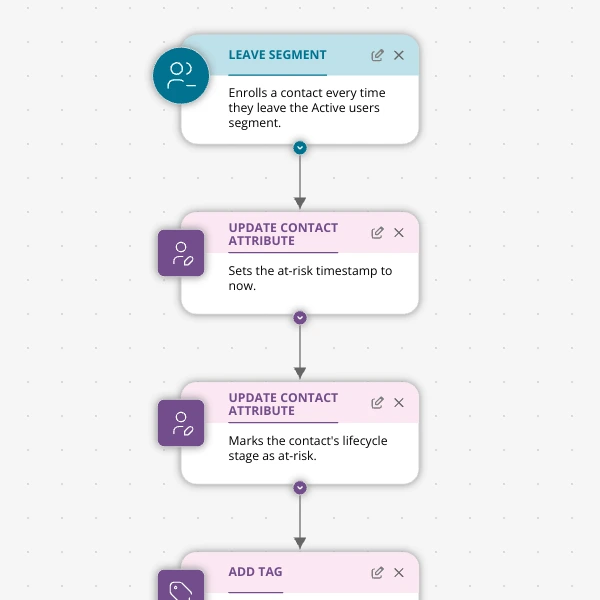
When Active Users Go Dark: A 4‑Touch Win‑Back Journey For Your Shopify App
A detailed, node-by-node Spreeflo journey for winning back previously active Shopify app users who stop engaging, using segment-based triggers, conditional logic, and a four-touch email plus internal alert sequence to recover usage and MRR.