Turn “Can’t Add Teammate” Friction into Seat Expansion Revenue
This playbook walks through a Spreeflo journey that turns “can’t add teammate” collaboration friction in Shopify and e‑commerce apps into ongoing seat expansion revenue, using custom events, branching logic, and contextual emails to nudge high-intent users to invite their team.
Industry
Niche
Pattern
Loading sequence...
The support ticket read: “I tried to add my VA to CartWizard but it says I can’t. If this app is only for one person, we’ll just stick with email reminders.”
The founder pulled up the account. Single-seat plan. Store doing $120k/month. Dozens of abandoned carts each day. And they were about to churn over a simple collaboration limit.
If you build apps for Shopify merchants or e‑commerce teams, you’ve seen this play out. A store owner hits a collaboration ceiling, bumps into a vague “you’ve reached your limit” message, and then either:
gives up on inviting their team, or
questions whether your app is “worth the hassle” at all.
Meanwhile, seat expansion is one of the cleanest ways to grow MRR without more installs.
The sequence at the top of this page is the whole journey, end to end. It shows how to catch that exact moment of frustration and turn it into a contextual “invite your team” nudge that feels helpful, not salesy.
We’ll walk through that journey step by step, using a fictional Shopify app called CartWizard (cart recovery + upsells, $49/mo base plan) as our example. The same pattern applies whether you sell a Shopify app, an embedded analytics tool like ShopMetrics, or any collaboration-heavy SaaS in the e‑commerce stack.
Why collaboration friction is silent churn
For most e‑commerce apps, your pricing model quietly assumes accounts will grow into more seats over time:
Owner installs the app on a single seat
They hire a marketing assistant, agency, or VA
That person needs to configure flows, check reports, or tweak campaigns
Suddenly “just one login” is not enough
If your only path to expansion is “maybe they’ll notice the seat settings page someday,” you’re leaking lifetime value.
Two things make this a missed opportunity:
The user hitting a collaboration limit is a high‑intent signal. They are literally trying to invite their team or add another seat.
The person best positioned to approve expansion is often the one feeling the pain in that moment (the store owner or lead marketer).
This pattern turns that event into a timely, personalized email:
Triggered by a Custom Event when a collaboration limit is hit
Targeted at single‑seat or under‑seated customers
Measuring both invite‑sent rate and seat expansion revenue
Under the hood, it uses Spreeflo’s journeys, Custom Event triggers, If/Else logic, and Wait Condition nodes to follow through intelligently. You build the system once, and it quietly nudges accounts toward expansion forever.
Step 0: Wire up the right events (without overcomplicating it)
Before we touch the journey builder, you need three basic data points:
A custom event when someone hits a collaboration limit
- Example:collaboration_limit_hit
- Properties you might send:limit_type = "teammate",current_seats = 1,role_attempted = "marketing".A custom event when a team invite is actually sent
- Example:team_invite_sent(fired once per invite, or once per batch).A contact attribute that tells us how many seats they currently have
- Example: custom attributeseat_count(NUMBER).
You’d send those from your app backend or admin UI using the Spreeflo API or, if you’re tracking in the browser, via the Spreeflo SDK described in the web tracking and analytics guide.
Once those are flowing, you can build a journey that reacts instantly when the limit event fires.
Trigger: Custom Event when collaboration limit is hit
At the very left of the sequence is a Custom Event trigger.
Configuration:
Event name:
collaboration_limit_hitProperty conditions:
limit_type is "teammate"(so you don’t trigger for other limit types like campaigns)Re-enrollment: On
Re-enrollment matters. You want this journey to fire each time a contact genuinely re‑hits the limit, but with sensible pacing later in the flow so they’re not spammed.
Why Custom Event as the trigger?
It’s precise. Only people who actually hit collaboration friction enter.
It’s contextual. You can reference the action they just tried in the email copy.
It encodes intent. Someone trying to add teammates is far more expansion‑ready than a random active user.
This is where brand message #1 shows up: you capture specific behavioral detail on every account, then speak to that behavior directly instead of guessing.
Step 1: Tag for visibility and later segmentation
Immediately after the trigger, the journey uses an Add Tag action:
Tag:
collab-limit-hit
This doesn’t send anything to the customer. It gives you:
A quick way to filter accounts in the UI (“who’s bumping into collaboration limits?”).
A reusable signal for future journeys (e.g., a quarterly “power features” webinar invite to everyone tagged this way).
You don’t need to force tag triggers here; the point is internal visibility and segmenting, not kicking off other automations.
Step 2: Split single-seat vs everyone else
Next in the sequence is an If/Else process node that checks whether this is a single-seat account.
Example condition (configured via the segment builder):
Contact attribute
seat_count
- Type: NUMBER
- Operator:is
- Value:1
You might also layer in:
Email Subscription Status
is Subscribed(so you respect marketing preferences)Plan attribute
isone of your seat‑metered tiers
Why split here?
Because the narrative is different:
For single-seat accounts, the message is: “Invite your team and step up from ‘founder-only’ usage.”
For accounts already on a multi-seat plan, the message is more: “You’re growing, add more seats so everyone can work comfortably.”
In the example journey, we focus the main path on single-seat accounts (the “yes” branch of the If/Else) and treat the “else” branch as a lighter-touch path.
Step 3: Send the first contextual invite-your-team email
On the “single-seat” branch, the next node is a Send Email action.
You build the content in Spreeflo’s email builder. Configuration highlights:
From: whichever sender identity you use for product updates
Subject: tie directly to what just happened
- Example: “You tried to add a teammate to CartWizard — here’s how to make it work”Body:
- Acknowledge the action: “We saw you tried to add [role] to your CartWizard account.”
- Clarify the constraint in plain language.
- Describe the benefit of having multiple seats (e.g., assistant can monitor recoveries, agency can tweak flows).
- One clear CTA: “Invite your team” or “Upgrade and invite teammates,” pointing straight back to your app’s invite/seat page.
This is not a generic “add your team” broadcast. It’s a specific response to a specific action, delivered while the intent is fresh. That behavioral tightness is what lifts invite‑sent rate.
On the node itself, you can keep “Send only once” enabled. Once this particular user has seen your contextual explanation, repeatedly sending the same long-form email isn’t useful; later touches can be more lightweight.
Step 4: Wait for an invite, but don’t stall forever
After the first email, the sequence uses a Wait Condition action instead of a blind Time Delay.
Configuration:
Condition: Custom Event
- Event:team_invite_sent
- Operator:at least1 time
- Time window:in the last3 daysTimeout: 3 days
What this does:
If the customer sends any team invite within three days, they satisfy the condition and move on immediately.
If they don’t, the timeout expires after three days and they still move forward.
Either way, nobody gets stuck in the journey indefinitely.
This node is key because it anchors your messaging to outcomes, not just time:
Engaged accounts who quickly invite their team don’t need more nudging. Hesitant accounts get a second, more concise reminder later.
You’re nurturing toward a behavior — not just blasting a sequence.
Step 5: Branch again: invited team vs still solo
Right after the Wait Condition, an If/Else process checks the same team_invite_sent event:
Yes branch: they’ve sent at least one invite in the last three days
Else branch: still no team invites
On the “yes” path, the sequence:
Uses an Add Tag action:
- Tag:team-invite-sent-from-nudgeOptionally uses Update Contact Attribute to stamp a timestamp:
- Attribute:last_team_nudge_at(TIMESTAMP)
- Update type:Set to now
You don’t need to send another customer-facing message here. The purpose is attribution and later analysis: “Which seat expansions started from this friction‑based nudge journey?”
On the “else” path, the contact hasn’t acted even after three days. That’s where a gentle second touch makes sense.
Step 6: A shorter follow-up email for non‑converters
Still in the single-seat path, the “else” branch leads to a second Send Email action.
Here, brevity wins:
Subject: “Quick way to get your team into CartWizard”
Two or three lines reminding them:
- Multiple seats keep things secure (no shared passwords).
- Your assistant/agency can handle the busywork.
- Click once to review invite options.
Because this email always comes after the three-day Wait Condition, you automatically respect pacing. Nobody gets two seat-expansion emails back-to-back.
After this email, the journey uses a Time Delay:
Delay: 14 days
That 14‑day pause does two things:
It leaves breathing room before you check again for invites or expansions.
It keeps the contact “mid-journey,” which prevents the Custom Event trigger from re‑enrolling them during that window.
For most apps, two nudges around the same friction point in a short span is plenty.
Step 7: Check for delayed invites and close the loop
After the 14‑day Time Delay, the journey adds one more If/Else node:
Condition: Custom Event
team_invite_sent
- Operator:at least1 time
- Time window:in the last14 days
Branches:
Yes branch: they eventually invited their team
- Add Tag:team-invite-sent-late
- Optional Webhook to pipe the expansion signal into your CRM (if you’re on the Pro plan and want sales to see it).Else branch: still no invite
- Add Tag:team-nudge-exhausted(so you can exclude them from future “add your team” pushes or handle them differently).
Both branches then rejoin through a Merge node and the journey ends.
From here, you can build separate reporting or downstream automations using segments:
A segment of all contacts tagged
team-invite-sent-from-nudgewhereseat_count > 1A segment of
team-nudge-exhaustedfor qualitative outreach or UX research
This is how brand message #3 shows up in practice: instead of letting collaboration friction quietly push users toward churn, you nurture them through it and capture the extra LTV.
What about non–single-seat accounts?
Remember that first If/Else split on seat_count?
On the “else” branch (accounts that already have more than one seat), the example journey takes a lighter approach:
One contextual Send Email explaining they’ve hit the seat cap for their current plan and outlining options to grow
A Wait Condition for a
plan_upgradedorseat_limit_increasedevent, with a several‑day timeoutA closing Add Tag for attribution
No second email, because these users already understand the value of collaboration. Often the better UX is in‑app messaging, with email as a single clear explanation of what happened.
You can extend this pattern with a Multi-way Split instead of a simple If/Else:
Branch for seat_count = 1 (core journey above)
Branch for seat_count between 2–5 (small teams)
Branch for seat_count above 5 (larger teams who might suit an enterprise tier)
The logic is the same; the offer and narrative change per branch.
Measuring invite-sent rate and seat expansion revenue
Once this journey is live, you care about two core metrics:
Invite-sent rate
Among all contacts who entered viacollaboration_limit_hit, what percentage firedteam_invite_sentwithin, say, 21 days?
You can build this using the segment builder:
- Segment A: all contacts with Custom Eventcollaboration_limit_hitat least once in the last 30 days
- Segment B: same, plus Custom Eventteam_invite_sentat least once in the last 21 days
The ratio |B| / |A| is your invite-sent rate for that window.Seat expansion revenue influenced
If you trackseat_countand aplan_upgradedoradditional_seats_purchasedevent, you can:
- Pull a cohort of contacts taggedteam-invite-sent-from-nudge
- Compare their MRR or seat_count before and after entering the journey
This isn’t a perfect causal study, but it’s enough to see whether the pattern is paying for itself. For most e‑commerce apps, a single extra multi-seat upgrade covers a lot of Spreeflo usage.
Adapting the pattern to your own app
Everything above is specific enough to be useful, but flexible enough to adapt:
Your “collaboration limit” might be:
- Number of users who can log in
- Number of stores a given user can access
- Number of workspaces an agency can manageYour plan structure might be:
- Per-seat pricing
- Bundled seats per tier (Starter includes 1, Pro includes 5, etc.)
A few guidelines as you adapt:
Choose one clear “limit hit” event per journey. Don’t overload the same flow with every kind of error or restriction.
Send the first email only to the person who can approve expansion (usually the account owner or billing contact).
Tie your copy tightly to the behavior. Vague upsell emails feel like marketing; contextual ones feel like help.
Keep the cadence short and finite: 1–2 emails over a few weeks, not a drip that nags forever.
Spreeflo’s campaigns and journeys model is what makes this practical for a small team. You define the logic visually — Custom Event in, If/Else splits, Wait Conditions, and a couple of emails — and the system runs 24/7 without anyone manually “looking for expansion opportunities.”
The bigger lesson: expansion lives inside product friction
Most e‑commerce app developers obsess about acquisition: App Store rankings, install rate, trial-to-paid conversion. Expansion often gets lumped under “we’ll deal with that when we’re bigger.”
But the cleanest expansion opportunities are already in your product:
The moment someone hits a limit
The moment they outgrow a feature set
The moment they ask support for something “only available on higher tiers”
If you’re not capturing those as events and reacting with targeted journeys, you’re leaving LTV on the table.
This seat-expansion / team-invite nudge is one small pattern, built from:
A little extra event data
A few clear branches in a journey
Two well-written emails
Yet it speaks uniquely to each account based on what they just tried to do, and it keeps nudging them toward a healthier, more collaborative setup.
That’s the heart of good lifecycle marketing: use the detail you have on every customer to intervene at the right moments, and let automation quietly compound your revenue while you keep building the app.
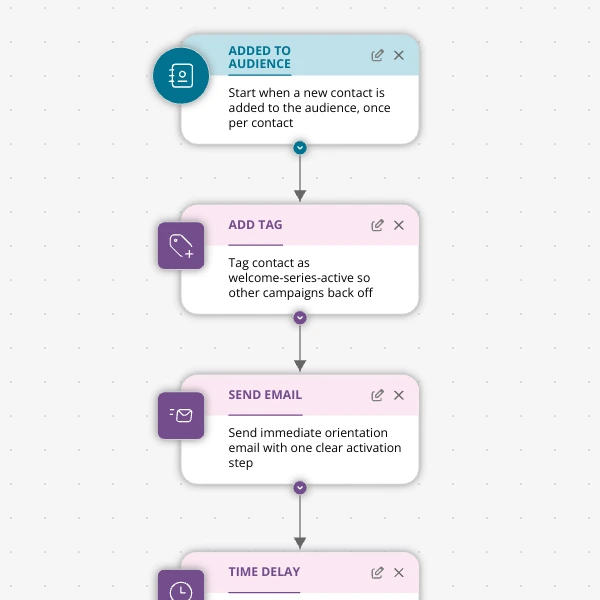
The Shopify app welcome series that turns installs into income
A step-by-step Shopify app welcome email journey for tools like CartSpark, showing how to turn new installs into activated, retained merchants using Spreeflo journeys, tags, and behavioral triggers so fewer trials quietly churn and more trials convert.
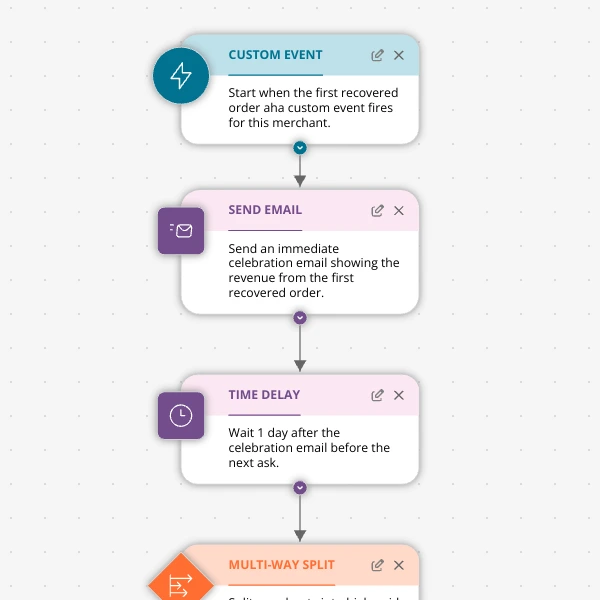
The Aha-Moment Playbook For Shopify Apps: Turn One Magic Action Into Months Of Revenue
A node-by-node playbook for Shopify and e‑commerce apps to center their lifecycle on one aha-moment custom event in Spreeflo, celebrate it, segment merchants by profile and engagement, and turn first recovered value into lasting revenue and retention.
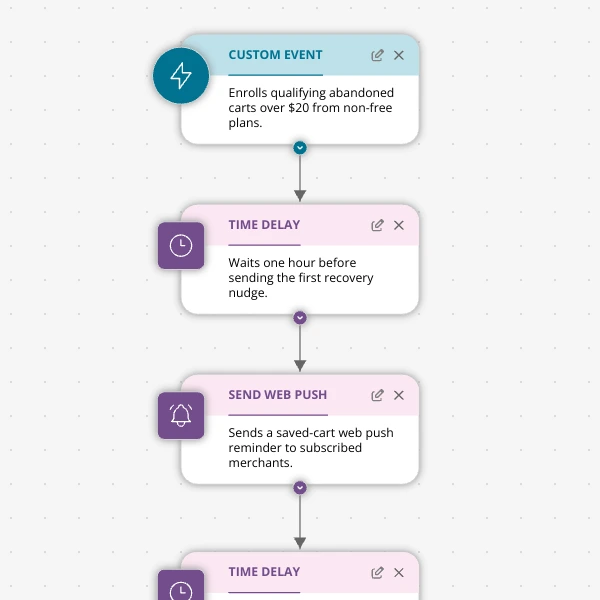
Stop Letting High‑Intent Carts Die: A 3‑Email Recovery Journey for Shopify Apps
A detailed, node-by-node walkthrough of a three-email (plus optional web push) cart-abandonment recovery journey for Shopify apps in Spreeflo, showing how to trigger events, branch on behavior, tag outcomes, and measure recovered carts and revenue.
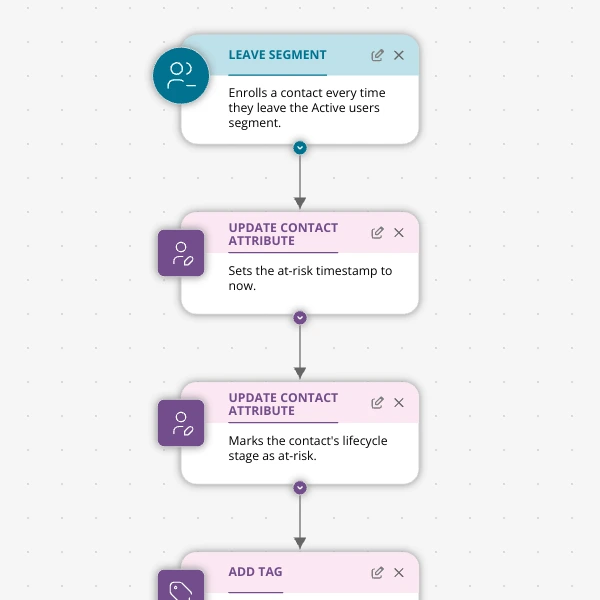
When Active Users Go Dark: A 4‑Touch Win‑Back Journey For Your Shopify App
A detailed, node-by-node Spreeflo journey for winning back previously active Shopify app users who stop engaging, using segment-based triggers, conditional logic, and a four-touch email plus internal alert sequence to recover usage and MRR.