Instant Slack Handoffs for High-Intent Shopify Leads
This playbook shows Shopify and e‑commerce app teams how to wire high-intent product events into Slack via Spreeflo journeys and webhooks, so a small team can respond quickly to priority installs, churn risks, and expansion signals.
Industry
Niche
Pattern
Loading sequence...
CartWizard’s founder has a browser tab open on the Shopify Partner dashboard, another on Stripe, and Slack lighting up with general support chatter.
A big Shopify Plus store installs their cart recovery app at 10:12am. No one notices. By the time someone checks the dashboard after lunch, the merchant has already uninstalled and gone with a competitor that replied faster.
That’s the gap this pattern closes: the handful of events in your app that should instantly ping your team, every time, without relying on anyone “keeping an eye” on a dashboard.
The sequence at the top of this page is the whole journey, end to end. It listens for a high-intent custom event from your app and pushes a structured payload into a Slack channel through Spreeflo’s Webhook action. Your team gets a rich, contextual alert in seconds, and you don’t need another tool to glue this together.
For a 3–7 person e‑commerce app team, this is one of the cleanest ways to convert time into leverage instead of headcount.
Why Slack alerts matter more than another report
If you’re building for Shopify or other e‑commerce platforms, you already track the right signals:
app_installedsubscription_upgradedpayment_failedfeature_usedon a power featureapp_uninstalled
But most teams treat these as analytics, not as triggers for real-time human action.
The reality:
A single enterprise customer can add five figures of ARR.
A “help, this is broken” support ticket from a large merchant is a churn risk if it sits for an hour.
A failed payment on a high-ARPU plan pays for a lot of your tooling if you rescue it quickly.
Routing those events straight into Slack is how a tiny team behaves like it has a sales floor and a dedicated CS team. The automation does the watching; your humans step in only when they’re actually needed.
With Spreeflo, you get that wiring inside the same place you already run your campaigns and journeys. No Zapier daisy chains. No additional per-seat pricing.
The journey you’re about to build
Before we go node by node, here’s what the journey in the visual sequence is doing conceptually:
A Custom Event trigger listens for a specific event from your app (for example
app_installedorupgrade_to_pro).An If/Else process qualifies whether this contact is worth a real-time Slack ping (for example “large store” or “on Plus”).
On the “yes” branch, three actions fire in quick succession:
- Add Tag marks the contact as a priority lead.
- A Webhook action POSTs a structured payload into a Slack incoming webhook URL.
- Update Contact Attribute stamps a timestamp likelast_priority_alert_atso you can avoid noisy repeats later.On the “else” branch, you might simply tag them for reporting and skip Slack.
Everything beyond that is optional nuance. The core value is: as soon as a high-intent event happens, the right Slack channel lights up with full context.
Let’s walk through each node and why it’s configured that way.
Step 1: Custom Event trigger – catching the right signal
At the top of the sequence you’ll see a Custom Event trigger. This is the entry point for the journey.
You send events into Spreeflo from your app using the Spreeflo API or the JavaScript SDK: things like app_installed, billing_activated, or payment_failed. Any of those can be the event name on the trigger.
Two important configuration choices here:
Event name
Pick a single, clearly defined moment where human attention is warranted. For a Shopify app, good candidates:
-app_installedfor stores over a certain size (more on size below).
-subscription_upgradedfor customers moving into your highest tiers.
-payment_failedfor high-MRR accounts.
You can mix and match by creating separate journeys if you need different Slack channels or escalation rules per event.Property conditions (optional but powerful)
The Custom Event trigger lets you add property conditions that filter events before they hit the journey. For example:
- Only fire when event propertyshopify_planisplusoradvanced.
- Only fire when event propertymrr_potential(a number you compute in your backend) is greater than 300.
These filters run on the event payload itself, before any branching. If you can compute “is this store a whale?” on your side, this is the cleanest way to avoid noise.Re-enrollment setting
For this pattern, you usually want Re-enrollment: on:
- A store might reinstall your app later. That’s another shot you want to know about.
- Apayment_failedevent might occur again after a retry window.
Remember that Spreeflo prevents duplicate enrollments while a contact is mid-journey. If the same event fires again while they’re still moving through the nodes, it’s ignored until they exit.
This trigger is your watchdog. It converts a raw stream of app events into “this contact should now enter the Slack handoff journey.”
Step 2: If/Else – qualify who deserves a ping
You probably don’t want Slack exploding for every tiny trial store.
That’s what the If/Else process node right after the trigger is for. Its condition uses the full segment builder to decide who goes down the “priority” branch.
A realistic rule might be:
Contact attribute
store_sizeislargeorenterprise, ORContact is tagged with
shopify-plus, ORCustom number attribute
estimated_mrris greater than 200
You populate those attributes earlier in your stack when you identify the contact (for example with Spreeflo.identify or via an API call). The builder doesn’t care how you set them; it just reads.
Why not just encode all that logic upstream and use property conditions on the trigger? Three reasons:
Your definition of “priority” will evolve. It’s easier to tweak it in a visual If/Else node than redeploy app code.
You might want to reuse that same condition in other journeys — for example, in a nurture sequence or upgrade promotion.
You can combine tags, attributes, and activity in one place. Maybe a tiny store that has already used advanced features deserves a ping too.
Contacts who match the condition go down the “then” branch. Everyone else takes the “else” branch.
Step 3: Add Tag – mark this contact as priority
On the “yes” path, the first action node after the If/Else is Add Tag.
Here you apply a tag like priority-lead or whale-install. Configuration is straightforward:
Tags:
priority-lead(and optionally others)Force tag trigger: usually off, unless you want to fire Added Tag triggers in other journeys even when the tag is already present.
Why tag at all?
Reporting: you can build segments later like “all priority leads in the last 30 days who didn’t convert.”
Safeguards: you might choose to suppress repeated Slack alerts if the contact already has this tag.
Context: if your team looks up the contact inside Spreeflo, they see immediately that this store has been considered a priority.
Tags are cheap. Use them.
Step 4: Webhook – the Slack alert itself
Next comes the heart of this pattern: the Webhook action on the Pro plan.
Slack’s incoming webhooks give you a unique URL. When you send an HTTPS POST with a JSON payload to that URL, Slack drops a message into the specified channel.
In the Webhook node, you configure:
Webhook URL: paste in your Slack incoming webhook URL.
Request method:
POST(Slack expects POST, not GET).Contact fields: choose whether to send all contact attributes or just a subset.
For most teams, “selected fields” is the right balance. You might include:
Contact email
Store name / URL
Plan or tier
Key metrics you track as attributes (current MRR, order volume, etc.)
A link back into your own admin for that store
Spreeflo serializes the selected fields as JSON in the body of the POST. On the Slack side, you can start simple with a generic formatter that pulls out the fields you care about, then evolve the message format over time.
Some practical tips:
Create a dedicated channel like
#priority-installsor#billing-alerts. Keep noise out of general rooms.Standardize the first line of the message: “New priority install: {store_name} on {plan}” so it’s scan-friendly.
Include a clear suggested action in the text: “Reply with a short welcome email within 5 minutes” or “Check billing portal and retry payment.”
This single node is where the “we should keep an eye on that” intention becomes an actual, visible alert in your team’s workflow.
Step 5: Update Contact Attribute – remember you alerted
After the Webhook node, the sequence uses Update Contact Attribute to stamp that this Slack alert happened.
A common pattern:
Attribute:
last_priority_alert_at(a custom timestamp attribute)Update type:
Set to nowDelete value: off
This writes the current timestamp when the node runs.
Why it matters:
You can build segments like “priority leads with no alert in the last 7 days” if you ever want to batch-review coverage.
You can prevent noisy repeat alerts by adding another If/Else at the top of the journey that checks “last_priority_alert_at is blank OR is before 30 days ago.”
One important Spreeflo detail: the Update Contact Attribute node only writes static values you configure at design time, except for Set to now on timestamps. If you want to store dynamic data from your event payload (like exact order count), you should set that attribute from your backend using the API, not via this node.
Step 6: The “else” path – gracefully doing nothing
On the “else” branch of the If/Else, you have options.
For many teams, the cleanest move is:
Add a milder tag like
standard-install.End the path.
You don’t send a Slack alert, and you don’t clutter your team’s mental space. The journey still did something useful: it classified the contact for future marketing.
If your install volume is low, or your team wants extra visibility, you could:
Use another Webhook node that posts into a different Slack channel like
#all-installs, with a simpler message.Or use Send Internal Email to drop a daily summary into an inbox instead of real-time Slack.
The pattern is the same. You’re just adjusting the intensity of the alert based on the lead’s potential value.
Variations worth testing
Once you have this basic Slack handoff working for priority installs, you can clone the journey and adjust it for other moments:
Churn rescue
Trigger onpayment_failedorapp_uninstalledevents. Qualify big accounts with an If/Else, then send an urgent Slack ping to#churn-riskwith a link to the account in your admin.Expansion opportunities
Trigger onfeature_usedfor advanced features in a lower plan. Slack alert to#expansion-oppswhen someone looks ripe for an upsell.High-intent web behavior
If you’re using Spreeflo’s web tracking and analytics, you can define a saved segment like “visited pricing page at least 3 times in 7 days” and then use a Join Segment trigger in another journey. That journey can also end in a Webhook to Slack with a “this user is shopping for plans” alert.
Each of these runs in parallel. You’re not building a monolithic mega-journey; you’re designing a handful of small, sharp automations, each wired to one Slack channel and one kind of human action.
Measuring whether this actually helps
Two simple metrics tell you if this pattern is earning its keep.
Handoff latency
How long does it take from the moment the event happens to the moment someone on your team takes a meaningful action?
- Before: could be hours, or never.
- After: should be minutes. You can check Slack timestamps against app logs to see the delta.
Lowering this is especially powerful for competitive install moments and payment failures.Team acknowledgement rate
For each Slack alert, does someone:
- React with a specific emoji (your agreed “I’ve got this”)?
- Log an activity in your own admin or CRM?
- Actually send the welcome / rescue message you intend?
You can track this manually at first, then summarize in a simple spreadsheet or internal report. The goal is to ensure that automation isn’t just shouting into the void. It should reliably produce human follow-up.
Compare cohorts before and after switching this on: trial-to-paid conversion for priority installs, churn rate after payment failures, and upgrade rate following expansion alerts.
If even a handful of extra accounts convert or are saved each month, the math works out quickly. The Webhook node is available on the Pro plan, and it only takes one rescued Shopify Plus customer to pay for Spreeflo’s pricing many times over.
Why this is pure founder leverage
This pattern is a textbook example of the second core idea behind Spreeflo: founder-led businesses win on leverage, not headcount.
You’re not hiring someone to watch dashboards and refresh exports. You’re teaching the system what “important” looks like, once, and letting automation sit guard 24/7:
The Custom Event trigger listens perfectly.
The If/Else node encodes your sense of “this is worth our time.”
The Webhook node taps into Slack, where your team already lives.
Tags and attributes keep your data clean for future journeys.
All of it runs inside the same automation canvas you use for nurture emails and lifecycle flows, backed by the same campaign and journey automation model and the same audience structure you see under Spreeflo’s audiences platform.
You design it once. Every future high-intent event gets the benefit.
If you’re already sending emails with our email builder, adding a Slack handoff journey like the one at the top of this page is often an afternoon’s work. For a Shopify app sitting between $50k and $200k MRR, that’s one of the highest-ROI afternoons you can spend.
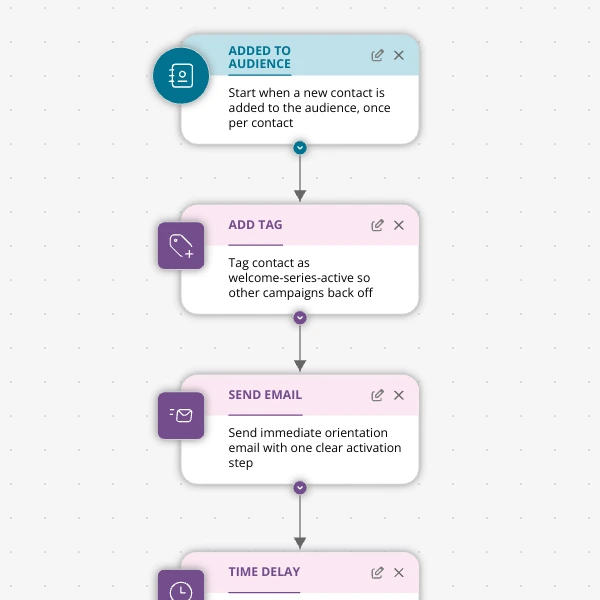
The Shopify app welcome series that turns installs into income
A step-by-step Shopify app welcome email journey for tools like CartSpark, showing how to turn new installs into activated, retained merchants using Spreeflo journeys, tags, and behavioral triggers so fewer trials quietly churn and more trials convert.
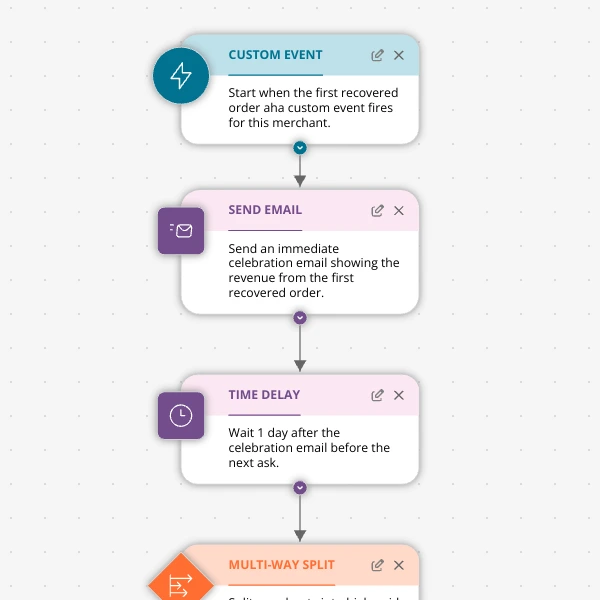
The Aha-Moment Playbook For Shopify Apps: Turn One Magic Action Into Months Of Revenue
A node-by-node playbook for Shopify and e‑commerce apps to center their lifecycle on one aha-moment custom event in Spreeflo, celebrate it, segment merchants by profile and engagement, and turn first recovered value into lasting revenue and retention.
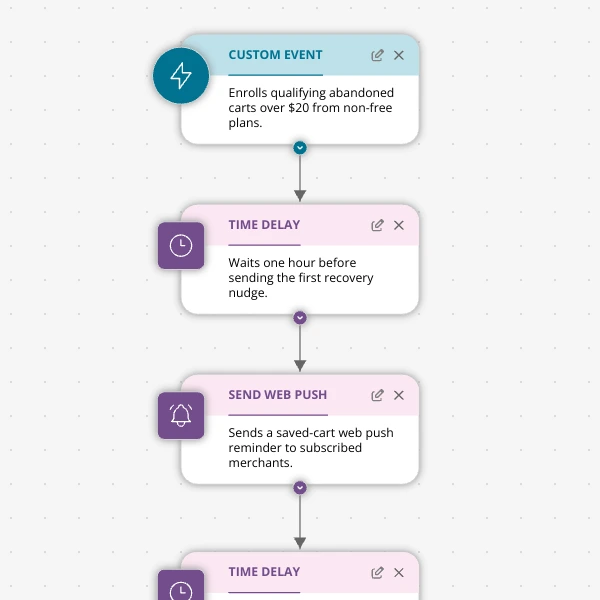
Stop Letting High‑Intent Carts Die: A 3‑Email Recovery Journey for Shopify Apps
A detailed, node-by-node walkthrough of a three-email (plus optional web push) cart-abandonment recovery journey for Shopify apps in Spreeflo, showing how to trigger events, branch on behavior, tag outcomes, and measure recovered carts and revenue.
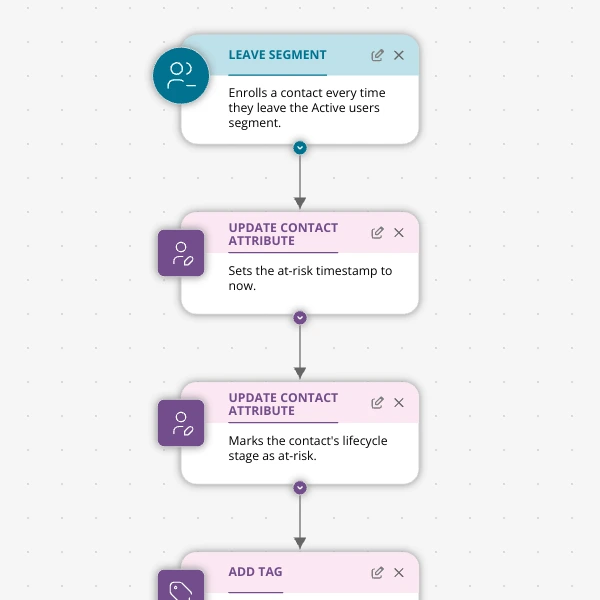
When Active Users Go Dark: A 4‑Touch Win‑Back Journey For Your Shopify App
A detailed, node-by-node Spreeflo journey for winning back previously active Shopify app users who stop engaging, using segment-based triggers, conditional logic, and a four-touch email plus internal alert sequence to recover usage and MRR.