One Announcement, Four Stories: Lifecycle Personalization for Your Shopify App
This playbook shows Shopify and e‑commerce app teams how to turn generic product announcements into a lifecycle-personalized journey, using Spreeflo to send stage-specific emails that lift engagement, conversions, expansion, and advocacy over time.
Industry
Niche
Pattern
Loading sequence...
Last December, CartWizard pushed out their big “Year in Review” email.
It went to everyone: people who had installed that morning, trial stores from six months ago that never activated, loyal customers paying $99/month, and two-year power users who tweet about them weekly.
The copy opened with “It’s been an incredible year together.” For a brand-new prospect who had only downloaded an ebook, that line landed flat. For churned trials, it felt off. For their best customers, it was… fine, but generic.
Open rates were okay. Clicks were mediocre. Upgrades barely moved.
What CartWizard was really doing was sending four different audiences the same story and hoping it would resonate equally. It didn’t.
The sequence at the top of this page is the whole journey, end to end. It’s a pattern that turns that one-size-fits-none announcement into four different narratives: one for prospects, one for active trials, one for paying customers, and one for advocates.
For a Shopify or e‑commerce app doing $20k–$200k MRR, this is one of those “build it once and keep cashing the checks” systems. You keep your regular cadence of product updates, recap emails, and promos, but every stage of your lifecycle hears a version that makes sense for where they actually are.
Let’s walk through how it works and why each node in that journey is there.
Why lifecycle-stage announcements beat generic broadcasts
Lifecycle-stage personalization is simple in theory:
Prospects, trials, customers, and advocates are all reacting to the same announcement, but they care about different things.
A few concrete differences for a Shopify app:
A prospect wants proof: “Stores like yours increased recovered revenue by 18%.”
A trial user wants clarity: “Here’s how the new feature reduces time-to-value this week.”
A paying customer wants impact: “You’ve already recovered $4,320. This update pushes that higher.”
An advocate wants status: “You’re in the top 5% of stores using this feature. Here’s early access to what’s next.”
When everyone gets the same version, two things happen:
Stage-specific click-through rates flatten. Prospects see CTAs that assume they are already users. Trials get asked for referrals. Customers get “learn more” instead of “enable this now.”
You silently leak lifetime value. Trials don’t convert because the product story never matches their activation moment. Customers don’t expand because you never make upgrades feel like a natural next step.
Spreeflo’s view is straightforward: the only way to fix this at scale is to capture enough detail about each contact to know their stage, then automate different messages for each group. That’s exactly what this journey does.
The data foundation: defining lifecycle stages in your app
Before this journey can do its job, you need a clean way to tell Spreeflo who is in which stage.
For a typical Shopify app, you already have clear events in your product and billing system:
signup_startedapp_installedtrial_startedsubscription_activatedsubscription_canceledsubscription_upgradednet_mrr_changenps_submittedreferral_sent
You can send these into Spreeflo as custom events via your backend or frontend using the Spreeflo API or the SDK’s Spreeflo.track call.
Then you model lifecycle in one of two ways:
A
lifecycle_stagecontact attribute with allowed values like "prospect", "trial", "customer", "advocate".A small set of tags such as
stage:prospect,stage:trial, etc.
Either works. Tags are often quicker to bolt on, and Spreeflo has a simple guide for getting started with tags. Attributes give you more room later if you want sub-stages.
You can maintain these stages through separate small journeys:
A
Custom Eventtrigger onapp_installedthat applies thestage:trialtag.A
Custom Eventtrigger onsubscription_activatedthat removesstage:trialand addsstage:customer.A
Custom Eventtrigger onsubscription_canceledthat moves them tostage:churned.
Those maintenance flows run in the background. The lifecycle-personalized announcement journey assumes your stages are accurate and focuses entirely on sending the right version of a recurring message.
The core idea: a date-based “announcement engine”
Think of the journey you see at the top of this page as an “announcement engine” that runs on a schedule.
You decide the cadence once: maybe the first business day of every month at 9am in your main timezone. Each time it runs, it:
Pulls in everyone who should receive your update.
Splits them by lifecycle stage.
Sends a tailored email to each group.
Optionally waits to see who progresses to a new stage and tags that for reporting.
Let’s go through each node and why it is configured that way.
Node 1: Cyclic trigger – your schedule and audience filter
We start with a Cyclic trigger, because this pattern is all about date-based communication.
Configuration:
Repeat interval: every 1 month.
Time of day: 09:00.
Timezone: your primary customer base or your own operations timezone.
Criteria: using the segment builder, define who can ever receive these announcements. At minimum:
Email subscription status is Subscribed.
Contact is not tagged with
do-not-contact.(Optional) Has at least 1 meaningful event, such as
app_installedortrial_started, so pure cold leads stay out.Most importantly,
isReEnrollmentis set to true.
That tells Spreeflo: “Every month, for every contact who matches this criteria, enroll them again.” Without that, each contact would only pass through this journey once and never receive subsequent announcements.
Why not just send a one-off campaign each month? Because you would be reinventing segmentation and personalization from scratch every time. With a recurring journey, you define the logic once and it keeps adapting as contacts move between stages.
Node 2: Multi-way Split – four lifecycle branches
Next is a Multi-way Split process node. This is where we translate your lifecycle model into routing.
We create four named branches:
prospecttrialcustomeradvocate
Plus the automatic Else branch for anyone who does not match those definitions.
Each branch uses the segment builder to define stage conditions. For example:
Prospect:
- Tag containsstage:prospectTrial:
- Tag containsstage:trialCustomer:
- Tag containsstage:customerAdvocate:
- Tag containsstage:customerAND email activity “opened at least 5 emails in the last 90 days” OR tag containsnps_promoter
You can keep these definitions simple at first (just the stage tag or attribute), then enrich the advocate branch later as you see which users really behave like champions.
The reason to use a Multi-way Split instead of four separate journeys is that many contacts will change stage over time. A trial this month could be a customer next month. By evaluating conditions fresh on every run, the same person naturally flows into a different branch as their relationship with you evolves.
Prospect branch: education over features
From the prospect branch of the split, we go straight into a Send Email action.
This email is all about education and social proof. Prospects may have opted into your content or signed up for the waiting list, but they have never installed your app.
Practical setup in Spreeflo:
Use our email builder to design a clean, mobile-friendly prospect version of the announcement.
Subject line: outcome-oriented, not feature-oriented. For a cart recovery app, something like “How Shopify brands added 12% extra revenue in Q3”.
Body:
Lead with one or two customer stories or metrics from the announcement.
Include a clear “Add the app on Shopify” CTA.
Offer a small incentive or checklist that links to your onboarding guide.
Configuration details:
Make sure
Send only onceis off for this node. Prospects should be allowed to receive a new version of the announcement every month while they remain in that stage.No additional delay node is needed before this email; the
Cyclictrigger itself is already the time control.
After this Send Email, you might add an Add Tag action like received_announcement_prospect. This is optional but helpful for later analysis.
Then the branch ends. They will re-enter on the next cycle if they are still prospects.
Trial branch: activation and urgency
Trials are actively trying you out. Your announcement should feel like a guided tour, not a newsletter.
The trial branch typically looks like:
Send Email– “This month’s update and how to get value in your trial.”Wait Condition– “Wait up to 14 days for this trial to convert.”Optional
Add Tag– “Converted after announcement” for those who make it.
Step-by-step:
The
Send Emailnode is configured with copy that:
- Acknowledges they are in a trial.
- Calls out features from the announcement that shorten time-to-value.
- Includes deep links into your product: “Create your first recovery flow” or “Connect your first store.”The
Wait Conditionaction then watches for progression. The condition might be:
- Segment membership “is member of segment Paid customers”, or
- Tag containsstage:customer.
Timeout: 14 days, unit Days.
That means: as soon as this contact becomes a customer, or after 14 days, whichever comes first, they move to the next step.From here, you add an
Add Tagnode on the “met condition” path (i.e., they converted) with something likeupgraded_after_announcement. On the timeout path (they did not convert), you might add a tag likeno_upgrade_after_announcement.
We use a Wait Condition instead of a fixed Time Delay so you can later measure lifecycle-progression rate more precisely: “Of everyone who received the trial version of the announcement, how many upgraded within 14 days?”
That is the second core metric for this pattern.
Customer branch: expansion and retention
Paying customers are already convinced. The announcement email should deepen their usage and gently point to expansion paths.
Here, the branch can stay simple and focused:
Send Email– “New ways to grow your store with [Feature X].”Optional
Check Email Activity– reaction-based follow-up.
The first Send Email:
Assumes they are installed and running.
Shows “before/after” examples using their data where possible (“Stores like yours recovered an extra $980 last month using this workflow”).
Includes CTAs directly into advanced features or higher tiers.
If you want to get more sophisticated, you can follow this with:
A
Time Delayof 7 days.A
Check Email Activityprocess on that same email, branching on:Clicked
Opened but did not click
Unopened
For the Clicked branch, you might Add Tag as engaged_with_announcement for later upsell journeys. For Unopened, you could queue a different nurture sequence in a separate journey.
Be careful not to stack another Send Email immediately after this one in the same path. Spreeflo requires at least a Time Delay or Wait Condition between sends to avoid spammy back-to-back messages.
Advocate branch: referrals and early access
Your advocates deserve a different tone. They have high engagement, and often higher ARPU.
This branch is your chance to:
Invite them to a referral or partner program.
Offer early beta access to new features.
Ask for a quick testimonial or review in the app store.
So the advocate branch might be:
Send Email– “You’re in our top 5%—here’s what’s next.”Add Tag–invited_to_advocate_program.
To keep the canvas tidy and analytics simple, all four lifecycle branches can then feed into a single Merge node, which itself leads to a final Add Tag like received_monthly_announcement.
The Merge process is important in Spreeflo because each non-merge node can only have one incoming connection. By merging branches first, you can run shared actions or webhooks afterwards without violating that rule.
The Else branch: handling the messy middle
No matter how neat your lifecycle model is, there will always be contacts who do not fit:
Old leads that never had stage tags applied.
Internal test accounts.
Recently imported lists.
You have two decent options:
Send a minimal, generic version of the announcement that avoids stage-specific language.
Skip emailing them entirely and instead use an
Add Tagnode (needs_lifecycle_cleanup) so you can fix their data later.
For most apps, the second option is better. It keeps your metrics clean and focuses your personalization efforts on contacts who matter.
Measuring success: CTR by stage and progression rate
This pattern lives or dies on two metrics:
Stage-specific click-through rate.
Lifecycle-progression rate after each announcement.
Here is how to make both visible.
For click-through rate, you can:
Use email analytics for each
Send Emailnode to see overall opens and clicks.Layer on lifecycle by building saved segments per stage (prospect, trial, customer, advocate) in the Audiences and segments area.
Filter or export activity by those segments to see that, for example, trials click the “Finish setup” CTA at a higher rate than before personalization.
For progression:
The
Wait Conditionnode on the trial branch, combined with tags likeupgraded_after_announcement, already encodes the cohort you care about.You can define a segment “Trials who received announcement last month and have tag
upgraded_after_announcement” and divide by all trials who received it. That gives you a clean lifecycle-progression rate for that announcement.
Most teams are surprised by how uneven performance is across stages once they break it out. Prospects might love these emails but trials ignore them. Or advocates click 3x as often when you include a roadmap preview.
That is exactly the point: you are no longer flying blind. You are capturing detail on every customer so you can speak to each uniquely, and the numbers reflect it.
Adapting the journey for different announcement types
The example we have used so far is a monthly recap or product update. The same structure works for:
A major feature launch.
Price or plan changes.
Seasonal campaigns like Black Friday.
An annual “Year in Review”.
For big one-off sends, you can copy this journey into a campaign instead of a recurring journey, swap the Cyclic trigger for a CAMPAIGN_START, and keep the Multi-way Split plus stage-specific emails exactly the same. The logic is reusable; only the trigger and content change.
When you build a journey this way once, you create a template you can repurpose any time you have news to share.
Why this pattern earns its keep for small app teams
Founder-led Shopify app businesses rarely have a full-time lifecycle marketer. You have developers, maybe one marketer, and a backlog of features fighting for attention.
Without automation, the default is a generic broadcast: easier to write, easy to send, and quietly expensive in churn and missed upgrades.
This lifecycle-stage announcement engine is the opposite approach:
You do the thinking once about who is where in your funnel.
You encode that thinking in a handful of nodes: a
Cyclictrigger, aMulti-way Split, and fourSend Emailnodes.Spreeflo runs it every month, routing each contact to the version of your story that fits their stage, and tracking how many of them move forward.
Over time, that gap compounds. Trials who get exactly the clarity they need convert at a higher rate. Customers who see expansion paths relevant to their usage upgrade more often. Advocates who feel seen are more willing to review and refer.
Most e‑commerce app developers are already doing the hard part: building features that genuinely help merchants grow. Lifecycle-stage personalization is how you stop leaving lifetime value on the table by making sure every announcement lands where the customer actually is.
Design this journey once, keep an eye on those stage-specific CTRs and progression rates, and let it run quietly in the background while you ship the next release.
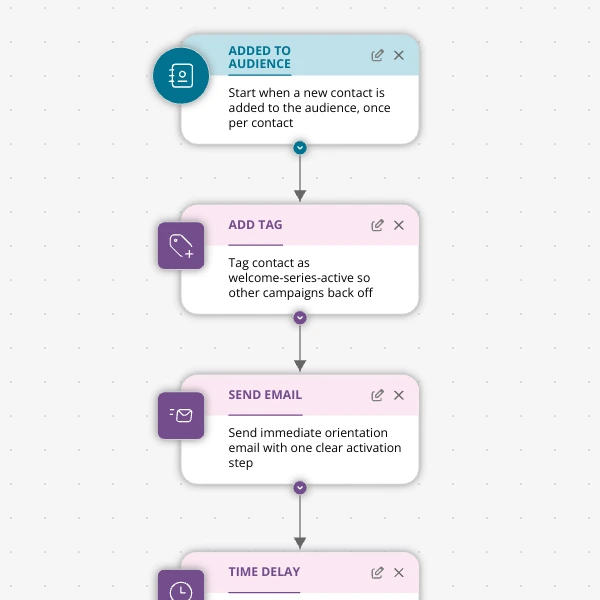
The Shopify app welcome series that turns installs into income
A step-by-step Shopify app welcome email journey for tools like CartSpark, showing how to turn new installs into activated, retained merchants using Spreeflo journeys, tags, and behavioral triggers so fewer trials quietly churn and more trials convert.
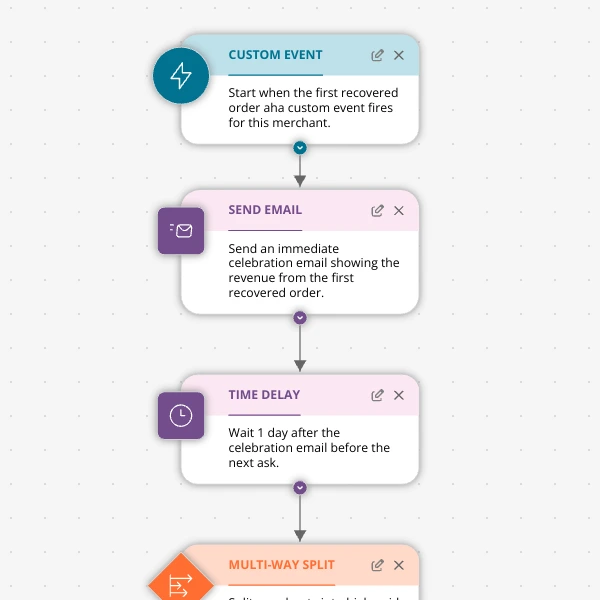
The Aha-Moment Playbook For Shopify Apps: Turn One Magic Action Into Months Of Revenue
A node-by-node playbook for Shopify and e‑commerce apps to center their lifecycle on one aha-moment custom event in Spreeflo, celebrate it, segment merchants by profile and engagement, and turn first recovered value into lasting revenue and retention.
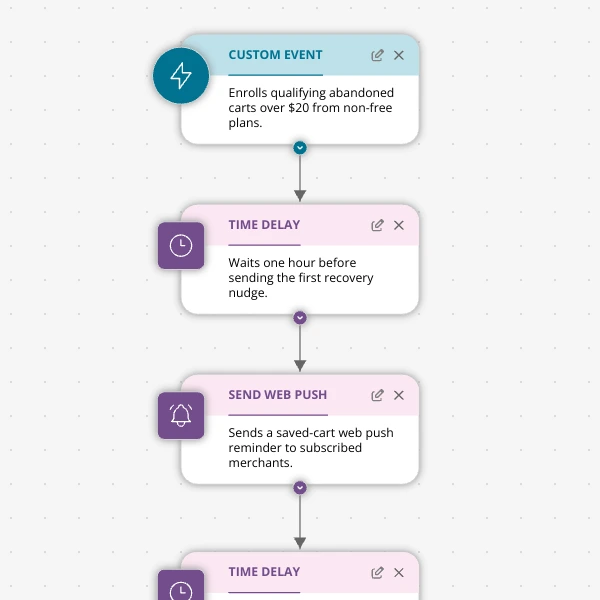
Stop Letting High‑Intent Carts Die: A 3‑Email Recovery Journey for Shopify Apps
A detailed, node-by-node walkthrough of a three-email (plus optional web push) cart-abandonment recovery journey for Shopify apps in Spreeflo, showing how to trigger events, branch on behavior, tag outcomes, and measure recovered carts and revenue.
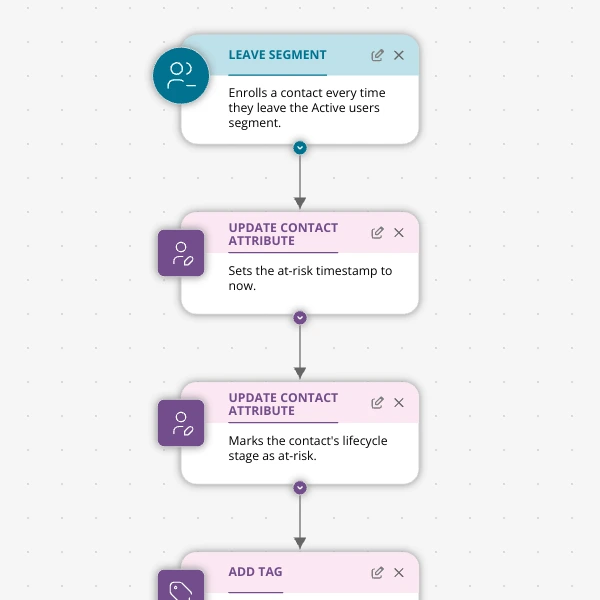
When Active Users Go Dark: A 4‑Touch Win‑Back Journey For Your Shopify App
A detailed, node-by-node Spreeflo journey for winning back previously active Shopify app users who stop engaging, using segment-based triggers, conditional logic, and a four-touch email plus internal alert sequence to recover usage and MRR.