Stop Ending at the Receipt: A Post‑Purchase Play That Grows ARPU for Shopify Apps
This playbook shows Shopify app and SaaS teams how to build a behavioral post‑purchase journey in Spreeflo that thanks buyers, guides activation, and introduces tailored cross‑sells to lift ARPU while reducing buyer’s‑remorse churn.
Industry
Niche
Pattern
Loading sequence...
CartWizard had what most Shopify app founders want: a 2,000‑store install base, $90k+ MRR, strong trial‑to‑paid conversion.
But buried in their Stripe exports was an uncomfortable pattern. Merchants would upgrade once, stay on a mid‑tier plan for months, and never touch the higher‑margin add‑ons CartWizard had spent six months building.
The only “marketing” after purchase was a generic receipt email from billing and a changelog link in the monthly newsletter.
That’s pure lifetime‑value leak.
The moment a customer buys is the moment they are most convinced you’re worth paying for. If all you do is send them a receipt and go quiet, you’re wasting the highest‑intent window you’ll ever get.
The sequence at the top of this page is the whole journey, end to end. It’s a simple post‑purchase automation that:
Thanks the customer right after they pay.
Sets clear expectations about what happens next.
Introduces a complementary product or plan upgrade only after a deliberate delay.
In this article, we’ll walk through that journey step by step in Spreeflo, from the Custom Event trigger through the branching logic, and talk about how to adapt it to your own Shopify app or e‑commerce SaaS.
Why post‑purchase is where most SaaS apps quietly bleed LTV
Think about your own billing events:
Merchant installs your app and starts a paid plan.
Existing customer upgrades to a higher tier.
Power user buys an add‑on or usage pack.
Each of those is a clear “yes” to your value proposition. They’ve hunted down their credit card, fought past tab fatigue, and accepted another monthly charge in their already‑crowded stack.
And what do most teams send?
A Stripe or Shopify receipt.
Maybe a “Welcome to Pro” system email.
Then… silence until the next feature launch.
For a Shopify app charging $49–$199/month, that silence shows up as:
Single‑plan customers who never discover higher tiers.
Add‑ons that only a tiny fraction of accounts ever touch.
Teams who churn because they never fully adopted the features that would have made you sticky.
A simple post‑purchase journey changes that. Instead of a dead end, every purchase becomes the start of a short, focused nurture that:
Confirms value and reduces buyer’s remorse.
Guides them to first meaningful outcome with what they just bought.
Suggests a logical “next thing” once they’ve seen results.
That is exactly what the journey at the top of this page does.
Let’s design it.
First decision: why this is a Journey, not a Campaign
We’re reacting to behavior here: a specific purchase event that can happen any time, for any customer, multiple times.
That calls for a Journey in Spreeflo, not a one‑off Campaign. Journeys are built for “whenever this happens, do that.” You can read more about the distinction on the campaigns and journeys page, but the short version is:
Campaign: one‑time blast to a snapshot of contacts.
Journey: always‑on flow reacting to triggers over time.
Our trigger family is behavioural. The primary trigger is a Custom Event called purchase.
Trigger: Custom Event “purchase” with re‑enrollment on
At the start of the sequence you’ll see a Custom Event trigger.
This is wired to fire whenever your app calls Spreeflo.track("purchase", ...) or backend sends an equivalent event via the Spreeflo API. If you already consume Shopify or billing webhooks in your app, you’re halfway there: forward those purchase events into Spreeflo with the right contact attached.
Configuration choices that matter:
Event name:
purchase(or whatever you use in your system).Property filters: e.g. only where
amount > 0andtype = "subscription"so free trials or zero‑value events don’t trigger the flow.Re‑enrollment: set to
true.
Re‑enrollment is important. You want this journey to run after every meaningful purchase: the first subscription, an upgrade, a big add‑on. With re‑enrollment on, the same merchant can re‑enter the journey after a previous run has finished.
There is still a built‑in mid‑journey lock: if they buy again while they’re already mid‑flow, Spreeflo deliberately ignores the new trigger to avoid overlapping emails. That’s good. If you ever truly need every event to send something instantly (like receipts), that belongs in your transactional system or the transactional email API, not in this nurture journey.
From this trigger, everyone flows straight into the first email.
Step 1: A thank‑you email that actually sets expectations
Next node: Send Email.
This is your post‑purchase “moment of truth” message. Build it in Spreeflo’s email builder so you can keep design consistent and mobile‑friendly without wrestling HTML.
What goes in this email?
A real thank you. Name the product or plan they just bought.
Clear expectations:
A simple success path: 1–3 bullet steps they can follow right now.
What will happen in the next hour, day, and week?
When will they see the first result your app creates?
Any setup steps that must be completed?
For example, CartWizard’s first email after a Pro upgrade:
Confirms “You’re now on CartWizard Pro for store mybrand.com.”
States “Over the next 7 days, our flows will automatically try to recover every abandoned cart over $20.”
Gives three concrete actions: connect SMS, review default templates, and enable a specific upsell widget.
Notice what’s missing: any mention of a cross‑sell yet. That comes later. This message is about reassurance and rapid activation. You’re reducing the risk of “buyer’s remorse” churn in the first week.
In the node configuration:
Pick the sender identity you use for product communication.
Leave “Send only once” off, because you do want this to send on each distinct purchase that meets your criteria.
Immediate next step: a pause.
Step 2: Time Delay so they can see value before you sell more
The third node is a Time Delay.
Here you set how long to wait between the thank‑you email and any cross‑sell. For most SaaS and Shopify apps, 3–7 days is a good starting range:
Short enough that the purchase is still fresh.
Long enough that they’ve had the chance to see a win if they followed your setup path.
In configuration:
Set the delay to something like “3 days”.
Use days rather than hours unless your app delivers obvious value almost instantly.
This delay is also structurally important. Spreeflo enforces sane pacing: you should never send two emails back‑to‑back with no wait node in between. The Time Delay keeps your cadence from feeling spammy.
After this pause, contacts flow into a branching decision.
Step 3: Multi‑way Split to adapt the cross‑sell to customer maturity
A generic cross‑sell email after every purchase is better than nothing. But you’re an app developer; you already track rich behavior. Use it.
The next node in the journey is a Multi‑way Split that uses Spreeflo’s segment builder inline. This branches customers into different paths based on their maturity and behavior.
A practical three‑branch setup for a Shopify app:
New customers
- Condition: “Contact Added Date is within the last 30 days” AND “Total visits at most 3” AND “Custom event feature_used has not triggered in the last 7 days.”
- Interpretation: they bought recently, they haven’t really used the app yet.Adopting customers
- Condition: “feature_used triggered at least 3 times in the last 14 days” but “higher_tier_plan is false”.
- Interpretation: active, but still on a mid or low tier.Power users
- Condition: “feature_used triggered at least 10 times in the last 14 days” OR “Total visits greater than 20” AND tagged with “beta_tester” or similar.
Everyone else drops into the default “Else” branch, which you can treat like a lighter version of “New customers”.
Why this step matters:
For new users, the best cross‑sell is more activation: templates, prebuilt flows, maybe a free strategy session.
For adopters, the cross‑sell is complementary: a reporting add‑on, SMS pack, or a slightly higher tier with features they’re already bumping against.
For power users, you can confidently pitch bigger: annual billing, multi‑store bundles, or a high‑touch add‑on like managed strategy.
With branches defined, each path now gets its own email.
Step 4: Cross‑sell email tailored to each branch
From each branch of the Multi‑way Split, the next node is another Send Email. Because we already had a 3‑day Time Delay above the split, we’re still respecting the rule of spacing between emails.
Let’s outline the three versions.
4A. New customers: guide to success + soft cross‑sell
Goal: get them to first success with what they already bought, while gently hinting at the next level.
Content ideas:
Subject: “You’re 1 step away from your first recovered order”
Body highlights:
One real customer result (“Stores like X recovered $Y in their first week”).
A quick checklist with a link back into your app.
A low‑friction upsell: “When this starts to work, Pro customers also enable [complementary feature] to increase average order value by 15%.”
Keep the main CTA focused on activation, and place the cross‑sell as a P.S. or secondary button.
Configuration:
One Send Email node off this branch.
No extra delay before it (the shared delay already happened).
Immediately after this, we add a Wait Condition (next step) before considering any further follow‑ups.
4B. Adopting customers: complementary feature with clear revenue angle
Goal: introduce an add‑on or plan jump that directly amplifies the success they’re already seeing.
Content ideas:
Subject: “Multiply the impact of your abandoned cart recoveries”
Open with usage‑based personalization: “You’ve recovered 37 carts in the last month with CartWizard.”
Then introduce a complementary feature: post‑purchase upsells, SMS reminders, on‑site banners.
If you’re using AI powered content, this is a great place to use AI variables in the builder so subject lines and intros reference their specific store type or niche.
Configuration:
Branch‑specific Send Email node.
Strong single CTA into the feature settings page.
4C. Power users: expansion and commitment
Goal: nudge them toward higher commitment and ARPU: annual billing, multi‑store bundles, or a consultative add‑on.
Content ideas:
Subject: “Let’s lock in your gains for the next 12 months”
Acknowledge their sophistication: “You’re among the top 5% of CartWizard users by recovered revenue.”
Offer something like: “Switch to annual, get two months free and priority access to new experiments” or “Bundle your three stores under one Pro+ plan.”
Configuration:
Send Email node again, possibly framed as from a founder or head of success, not just the app name.
After all three Send Email nodes, we do not immediately send anything else. We insert waits and checks.
Step 5: Wait Condition to react to adoption before nudging again
From each cross‑sell email, the journey flows into a Wait Condition node.
Configuration pattern:
Condition: “Custom event feature_used triggered at least 1 time in the last 7 days” OR “Custom event subscription_upgraded triggered at least 1 time.”
Timeout: 7 days.
What this does:
If they adopt the complementary feature or upgrade within a week, the condition fires and they move on instantly.
If they don’t, the timeout expires and they move on anyway, but you know they’re cold to this specific pitch.
From here, you can:
On the “condition met” path:
- Add a tag like “post_purchase_cross_sell_success”.
- Optionally increment a numeric attribute likefeatures_adoptedwith an Update Contact Attribute node.On the “timeout” path:
- Add a gentle, more support‑flavored follow‑up email after an additional Time Delay of 1–3 days.
- Or simply tag them as “post_purchase_cross_sell_ignored” for future segmentation.The Wait Condition doubles as spacing between emails, so you stay compliant with the no‑back‑to‑back rule while genuinely listening for behavior.
Step 6: Optional Random Split to measure real impact
You’re technical. You know that without a control group, it’s hard to know if this journey actually moved the needle.
That’s where a Random Split node comes in.
Place it right after the Custom Event trigger and before the first Send Email:
Path A: 80% of purchasers go into the full journey you’ve just designed.
Path B: 20% skip straight to the end (no post‑purchase flow).
You can then:
Compare repeat purchase rates and ARPU between the two groups in your own product analytics.
Use Spreeflo segments filtered by “is member of segment Journey‑Path‑A” vs “Path‑B” to run periodic checks.
Given the metrics we care about — repeat purchase rate, post‑purchase CTR, AOV uplift, product adoption — this split gives you evidence that the complexity you added is paying back its rent.
Most teams discover that a well‑timed, behavior‑aware post‑purchase series quietly adds a few percentage points of ARPU. At your scale, that’s serious money.
Handling edge cases: re‑purchases, spamminess, and over‑qualification
A few design notes to keep the journey clean:
Multiple small purchases: if your app fires
purchasefor tiny usage‑based charges, consider filtering the trigger onamount >= Xso you don’t thank and cross‑sell on every micro‑event.Too many upsell emails: keep this journey short. One thank‑you, one cross‑sell, maybe one follow‑up. Anything longer belongs in a separate lifecycle nurture triggered by tags or segments, not the purchase itself.
Existing top‑tier customers: in your Multi‑way Split, include a branch that catches customers already on your highest plan and sends them down a path that focuses on adoption, not plan upgrades.
And remember: you don’t pay extra in Spreeflo for non‑marketing contacts. You can store everyone and only mark truly reachable customers as marketing contacts per plan rules, explained in detail in the pricing guide.
The bigger picture: fixing the quietest leak in your SaaS funnel
Most Shopify apps obsess over install rate and trial conversion. They ship attribution dashboards, A/B test store listing copy, and watch Stripe MRR like a hawk.
Then they treat “customer bought” as the end of the story instead of the start of a new one.
That’s the leak this journey plugs.
A simple, behavioral post‑purchase flow:
Protects you against early buyer’s remorse churn by setting expectations and guiding activation.
Surfaces complementary products and plans when customers are most ready to hear about them.
Uses your own event and usage data to talk differently to new, adopting, and power users.
And once you set it up in Spreeflo, it just runs. No extra headcount. No one on your team has to remember to send the “nice, you upgraded — here’s what serious stores do next” email at 2am on a Sunday.
Founder‑led, small teams win when every hour of thinking compounds into systems like this. Post‑purchase is one of the cleanest places to start, because the intent is already there. You just need to stop ending at the receipt.
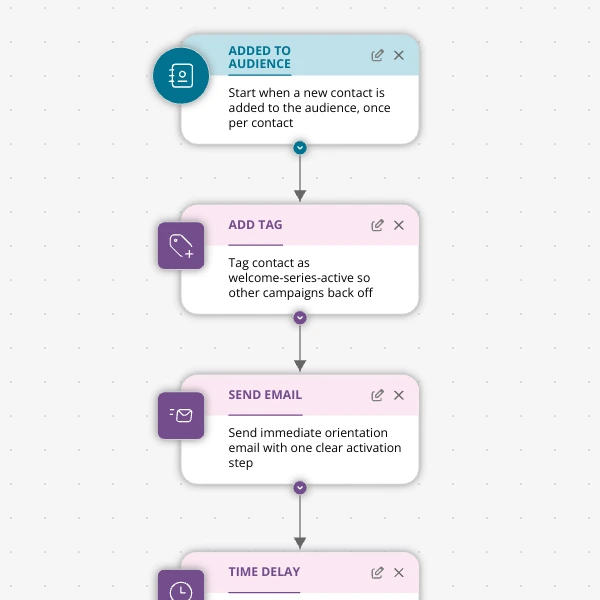
The Shopify app welcome series that turns installs into income
A step-by-step Shopify app welcome email journey for tools like CartSpark, showing how to turn new installs into activated, retained merchants using Spreeflo journeys, tags, and behavioral triggers so fewer trials quietly churn and more trials convert.
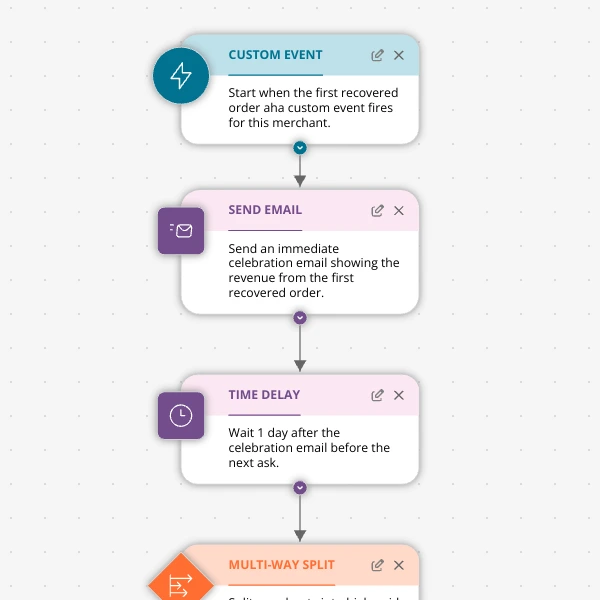
The Aha-Moment Playbook For Shopify Apps: Turn One Magic Action Into Months Of Revenue
A node-by-node playbook for Shopify and e‑commerce apps to center their lifecycle on one aha-moment custom event in Spreeflo, celebrate it, segment merchants by profile and engagement, and turn first recovered value into lasting revenue and retention.
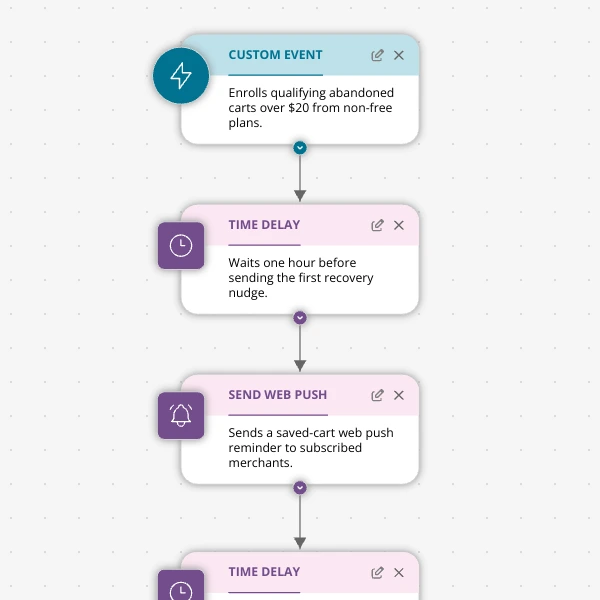
Stop Letting High‑Intent Carts Die: A 3‑Email Recovery Journey for Shopify Apps
A detailed, node-by-node walkthrough of a three-email (plus optional web push) cart-abandonment recovery journey for Shopify apps in Spreeflo, showing how to trigger events, branch on behavior, tag outcomes, and measure recovered carts and revenue.
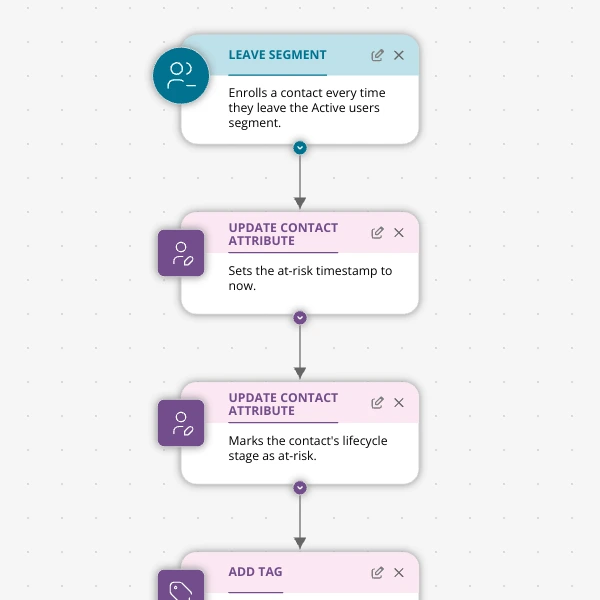
When Active Users Go Dark: A 4‑Touch Win‑Back Journey For Your Shopify App
A detailed, node-by-node Spreeflo journey for winning back previously active Shopify app users who stop engaging, using segment-based triggers, conditional logic, and a four-touch email plus internal alert sequence to recover usage and MRR.