Stop Letting Anonymous Visitors Walk Away: An Email Capture Welcome Flow for Shopify Apps
A detailed Spreeflo journey for Shopify app and e‑commerce SaaS teams to capture emails from high-intent visitors, immediately deliver the promised incentive, track installs or activations, and branch into activation or longer-term nurture based on behavior.
Industry
Niche
Pattern
Loading sequence...
CartWizard’s founder could see it in the analytics.
Traffic from the Shopify App Store listing and comparison articles was steady. Hundreds of store owners were reading the “Recover 15% more revenue” pitch every day. Then they left.
Most of them never installed the app. They never started a trial. And, critically, CartWizard had no way to talk to them again.
A simple pattern fixes a lot of that leak: ask for an email with a clear promise, then immediately send a focused welcome that moves them toward their first install or session.
The sequence at the top of this page is the whole journey, end to end. It turns an anonymous browser into a tagged contact, delivers the incentive you promised, then watches for the install or key activation event and responds differently based on what they do.
For Shopify app and e‑commerce SaaS teams, this is low-effort, high-upside work. You already fight hard for qualified traffic. Let’s stop wasting it.
Why email capture beats one more App Store tweak
Most e‑commerce app teams put their energy into App Store SEO, screenshots, and demo videos. That work matters. But it only optimizes what happens inside a tiny window: the few minutes someone spends on your listing or marketing site.
If they are not ready to install right now, they disappear.
An email capture prompt with an immediate welcome flow changes that:
You turn “maybe later” into a concrete asset: a contact you can nurture.
You collect context at the moment of interest (store size, pain point, feature of interest).
You can keep showing up over the next few days instead of hoping they remember you.
This hits two of the big truths behind Spreeflo’s product:
Winning customers comes from rich customer data. When you capture detail on every visitor who raises their hand, you can speak to each of them uniquely instead of blasting the same launch email to everyone.
Most apps leak lifetime value by not nurturing engagement. Trial conversions and installs that “almost happened” are usually invisible. A capture + welcome pattern makes those near-misses visible and recoverable.
The rest of this article walks through exactly how the journey at the top of this page is built in Spreeflo, node by node, and how you can adapt it to your own app.
The core idea: one micro-commitment, then one focused push to install
Before we dive into nodes, clarify what your prompt is actually offering.
For a Shopify app or e‑commerce SaaS, good patterns look like:
“Get a 21-day trial instead of 14 days when you join the early access list.”
“Send me the abandoned cart playbook we used to recover $87k last quarter.”
“Email me the 3-step setup checklist that gets most stores live in under 10 minutes.”
The only job of that prompt is to earn the email and consent. The journey’s job is to:
Store that contact with useful context.
Immediately send what you promised.
Watch for the install or key event.
Nudge if they stall, then hand them off to your broader onboarding or nurture.
You build this as a continuously running journey in Spreeflo, not as a one-off campaign. If you are new to journeys, Spreeflo’s overview on how to build a journey is a good primer.
Now let’s walk the actual flow.
Node 1: Add to Audience trigger – catching every new email
Everything starts with the Add to Audience trigger.
Whenever a visitor submits your email capture form (on your marketing site or inside your app), your backend should call the Spreeflo API or use the JavaScript SDK to upsert a contact with:
Their email address.
A
lead_sourceattribute likepricing_page_popuporin_app_banner.Any other attributes you know at that moment (store URL, platform, estimated monthly revenue).
Email Subscription Status set to Subscribed, if they explicitly opted into marketing.
The moment that contact is added to your audience, the Add to Audience trigger fires.
Key configuration choice:
Re-enrollment: set this to
false. You do not want the same store owner running through this “first-touch” welcome sequence multiple times if they are re-imported later. If you want a separate “reinstall” or “returning visitor” experience, build that as its own journey with a different trigger.
Without this trigger, new contacts just sit there. They never automatically get pulled into a welcome.
Node 2: If/Else – limit the flow to this specific capture source
In most SaaS setups, contacts are added to your audience from several places:
App installs via OAuth.
Trials started on your main signup page.
CSV imports from old tools.
This new capture prompt.
You do not want to send “Get an extended trial if you install now” to someone who already installed yesterday.
So the first If/Else node after the trigger checks the lead_source (or similar) attribute:
Condition: Contact Attribute
lead_sourceis one of the values you set for this specific prompt, for examplepricing_page_popuporlp_exit_intent.“Then” branch: contacts from this capture source.
“Else” branch: everyone else.
Contacts who do not match the source simply exit the flow. You can optionally attach an Add Tag action on the “Else” branch (for example, tag as lead_source_unknown), but the important part is that they do not receive this particular incentive and welcome.
This is where detail at capture time starts paying off: a single attribute lets you cleanly separate paths without messy manual lists.
Node 3: Second If/Else – respect subscription status
On the “Then” path from Node 2, you now know the contact came from the capture prompt. Next, check whether they actually gave you permission to send marketing email.
Add a second If/Else:
Condition: Email Subscription Status is
Subscribed.
Two paths:
“Yes” branch: fully opted-in contacts. These will get your welcome series.
“Else” branch: contacts without consent (Non-subscribed, Unsubscribed, or Cleaned).
On the “Else” branch, you typically:
Use Add Tag to label them as
no_marketing_consent.End the journey there.
Because Spreeflo supports unlimited non-marketing contacts (see the guide on about Spreeflo pricing plans), you can still keep these records for transactional or in-app messaging without paying to market to them.
This step protects deliverability and keeps you compliant with your own standards.
Node 4: Add Tag – label the intent clearly
Back on the “Subscribed” path, the next node is Add Tag.
Good practice is to attach two types of tags:
A lifecycle tag, such as
lead:capture_welcome.An offer or context tag, such as
offer:extended_trialoroffer:cart_playbook.
Configuration details:
Use the Add Tag action with those tag IDs selected.
Leave “Force tag trigger” off unless you have other journeys depending on the Added Tag trigger for the same tag and want those to fire even if the tag is already present.
Why this matters:
It gives you a durable way to identify everyone who came through this pattern.
Later, you can build segments like “Installed app AND tagged with
offer:extended_trial” to evaluate opt-in quality and offer performance.Other journeys can safely key off these tags without re-creating this source logic.
This is exactly what “capture detail on every customer” looks like in practice: tags that reflect how they first raised their hand.
Node 5: Send Email – the immediate, promised value
Now you send the thing you promised.
Use a Send Email node configured with:
A marketing template built in the email builder.
“Send only once” turned on, so even if you adjust the journey later, nobody gets this specific welcome twice.
This email should:
Deliver the promised incentive clearly and upfront.
Make one primary ask:
Reflect what you know about them.
If it is an extended trial, include a unique link or instructions that set the right plan.
If it is a playbook or checklist, link to it above the fold.
“Install the app” or
“Start your trial” or
“Book a quick setup call”.
If you captured store size or vertical at signup and wrote that into attributes, use personalization inside the email: for example, “For mid-sized fashion stores, CartWizard typically recovers X% more revenue.”
You do not need a delay before this email. The value of the experience is in the immediacy: they submit the form, flip back to their inbox, and your message is already there.
Node 6: Time Delay – give them room to act
After the welcome, add a Time Delay node:
Duration: 1 day (or 24 hours).
Unit: Day(s).
This pause serves two purposes:
It respects inbox fatigue. You just sent an email; do not follow it immediately with another.
It gives them time to act on the install or trial link without more noise from you.
For many Shopify store owners, the rhythm is: read email in the morning, bookmark, then actually install or tweak apps in a quieter window later that day. A one-day delay fits that cadence without dragging on.
Node 7: Wait Condition – watch for the install or activation event
The heart of this pattern is not more copy. It is reacting to what they actually do.
Add a Wait Condition node configured like this:
Condition: Custom Event
app_installedtriggered at least 1 time in the last 3 days. This uses the same criteria you would set in the segment builder: category “Custom Events,” event nameapp_installed, frequency “at least 1 time,” time window “in the last 3 days.”Timeout: 3 days, in Day(s).
Under the hood, your app should be calling Spreeflo.track('app_installed', …) or sending the equivalent via the same API whenever a new store completes installation.
What the Wait Condition does:
If they install anytime in those 3 days, the condition is met and they move on immediately.
If they do not, the timeout expires after 3 days and they still move on.
Either way, the rest of the flow runs at most three days after the first email. You avoid pestering someone who just installed, but you also do not leave non-installers hanging.
Node 8: If/Else – installed vs still on the fence
Immediately after the Wait Condition, insert another If/Else node with the same logical condition:
Condition: Custom Event
app_installedtriggered at least 1 time over all time (or within the last 7 days, if you want a tighter window).
Two paths:
8A. “Installed” branch: shift into activation mode
For contacts who did install:
Add Tag
Time Delay
Send Email – activation helper
Tag them as state:installed_from_capture. This gives you a clean cohort for analytics, and you can use that tag to start your main onboarding journey via an Added Tag trigger elsewhere.
Add a one-day Time Delay before sending anything else. That lets them explore the app a bit on their own.
Send a second email focused purely on getting them to first value. Depending on your app, that might be:
“Create your first recovery flow in 3 clicks.”
“Connect your ad accounts so we can start attribution tracking.”
“Invite a teammate to review the first reports with you.”
Because this branch is only for people who have already installed, this email can assume more context and go deeper into product specifics than your generic onboarding blast.
8B. “Not installed” branch: one high-value nudge
For contacts who still have not installed three days after the welcome:
Send Email – friction removal
Time Delay
Add Tag – long-term nurture
Use a Send Email node to send a focused nudge. This message works best if it tackles the main objections you hear in support or sales:
“Worried about speed? Here is how CartWizard runs without slowing your theme.”
“Not sure what you will get out of this? Here are three real stores, their revenue before and after.”
“Short on time? Here is a 2-minute video of the entire setup.”
Include a single, clear call to action to install or start the trial.
Add another Time Delay of 3 days. Again, this prevents you from stacking emails too close and gives them a quiet window to act or decide.
After that delay, use Add Tag to mark them as state:capture_no_install. That tag can drive a slower-burn educational series: monthly case studies, new feature announcements, occasional “we added something that might change your calculus” emails.
You can wire that separate series with a Join Segment or Added Tag trigger in a different journey, without bloating this initial sequence.
At this point, the initial email capture journey is done. Each contact either:
Installed and moved into activation.
Did not install but is tagged for longer-term nurture.
Was not eligible (wrong source or no consent) and quietly exited.
Adapting this flow for in-app prompts
Everything above assumed a marketing or documentation site. The same pattern works for in-app prompts inside a broader e‑commerce platform tool.
Common example: your analytics SaaS has many logged-in users who have not yet connected their Shopify store or installed the companion app.
You show a dismissible in-app banner:
“Connect your store this week and we will send you a 3-report template our top merchants use to optimize their funnel.”
Behind the scenes, when they click “Send me the template,” you:
Confirm their email and consent.
Set
lead_sourcetoin_app_connect_prompt.Add them to your audience (triggering this same journey).
The only tweaks you would make:
Adjust copy in the emails to reference them as an existing user rather than a pure prospect.
Use a different custom event in the Wait Condition and If/Else, such as
store_connectedinstead ofapp_installed.
The automation skeleton stays identical.
Knowing if this flow is actually working
Three metrics tell you whether this is a win:
Email capture rate
Opt-in quality
First-session conversion
Of all visitors who see the prompt (or all logged-in users who see the in-app banner), how many give you their email and consent? Track this in your own product analytics, but mirror it in Spreeflo by building a segment like:
lead_source is pricing_page_popupANDContact Added Date is within the last 30 days.
This makes it easy to pull counts and trends.
Among those tagged with lead:capture_welcome, what are their open, click, and install rates?
Use email Activity filters in the segment builder to define engaged versus unengaged.
Combine with custom event rules like
app_installed at least 1 time in the last 14 daysto see how capture leads compare to other acquisition sources.
Your ultimate goal is not “more emails.” It is more stores with a successful first session. If you have web tracking and analytics set up, you can go deeper:
How many capture leads reach a “feature_used” event like
created_first_campaign?How does their churn over the first 30 days compare to trial signups who came straight from the App Store?
Because Spreeflo does not charge for non-marketing contacts, you can store plenty of supporting data and events without worrying about blowing up your bill. You only pay for the subset that you actually market to.
Why this earns its place in your backlog
For most Shopify app and e‑commerce SaaS teams, marketing feels like a list of “shoulds” that never get done: you should rebuild onboarding, you should redo your listing creative, you should rewrite your lifecycle emails.
This pattern is small, contained work with clear upside:
It captures high-intent visitors you are currently losing forever.
It stores richer context so future messaging can be specific, not generic.
It nurtures just enough to move the right people over the line, then gets out of the way.
You build the journey once, test a couple of subject lines and offers, then let it run. That is what founder-led businesses win on leverage, not headcount actually looks like in your marketing stack.
Whether you wire it up in your current tooling or try it using Spreeflo’s journeys, web tracking and analytics, and email builder, the underlying idea is the same: stop treating anonymous traffic as disposable. Treat every raised hand as the start of a relationship, and back that up with automation that behaves like you would if you had the time to email each person yourself.
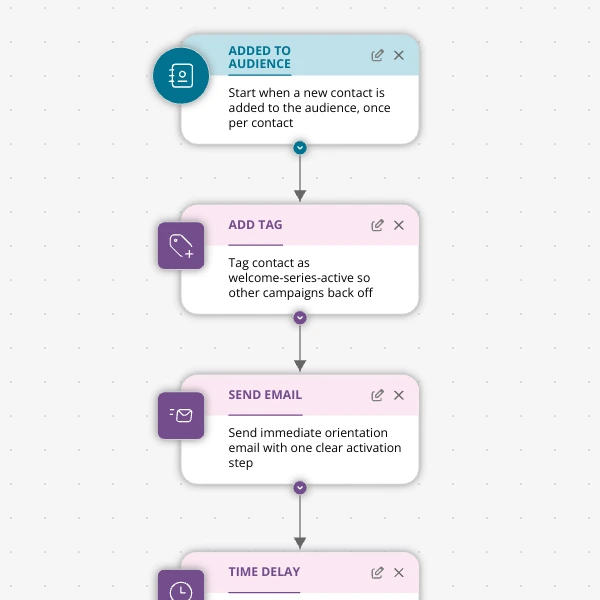
The Shopify app welcome series that turns installs into income
A step-by-step Shopify app welcome email journey for tools like CartSpark, showing how to turn new installs into activated, retained merchants using Spreeflo journeys, tags, and behavioral triggers so fewer trials quietly churn and more trials convert.
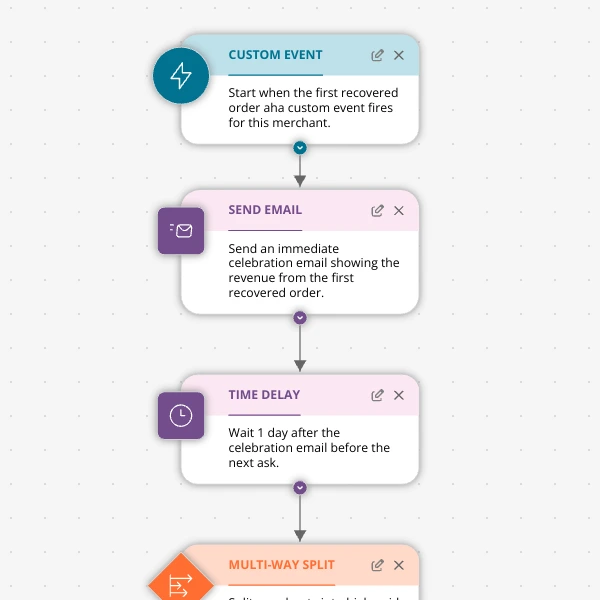
The Aha-Moment Playbook For Shopify Apps: Turn One Magic Action Into Months Of Revenue
A node-by-node playbook for Shopify and e‑commerce apps to center their lifecycle on one aha-moment custom event in Spreeflo, celebrate it, segment merchants by profile and engagement, and turn first recovered value into lasting revenue and retention.
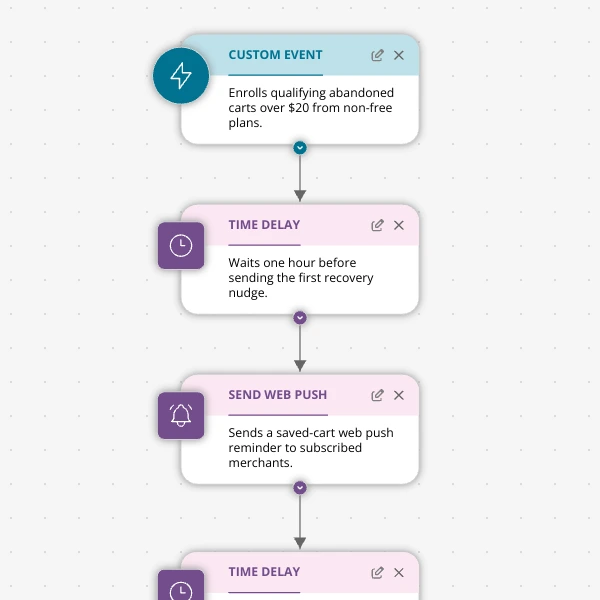
Stop Letting High‑Intent Carts Die: A 3‑Email Recovery Journey for Shopify Apps
A detailed, node-by-node walkthrough of a three-email (plus optional web push) cart-abandonment recovery journey for Shopify apps in Spreeflo, showing how to trigger events, branch on behavior, tag outcomes, and measure recovered carts and revenue.
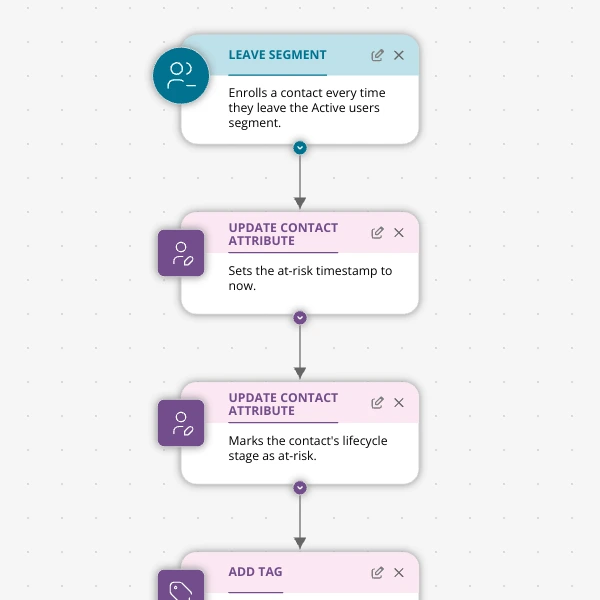
When Active Users Go Dark: A 4‑Touch Win‑Back Journey For Your Shopify App
A detailed, node-by-node Spreeflo journey for winning back previously active Shopify app users who stop engaging, using segment-based triggers, conditional logic, and a four-touch email plus internal alert sequence to recover usage and MRR.