Stop Letting Half-Installed Shopify Apps Churn in Silence
Detailed playbook for Shopify and e‑commerce app teams to build a Spreeflo journey that rescues half-installed apps from silent churn by tagging setup state, segmenting by store value, and nudging or escalating merchants until they activate.
Industry
Niche
Pattern
Loading sequence...
CartWizard had what most Shopify app founders dream about: 120 new installs a day, a solid 4.8 rating, inbound support from larger brands.
But the numbers behind that headline were ugly.
Half of those installs never finished the initial setup. They installed the app, clicked around once, and disappeared. They never connected their store, never turned on a recovery flow, never saw a single cart saved.
On paper, CartWizard was adding thousands of “users” a month. In reality, a huge chunk never activated, never upgraded, and eventually uninstalled without sending a single support ticket.
The sequence at the top of this page is the whole journey, end to end, that fixed that leak.
It’s a setup-incomplete reminder system: every new install either completes the critical integration steps or gets guided, escalating nudges. High-value stores get personal attention. And it runs without the founder or the team manually checking “who’s stuck?” every day.
In this article, we’ll walk through how CartWizard (our fictional, but very typical Shopify app) uses Spreeflo to build this journey, node by node, and how you can adapt it to your own app.
The real cost of “they just never set it up”
For an e‑commerce app, activation is binary.
Either the merchant completes the setup that lets your app work (connect store, add snippet, turn on at least one flow), or they don’t. There isn’t much value in between.
If you’re seeing:
Healthy install numbers but weak trial‑to‑paid conversion
Churn reasons like “didn’t get around to using it”
Support tickets asking basic “how do I turn it on?” questions
then incomplete setup is probably the biggest leak in your funnel.
The good news: this is exactly the kind of problem that marketing automation is built to solve. Especially when you’re already tracking detailed events from your app.
CartWizard’s setup looked like this:
Merchant installs the Shopify app.
They’re dropped into a three‑step wizard:
- Connect their Shopify store permissions.
- Add the cart recovery snippet to their theme.
- Turn on their first recovery flow.Only after step 3 can CartWizard start recovering revenue.
Before they wired Spreeflo in, CartWizard treated everyone the same: a single generic welcome email from their existing tool, then silence.
Afterward, every new install was tagged with a setup state, watched for completion, and nudged with context‑specific emails. High‑GMV stores that stalled got an internal alert too.
Let’s walk through how that journey is built in Spreeflo.
Step 1: Trigger on “app installed” and capture setup intent
You want to enroll people in this journey the moment they’re most motivated: right after they install.
CartWizard’s backend sends a custom event into Spreeflo using the Spreeflo API whenever someone installs:
Event name:
app_installedProperties:
shop_domain,owner_email,plan,estimated_store_gmv, etc.
In the journey editor, that event is the Custom Event trigger at the very left of the sequence:
Event name:
app_installedProperty conditions: none (you want all installs)
Re-enrollment: turned on, so if a store uninstalls and later re‑installs, they can go through the journey again once they’re fully out of it.
The moment that app_installed event arrives for a contact, they enter the journey.
Right after the trigger, CartWizard uses an Add Tag node to stamp the contact:
Tags:
trial,setup_incomplete
That tag is cheap context that pays off later. It’s also reusable in other flows and segments. If you’re new to tags in Spreeflo, the guide on getting started with tags is worth a skim.
This is Brand Message #1 in action: you’re capturing detail on every customer upfront so you can speak to them based on their actual state, not just “is on trial.”
Step 2: Send a focused welcome email with one job
Next comes the first Send Email node.
CartWizard doesn’t use this email as a product tour. It has one goal: get the merchant to complete step 1 of setup.
Inside the journey:
Template: “Welcome to CartWizard – let’s get your first recovery running”
From: support@cartwizard.io (or similar)
Send only once: left on, so if the contact ever re‑enters this node, they won’t get duplicates.
Content-wise, CartWizard uses our email builder to keep things simple:
A short reminder of the job‑to‑be‑done (“Recover the revenue hiding in abandoned carts.”)
A single primary CTA: “Connect your store and finish setup.”
A side link to docs for power users who want to skim details.
If you want to go further, you can use AI‑powered personalization in the editor (for example, subject lines that call out the merchant’s vertical), but the key is not overloading this first touch.
Per messaging‑pacing rules, you never send two emails back to back on the same path. So the next node is a Time Delay:
Delay: 1 hour
That hour gives motivated users time to click through and complete setup with no further nudges.
Step 3: Wait for setup to complete… or stall
After the initial delay, CartWizard adds a Wait Condition node.
This is where profile state really drives the journey. The condition uses Spreeflo’s segment builder to express:
Custom event
setup_completedOperator: triggered at least 1 time
Time window: over all time
Configuration:
Condition: “has triggered
setup_completedat least once”Timeout: 2 days
What this does:
If the merchant completes setup any time in the next 2 days and your app fires
setup_completed, the Wait Condition releases immediately.If they don’t, the Wait Condition releases after 2 days anyway.
Either way, the contact moves forward in the journey. You’re no longer guessing who’s stuck; you’re reacting to their actual behavior.
Immediately after that Wait Condition, an If/Else node checks the same condition:
If branch (“Yes”): contact has
setup_completed.Else branch (“No”): they still haven’t finished.
This explicit branch is where the journey splits into two different experiences.
Step 4: Fast-track the people who finish setup
On the “Yes” side, CartWizard keeps things light but intentional.
First comes a Send Email node:
Template: “You’re live – here’s what to expect next”
Purpose: confirm that they’re up and running, set expectations about recovered revenue and reporting, and point to one next‑level feature for power users.
Then an Add Tag node:
Remove
setup_incompletetag (via a separate Remove Tag node)Add
activatedtag
Optionally, CartWizard also uses an Update Contact Attribute node to set a static string attribute:
Attribute:
onboarding_stageUpdate type: Update
Value: "activated"
That attribute isn’t populated from the event payload; it’s just a literal you choose when designing the journey. The point is to give yourself simple, queryable state across the rest of your automations.
After that, this path can end or merge into your broader onboarding series. Either way, activated users are now treated very differently from those who got stuck.
Step 5: For everyone still stuck, branch by value
On the “No” branch of the If/Else, you know one key thing: this merchant installed, saw your welcome email, had at least 2 days, and still hasn’t completed setup.
This is where most apps either blast a generic reminder or give up.
CartWizard does something smarter: it uses a Multi-way Split to branch contacts based on potential value.
Using contact attributes populated at install time (like estimated_store_gmv or shop_size), the Multi-way Split has two main branches:
High-value stores
- Condition:estimated_store_gmvgreater than, say,$50,000per month.Standard stores
- Condition: everyone else (handled by the else branch).
You can adapt those thresholds to your own economics. The key is that large stores get a different strategy than a dropshipping experiment on a starter plan.
This is another win for detailed profiles: because CartWizard pushed store size data into Spreeflo on app_installed, the journey can speak differently to each merchant without manual sorting.
Step 6: A gentle, automated reminder for standard stores
On the standard‑store branch, CartWizard runs a simple reminder cadence that doesn’t require human attention.
First, a Send Email node:
Template: “Still want CartWizard to recover your carts?”
Content:
- A reminder of why they installed.
- A visual of “You’re here → you want to be here” with setup progress.
- A short video or GIF link walking through the wizard.
Then a Time Delay:
Delay: 2 days
After that, another Wait Condition looking for setup_completed with a longer timeout:
Condition: same as before (“has triggered
setup_completedat least once”).Timeout: 5 days.
Once contacts come out of this Wait Condition, a second If/Else checks again:
If they’ve finally completed setup:
- Send a quick “You’re live – here’s what happens now” email.
- Update tags and attributes like in the fast‑track path.If they still haven’t:
- Optionally send a final email asking if they want help or prefer to uninstall.
- Add a tag likesetup_never_completedfor future analysis.
At this point, you’ve done what you reasonably can in a fully automated way. Any store that still doesn’t engage probably wasn’t going to be a good long‑term customer.
Step 7: Escalate high-value stores with internal alerts
High‑value stores get a more attentive journey.
On the high‑value branch off the Multi-way Split, CartWizard starts with a tailored Send Email:
Template: “Let’s get CartWizard recovering at least $X/mo for you”
Where
Xis a rough projection based on their store size (you can bake this into the copy or personalize with AI variables).
The email:
Acknowledges that they’re busy.
Emphasizes the potential recovered revenue relative to their scale.
Offers a “we’ll do it for you on a quick call” option.
Then a Time Delay:
Delay: 1 day
After that, CartWizard drops in another If/Else checking for setup_completed. If the answer is still “No,” it triggers a Send Internal Email node.
That internal email goes to the founder or success lead:
Subject: “High‑GMV store hasn’t finished CartWizard setup”
Body:
- Merchant name, domain, and estimated GMV.
- How long ago they installed.
- A link to their profile in your admin.
- Suggested next step (“Send a quick Loom walking through setup,” “Offer done‑for‑you setup,” etc.)
Because this is an internal notification, it doesn’t count toward customer email volume, and it turns “high-value stall” into a clear action item instead of a silent failure.
If you prefer, you could also add a Webhook node here (Professional plan) to ping a Slack channel or CRM, but for most small teams a Send Internal Email is enough.
Alternative entry: when you can’t send events (yet)
If your app doesn’t emit custom events yet, you can build a variant of this journey anchored on a Criteria Match trigger instead of Custom Event.
For example, your Criteria Match trigger could use the segment builder to enroll contacts when:
Tag contains
trialContact attribute
setup_statusis"incomplete"Contact added date is after a certain point
The rest of the flow stays mostly the same: Time Delay, Wait Condition looking at attributes instead of events, If/Else, Multi-way Split.
As you mature your stack, you can add event tracking and tighten these conditions. Because Spreeflo lets you build a journey visually, you’re free to iterate without rewriting code.
Measuring whether this journey earns its spot
CartWizard didn’t build this flow because it felt nice. They built it because they wanted numbers to move.
The three core metrics to watch:
Setup completion rate
- Of everyone who installs, how many triggersetup_completedwithin the first 7 days?
- Compare before and after turning the journey on.Activation‑to‑paid conversion
- Among those who finish setup, how many start recovering enough value to justify a paid plan?
- This is where better activation messaging feeds straight into MRR.Support‑ticket volume about setup
- If your inbox is full of “I’m confused about step 2,” an automated, guided reminder sequence should reduce those.
- Fewer tickets for the same or higher conversion is exactly the kind of operational win small teams need.
Underneath those, you’ll see second‑order effects:
Fewer “I never got it working” churn reasons.
Clearer segments for who to re‑engage later (you tagged the
setup_never_completedgroup).A much sharper picture of how long setup actually takes across store sizes, which you can analyze later using web tracking and analytics if you embed the SDK in your app UI.
Adapting this pattern to your own app
Not every e‑commerce app looks like CartWizard, but the pattern holds:
Identify the minimum technical steps that block value (connect, tag, import, enable).
Capture those steps as events or attributes in Spreeflo.
Use a Custom Event or Criteria Match trigger to catch people at the moment they install or enter a “setup incomplete” state.
Wait just long enough for self‑service to work, then branch:
- Fast‑track the ones who complete into a richer onboarding.
- Nudge the ones who stall, with different paths for different value segments.
- Escalate the top tier with internal alerts.You’re no longer treating “install” as success. You’re speaking to each contact based on exactly where they’ve stalled, and you’re doing it automatically.
That’s the deeper point here.
Most e‑commerce apps leak lifetime value not because their features are weak, but because too many merchants never experience those features at all. Activation is a messaging and timing problem as much as a product one.
A setup‑incomplete reminder journey is a one‑time investment that pays out every day after. It captures more detail on every customer, nudges them through the friction that stands between “install” and “value,” and does it without adding headcount.
For a founder‑led team, that’s the kind of system that earns its keep.
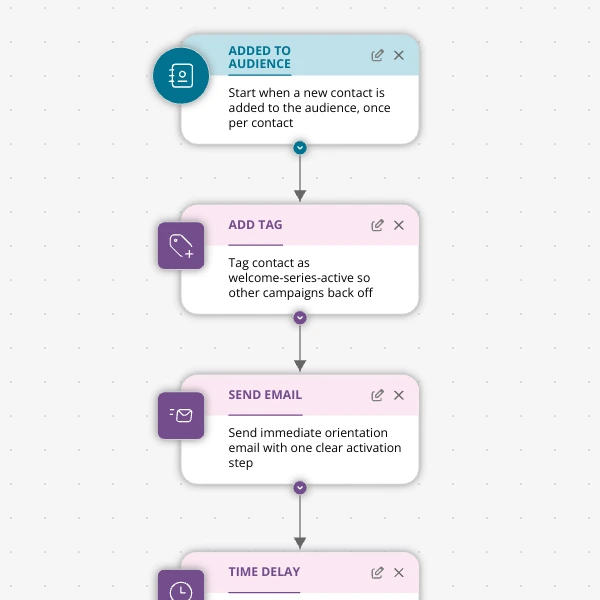
The Shopify app welcome series that turns installs into income
A step-by-step Shopify app welcome email journey for tools like CartSpark, showing how to turn new installs into activated, retained merchants using Spreeflo journeys, tags, and behavioral triggers so fewer trials quietly churn and more trials convert.
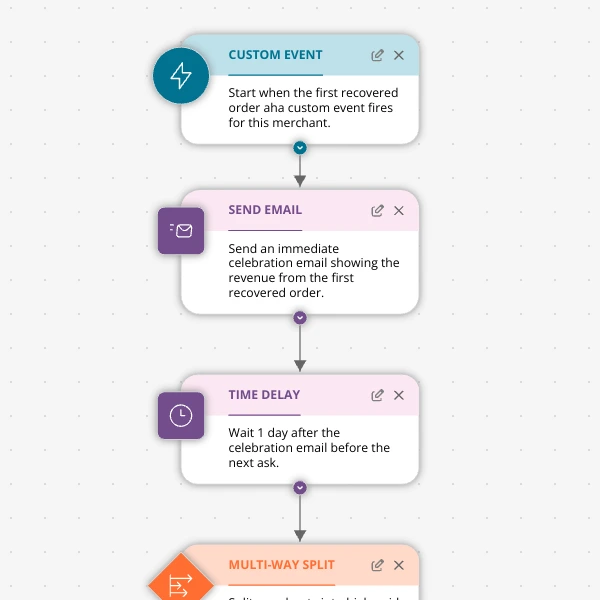
The Aha-Moment Playbook For Shopify Apps: Turn One Magic Action Into Months Of Revenue
A node-by-node playbook for Shopify and e‑commerce apps to center their lifecycle on one aha-moment custom event in Spreeflo, celebrate it, segment merchants by profile and engagement, and turn first recovered value into lasting revenue and retention.
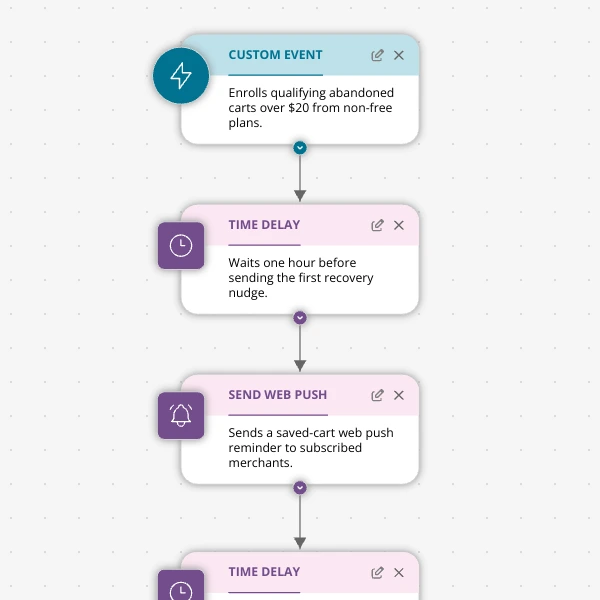
Stop Letting High‑Intent Carts Die: A 3‑Email Recovery Journey for Shopify Apps
A detailed, node-by-node walkthrough of a three-email (plus optional web push) cart-abandonment recovery journey for Shopify apps in Spreeflo, showing how to trigger events, branch on behavior, tag outcomes, and measure recovered carts and revenue.
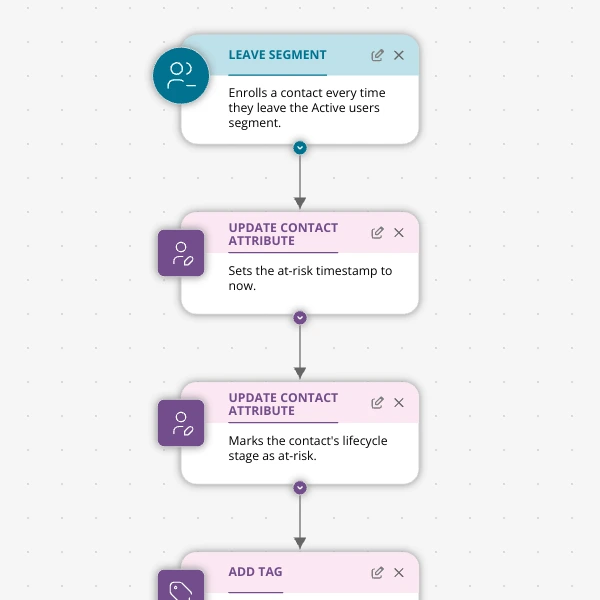
When Active Users Go Dark: A 4‑Touch Win‑Back Journey For Your Shopify App
A detailed, node-by-node Spreeflo journey for winning back previously active Shopify app users who stop engaging, using segment-based triggers, conditional logic, and a four-touch email plus internal alert sequence to recover usage and MRR.