The Power-User Radar: An Automation That Feeds Your Expansion Pipeline
Walks through a Spreeflo journey that automatically detects power users on low plans using custom events, tags, and internal alerts, so your small team gets a steady, qualified stream of expansion leads without manual digging.
Industry
Niche
Pattern
Loading sequence...
The first time Tessa, founder of “CartWizard,” pulled a usage report, she saw something odd.
Dozens of free and starter-plan stores were hammering her advanced automation builder every day. Some of them were running more campaigns than her highest-tier customers. But those stores were still paying $29 a month.
No one on her four-person team had time to dig through logs, identify those power users, and actually reach out. So those accounts stayed on the cheapest plans, month after month.
This is the gap the “power-user upsell handoff” pattern closes.
You use product behaviour—deep feature usage on a low plan—to automatically flag and route contacts to whoever owns expansion. Zero manual digging. No half-kept spreadsheet of “accounts to watch.”
The sequence at the top of this page is the whole journey, end to end. In this article, we’ll walk that journey node by node, explain why it’s wired this way, and show how to adapt it to your own Shopify app or e‑commerce tool.
Why power users are your easiest expansion revenue
For e‑commerce and Shopify apps, expansion rarely comes from “random” stores.
It comes from:
Free users who adopt a feature so deeply that they’d happily pay for more capacity.
Starter-tier stores that quietly behave like mid-market customers.
Teams doing manual work around your artificial limits.
Those accounts already understand your value. They’ve cleared “activation.” They’ve proven intent in the one place that matters: usage.
The problem is spotting them at the right moment.
By default, your product is emitting the perfect signals—feature_used, campaign_created, report_generated—but nobody is watching them in real time. That’s where a behaviour-driven handoff pays for itself: the journey runs 24/7, catches those patterns, and sends a clean, qualified feed of expansion leads to your inbox or CRM.
Spreeflo’s job here is to connect your high-signal events to automation: you capture detail on every customer so you can speak to each one uniquely. And because the journey runs itself after you set it up, you get the leverage of a much larger sales team without hiring SDRs.
Let’s look at how the journey actually works.
Step 0: Instrument the right custom event
This pattern assumes you already track at least one “high-value” custom event for your app. For CartWizard, it might be recovery_flow_published. For an analytics product like “ShopMetrics,” it might be custom_report_run or segment_created.
You can send those events from your backend or front-end using the Spreeflo SDK or the Spreeflo API. If you’re on the Professional plan and have the SDK installed for web tracking and analytics, those custom events also become first-class inputs to segments and triggers.
For this walkthrough, we’ll assume you have a feature_used event with a property feature_name, and you treat feature_name = "advanced_automation" as your high-value action.
Node 1: Custom Event trigger – every meaningful use enters the radar
The journey starts with a Custom Event trigger:
Event name:
feature_usedProperty condition:
feature_name is "advanced_automation"Re-enrollment: on
Why this, and why like this?
We want this flow tied tightly to a specific behaviour, not just generic login or install. That keeps the expansion feed meaningful.
We turn Re-enrollment on because the same contact might become a power user more than once over their lifetime (for example, they downgrade then later ramp up again). Journey-level locking protects you from duplicates while they’re mid-journey anyway.
Every time a user runs that high-value feature, they hit this trigger and enter the flow—once at a time.
Node 2: If/Else – are they actually upsell-eligible?
Immediately after the trigger, the sequence uses an If/Else process node as a guardrail.
The condition uses the segment builder to express something like:
Contact attribute
plan_tier is "Free" OR "Starter"AND tag
contact is not tagged with "power-user-upsell-lead"AND tag
contact is not tagged with "do-not-upsell"
Why this matters:
You only want to surface accounts that can expand. If someone is already on your highest plan, they might be a power user but they’re not an expansion lead.
You avoid re-sending the same account to sales once they’ve already been worked, by excluding the
power-user-upsell-leadtag you’ll add later.You respect any manual opt-outs from the team via a
do-not-upselltag.
Contacts who don’t meet this condition exit on the Else path. They’ve used the feature, but they’re either on the wrong plan or already processed. Everyone else continues.
Node 3: Wait Condition – accumulate usage over 14 days
Next is the heart of the pattern: a Wait Condition node that lets usage accumulate and only continues when someone truly qualifies as a power user.
Configuration:
Condition (via segment builder):
Custom event
feature_used(matchfeature_name is "advanced_automation")triggered at least 10 times in the last 14 daysAND plan_tier is still "Free" or "Starter"
Timeout:
14 days
What this does:
As soon as the contact enters, the journey pauses here.
Every time they use the feature again, that custom event is logged. The condition re-evaluates against the last 14 days of activity.
If they hit 10 or more qualifying actions within that 14‑day window, the Wait Condition is satisfied and the contact moves forward immediately.
If they never reach that threshold, the timeout fires after 14 days and the contact proceeds anyway, but will fail the next check.
Why use Wait Condition instead of just an If/Else?
You care about behaviour over a period, not a single snapshot. The Wait Condition creates a rolling observation window:
It gives late bloomers time to qualify.
It protects your team from being spammed every time somebody pokes the feature once or twice.
The subtle detail: we include the plan-tier check inside the condition as well. If they upgrade organically during those 14 days, they’ll simply never meet the “Free or Starter” portion of the condition, so they’ll age out gracefully.
Node 4: If/Else – confirm real power users vs. timeouts
After the Wait Condition, the journey uses a second If/Else with the same logic as the Wait Condition condition:
Custom event
feature_usedwithfeature_name = "advanced_automation"triggered at least 10 times in the last 14 daysAND plan_tier is "Free" or "Starter"
Why repeat yourself?
Because a Wait Condition only controls when the journey continues, not why. It doesn’t provide a built-in branch for “condition met vs timed out.” The second If/Else is the explicit gate:
If the condition is true: they’re a true power user on a low plan.
Else: they timed out or haven’t hit the threshold, and you can safely end their path without a sales ping.
Everyone on the Else branch exits quietly. Everyone on the Yes branch moves into the handoff steps.
Node 5: Update Contact Attribute – timestamp the moment
Before you notify anyone, add a Update Contact Attribute node to timestamp the event:
Attribute:
power_user_qualified_at(a TIMESTAMP custom attribute you create)Update type:
Set to now
This does two things:
It gives your team an exact “caught them at this moment” field for context.
It lets you build future segments like “power users qualified in the last 30 days” without re-implementing the logic.
Because Update Contact Attribute writes a static value or “now” when the node executes, it’s ideal for this kind of milestone tracking.
Node 6: Add Tag – mark them as an expansion lead
Next we apply a tag with the Add Tag action node:
Tags:
power-user-upsell-leadForce tag trigger: off (you typically don’t need to re-fire Added Tag triggers here)
This tag does a lot of work for you:
It prevents re-processing, because the first If/Else explicitly excludes anyone already tagged
power-user-upsell-lead.It gives you a simple segment to inspect and export later.
It becomes a universal marker that “this account is expansion-worthy,” which you can also reuse in other automations.
If you’re new to tag strategy inside Spreeflo, our guide on getting started with tags is worth a skim before you finalise your naming scheme.
Node 7: Send Internal Email – route the lead to a human
Now the journey surfaces the contact to a human using a Send Internal Email action.
Configuration ideas:
Template name:
New power user on Free/StarterFrom: a generic notifications sender
Recipients: your team inbox, or a distribution list for sales/CS
Content: include key fields like:
Store name and URL
Current plan_tier
Power-user feature and usage count
power_user_qualified_atSuggested next step (e.g., “Offer Pro plan with 14‑day upgrade trial”)
This is where you get leverage. You write the email once in Spreeflo’s email builder, wire in the dynamic fields you care about, then let it quietly feed your inbox with only the most interesting accounts.
A solo founder can wake up to three high-quality expansion leads instead of a screenful of raw event logs.
Optional: Webhook – push into your CRM or Slack
If you’re on the Professional plan, you can add a Webhook node after the internal email to pipe the same context into your CRM, a Slack channel, or a custom backend.
Typical setup:
Webhook URL: your internal endpoint or an automation tool
Method: POST
Contact fields: either all attributes or a curated subset (email, plan_tier, MRR, tags)
Authentication: API key or token as needed
Whether you centralise everything in a CRM or keep it lean with email + Slack, the Webhook ensures each power user shows up where your team already works.
How this earns its keep for a Shopify app
For CartWizard, the numbers looked like this:
About 8% of free/starter stores crossed the “10 recovery flows published in 14 days” line.
Historically, when Tessa manually found and contacted those stores, 30–40% upgraded to a higher tier.
Before automation, she only found a handful a month.
With the journey above in place, every one of those stores is:
Detected automatically via Custom Event, Wait Condition, and If/Else.
Tagged and timestamped.
Pushed to a shared inbox as a clean, contextual lead.
Once a quarter, they build a segment in Spreeflo’s segment builder that combines:
tag is power-user-upsell-leadAND custom event
subscription_upgradedtriggered at least 1 time over all time
That segment shows their effective expansion close rate from this automation. Multiply by ARPU and it becomes very obvious that this journey more than covers Spreeflo’s pricing.
Adapting the pattern to your own product
The structure stays the same. What changes is:
Which event you treat as “high value.”
How high the threshold should be.
How long the observation window is.
Some examples tailored to e‑commerce apps:
Cart recovery app:
Event:
recovery_flow_publishedThreshold: at least 3 flows in 7 days
Analytics app:
Event:
custom_report_runThreshold: at least 15 runs in 30 days
Reviews app:
Event:
review_request_sequence_startedThreshold: at least 5 sequences in 14 days, and store has > 500 orders/month (captured as a contact attribute)
You don’t need to guess. Start conservative so you only send slam-dunk leads. Once you see the volume and conversion rate, you can lower the threshold or widen the window.
Because all of this is defined with the segment builder, changing “10 actions in 14 days” to “5 actions in 7 days” is one edit, not a re-implementation.
Keeping your journeys maintainable
A few practical tips that matter once you’re running this in production:
Name events and properties carefully. If you have multiple high-value features, consider one journey per feature instead of stuffing everything into one Multi-way Split. It’s easier to reason about.
Keep guardrails close to the trigger. That early If/Else protecting against wrong plan tiers and existing tags ensures you don’t waste compute (or team attention) downstream.
Centralise “stop conditions” in one place. When you add the
power-user-upsell-leadtag, make sure every upsell-related journey uses that same tag to skip already-worked accounts.Avoid over-notification. Internal emails are cheap, but your attention isn’t. If this feed ever feels noisy, raise the threshold or tighten the plan filters rather than turning off the journey entirely.
And when you’re ready to layer on more, you can always build a journey that reacts to that same power-user-upsell-lead tag from the customer’s side: a gentle “you’re hitting the limits of your plan” email, or a trial of the next tier. That lives as a separate journey, triggered by an Added Tag node, so your sales motion and lifecycle messaging stay decoupled.
The bigger win: seeing every customer as an individual
On the surface, this pattern is about expansion MRR. Underneath, it’s about something deeper: refusing to treat your users as one flat list.
When you track detailed custom events, then wire them into journeys like this, you stop guessing who’s ready to upgrade. You know. You capture the nuance of “this store is absolutely living inside my advanced feature” and let your system respond accordingly.
For a founder-led, 2–10 person team, that’s where you win. You don’t out-hire your competitors’ sales teams. You out-automate them. You design a couple of thoughtful journeys, wire them once, and let them run quietly in the background, compounding every month.
The power-user upsell handoff is one of those journeys. Build it, tune it, and let your product’s own behaviour tell you where the next chunk of revenue is hiding.
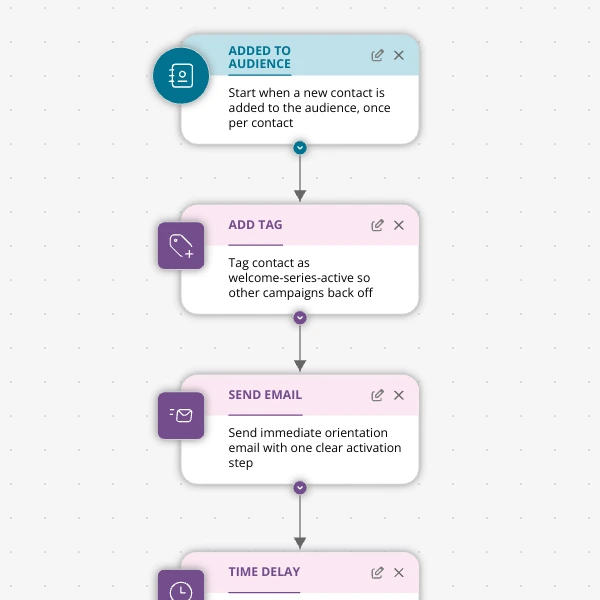
The Shopify app welcome series that turns installs into income
A step-by-step Shopify app welcome email journey for tools like CartSpark, showing how to turn new installs into activated, retained merchants using Spreeflo journeys, tags, and behavioral triggers so fewer trials quietly churn and more trials convert.
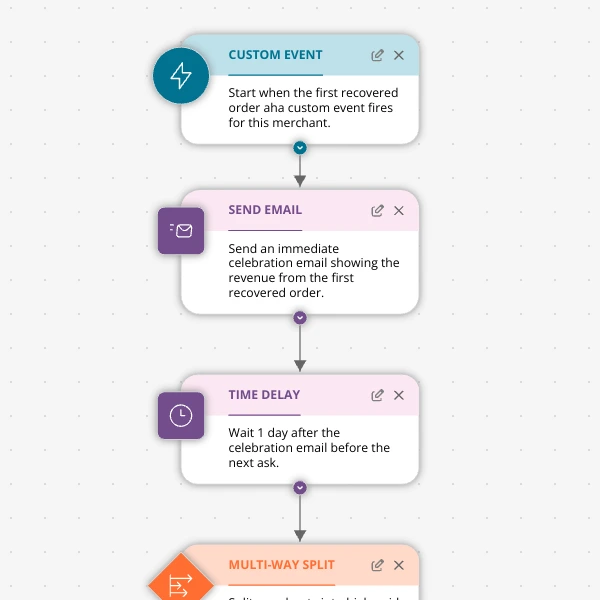
The Aha-Moment Playbook For Shopify Apps: Turn One Magic Action Into Months Of Revenue
A node-by-node playbook for Shopify and e‑commerce apps to center their lifecycle on one aha-moment custom event in Spreeflo, celebrate it, segment merchants by profile and engagement, and turn first recovered value into lasting revenue and retention.
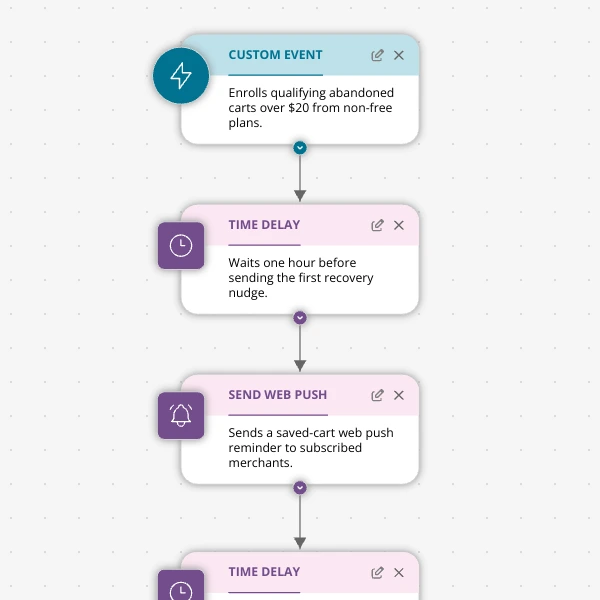
Stop Letting High‑Intent Carts Die: A 3‑Email Recovery Journey for Shopify Apps
A detailed, node-by-node walkthrough of a three-email (plus optional web push) cart-abandonment recovery journey for Shopify apps in Spreeflo, showing how to trigger events, branch on behavior, tag outcomes, and measure recovered carts and revenue.
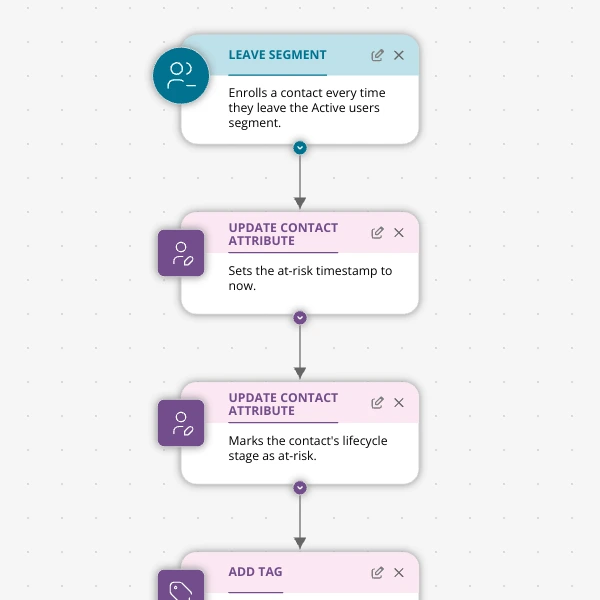
When Active Users Go Dark: A 4‑Touch Win‑Back Journey For Your Shopify App
A detailed, node-by-node Spreeflo journey for winning back previously active Shopify app users who stop engaging, using segment-based triggers, conditional logic, and a four-touch email plus internal alert sequence to recover usage and MRR.