Tier-Up Notifications That Make Your Shopify App Sticky
This playbook walks through a Silver-to-Gold tier upgrade journey for a fictional Shopify app, showing how to use Spreeflo segments, tags, events, and journeys to celebrate tier changes, drive perk adoption, and grow lifetime value.
Industry
Niche
Pattern
Loading sequence...
A merchant hits your “Gold” tier at 2:17 p.m.
They’ve been with your Shopify app for eight months, send thousands of orders through it every week, and just crossed the MRR threshold that finally makes them a power user.
Inside your admin, a number ticks up.
Inside their world, nothing happens.
No “congrats,” no new-perk rundown, no gentle nudge to go deeper. They keep using your app the same way they always have, and a few months later they churn because “it felt expensive for what we were using.”
That quiet non-event is where a lot of e‑commerce apps leak lifetime value.
The sequence at the top of this page is the whole journey, end to end. It’s a simple, always‑on automation that treats a Silver‑to‑Gold upgrade like the milestone it is: congratulate, explain the perks, and nudge merchants to actually use them.
We’ll walk through it node by node, using a fictional app to keep things concrete, and show how to adapt it for your own tiers.
The Shopify app we’re building this for
Meet FlowBoost, a Shopify app that automates post‑purchase upsells and win‑back emails.
5‑person remote team
~$120k MRR
Pricing: Free, Silver, Gold, Platinum, based on store revenue driven through the app
Stack: Stripe, a custom dashboard, Shopify APIs, and a legacy email tool they’re trying to replace
FlowBoost already tracks which merchants are in which tier in their own database and exposes a little “Gold” badge inside the app UI.
What they don’t do is mark the transition moment in any meaningful way. The merchant sees a new badge eventually. That’s it.
So this journey uses Spreeflo to turn “Silver → Gold” into a relationship event:
A targeted Gold‑welcome email
A timed check for perk usage
A different path for merchants who use their new benefits vs those who ignore them
All without a human touching it.
Why tier upgrades deserve their own automation
There are two reasons to design a dedicated tier‑up journey for your Shopify app.
First, tier moves are high‑signal behavior. A merchant doesn’t accidentally become Gold. By the time they cross that line, they’re likely:
Running a meaningful slice of their revenue through your app
Deeply integrated into their operations
Comparing your “cost” against growing usage
They’re primed for upsell, and they’re also primed to churn if they don’t feel the extra value.
Second, this is where most apps quietly leave money on the table. You do the hard work of acquisition and activation, then treat your best users like everyone else. No contextual “here’s what just changed,” no perks framed as rewards, no concrete expectation setting.
This pattern fixes that by:
Capturing detail on each merchant — their tier, usage, and perk adoption — so you can speak to them uniquely
Nurturing engagement right when their value to you steps up, instead of months later when you’re fighting churn
Let’s set up the data you’ll need, then go through the journey.
Step 0: Make your tiers visible inside Spreeflo
Before any automation fires, FlowBoost needs Spreeflo to “see” tier changes.
On the app side they already know a merchant’s:
Current tier:
Free,Silver,Gold,PlatinumMRR driven through the app
Whether they’ve activated specific perks (like “priority support” or “advanced A/B testing”)
They wire this into Spreeflo in two ways:
Whenever a tier changes, their backend calls the Spreeflo API or
Spreeflo.identifyon the web to update atiercontact attribute and amrr_via_appattribute.Whenever a merchant uses a Gold‑only perk, they track a custom event such as
gold_perk_usedviaSpreeflo.track. This also feeds into web analytics and journeys.
With that data flowing, FlowBoost creates a saved “Gold Tier” segment using the segment builder:
Contact Attributes →
tierisGoldOptional:
mrr_via_appgreater than some floor (for example, > $500/month)
This segment is the backbone of the journey. Membership changes are what we react to.
Node 1: Join Segment (Tier) trigger — catching the exact upgrade moment
The journey starts with a Join Segment trigger on that “Gold Tier” segment.
Configuration:
Trigger: Join Segment
Segment:
Gold TierRe‑enrollment: usually off for this pattern
Why Join Segment?
It fires at the moment a merchant newly qualifies as Gold. You don’t have to re‑express the tier logic inside the journey.
It’s resilient. If you ever change what “Gold” means in the segment, this journey follows automatically.
Why turn re‑enrollment off?
For most apps, being welcomed into Gold is a one‑time milestone. If a merchant churns or downgrades later, then comes back and re‑qualifies, you probably don’t want to send the same “Welcome to Gold” sequence over and over.
If your tiers are especially fluid and you do want to celebrate repeat climbs, you can turn re‑enrollment on, but then you should be very sure your tier logic doesn’t flap merchants in and out of Gold frequently.
The Join Segment trigger pushes merchants straight into a short data‑tagging layer.
Node 2: Add Tag — stamping the VIP status
Next, FlowBoost drops in an Add Tag node to apply a permanent label:
Tags:
tier-gold,vip-merchantForce tag trigger: off
Why tag if you already have a tier attribute?
Because tags are cheap, flexible, and easy to reference later. With a vip-merchant tag you can:
Exclude Gold merchants from generic discount campaigns
Trigger other journeys using the Added Tag trigger
Quickly filter in the UI or build other segments
If you’re not using tags heavily yet, this is also a gentle way to start. Spreeflo’s guide on getting started with tags is worth a skim here.
Node 3: Update Contact Attribute — record when they became Gold
Right after tagging, FlowBoost adds an Update Contact Attribute node to capture timing:
Attribute:
gold_joined_at(a custom timestamp attribute)Update type:
SET_NOW
This writes the current timestamp when the node executes.
Two reasons to do this:
It gives you a clean way to filter “newly Gold” merchants in other journeys or reports.
It keeps the tier logic simple. Your own system decides when someone qualifies as Gold; Spreeflo just records when that change was acknowledged.
Note that Update Contact Attribute uses static values you define at design time. For anything dynamic like “set tier to Gold” or “store the exact MRR number,” you should already be doing that in your app and syncing it via the Spreeflo API.
Node 4: Send Email — the actual Gold welcome
Now the fun part: the Send Email node that merchants actually see.
Configuration decisions:
Template: a dedicated “Welcome to Gold” marketing email
Send only once: on
Sender: whichever identity you normally use for lifecycle emails
Inside the email, FlowBoost does three things:
Celebrate the upgrade
List new perks in plain language
Set expectations
“You’ve just moved from Silver to Gold on FlowBoost.”
Make it explicit; don’t assume they’ve noticed a tiny UI badge.
Priority support with a realistic SLA
Higher send limits or bigger audience caps
Access to Gold‑only features or templates
How billing changes
How to get help faster as a Gold merchant
What “success” with this tier looks like (for example, “most Gold merchants see X% lift in AOV within 60 days by turning on features A and B”)
You can build and style this quickly using Spreeflo’s drag‑and‑drop email builder, or pull in an existing template and adapt it. The important part is that the copy is specific to Gold, and uses the contact attributes you’re already tracking to personalize examples.
This is where capturing detail on every customer starts paying off. “You processed 3,274 orders through FlowBoost last month; here’s how Gold puts that on rails” reads very differently from “Thanks for upgrading your plan.”
After the welcome, the journey needs to watch how they respond with behavior, not just opens or clicks.
Node 5: Wait Condition — give them time to use a perk
Right after the welcome email, FlowBoost adds a Wait Condition node:
Condition: Custom Event
gold_perk_usedtriggered at least 1 time in the last 7 daysTimeout duration: 7 days
In practical terms, this means:
If the merchant uses any Gold‑only perk within a week, the journey continues as soon as that happens.
If they don’t, the journey moves on after 7 days.
Why Wait Condition instead of a simple Time Delay?
Because we care about behavior, not the calendar. You want to talk to engaged Gold merchants differently from those who upgraded and then ignored the extra capabilities. Waiting “up to” seven days and then branching lets you do that without writing multiple separate flows.
To make this work, your app needs to fire a custom event when a Gold perk is used: for example, gold_perk_used with a property like perk_name = "advanced_ab_testing". That’s straightforward to wire in through the SDK and shows up alongside other analytics in Spreeflo’s web tracking and analytics.
Node 6: If/Else — split engaged vs unengaged Golds
Right after the Wait Condition, FlowBoost uses an If/Else process node with a condition that mirrors the wait:
Condition: Custom Events →
gold_perk_usedat least 1 time in the last 7 days
Contacts who match go down the “Engaged” branch. Everyone else goes down “Not yet engaged”.
This might look redundant, but it’s important. The Wait Condition only controls when we move forward, not which path we take. The If/Else check determines what we send next.
From here, the sequence has two short arms.
Engaged branch: reward and deepen usage
For merchants who actually used a Gold perk, FlowBoost does two things.
Send Email — “You’re getting real value from Gold”
Add Tag —
gold-perk-engaged
This email thanks them for putting their new tier to work and shows the next level:
A quick stat pulled from their usage: “You’ve already run 5 Gold‑level campaigns.”
One advanced tip or pattern they haven’t tried yet.
A soft upsell toward Platinum if that’s realistic, framed around outcomes rather than features.
Because there’s already a Wait Condition between the original welcome and this email, pacing rules are satisfied. You’re not hitting them with multiple emails back to back.
This tag makes engaged Gold merchants easy to reference in other automations, like beta invites or testimonial requests.
At this point the engaged path can end. You’ve acknowledged their progress, nudged them deeper, and marked them for future VIP‑style treatment.
Not‑yet‑engaged branch: a gentle “use your perks” nudge
For Gold merchants who still haven’t touched their new benefits after a week, the journey takes a different tack.
Send Email — “You’ve unlocked Gold. Don’t leave value on the table.”
Add Tag —
gold-perk-not-engaged
The copy here is direct but friendly:
Remind them what being Gold gives them, using one or two concrete perks, not a laundry list.
Show a simple “do this next” step that uses a Gold feature.
Include a tiny walkthrough or a 60‑second GIF for how to turn it on.
The goal is to move them from “I upgraded because I hit a limit” to “I upgraded and actually got something meaningful out of it.”
This tag is useful later when you want to identify high‑MRR accounts who still behave like lower tiers. You might feed them into a separate handhold sequence or a sales‑assisted outreach.
Again, the path can reasonably end here. A short, focused automation is usually better than a month‑long drip few people finish.
Adapting the pattern: more tiers, tests, and human touch
The Silver‑to‑Gold journey is only one instance of the same pattern.
Here’s how FlowBoost extends it safely:
Bronze → Silver: a parallel journey with a Join Segment trigger on a “Silver Tier” segment and simpler copy. Perks are smaller, so they keep the sequence lean.
Gold → Platinum: same structure, but they add a Send Internal Email node on the engaged branch to alert the founder or a CSM whenever a merchant becomes a Platinum user and uses a flagship perk. That prompts a personal “thank you” or check‑in.
They also experiment with the content of the nudge email using a Random Split:
50% of not‑yet‑engaged Golds go down path A with a playbook‑style email.
50% go down path B with an offer of a short onboarding call.
Each arm has its own Send Email node and uses the same Add Tag at the end. Over a few weeks, they can see which variant drives more gold_perk_used events and standardize on the winner.
Because all of this lives in one visual flow, it’s easy to reason about. You can build a journey once and let it run quietly in the background.
Measuring whether this journey earns its keep
Two metrics tell you whether your tier‑up automation is doing its job.
Tier‑up rate
Perk‑redemption per tier
Defined as: merchants who join a higher‑tier segment in a period divided by the number of merchants in the lower tier during that period.
With gold_joined_at timestamps and tier segments in place, it’s easy to answer questions like “how many Silver merchants became Gold last quarter” or “do merchants who go through the journey upgrade faster.”
For Gold, that’s simply the share of Gold merchants with at least one gold_perk_used event in, say, their first 30 days on the tier.
Because you’re already tracking perk‑use events through web tracking and analytics, you can segment by tags like gold-perk-engaged vs gold-perk-not-engaged and see whether your emails are nudging people into action.
You don’t need a huge analytics stack for this. Spreeflo gives you the segmentation and automation primitives, and you decide what “good” looks like for your specific app economics.
The broader lesson: treat behavior changes as starting lines
A merchant moving from Silver to Gold is not the happy ending of a funnel. It’s the starting line of a more valuable relationship.
When you:
Keep a clean, detailed record of who each merchant is and what tier they’re in
React automatically the moment that tier changes
Nudge them to actually use the benefits you’ve already built
you stop treating your best users like line items and start treating them like the VIPs they are. That’s where lifetime value grows quietly, month after month.
This is exactly the kind of work founder‑led SaaS teams can win at. You don’t need a big success team to hand‑craft these touchpoints. You need a clear data model, a handful of well‑designed journeys, and tooling that doesn’t fight you.
Spreeflo exists for that layer. With segments, tags, and automation wired together in one place, you can design flows like this once and let them run while you ship the next feature.
And the next time a merchant crosses into Gold, something will actually happen.
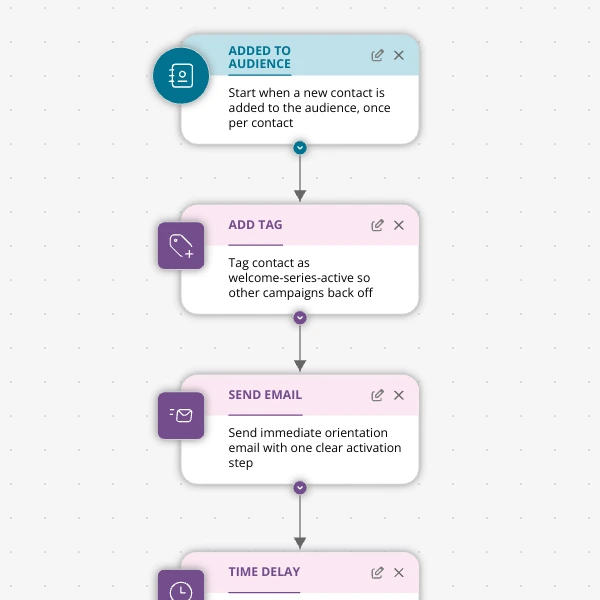
The Shopify app welcome series that turns installs into income
A step-by-step Shopify app welcome email journey for tools like CartSpark, showing how to turn new installs into activated, retained merchants using Spreeflo journeys, tags, and behavioral triggers so fewer trials quietly churn and more trials convert.
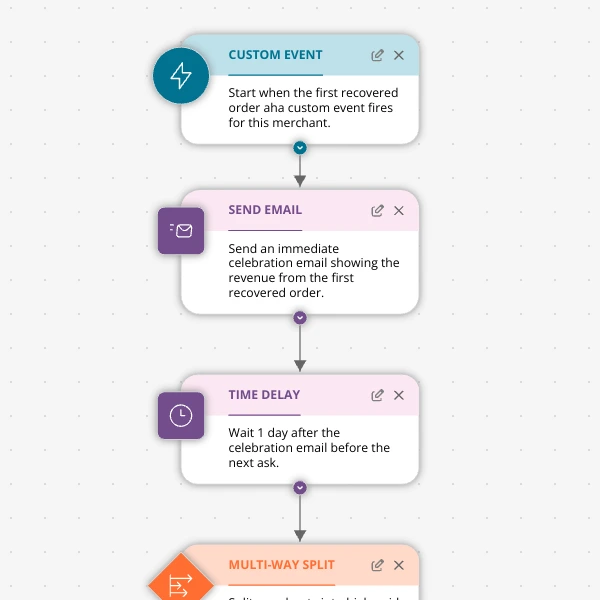
The Aha-Moment Playbook For Shopify Apps: Turn One Magic Action Into Months Of Revenue
A node-by-node playbook for Shopify and e‑commerce apps to center their lifecycle on one aha-moment custom event in Spreeflo, celebrate it, segment merchants by profile and engagement, and turn first recovered value into lasting revenue and retention.
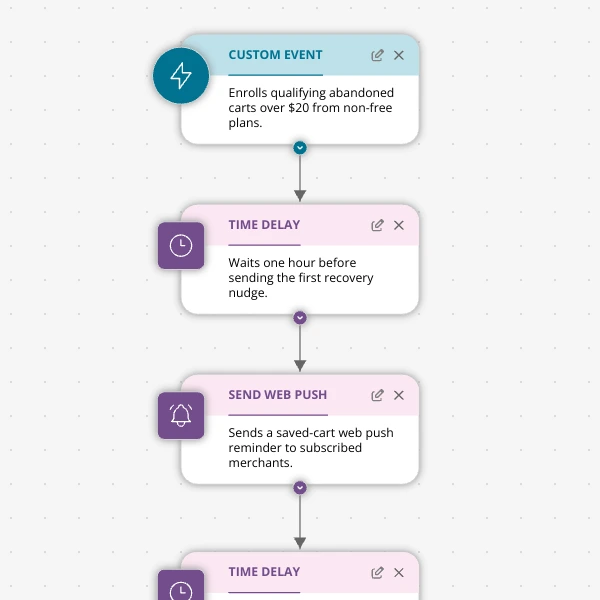
Stop Letting High‑Intent Carts Die: A 3‑Email Recovery Journey for Shopify Apps
A detailed, node-by-node walkthrough of a three-email (plus optional web push) cart-abandonment recovery journey for Shopify apps in Spreeflo, showing how to trigger events, branch on behavior, tag outcomes, and measure recovered carts and revenue.
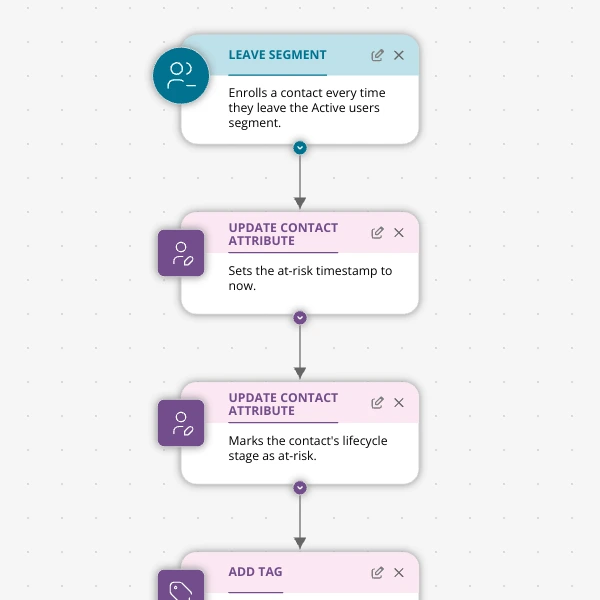
When Active Users Go Dark: A 4‑Touch Win‑Back Journey For Your Shopify App
A detailed, node-by-node Spreeflo journey for winning back previously active Shopify app users who stop engaging, using segment-based triggers, conditional logic, and a four-touch email plus internal alert sequence to recover usage and MRR.