Turn Blog Binge-Readers into Qualified Leads with Topic-Specific Drips
Walkthrough of a Spreeflo journey for Shopify apps that turns blog binge-readers into tagged, topic-specific leads using web tracking, Criteria Match triggers, and deep guide emails, then promotes clickers to MQLs your team can prioritize.
Industry
Niche
Pattern
Loading sequence...
Someone installs your Shopify app, pokes around the docs, then disappears into your blog.
They read a case study on abandoned-cart recovery. Then a teardown of high-converting email flows. Then a technical post about integrating your API with Klaviyo. Three posts, same theme: “How do I squeeze more revenue from each store visitor?”
Your analytics show three pageviews and a five-minute session.
What they actually told you is: “I care a lot about this specific problem. Show me what to do next.”
The sequence at the top of this page is the whole journey, end to end. It turns that behaviour into a targeted drip: once someone has read three or more posts in a topic, Spreeflo tags them with that interest, sends a deep guide on that exact topic, and treats clicks on that guide as a qualification signal.
Let’s walk through how that works, using a fictional Shopify app, CartWizard, as our running example.
CartWizard recovers abandoned checkouts for Shopify merchants. They’re doing ~$100k MRR, mostly self-serve installs, and run content on three pillars: “Abandoned Cart Recovery,” “Post-Purchase Upsells,” and “Email Flows for Shopify.” They already send a generic newsletter. What they don’t do is react when someone clearly binge-reads one pillar.
That’s the leak this journey closes.
Why topic-specific drips beat generic newsletters
Reading three posts in a single category is a strong signal:
It’s more intentional than a single click from Twitter.
It’s more precise than “visited pricing.”
It’s often the last thing someone does before deciding whether to really try your app.
Most SaaS teams still treat that visitor like the rest of the list. Same welcome series. Same generic product tour. Then they wonder why trial-to-paid conversion stalls.
The core belief behind this pattern is simple:
When you capture detailed behavioural data, you can speak to each contact uniquely.
If you don’t nurture that engagement, you leave lifetime value on the table.
This journey uses Spreeflo’s web tracking, segment builder, and email automation to formalise that belief. You’ll use content behaviour to infer intent, then respond with the one thing that’s obviously useful: a deep, practical guide on the exact topic they’re obsessed with.
What this journey does, in plain English
Before we dive into nodes, zoom out:
You track every blog post view as a custom event with a
categoryproperty.For each category (say “Abandoned cart recovery”), you define a Criteria Match trigger: “Has viewed at least 3 posts in this category in the last 30 days, is email subscribed, and hasn’t already been tagged for this topic.”
When that condition flips from false to true, Spreeflo:
Tags the contact with that topic interest.
Waits a couple of hours.
Sends a deep guide email tailored to that topic.
Waits a few days, then checks if they clicked the guide.
Tags clickers as MQLs for that topic and pings your team.
You end up with:
Clear interest tags on each contact.
A library of deep, topic-specific guides doing qualification for you.
A pool of “clicked-topic-guide” contacts your sales or success team can prioritise.
Now let’s break down how the sequence at the top of this page achieves that, node by node.
Stage 1: Instrument your blog so Spreeflo can see interest
Before any automation, you need clean signals.
CartWizard embeds the Spreeflo SDK on their marketing site and blog using the setup from the web tracking and analytics guide. That gives them page tracking out of the box. For this journey, they go one step further and track a custom event on each blog view:
Event name:
blog_post_viewProperties:
category: one ofcart-recovery,post-purchase-upsell,email-flows, etc.slugortitleif they want extra detail.
You can send that event either from your front-end with Spreeflo.track or from your backend via the Spreeflo API. The key is consistency: same event name, clean category values.
Once events are coming in, you’ll see blog_post_view under Custom Events in:
The segment builder (so you can define conditions like “triggered at least 3 times”).
Journey triggers that support Criteria Match conditions.
That’s your raw material.
Stage 2: Criteria Match triggers per topic
This journey is a continuously-running journey, not a one-off campaign. You’re reacting anytime someone crosses the “3+ posts in a category” line, now or six months from now. If you’re new to journeys in Spreeflo, the high-level model is in the campaigns and journeys overview.
On the canvas, you’ll have one Criteria Match trigger per topic you care about. We’ll walk through one: the “Abandoned cart recovery” path.
Node: Criteria Match trigger – “Abandoned cart super-interested”
Configuration:
Type: Criteria Match.
Re-enrollment:
true.
Criteria (expressed with the segment builder):
Custom Events →
blog_post_view:AT_LEAST3 timesin the last30 daysProperty
categoryIScart-recoveryAND Email Subscription Status
isSubscribed.AND Contact Tags
contact is not tagged withtopic:cart-recovery.
Why this setup:
The frequency clause (“at least 3 times in 30 days”) avoids one-off randomness.
The category property keeps it topic-specific.
Email Subscription Status makes sure you only email people you’re allowed to.
The “does not have tag” rule ensures this trigger only fires once per contact per topic, even though re-enrollment is on.
Re-enrollment is important. Because Spreeflo’s re-enrollment is journey-scoped, a contact who has been through a different topic path in this same journey should still be able to enter this one later. Setting isReEnrollment=true on each Criteria Match trigger allows that. The tag condition prevents repeat runs for the same topic.
You’ll repeat this trigger (with adjusted category values and tags) for each topic pillar.
From each trigger, the next node is specific to that topic path. There’s no fan-in here; each path runs independently.
Stage 3: Tag the topic and time the deep guide email
Once the trigger fires for the “cart recovery” path, the sequence moves into two simple action nodes.
Node: Add Tag – record the interest
Configuration:
Type: Add Tag.
Tags:
topic:cart-recovery, and optionally a broader tag likecontent-topic-subscribed.Force tag trigger: off (you already prevented double-tagging in the trigger criteria).
Why this is first:
Tags are your long-term memory. Months from now, you may build a different journey that starts from “contacts tagged with
topic:cart-recovery” instead of raw event data.It also doubles as a guardrail: if you ever change the Criteria Match logic, the “does not have tag” rule still stops duplicates.
Node: Time Delay – create a small buffer
Configuration:
Type: Time Delay.
Delay: 2 hours.
Why not send the guide immediately?
It feels more natural if the email lands a bit after their reading session, not the second they close the tab.
It gives them time to finish whatever they’re doing in your app or on your site.
It respects pacing: you’re unlikely to have sent another email in the past couple of hours, but this buffer makes sure you never stack messages too tightly.
You could set this to a day if your sales cycle is longer. The key is that there’s at least some pause before the Send Email node.
Node: Send Email – the deep guide
Configuration:
Type: Send Email.
Template: a dedicated “Abandoned Cart Deep Guide” marketing email, built in the email builder.
From: your usual marketing identity (e.g.
team@cartwizard.app).Send only once: on.
Email content principles:
Subject line speaks directly to the topic: “Your step-by-step plan to fix abandoned carts on Shopify.”
Body reuses what you already know:
They’re reading cart recovery content.
They have (or are evaluating) your app.
Include implementation steps, screenshots, and one clear CTA:
For new leads: “Start your 14-day trial with these settings pre-configured.”
For existing customers: “Turn on this sequence in your CartWizard dashboard.”
You can use AI-based personalization through the AI variables guide to adapt examples to their store size or region, but the big win is already in the targeting: you’re sending the right guide to the right person at the right time.
Stage 4: Use clicks to graduate readers into MQLs
Sending a great guide is useful. Knowing who actually engaged with it is where qualification happens.
The second half of each topic path turns email engagement into tags your team can act on.
Node: Time Delay – give them time to react
Configuration:
Type: Time Delay.
Delay: 3 days.
Why:
Some readers click immediately. Others star the email and come back on the weekend.
Waiting three days gives a fair window for normal behaviour before you classify them as non-engaged.
Only after this pause do you branch on activity.
Node: Check Email Activity – did they click the deep guide?
Configuration:
Type: Check Email Activity.
Marketing email: the specific “Abandoned Cart Deep Guide” template.
Activities to branch on:
Branch
clicked:Link Clicked.Else branch ID:
no_click.
This creates two exits:
clicked– anyone who clicked a link in the guide.no_click– everyone else (never opened, opened but didn’t click, delivery issues).
You don’t need to overcomplicate with multiple nuanced branches here. For CartWizard, the main distinction is “interested enough to click into the guide” versus “not yet.”
From here, each branch gets its own small follow-up.
Branch 1: Clicked – tag as MQL and alert the team
First action on this branch:
Node: Add Tag.
Tags:
mql:cart-recovery,clicked:cart-recovery-guide.
Second action (optional but powerful):
Node: Send Internal Email.
To: founder or sales inbox.
Content: a short summary with contact details and context (“Read 3+ cart recovery posts, clicked deep guide, not yet on paid plan”).
Why this matters:
For many Shopify apps, you don’t have a big outbound sales team. But you probably have a handful of merchants who would respond well to a personal note.
These are some of the best candidates: they’ve told you both what they care about and that they want help.
Your internal workflow from there can be manual (personal outreach) or automated (another journey that starts when mql:cart-recovery is added).
Branch 2: No click – keep them in the topic universe
On this branch, you want to:
Avoid spamming them.
Still capture the fact that they showed topical interest.
First action:
Node: Add Tag.
Tags:
topic:cart-recovery-warm.
Later, you might build a monthly “Best of cart recovery tactics” digest that targets topic:cart-recovery-warm but excludes clicked:cart-recovery-guide. For now, it’s enough to have the data.
If you do want a follow-up email here, insert another Time Delay of at least 7 days before any new Send Email node, so there’s no risk of back-to-back sends along this path.
Scaling out to multiple topics
Everything we’ve walked through was for a single topic pillar. To support additional pillars like “Post-purchase upsells” or “Email flows,” you:
Add new Criteria Match triggers with the same structure but different
categoryvalues and tags.Clone the downstream nodes and swap in the topic-specific email templates and tag names.
Because each trigger’s criteria exclude contacts who already have that topic’s tag, and because isReEnrollment is on, the same person can:
Go through the cart recovery path in March.
Then go through the email flows path in May.
Without ever looping twice through the same topic.
Over time you accumulate a rich set of tags per contact that tells you exactly which themes resonate. That’s the first brand message in action: capturing detail on every customer so you can speak to each uniquely.
How to tell if this journey is earning its keep
Three metrics tell you whether this pattern is worth the space in your mental stack.
Topic-tag accumulation
- Segment: contacts tagged with anytopic:*tag.
- Watch how this grows relative to total new contacts. If only a handful ever cross the “3+ posts” threshold, consider lowering the bar to 2 posts or widening your time window.Deep-guide click-through rate
- Look at the analytics for each guide email template.
- Because these sends are behaviourally targeted, you should expect noticeably higher CTR than your generic newsletter. If not, revisit your subject lines and the clarity of the CTA.MQL conversion
- Define what “MQL” means for you. For CartWizard, taggingmql:cart-recoveryand then looking at “started trial within 14 days” is a good start.
- You can create segments that combine tags and events (e.g. “has tagmql:cart-recoveryAND custom eventapp_installedat least 1 time in last 14 days”) using the segment builder.
Because Spreeflo separates marketing and non-marketing contacts, you can store every visitor the SDK sees without blowing up your bill, then promote only engaged readers into marketing status as needed, as described in Spreeflo’s pricing details.
Why this pattern matters more for Shopify app developers
If you sell a Shopify or e‑commerce app, your blog isn’t just for traffic. It’s often your best window into which job a merchant is hiring your app to do:
Are they fighting abandoned carts?
Are they trying to improve post-purchase upsells?
Are they worried about email deliverability?
Treating all readers the same throws away that context.
The topic-specific behavioural drip in the sequence above is a small, opinionated fix. It doesn’t need a big team. Once you set up tracking and journeys, it runs quietly in the background while you ship features and handle support.
And it does three compounding things for you:
It converts anonymous browsing into tagged, structured interest.
It nudges those readers toward meaningful outcomes with deep, focused content.
It surfaces the small subset of people who are ready for a higher-touch conversation.
For a founder-led, resource-constrained team, that’s what good automation looks like: build it once, let it keep working while you sleep.
If you already have a content library around your app, this journey is one of the highest-ROI ways to make that content pull its weight. Set it up once in Spreeflo, then watch as your blog quietly turns binge-readers into the kind of leads your product deserves.
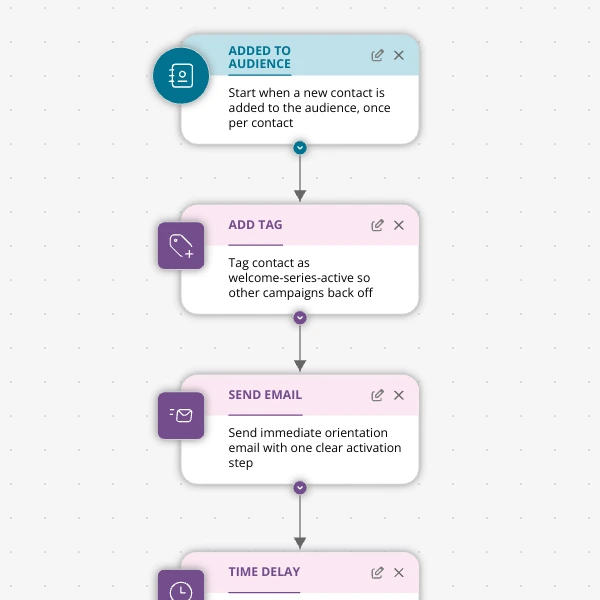
The Shopify app welcome series that turns installs into income
A step-by-step Shopify app welcome email journey for tools like CartSpark, showing how to turn new installs into activated, retained merchants using Spreeflo journeys, tags, and behavioral triggers so fewer trials quietly churn and more trials convert.
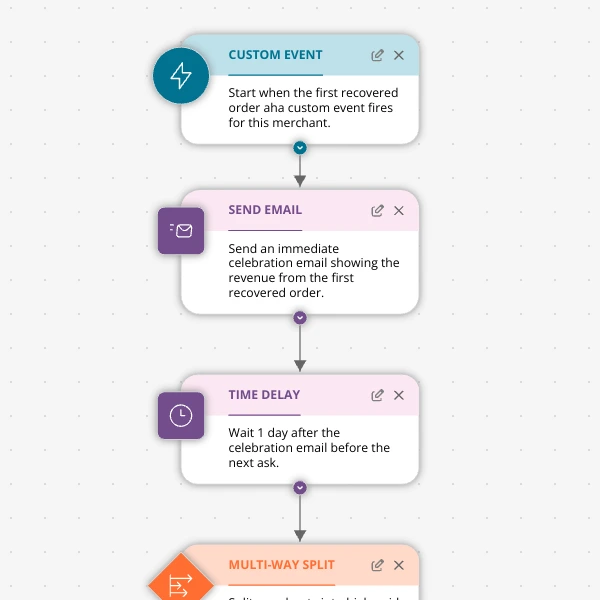
The Aha-Moment Playbook For Shopify Apps: Turn One Magic Action Into Months Of Revenue
A node-by-node playbook for Shopify and e‑commerce apps to center their lifecycle on one aha-moment custom event in Spreeflo, celebrate it, segment merchants by profile and engagement, and turn first recovered value into lasting revenue and retention.
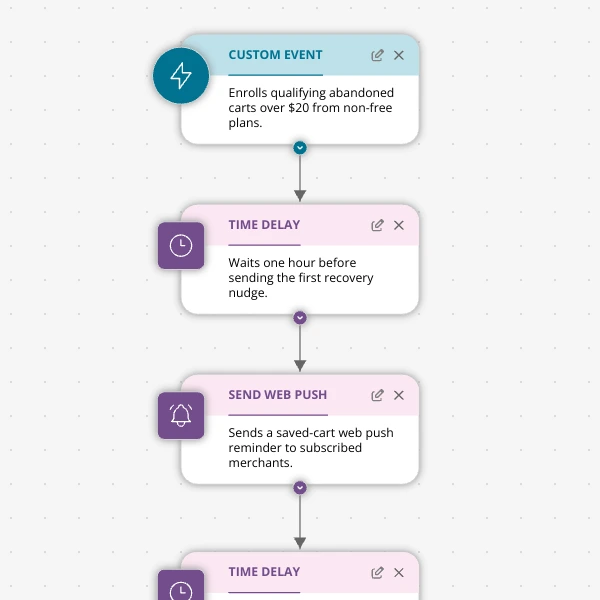
Stop Letting High‑Intent Carts Die: A 3‑Email Recovery Journey for Shopify Apps
A detailed, node-by-node walkthrough of a three-email (plus optional web push) cart-abandonment recovery journey for Shopify apps in Spreeflo, showing how to trigger events, branch on behavior, tag outcomes, and measure recovered carts and revenue.
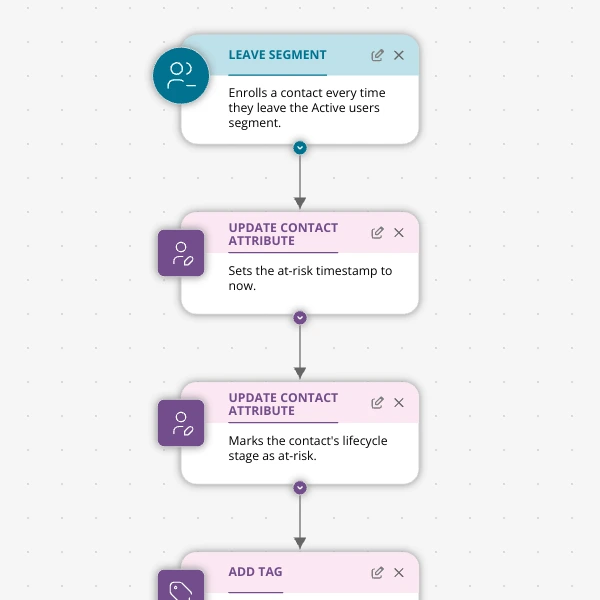
When Active Users Go Dark: A 4‑Touch Win‑Back Journey For Your Shopify App
A detailed, node-by-node Spreeflo journey for winning back previously active Shopify app users who stop engaging, using segment-based triggers, conditional logic, and a four-touch email plus internal alert sequence to recover usage and MRR.