The One-Click Safety Net For Spam Complaints
This playbook walks e‑commerce and Shopify app teams through wiring spam complaints into an automated “pause and review” journey in Spreeflo, protecting deliverability while turning complaints into actionable signals for segmentation, messaging, and VIP handling.
Industry
Niche
Pattern
Loading sequence...
CartWizard’s founder thought it was just another Monday.
She opened her email provider dashboard and saw the usual spikes from a weekend promotion. Then she noticed the warning: “Complaint rate above threshold.” A handful of Shopify merchants had hit “Mark as spam” on her new onboarding sequence. Nothing huge. But enough to drag down sender reputation on the domain that every product update, trial reminder, and win-back depends on.
She spent the next two hours manually unsubscribing contacts, digging through logs to see what they received, and Slacking the team: “Stop all sends until we know what’s going on.”
That “oh no” moment is exactly what this pattern is designed to remove.
The sequence at the top of this page is the whole journey, end to end. A complaint comes in. The contact is instantly paused from marketing. Your team gets a clear, contextual internal email to review what went wrong. No scrambling, no guesswork.
For e‑commerce app developers, this isn’t just a deliverability nicety. It’s a revenue safeguard. If your spam complaints quietly creep up, your onboarding and upsell emails stop landing for the customers who didn’t complain. That’s lifetime value leaking out of your funnel.
Let’s walk through how to make complaints trigger an immediate “pause and review” in Spreeflo, and how to adapt the sequence for your own Shopify or headless app.
Why spam complaints are a growth problem, not just a compliance risk
Most SaaS teams think of complaints as an ESP metric that might get them a nastygram or, worst case, an account suspension.
For a Shopify app, the impact is more direct:
Complaint spikes train inbox providers to distrust your domain. That means fewer merchants see your onboarding flow, feature announcements, and upgrade nudges.
Many complaints are actually “this feels irrelevant” or “I didn’t expect this” rather than true spam. That’s a segmentation and UX signal, not just a deliverability one.
Complaints from previously engaged users often point to confusing product decisions or mismatched expectations in your App Store listing.
If you ignore those signals or handle them manually, you’re leaving retention and expansion revenue on the table. You also increase the odds that a big launch or Black Friday promotion collides with a deliverability issue at the worst possible time.
A complaint-based pause-and-review journey solves for this by doing three things every time a complaint lands:
Immediately stop marketing email to that contact.
Record the complaint in a consistent, queryable way.
Alert a human with enough context to investigate within your target SLA.
That’s exactly what the journey at the top of this page implements.
The pattern in one glance
Before we go node by node, here’s what the journey does conceptually:
A
complaintcustom event enters Spreeflo from your email infrastructure or webhook processing.A Custom Event trigger catches it and starts the journey.
The contact is instantly moved out of marketing: Email subscription set to “unsubscribed”; Marketing status set to “non-marketing”.
The journey tags the contact for reporting and tracking.
A Send Internal Email node notifies the right person or team to review.
Optional branches handle VIP accounts or severe patterns differently (escalation, faster SLA).
Because this is a continuously running automation, you build it once and it watches over every email you send.
You can build a journey like this in Spreeflo’s visual editor in a few minutes. The design choices are where the real leverage comes from, so let’s dig into those.
Step 1: Getting the complaint into Spreeflo
The journey starts with data, not with a UI click.
Wherever your spam complaints originate, you want them to end up in Spreeflo as a custom event. Common setups for e‑commerce apps:
Your transactional provider (e.g. SES, Postmark) fires a webhook when mailbox providers send a complaint (Feedback Loop).
A homegrown email microservice captures complaint events in your app’s log stream.
A support or feedback tool classifies messages as “spam / unsolicited”.
In each case, you map that inbound signal to a call to the Spreeflo API or to Spreeflo.track on the server:
Event name:
complaintEvent properties: at minimum, something like:
source("ses", "postmark", "support")reason(if you get it, e.g. "abuse", "feedback")message_idor similar
On the Spreeflo side, you make sure those events are associated with a contact (by email) so the automation can act on that specific merchant.
This is the only setup step that happens outside the journey itself, but it’s crucial. Once complaint events flow in reliably, the rest is drag-and-drop.
Step 2: Custom Event trigger — catching the complaint
Node: Custom Event trigger
Configuration:
Event name:
complaintProperty conditions (optional but recommended):
For example:
source is sesORsource is postmarkif you want to react only to mailbox-provider spam complaints, and not to internal feedback labels.Re-enrollment: off
Why this trigger?
Spreeflo already has an Email Action trigger for opens, clicks, and replies, but complaints are usually surfaced by external systems. A Custom Event trigger is exactly for this “fire when an arbitrary event hits our API” use case.
Why turn re-enrollment off?
A complaint from a mailbox provider is a hard stop. Once a contact has complained, you unsubscribe and stop marketing to them. If your upstream provider glitches and replays events, you don’t want that to constantly retrigger the flow. With re-enrollment off, the journey processes each contact once and then ignores future complaint events for them.
If you do have a legitimate need to track multiple complaints from the same contact over time, handle that via a numeric attribute (e.g. complaint_count) rather than re-running the entire journey.
Step 3: Immediately pause marketing for that contact
As soon as the trigger fires, the first responsibility is protective: make sure you don’t send this person more marketing.
3a. Update Email Subscription Status
Node: Update Email Subscription Status
Set:
Status:
Email unsubscribed
This switches the contact’s email subscription state, which Spreeflo respects when sending marketing emails. Future campaigns and journeys will treat them as opted out.
You could rely on the upstream ESP’s suppression list alone, but having the state inside Spreeflo keeps your analytics, segments, and future journey design honest. It also means if you ever change infrastructure, this “do not email” intent comes with you.
3b. Mark them as non-marketing
Node: Update Contact Attribute
Attribute: Marketing status
Update type: Update
Value: Non-marketing
Marketing status is separate from subscription. For a Shopify app, this distinction matters:
Subscription status: “May we send marketing emails?”
Marketing status: “Is this contact part of the group we treat as marketing-relevant?”
By setting marketing status to Non-marketing, you:
Keep them out of Cyclic “newsletter” or “digest” journeys that look at Marketing contacts.
Avoid counting them against your paid marketing-contact limits unnecessarily (see about Spreeflo pricing plans for how this is billed).
Together, these two nodes form the “panic brake” that actually protects your list.
Step 4: Tag and timestamp for reporting
Now that the fire is contained, you want a clean paper trail for later analysis and false-positive handling.
4a. Add complaint tags
Node: Add Tag
Tags might include:
complaintcomplaint-source-sescomplaint-onboarding(if you can infer which sequence it was)
You can apply multiple in one node. This makes it easy to create segments like “all contacts with tag complaint added in the last 30 days” or “complaints tied to onboarding vs. promotional sends.”
If you’re new to Spreeflo’s tag system, the guide on using tags is a good primer.
4b. Stamp the complaint time
Node: Update Contact Attribute
Attribute: a custom timestamp attribute, say last_complaint_at
Update type: Set to now
This captures when the complaint happened. Later, you can compare it to a complaint_reviewed_at timestamp (set by another system or manual process) to track your review SLA.
No logic yet, just recording what happened.
Step 5: Notify the right human with a contextual internal email
Node: Send Internal Email
This is where the “review” part of pause-and-review kicks in.
Configuration basics:
Recipient: a shared inbox (e.g.
deliverability@yourapp.com) or your support queue.Template: built in Spreeflo’s email builder with merge fields for contact email and name, key attributes (plan tier, MRR band, install date), complaint source and reason from the custom event, and a link to their profile in your admin.
The goal is for whoever opens this email to decide quickly:
Was this a true spam complaint (we shouldn’t contact this person again)?
Was this an overzealous click from someone who installed yesterday and never saw a clear opt-in?
Does this point to a broken segment, a misleading call-to-action, or a bad subject line?
Because Send Internal Email supports templates just like marketing emails, you can standardize what information your team sees and reduce back-and-forth.
If you want an SLA, include a sentence like “Please review this complaint within 24 hours” and train your team to respond by tagging or updating an attribute when they’ve done so.
Optional: Escalate VIP complaints differently
For many e‑commerce apps, not all merchants are equal. A spam complaint from a $9/mo trial is unfortunate. A complaint from a $499/mo enterprise account might be a signal that the relationship is at risk.
You can bake this prioritization into the journey with a simple branch.
6a. Split VIP vs. standard accounts
Node: If/Else
Condition (using the segment builder):
For example: Contact attribute
planisProOREnterprise, OR custom attributemrrgreater than200
“Then” branch: VIPs
“Else” branch: everyone else
The segment builder lets you combine plan, MRR, and behavioral signals (like “total visits at least 50”) into a single definition without writing code.
6b. Different internal emails, same outcome
On the VIP branch, you might:
Send an internal email directly to the founder or a senior CSM.
Use a subject like “VIP spam complaint – review within 4 hours.”
On the non-VIP branch, you:
Send the internal email to support or a shared deliverability inbox.
Promise a more relaxed SLA.
Both branches then converge on a Merge node so the rest of the flow stays tidy. Remember, each contact still only receives one internal email; the branching just decides who sees it and how urgent it feels.
Turning review into measurable operations
The pattern so far catches the complaint, pauses marketing, and notifies a human. To make it part of your operating system, you want to be able to answer three questions:
Spreeflo doesn’t impose an opinionated “complaints dashboard,” but the pieces you’ve set up make it easy to track these with segments and exports.
Some examples:
Complaint rate: segment for “tag contains
complaintAND contact added date is within last 30 days,” compare that count to “emails sent in last 30 days” from your email reporting.Review SLA: add a
complaint_reviewed_attimestamp attribute and have your team set it (via admin tools or another automation) when a review is complete. The difference betweenlast_complaint_atandcomplaint_reviewed_atgives you per-contact turnaround time.False-positive rate: tag contacts as
complaint-false-positivewhen you conclude it wasn’t really spam. Segment on that tag to see how often this happens and which campaigns most often produce it.
Because every one of these is just a combination of tags, attributes, and events, you can build the logic entirely inside Spreeflo with the same segment builder you used for the VIP split.
Adapting the pattern for your Shopify or headless app
The exact details of the complaint event and review email will look different for CartWizard versus an analytics tool like ShopMetrics, but the journey design holds up with small tweaks.
A few adaptations worth considering:
Separate onboarding vs. promo complaints
If your complaint events carry acampaign_typeproperty, you can add a Multi-way Split after the trigger foronboarding,newsletter,billing, etc. This lets you see where issues concentrate and route them to the right owner.Detect “rage-click” bursts
If you see multiple complaints in a short period for the same campaign, that might be a broken segment or misconfigured automation. Add a numeric attributecomplaint_countand an Update Contact Attribute node set toIncrementfor each complaint. A separate journey can watch for “joined segment Complaint Count >= 2 in last 24h” and alert you of systemic issues.Tie complaints back to web behavior
With Spreeflo’s web tracking and analytics, you can correlate complaints with “visited /pricing” or “time on site < 30 seconds.” That’s gold when you’re writing clearer copy or adjusting trial flows.
The core remains the same: complaint in, pause and tag, internal review. Everything else is about tailoring it to your product’s risk profile and customer tiers.
The bigger picture: protecting your ability to nurture
Most Shopify apps already know that retention beats acquisition for unit economics. What’s easier to miss is how fragile the channel is that drives that retention.
If complaints quietly erode your deliverability, the merchants who never complain simply stop seeing your emails. Onboarding stalls. Upsells land in spam. Win-backs never reach abandoned trials. From your analytics, it just looks like “email isn’t working as well anymore.”
A tiny, always-on journey like the one at the top of this page changes that dynamic:
Every complaint gets the same fast, respectful treatment.
You protect your sender reputation before it impacts non-complaining users.
You turn a negative signal into a feedback loop that improves segmentation and messaging.
For a small, founder-led team, this is exactly the kind of automation that earns its keep. You design it once, wire up a single custom event, and it quietly guards the health of the channel you rely on to nurture customers over the full lifetime of your app.
Open your automation workspace, wire up that complaint event, and build this journey. The next time someone hits “spam,” your system will already know what to do.
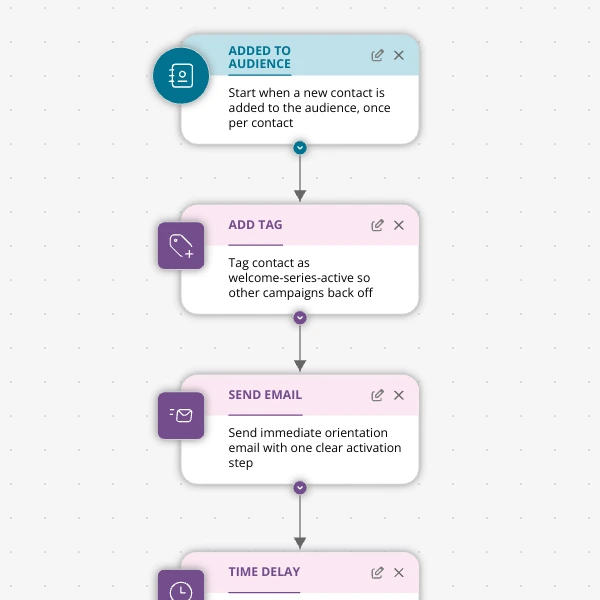
The Shopify app welcome series that turns installs into income
A step-by-step Shopify app welcome email journey for tools like CartSpark, showing how to turn new installs into activated, retained merchants using Spreeflo journeys, tags, and behavioral triggers so fewer trials quietly churn and more trials convert.
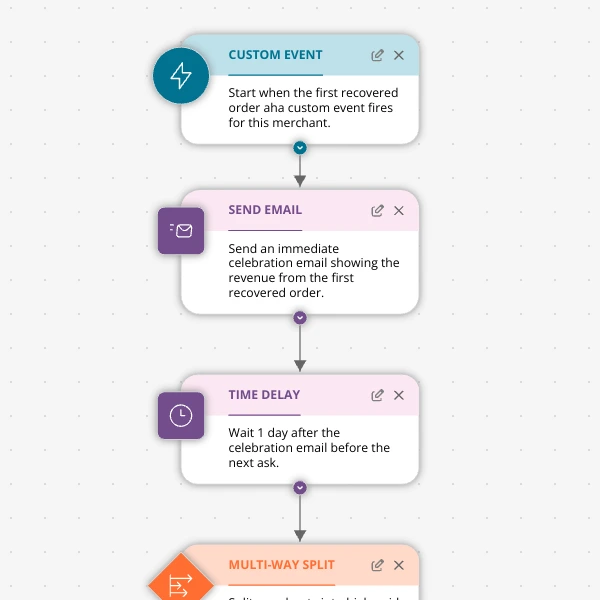
The Aha-Moment Playbook For Shopify Apps: Turn One Magic Action Into Months Of Revenue
A node-by-node playbook for Shopify and e‑commerce apps to center their lifecycle on one aha-moment custom event in Spreeflo, celebrate it, segment merchants by profile and engagement, and turn first recovered value into lasting revenue and retention.
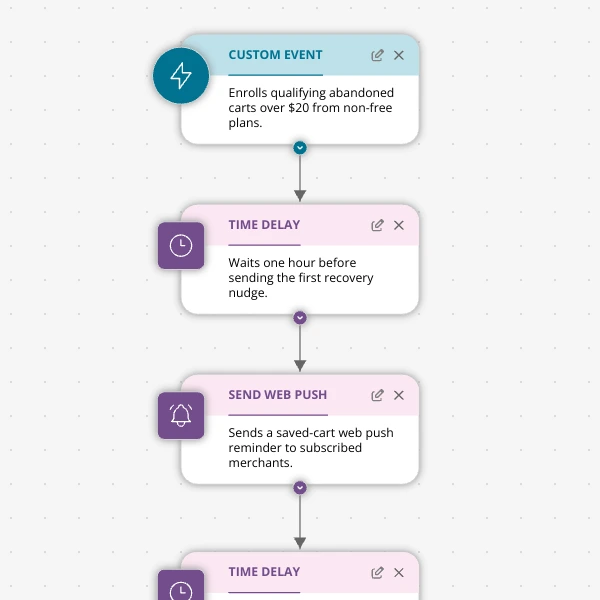
Stop Letting High‑Intent Carts Die: A 3‑Email Recovery Journey for Shopify Apps
A detailed, node-by-node walkthrough of a three-email (plus optional web push) cart-abandonment recovery journey for Shopify apps in Spreeflo, showing how to trigger events, branch on behavior, tag outcomes, and measure recovered carts and revenue.
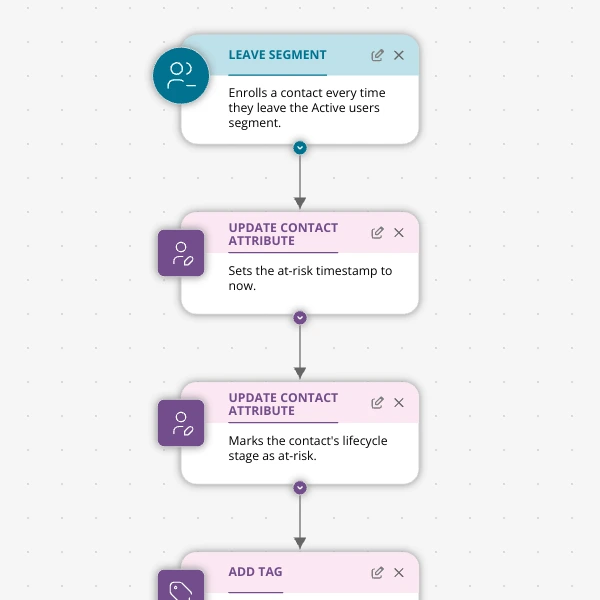
When Active Users Go Dark: A 4‑Touch Win‑Back Journey For Your Shopify App
A detailed, node-by-node Spreeflo journey for winning back previously active Shopify app users who stop engaging, using segment-based triggers, conditional logic, and a four-touch email plus internal alert sequence to recover usage and MRR.