Build a One-Time Preference Survey That Personalizes Every Email in Your SEO SaaS
Build a micro-survey inside your SEO SaaS that captures role, primary SEO focus, and content preferences, maps them to Spreeflo attributes, and powers personalized onboarding, nurture, and measurement across journeys, segments, and every future email.
Industry
Niche
Pattern
Loading sequence...
You can have a brilliant rank tracker and still lose users because your emails talk about the wrong problem.
An agency signs up for your tool looking for client reporting. Your onboarding sequence spends a week on content briefs. Another user cares about technical audits, but all they see are “how to pick keywords” guides. They stop opening. They churn.
The sequence at the top of this page is the whole journey, end to end: a tiny, early preference-capture survey that quietly powers every content split for the rest of the lifecycle.
In this playbook, we’ll build that journey for an SEO SaaS like “RankPulse” or “BrieflySEO”: short survey, mapped to attributes, wired into Spreeflo so every contact gets emails that match their role and use case.
Why early preference capture is such a big deal for SEO SaaS
SEO users are not one persona:
Agency owners doing high-volume reporting
In-house marketers juggling content, backlinks, and stakeholders
Founders doing scrappy DIY SEO
Technical SEO specialists buried in audits and Core Web Vitals
Send the same onboarding and newsletter to all of them and you get mediocre engagement everywhere. Worse, you learn nothing about who is who.
A simple preference survey early in the journey flips this:
Ask 2–4 questions once (role, primary SEO focus, maybe content preference).
Store answers on the contact as attributes.
Use those attributes in every segment and content split from then on.
Spreeflo is built for exactly this style of marketing: capture detail on every customer so you can speak to each uniquely. With one well-placed micro-survey you stop treating your 10,000 contacts as a flat list and start talking to actual people with specific jobs to be done.
Let’s build it.
Decide what you’ll ask (and how you’ll actually use it)
Before touching the journey, sketch the minimum viable survey. For an SEO SaaS, three questions are enough:
Role
Example options:
- Agency owner / consultant
- In-house marketer
- Founder / operator
- FreelancerPrimary job to be done
Example options:
- Rank tracking & monitoring
- Content briefs & on-page SEO
- Technical audits & site health
- Client reporting & white-label dashboardsContent format preference (optional but useful)
- Tactical walkthroughs
- High-level strategy
- Product updates & feature tips
Every question should drive a real decision later:
Which onboarding emails they get (technical vs content-focused)
Which case studies you highlight (agency vs in-house)
Which product features you showcase first
If a question doesn’t change content or product surface for that user, drop it.
You’ll build this survey once in Spreeflo’s form builder, then map each answer to a contact attribute so it’s usable everywhere. The form itself lives inline or as a popup in your app; journeys trigger around it.
Build the preference survey as a mapped form
In Spreeflo, head to Forms and create a new form dedicated to this micro-survey.
Key setup:
Turn on “Map to contacts”.
Because this survey is for known users already identified in your app, you don’t need to ask for email again. The Spreeflo SDK on your app will already have called
Spreeflo.identify('user@example.com', {...})at login, so submissions automatically attach to the right contact.For each question, use Map to attribute:
- Role →seo_role(TEXT)
- Primary job →primary_seo_focus(TEXT)
- Content format →content_preference(TEXT)
That mapping is crucial. It’s how those answers become usable in the segment builder, in If/Else decisions, and in every downstream journey.
Finally, create a popup embed for this form targeting your app domain (e.g. app.rankpulse.com). Choose a simple Popup or Slider style and keep the design minimal: headline, the three questions, and a short reassurance about why you’re asking.
On the Free plan you can already create and embed forms with unlimited responses. The step that ties this popup to automation is the Popup Form action, which lives in journeys on the Professional plan.
Step 1: Trigger on every new marketing contact (Add to Audience)
In the sequence at the top of this page, everything starts with an Add to Audience trigger.
Configuration:
Trigger: Add to Audience
Re-enrollment: Off
This fires whenever a new contact is added to your audience, whether that’s:
A new trial signup via a Spreeflo signup form
A lead imported from CSV
A contact created via the Spreeflo API
Turning re-enrollment off keeps things sane: you don’t want to ask the same person for their preferences every time they re-enter via a different door.
Because this is a journey (not a one-off campaign), it will keep running for as long as your product exists. Any future signup automatically flows through.
Step 2: Send a welcome email that sets up the survey
From the Add to Audience trigger, the first node is a Send Email action.
Configuration:
Node: Send Email
Content: a simple welcome built in the email builder
“Send only once”: On
The goal of this first email is:
Welcome them to the product
Point them to the first action (e.g. “add your first keyword”)
Set the expectation that, next time they’re in the app, you’ll ask two quick questions to tailor tips and examples
Important constraint from Spreeflo’s form model: you do not email the survey itself and you don’t link to a hosted form page. Forms are always in-app (inline or popup), tied to web tracking and your SDK.
So the email teases the benefit of answering (“we’ll only send examples that match your work”) but doesn’t try to deliver the form.
Step 3: Give them some breathing room (Time Delay)
Never stack back-to-back emails. It feels spammy and doesn’t give the user a chance to act.
From the welcome email, add a Time Delay:
Node: Time Delay
Delay: 1 day (or 4–8 hours if your onboarding cycle is faster)
This does two things:
Respects inbox pacing
Gives new users time to log in, poke around, and start forming an impression before you ask questions
By the time the next step runs, many trials will have at least opened the app once.
Step 4: Show the in-app preference popup (Popup Form)
After the delay, add a Popup Form action to show the survey inside your product.
Configuration:
Node: Popup Form
Form: the preference-survey form you created earlier
Popup embed: the popup/slider embed targeting your app
Show on: key pages like
/dashboard,/keywords,/projectsExpiration: 7 days
Frequency cap: 3 times in 7 days
Behind the scenes, this relies on two things:
Your app has the Spreeflo SDK installed, as described in the web tracking and analytics guide.
When users log in, your frontend calls
Spreeflo.identify(email, attributes)so Spreeflo knows which contact is on that browser.
Once that’s in place, the Popup Form node does the heavy lifting: for any contact reaching this step, Spreeflo will try to show the survey popup while they’re active on your app, within the rules you’ve set (pages, expiration, and caps).
Because Map to contacts is on and they’re SDK-identified, every submission updates the right contact record with seo_role, primary_seo_focus, and content_preference.
Step 5: Wait, then check who actually answered (Check Form Activity)
Right after showing the popup, add another Time Delay:
Node: Time Delay
Delay: 3 days
This gives the popup a few chances to appear while the user is active. After the delay, insert a Check Form Activity process node.
Configuration:
Node: Check Form Activity
Form: your preference survey
Activities to branch on:
- Branch A: Submitted
- Branch B: Shown but Not Submitted (use “Shown” and handle non-submitted in Else)Else branch: everyone else (never shown, never submitted)
Now your path looks like this:
Submitted → they gave you preferences
Shown → they saw the popup but didn’t respond
Else → they never even saw the survey (e.g. they haven’t logged back in)
Each branch deserves slightly different treatment.
Step 6: Tag contacts based on survey completion
On the “Submitted” branch, add an Add Tag action:
Node: Add Tag
Tags:
preferences_captured, maybe alsoonboarding_personalized
This tag is your quick visual indicator that the contact has usable profile data. It also lets you trigger follow-up journeys later via an Added Tag trigger if you want a separate track for “fully profiled” users.
On the “Shown but not submitted” and Else branches, you might:
Add a
preferences_missingtagOr skip tags entirely and just let the blank attributes tell the story
Don’t overdo it with reminders. For a busy SEO lead, three nag emails about a micro-survey feel like friction. It’s often better to treat “no answer” as a signal: they’re either time-poor or low-intent, so stick to a solid generic path.
Step 7: Split onboarding content by primary SEO focus
Now the magic: branch your future content based on what they told you.
From the “Submitted” branch, add a Multi-way Split:
Node: Multi-way Split
Branch 1: “Rank tracking focus”
- Condition:primary_seo_focusis "Rank tracking & monitoring"Branch 2: “Content briefs focus”
- Condition:primary_seo_focusis "Content briefs & on-page SEO"Branch 3: “Technical audits focus”
- Condition:primary_seo_focusis "Technical audits & site health"Branch 4: “Client reporting focus”
- Condition:primary_seo_focusis "Client reporting & dashboards"Else branch: everything else (including people who picked “Other”)
Each branch gets its own Send Email node, using content tailored to that use case:
Rank tracking: “Set up your first ranking alerts in 10 minutes”
Content: “Turn your top 10 keywords into shippable briefs”
Technical: “Run a site audit and prioritize fixes by impact”
Reporting: “Build your first client-ready dashboard”
Because we already spaced emails with two Time Delay nodes, you can safely send these immediately on each branch without feeling spammy. If you want to be extra cautious, add another 1–2 day Time Delay before this second email.
After those emails, drop a Merge node to bring all paths back together into your general nurture sequence.
From that point forward, you treat primary_seo_focus, seo_role, and content_preference as core profile data:
In other journeys triggered by feature usage
In segments (e.g. “Agencies focused on reporting with >3 active projects”)
In ad-hoc campaigns to promote new features
This is where Spreeflo’s campaigns and journeys shine: the same attributes you filled via this one survey drive every future split.
Step 8: Measure whether this survey is actually earning its keep
There are three metrics that tell you if this pattern is working.
Survey completion rate
Build two quick segments:
- “Has preferences”:primary_seo_focusis not blank
- “Missing preferences”:primary_seo_focusis blank
The ratio between them is your coverage. For most SEO SaaS products, hitting 40–60% of new signups within the first week is already a huge win. Over time you can optimize copy and popup timing to lift this.Downstream CTR uplift
Compare email performance:
- Emails that use preference attributes in subject/body (e.g. “For your technical audits…”)
- Generic emails sent to everyone
You can do this by cloning a campaign and adjusting the audience, or by inserting a Random Split before the personalization in a journey and keeping 10–20% as a holdout group. When you start to see higher click-through and reply rates in the personalized branch, you know the extra data is pulling its weight.Segmentation coverage where it matters
Beyond raw coverage, check:
- Among users who are still active after 30 days, what percentage hasprimary_seo_focusset?
- Among high MRR accounts, what percentage hasseo_roleandcontent_preference?
If your best customers are also the best-profiled, doubling down on this pattern makes sense.
Because all of this runs off native contact attributes and segments in Spreeflo’s audiences, you don’t need extra tooling. It’s all queryable via the same segment builder you used in the journey.
Turning one micro-survey into long-term leverage
The real win here isn’t the survey. It’s the discipline behind it:
Decide which 2–3 attributes would actually change your messaging.
Capture them once, early, at the moment of highest intent.
Wire them into every email split and segment from then on.
For an SEO SaaS founder, that’s exactly the kind of system that compounds. You build this journey once, it runs for every new signup, and your future experiments all benefit from richer data on day one.
Most businesses leak lifetime value because they talk to everyone the same way. A simple preference-capture journey in Spreeflo is one of the cleanest ways to stop doing that — and to make every onboarding and nurture email feel like it was written for the actual human behind the account.
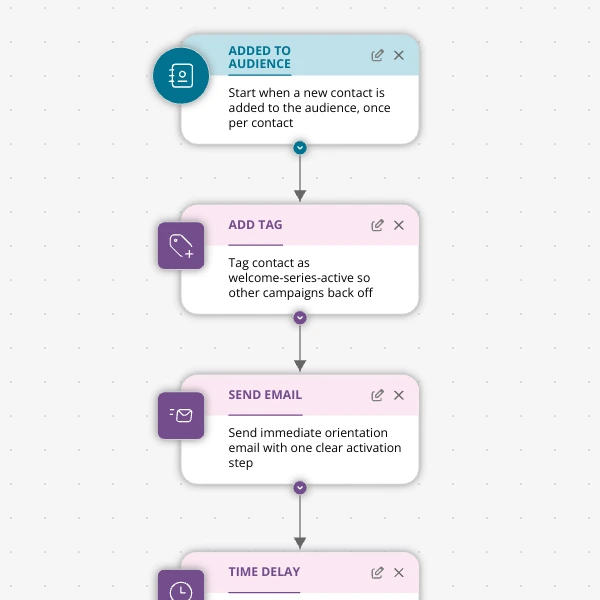
The Shopify app welcome series that turns installs into income
A step-by-step Shopify app welcome email journey for tools like CartSpark, showing how to turn new installs into activated, retained merchants using Spreeflo journeys, tags, and behavioral triggers so fewer trials quietly churn and more trials convert.
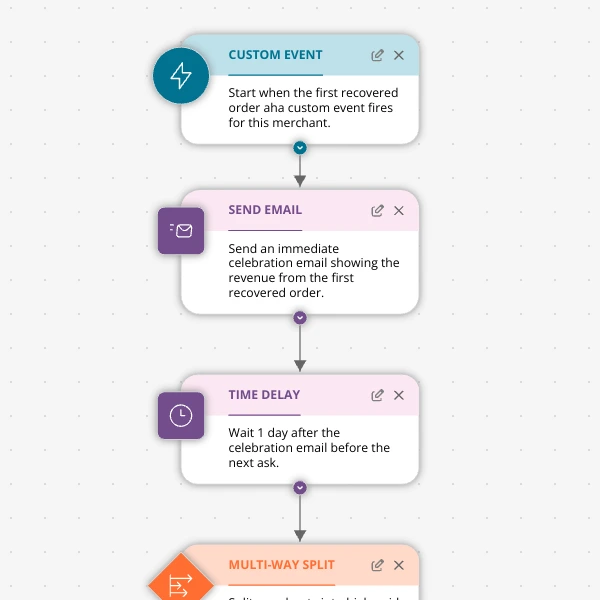
The Aha-Moment Playbook For Shopify Apps: Turn One Magic Action Into Months Of Revenue
A node-by-node playbook for Shopify and e‑commerce apps to center their lifecycle on one aha-moment custom event in Spreeflo, celebrate it, segment merchants by profile and engagement, and turn first recovered value into lasting revenue and retention.
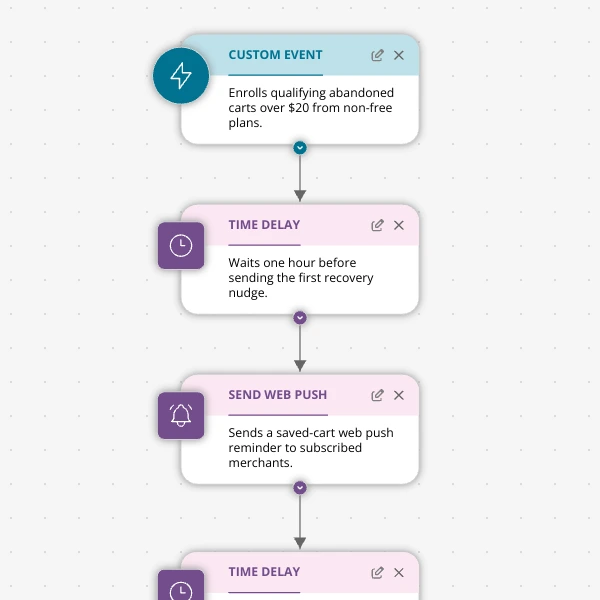
Stop Letting High‑Intent Carts Die: A 3‑Email Recovery Journey for Shopify Apps
A detailed, node-by-node walkthrough of a three-email (plus optional web push) cart-abandonment recovery journey for Shopify apps in Spreeflo, showing how to trigger events, branch on behavior, tag outcomes, and measure recovered carts and revenue.
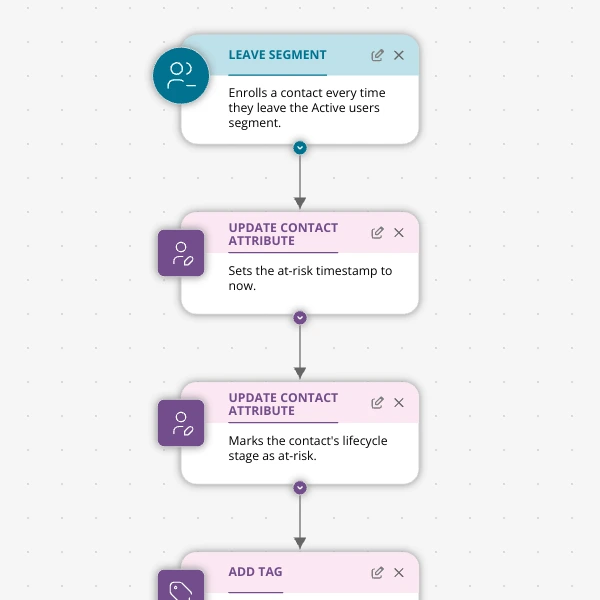
When Active Users Go Dark: A 4‑Touch Win‑Back Journey For Your Shopify App
A detailed, node-by-node Spreeflo journey for winning back previously active Shopify app users who stop engaging, using segment-based triggers, conditional logic, and a four-touch email plus internal alert sequence to recover usage and MRR.