Build an Evergreen SEO Education Engine for Your SaaS
A step-by-step playbook for SEO SaaS teams to turn existing content into a multi-stream, evergreen education engine in Spreeflo that nurtures leads, trials, and customers, plugs lifecycle leaks, and surfaces clear engagement and MQL signals.
Industry
Niche
Pattern
Loading sequence...
A lot of SEO SaaS funnels look great on a whiteboard and terrible in real life. Leads binge a few blog posts, maybe start a trial, then drop into a one-and-done “7-day onboarding” and disappear into silence.
For RankPulse or BrieflySEO, that silence is where churn and missed upgrades live. You have years of content, but only a tiny slice is ever used in automation. The rest sits in your blog archive while trial users quietly cancel. The sequence at the top of this page is the whole journey, end to end, built to fix exactly that.
This playbook walks through how to turn your best SEO content into a multi-stream, always-on education program in Spreeflo, so every contact is always in the right stream with the next useful lesson queued up.
Why single-track nurture breaks for SEO SaaS
Most SEO tools share the same pattern:
Complex product: rank tracking, briefs, audits, integrations.
Several distinct user types: agency SEOs, in‑house marketers, founders doing their own SEO.
Wide lifecycle spread: newsletter readers, evaluators, trials, long-term customers.
Yet the automation is often one linear sequence:
“Welcome” email
“How to get started”
“Here’s a case study”
Maybe a “last chance” trial extension
Then nothing.
Problems this creates:
New leads get trial-focused content they’re not ready for.
Mature customers see “how to start a trial” emails that make you look disorganized.
Agencies running client projects churn after one project because you never re-educate them on new use cases.
The pattern on this page replaces that with an education program where:
Content is organized into streams by lifecycle stage (and optionally interest).
A scheduler checks every day or week who should get the next lesson.
Stage changes (lead → trial → customer) automatically move people between streams.
It only works if you actually capture profile detail and product behavior. That’s the point: you win by knowing who each contact is and continuously nurturing them, not by blasting one more generic newsletter.
The architecture: three evergreen streams plus stage-change routing
At a high level, the journey in the sequence has four entry points:
A Cyclic trigger for your “Stage 1: Pre‑trial lead” stream.
A Criteria Match trigger for a time-bound “Stage 2: Trial onboarding” stream.
A Cyclic trigger for your “Stage 3: Customer education / expansion” stream.
A second Criteria Match trigger that reacts when a contact’s lifecycle stage changes and resets their stream position.
All four triggers have Re-enrollment turned on, because this program is meant to run for the lifetime of a contact. As long as they still match your criteria, they keep flowing through.
Under each trigger, the pattern looks similar:
Use profile state (like
lifecycle_stageand plan) to route into the correct stream.Use a numeric “position” attribute per stream to decide which lesson comes next.
Use Send Email nodes for the lessons, with Send only once toggled on.
After each lesson, Update Contact Attribute to increment the position.
Optionally use Check Email Activity, If/Else, and tags to mark high-intent or completed contacts.
Everything is wired in the visual editor you use to build a journey. Let’s walk it stream by stream.
Stream 1: Warming up pre‑trial leads
This stream nurtures newsletter subscribers, content downloaders, and leads who haven’t started a trial yet.
Entry: Cyclic trigger for leads
At the far left of the sequence, you’ll see a Cyclic trigger named something like “Lead nurture scheduler”.
Configuration:
Repeat interval: every 2 days, 09:00, in your primary timezone.
Criteria (via the segment builder):
- Contact attributelifecycle_stageislead.
- Email subscription status isSubscribed.
- Optional: custom number attributelead_stream_positionis less than 10 (so there’s still content to send).
Re-enrollment is on. Every two days, any contact who currently looks like a “lead” is eligible for the next lesson.
Routing: Multi-way Split by stream position
From the Cyclic trigger, the journey hits a Multi-way Split that branches on lead_stream_position:
Branch "position_0_or_blank":
lead_stream_positionis blank or is 0.Branch "position_1":
lead_stream_positionis 1.…
Branch "position_9":
lead_stream_positionis 9.Else branch: everyone who doesn’t match the above (e.g., position ≥10).
Each branch maps to one specific email in the lead stream. The Else branch is your safety net for people who’ve finished the stream.
Lessons: Send Email → increment position
Inside each branch, the pattern is identical:
Send Email
- Template: e.g., “Lead – Lesson 1: Keyword strategy that compounds”, “Lead – Lesson 2: Turning GSC into a roadmap”, etc.
- Use the email builder to pull in blog content, loom videos, or teardown screenshots.
- Toggle Send only once on, so if the contact ever loops back to this node, they won’t see duplicates.Update Contact Attribute
- Attribute:lead_stream_position(a custom NUMBER attribute).
- Update type:INCREMENT.
- New value:1.
That configuration adds 1 to whatever their current position is. Starting from 0 or blank, it moves them to 1 after the first lesson, 2 after the second, and so on.All branches then join into a Merge node, which simply recombines the paths and ends the stream for this tick.
For the Else branch (positions ≥10), you skip the email and either:
Add Tag:
lead_stream_completed, then exit; and/orUpdate Contact Attribute
lead_stream_activetofalseso your Cyclic criteria can exclude them on future ticks.
This is your first plug in the lifecycle leak: no more leads stuck between “blog reader” and “trial” with no context-aware follow-up.
Stream 2: Trial onboarding that doesn’t stall
Trials are time-bound. For this stage, a scheduled drip is less important than reacting to trial_start and product usage.
Entry: Criteria Match on trial start
A separate Criteria Match trigger labeled “Trial onboarding” lives near the top of the canvas:
Condition:
- Contact attributelifecycle_stageistrial.
- Custom timestamp attributetrial_started_atis within the last 1 day.
- Email subscription status isSubscribed.
Re-enrollment is off here if you only want one full onboarding run per trial. If you support re-trials, you can turn it on and refine the criteria to look at trial_started_at instead.
Your product should keep lifecycle_stage and trial_started_at up to date via the Spreeflo API or the web SDK, depending on whether you’re sending events server-side or from the browser.
The onboarding sequence: timed, behavior-aware emails
From this trigger, the path looks like a classic but smarter onboarding series:
Send Email – “Trial Day 0: One win in 15 minutes”
- Focus on one clear first action: connect GSC, add first site, or add first keywords.Time Delay – 1 day
Wait Condition – up to 3 days
- Condition (segment builder): custom eventadded_first_keywordhas triggered at least 1 time in the last 3 days, ORconnected_search_consolehas triggered at least 1 time.
- Timeout: 3 days.
The contact waits here until either they reach activation or three days pass.If/Else – “Activated?”
- If branch:
- Condition: a boolean attributeis_activatedis true, or the same events as in the Wait Condition.
- Actions:
- Add Tag:trial_activated.
- Send Email: “Nice work – here’s how to turn that into client wins.”
This shifts from “get started” to “here’s how to show ROI to your boss/client.”
- Else branch:
- Send Email: “Stuck? Here’s a 5‑minute walkthrough.”
- Optional Check Email Activity after a 1‑day Time Delay to see who clicked the walkthrough link and treat them as warmer intent.
Throughout this branch, make sure every Send Email node has a Time Delay before the next one the contact will see. The visual flow uses delays of 1–2 days between touches, so you never hammer someone’s inbox when they’re still deciding if you’re worth the learning curve.
The outcome:
Activated trials see deeper content and soft upgrade nudges.
Non-activated trials get focused help instead of generic spam.
This is the second lifecycle leak plugged: trials now either convert or fail with a clear record of what they did and didn’t engage with.
Stream 3: Customer education and expansion
Your customer stream is where you nurture long-term retention and expansion: using more features, adding more sites, inviting teammates.
Entry: Cyclic trigger for customers
On the right of the canvas, another Cyclic trigger powers this stream:
Repeat interval: every 7 days, 10:00.
Criteria:
-lifecycle_stageiscustomer.
- Email subscription status isSubscribed.
- Optional: exclude high-touch enterprise accounts with a tag likemanual_success_plan.
As with the lead stream, re-enrollment is on, because you want customers to receive an ongoing cadence of education as long as they fit the criteria.
Routing: Split by customer stream position and plan
From the trigger, the journey uses a Multi-way Split with slightly richer logic than for leads:
Branch “position_0_or_blank”: early customers.
Branch “position_1–3”: mid-stream.
Branch “position_4+”: long-time customers.
Within those, conditions may further filter by plan:
- AttributeplanisAgency.
- AttributeplanisPro.
- Else:Starter.
In practice, you might choose:
Stream A: Agency customers – content on reporting, client communication, and multi-site setups.
Stream B: In‑house / starter plans – content on in-house reporting, aligning with product and content teams.
Each branch points to a different Send Email node with content tuned to that combination of maturity and plan.
After each email:
Update Contact Attribute
customer_stream_positionwith INCREMENT 1.(Optional) Check Email Activity on that specific marketing email after a 3‑day Time Delay:
- Branchclicked: Add Tagexpansion_mqland optionally trigger a Send Internal Email to notify you or sales.
- Else: no tag, just rejoin via Merge.
This is where you start to see per-stream MQL rates. A contact who has made it to, say, customer_stream_position >= 4 and has clicked on 2+ expansion-focused lessons is a different quality of lead than someone who never opened a single education email.
Moving people between streams when their profile changes
All of this depends on a clean “single source of truth” for lifecycle stage and key profile attributes.
The sequence includes a second Criteria Match trigger labeled “Lifecycle stage changed”. Its condition is intentionally simple:
Email subscription status is
Subscribed.Tag
recalculate_streamsis present.
You then have a tiny separate automation (or your backend) apply recalculate_streams whenever lifecycle stage or a key interest attribute changes. When that tag is applied, this Criteria Match trigger fires.
Inside this arm:
If/Else on
lifecycle_stage:
- Iflead:
- Update Contact Attributelead_stream_positionset to 0.
- Remove Tagtrial_stream_active,customer_stream_active.
- Add Taglead_stream_active.
- Else iftrial:
- Resettrial_stream_positionto 0.
- Addtrial_stream_activetag, remove others.
- Else ifcustomer:
- Resetcustomer_stream_positionto 0.
- Addcustomer_stream_activetag.Remove Tag
recalculate_streamsso this trigger is ready to fire again next time something changes.
Because all your Cyclic triggers and stream splits read from the same attributes and tags, one consistent profile update is enough to move a contact from one stream to the next without manual list juggling.
This is where Spreeflo’s “capture detail on every customer so you can speak to each uniquely” really shows up: a lifecycle change isn’t just a CRM flag, it’s a routing change in your education engine.
Measuring engagement and MQL rate per stream
The pattern is built to surface the three metrics you care about:
Engagement score
You can store this as a custom NUMBER attributeengagement_scoreand use Update Contact Attribute to INCREMENT it when someone hits certain milestones (e.g., reaches lesson 5 in any stream, or clicks key emails). You can also build diagnostic segments like:
- Email Activity: opened at least 4 emails in the last 30 days.
- Tag containsexpansion_mql.
- Segment membership for “Trial stream engaged”.
From there, you can use the segment builder to create “high-engagement” cohorts and watch them over time.Stream-completion rate
Because you tag*_stream_completedat the end of each stream, a simple audience filter shows how many contacts reach that point vs. how many started (tag*_stream_active). Completion rate per stream gives you a quick health check on your content’s pull.MQL rate per stream
Treat tags likelead_mqlandexpansion_mqlas MQL markers, applied only when contacts meet both engagement and behavior thresholds. Then use segments to ask:
- “Of everyone withlead_stream_active, how many have taglead_mql?”
- “Of everyone withcustomer_stream_active, how many have tagexpansion_mql?”
Because all of this runs in the same system that sends your emails, reporting is far simpler than gluing together half a dozen tools. You can scale this without bidding up a bloated stack; if you care about costs as you grow, it’s worth skimming Spreeflo’s pricing to see how this compares to legacy tools.
Adapting the pattern to your SEO SaaS
The visual sequence is built around lifecycle stage, but you can easily pivot it:
By interest: content vs technical vs local SEO streams, keyed off a “primary_interest” attribute that you set from a form or early onboarding choices.
By role: agency vs in-house vs founder, if you collect it on signup.
By feature cluster: one stream for rank tracking power users, another for content brief power users.
The structure remains the same:
Cyclic triggers keep the engine running.
Position attributes keep each stream ordered.
Criteria Match triggers and tags move contacts between streams when their profile changes.
Emails are tuned to where they are and what they care about.
You built an SEO product because compounding curves make sense to you. This is the same idea applied to your marketing: a system where every touch builds on the last, across months and years, without more headcount or weekly manual campaigns.
Founder-led businesses win on leverage, not on how many people they can put behind a keyboard. An always-on, multi-stream education journey is one of those rare systems where a few hours of thoughtful setup in Spreeflo keep paying off indefinitely.
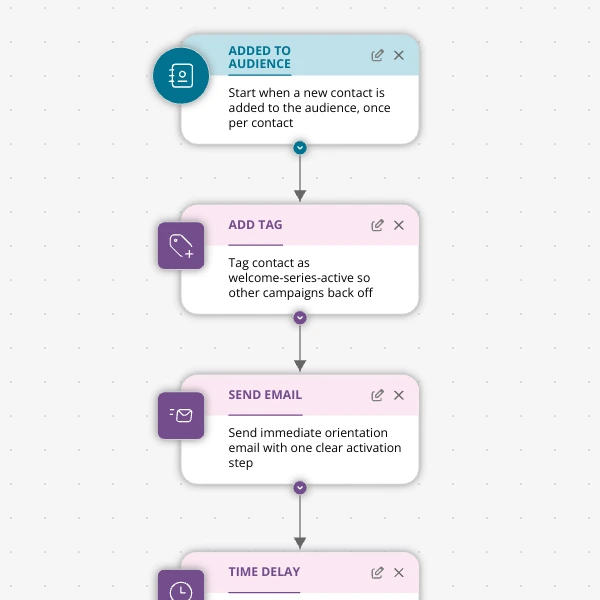
The Shopify app welcome series that turns installs into income
A step-by-step Shopify app welcome email journey for tools like CartSpark, showing how to turn new installs into activated, retained merchants using Spreeflo journeys, tags, and behavioral triggers so fewer trials quietly churn and more trials convert.
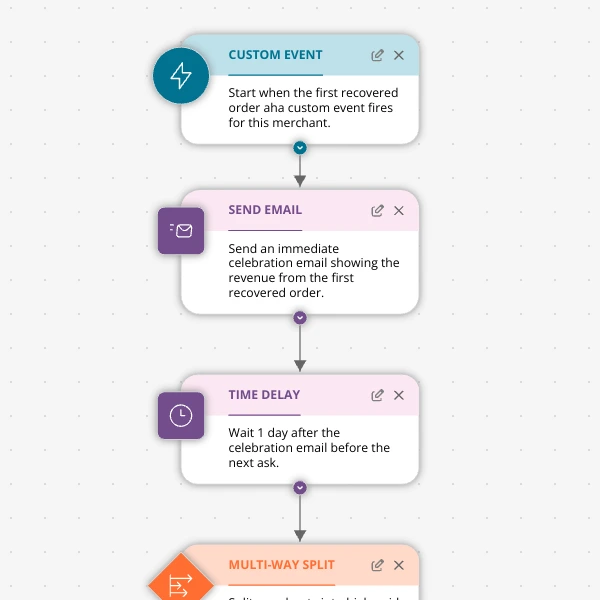
The Aha-Moment Playbook For Shopify Apps: Turn One Magic Action Into Months Of Revenue
A node-by-node playbook for Shopify and e‑commerce apps to center their lifecycle on one aha-moment custom event in Spreeflo, celebrate it, segment merchants by profile and engagement, and turn first recovered value into lasting revenue and retention.
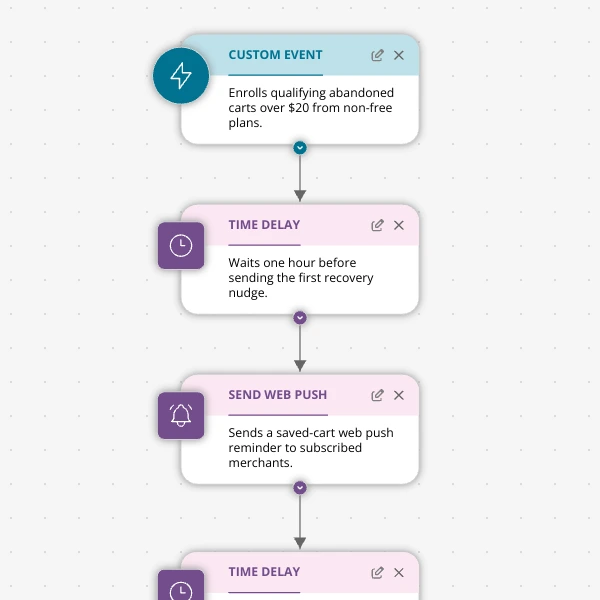
Stop Letting High‑Intent Carts Die: A 3‑Email Recovery Journey for Shopify Apps
A detailed, node-by-node walkthrough of a three-email (plus optional web push) cart-abandonment recovery journey for Shopify apps in Spreeflo, showing how to trigger events, branch on behavior, tag outcomes, and measure recovered carts and revenue.
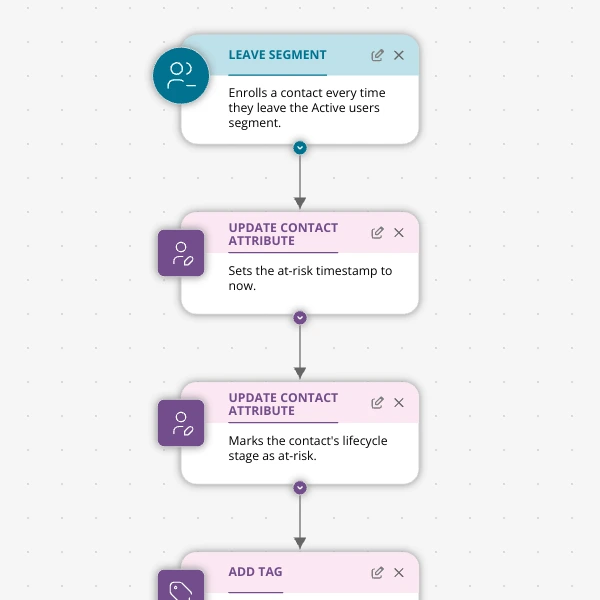
When Active Users Go Dark: A 4‑Touch Win‑Back Journey For Your Shopify App
A detailed, node-by-node Spreeflo journey for winning back previously active Shopify app users who stop engaging, using segment-based triggers, conditional logic, and a four-touch email plus internal alert sequence to recover usage and MRR.