Don’t Let Cancel Clicks Be the End: A Churn‑Save Journey for SEO SaaS
A detailed churn‑save journey for SEO SaaS that listens for cancel intent and at‑risk signals, triages by account value, and uses targeted emails, tags, and events in Spreeflo to rescue customers and measure saves, cancellations, and post‑save retention automatically.
Industry
Niche
Pattern
Loading sequence...
Someone hits your “Cancel subscription” page. Stripe pings you a few minutes later. By the time you see it in your inbox, they’re already gone.
For a rank tracker or content-brief tool doing $30k–$100k MRR, that moment adds up to real money fast.
The sequence at the top of this page is the whole journey, end to end: it catches both hard cancellation intent and quiet churn risk, responds with a tailored save offer, and pulls a human in when it matters.
This playbook walks through that journey node by node, tuned for SEO SaaS.
What this journey is trying to fix
Most SEO SaaS teams only see churn at two points:
When someone stops logging in.
When billing actually cancels the subscription.
Everything in between is a blind spot. You don’t know who hesitated on the cancel page, who is quietly at risk, or who would have stayed if they’d had a quick call or a smarter offer.
That blind spot is pure lifetime‑value leak.
This journey closes it by:
Listening for strong churn signals (cancel page views, “at‑risk” tags).
Responding differently based on each customer’s behavior and value.
Giving them a clear alternative to cancelling: pause, downgrade, or hands‑on help.
Alerting a human when a valuable account is on the edge.
Tagging outcomes so you can measure save rate, cancellation rate, and post‑save retention.
You’ll build it in Spreeflo as a continuously running journey in the journey editor, not a one‑off campaign, so it quietly does this for every customer without more manual work.
Step 1: Wire in the two churn‑risk triggers
This journey has two behavioral entry points, each as its own Trigger node:
A Custom Event for hard cancellation intent.
An Added Tag for softer “at‑risk” health.
They’re separate branches in the same journey so you don’t need to maintain two different flows.
Trigger A: Custom Event – “cancel intent”
For SEO SaaS, this usually means:
The user visited
/billing/cancelor a “Close account” screen.Or they started a cancellation flow inside your app.
You capture that as a custom event and trigger the journey with a Custom Event trigger:
Event name:
cancel_intent_started(or similar).Optional property filters: plan tier, billing period (monthly vs annual), or user role.
How to get the event into Spreeflo:
If you fire it from your web app, use the SDK: when someone lands on the cancel page or clicks “Start cancellation,” your frontend calls
Spreeflo.track('cancel_intent_started', { plan_tier: 'Agency', billing_period: 'annual' }).If you catch it server‑side (for example in a billing portal), post the event to the Spreeflo API from your backend with the contact’s email and properties.
Set this trigger’s re‑enrollment to on. Every time a customer reaches the cancel flow, they should be eligible for this save path again (Spreeflo still prevents parallel runs while they’re mid‑journey).
Trigger B: Added Tag – “at‑risk”
The second entry is earlier in the lifecycle: you or your product logic tag someone as at‑risk based on usage signals:
No
added_first_keywordorgenerated_content_briefin the first 10 days.Previously active (daily rank checks) but no login for 21 days.
Agency plan with several inactive workspaces.
Your app, data job, or another journey applies a tag like at-risk to the contact. That fires an Added Tag trigger:
Tag:
at-risk.Re‑enrollment: on. A customer can swing in and out of risk multiple times over their lifetime.
Now you have two clear doors into the flow: “I’m about to cancel” and “I’m quietly drifting away.”
Step 2: Triage by value before you say anything
Not every account deserves the same level of human follow‑up. An agency paying $499/mo needs different treatment from a solo blogger on the starter plan.
Right after each trigger, add a quick If/Else split on value, using contact attributes you already sync from your app:
Annual recurring revenue (e.g.,
mrrorplan_price).Plan type (
Agency,Team,Solo).Seat count, if you track it.
“Yes” branch: high‑value.
“Else” branch: everyone else.
On the high‑value side, drop a Send Internal Email action immediately:
Recipient: you, customer success, or a shared inbox.
Subject: “High‑value account started cancelling: {{ company_name }} – {{ plan_type }}”.
Body: include key context (plan, MRR, last login, top features used) with personalization variables.
Then use a Merge node to bring both branches back into a single path. From here on, both high‑value and normal accounts get the same automated logic, but the right humans have been alerted for the ones that matter most.
You’ll repeat this “quick triage + internal email + merge” pattern on both the cancel‑intent trigger and the at‑risk trigger.
Step 3: The hard cancel path – save offer plus 7‑day watch window
Let’s walk through the cancel‑intent branch first.
3.1 Send a “before you cancel” email immediately
From the Merge after your cancel‑intent trigger, add a Send Email node:
This goes out right away, no delay.
Choose a short, plain‑spoken subject: “Before you cancel {{ product_name }}…”
The body should:
Acknowledge their intent directly.
Show specific value they’ve already created (“You’re tracking 148 keywords and have shipped 12 briefs from RankPulse”).
Offer concrete paths other than cancelling: pausing, downgrading, or a 15‑minute consult.
Design it in Spreeflo’s email builder, pulling in contact attributes like keywords tracked, projects created, or team size. This is where “capture detail on every customer so you can speak to each uniquely” stops being a slogan and becomes obvious in the inbox.
Leave “Send only once” toggled on for this email. Even if they start the cancel flow multiple times over the years, you don’t want to hammer them with the same save pitch.
3.2 Give them air, then branch on behavior
Next, insert a Time Delay:
Delay: 1 day.
Unit: Day(s).
After 24 hours, use Check Email Activity on that save email with three branches:
Clicked a link.
Opened but didn’t click.
Did not open.
That split matters:
Clickers are actively considering options.
Open‑no‑click saw the pitch but didn’t care enough to act.
Non‑openers might just have missed it or filtered it out.
Clicked branch: lean in with human help
On the “Clicked” path:
If you want extra triage, you can add another If/Else here to filter high‑value accounts again and send an additional Send Internal Email just for those clicks (“Agency plan clicked cancel‑save email”).
Then send them straight into a Merge node that will later receive all three behavior branches.
You might be tempted to send another marketing email here, but usually the click means they hit:
A “book a call” page.
A help doc about pausing or downgrading.
A mini cancellation‑reason survey in‑app.
Let the link do its job. The human‑touch handoff is the internal email you already sent on high‑value accounts.
Opened but didn’t click: one more nudge
On the “Opened but didn’t click” path:
Insert a Time Delay of 1 day.
Then add a second Send Email:
Subject: “Quick question about {{ product_name }} before you leave”.
Body: very short, from a founder or head of product angle, asking what’s making them leave and offering to help or adjust their plan.
Spreeflo’s send‑spacing rule matters here: the delay keeps you from stacking emails back‑to‑back in a way that feels spammy.
After this second email, send the path into the same Merge node.
Didn’t open: a last, light touch
On the “Did not open” branch:
Add a Time Delay of 1 day.
Then a third Send Email with a very different feel:
Plain‑text style.
A subject that reads like a personal note (“Can I ask a 5‑second favor?”).
A single question in the body, maybe with a one‑click answer link: “What’s the main reason you’re leaving? A) Price, B) Didn’t get results, C) Switched tools.”
Again, after this, send the path into the Merge node.
Now every cancel‑intent contact, regardless of engagement level, flows into the same next stage.
3.3 Wait up to 7 days to classify saved vs lost
From that Merge, add a Wait Condition:
Condition: Custom Event
subscription_cancelledtriggered at least 1 time in the last 7 days.Timeout: 7 days.
Your billing system should POST a subscription_cancelled event to the Spreeflo API whenever Stripe or Paddle actually cancels a subscription. That event is the ground truth for whether your save attempt worked.
This Wait Condition does two things:
If they cancel quickly, the condition becomes true and the flow moves on without waiting the full week.
If they don’t cancel, it times out at 7 days.
Immediately after, add an If/Else node with the same event‑based condition:
If they have
subscription_cancelledat least once in the last 7 days:
→ Add Tagchurn-lost.Else:
→ Add Tagchurn-saved-after-intent.
Now you know exactly how many “I’m cancelling” users you’ve actually kept, which is the core save‑rate metric for this path.
Step 4: The at‑risk path – stop quiet churn before it hits Stripe
The second arm of the journey starts from the Added Tag trigger on at-risk. This is about prevention rather than rescue.
4.1 Triage and internal alert, again
Just like the cancel path, immediately branch on value with If/Else:
High‑value “yes” side: Send Internal Email (“High‑value account marked at‑risk”).
Everyone merges back through a Merge node.
You want customer success or the founder to see a weekly trickle of “these are the accounts sliding away” without combing through dashboards.
4.2 Split by activation level
From the Merge, drop a Multi-way Split based on product behavior:
Branch 1: Never activated core value.
Custom Eventadded_first_keywordhas not triggered over all time.Branch 2: Was active, now slipping.
Custom Eventadded_first_keywordtriggered at least 1 time over all time
AND
Nochecked_rankingsevent in the last 14 days.Else branch: Everyone who doesn’t fit cleanly (you can treat them as “generic at‑risk”).
You define these conditions directly in the segment builder inside the Multi‑way Split.
4.3 Branch 1: Never activated
These are trial‑to‑paid conversions who never found the “aha” moment.
On this branch:
Send Email: an activation‑focused message.
Time Delay: 3 days.
If/Else:
Subject: “Let’s get your first keywords ranking this week”.
Body: show a 3‑step path to value and link straight to the “add first keyword” screen. If you track their site inside Spreeflo as an attribute, you can even suggest a couple of starter keywords by name.
Condition:
added_first_keywordfired at least once in the last 3 days.If yes: Add Tag
risk-resolved-activated.Else: Add Tag
still-at-risk-no-activation(which you might use to feed a separate win‑back or pricing‑change experiment later).
4.4 Branch 2: Was active, now slipping
These users have already proven the product fits. They’re just not coming back.
Here:
Send Email: a value‑reminder and insight email.
Time Delay: 5 days.
If/Else:
Subject: “Here’s what {{ product_name }} has already done for you”.
Body: recap the last 30 days or 90 days of value: number of keywords tracked, briefs generated, pages that moved up in SERPs. Those stats live as contact attributes you sync into Spreeflo; the email feels tailored, not generic.
Condition:
checked_rankingsORgenerated_content_brieftriggered at least once in the last 5 days.If yes: Add Tag
re-engaged-from-risk.Else: Add Tag
still-at-risk-low-usageand optionally another Send Internal Email for very high‑value customers (“Agency still at‑risk after re‑engage email”).
4.5 Else branch: Generic at‑risk
On the catch‑all branch, send a simple check‑in:
One Send Email asking what’s blocking them and offering a quick Loom walkthrough or strategy review, then a Time Delay, then an If/Else keyed to any meaningful event in your product in the following few days.
You don’t need to over‑engineer this branch on day one. It exists so no at‑risk tag is ignored.
Step 5: Reading the numbers that actually matter
By the time contacts fall out of this journey, they carry a rich combination of:
Behavior events (cancel intent, cancellation, product usage).
Tags describing the path they took (
churn-saved-after-intent,risk-resolved-activated,still-at-risk-low-usage).Attributes around plan, MRR, and use case.
That’s the foundation for the three metrics you care about:
Save rate from hard cancel intent
Cancellation rate among at‑risk
Post‑save retention
Build a segment where:
Tag contains
churn-saved-after-intent.
Compared with:
Custom Event
cancel_intent_startedtriggered at least once over all time.
That ratio is “we thought we lost them, but we didn’t.” As you iterate copy and offers, you want to see it climb.
Look at contacts who entered through the at-risk Added Tag trigger and later have the churn-lost tag (or the subscription_cancelled event). That tells you how predictive your “at‑risk” logic is and whether this journey actually moves the needle.
For everyone with churn-saved-after-intent, track whether they later fire subscription_cancelled again in the next 90 days. That’s another segment you define with the same web tracking and analytics event data.
None of this needs another BI tool. It’s just saved segments and event filters on top of the structure you already laid down in the journey.
Why this earns its spot in your stack
For an SEO SaaS founder, it’s easy to obsess over acquisition and rankings. But the quiet reality is that most of your lost lifetime value slips out at exactly the moments this journey watches:
The split‑second where someone hesitates on the cancel page.
The slow fade from “daily rank checks” to “haven’t logged in this month.”
By capturing detailed behavior on every customer and responding differently based on what they actually do, you stop treating churn as a flat binary flag and start treating it as a series of conversations.
You build this once in Spreeflo, connect it to your product events via the Spreeflo API, design a few well‑targeted emails in the email builder, and it keeps running while you ship features and write content.
That’s the point: less guesswork, less silent churn, more customers saved at the exact moment they were about to walk away.
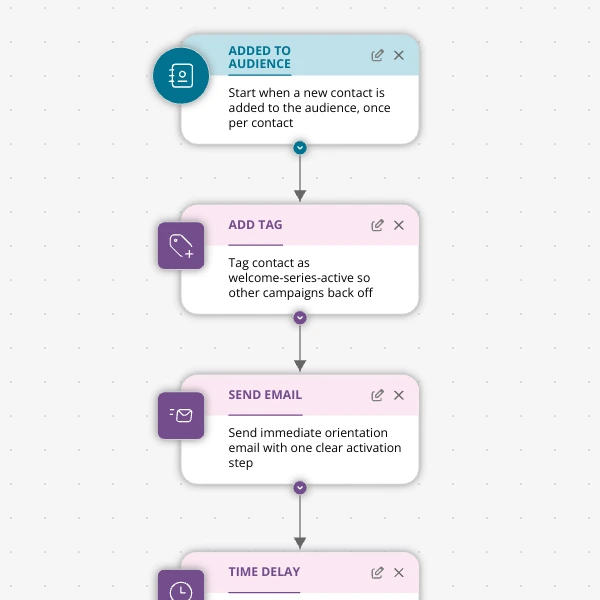
The Shopify app welcome series that turns installs into income
A step-by-step Shopify app welcome email journey for tools like CartSpark, showing how to turn new installs into activated, retained merchants using Spreeflo journeys, tags, and behavioral triggers so fewer trials quietly churn and more trials convert.
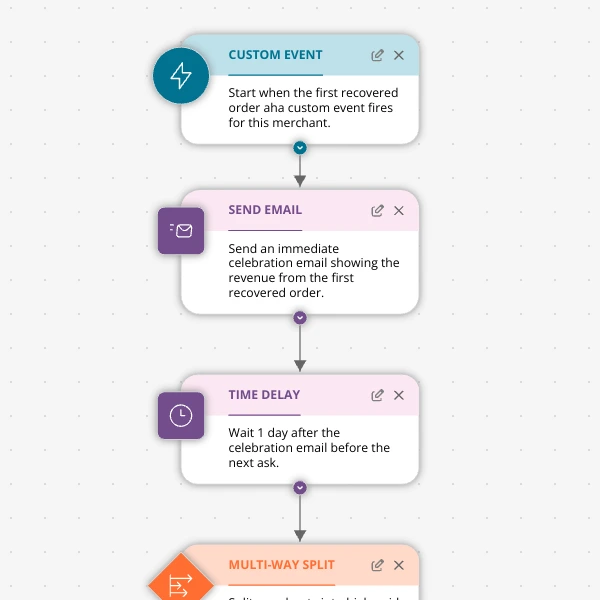
The Aha-Moment Playbook For Shopify Apps: Turn One Magic Action Into Months Of Revenue
A node-by-node playbook for Shopify and e‑commerce apps to center their lifecycle on one aha-moment custom event in Spreeflo, celebrate it, segment merchants by profile and engagement, and turn first recovered value into lasting revenue and retention.
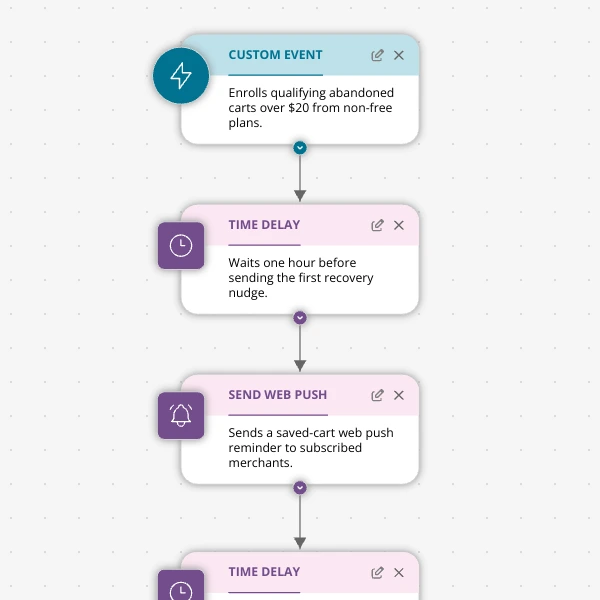
Stop Letting High‑Intent Carts Die: A 3‑Email Recovery Journey for Shopify Apps
A detailed, node-by-node walkthrough of a three-email (plus optional web push) cart-abandonment recovery journey for Shopify apps in Spreeflo, showing how to trigger events, branch on behavior, tag outcomes, and measure recovered carts and revenue.
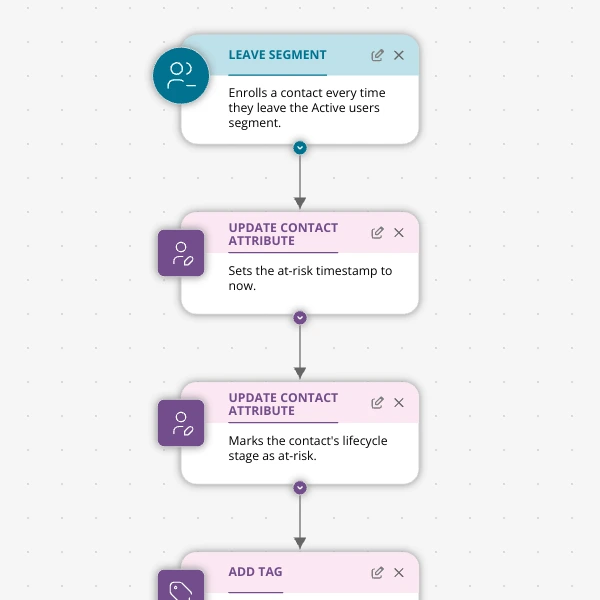
When Active Users Go Dark: A 4‑Touch Win‑Back Journey For Your Shopify App
A detailed, node-by-node Spreeflo journey for winning back previously active Shopify app users who stop engaging, using segment-based triggers, conditional logic, and a four-touch email plus internal alert sequence to recover usage and MRR.