One Question, Three Journeys: Persona-Based Paths for SEO SaaS
Build a Spreeflo journey that routes SEO SaaS signups into persona-specific onboarding for agencies, in-house SEOs, and founders, so each sees the right features, activates faster, and reaches a clear, persona-based MQL state.
Industry
Niche
Pattern
Loading sequence...
A founder at “RankPulse” looks at their onboarding stats and winces: agencies churn after two months, solo founders ghost after the trial, and in-house SEOs barely touch the technical features. Same product, three totally different jobs to be done — all getting the same copy-pasted onboarding.
That’s the gap this pattern fixes: one simple persona choice (agency, in-house, founder) that drops every new user into a nurture stream written exactly for their world. The sequence at the top of this page shows what happens the moment a persona tag is set.
In this playbook, we’ll build that journey for an SEO SaaS: rank tracking, content briefs, and technical SEO. We’ll wire it in Spreeflo so your “are you an agency or in-house?” question powers everything that follows — emails, timing, and how you define a marketing-qualified lead (MQL) for each persona.
Why generic onboarding quietly kills SEO SaaS growth
If you sell SEO tooling, you already live in a segmented world:
Agencies juggle 10–50 clients and care about reporting, multi-project views, and margin.
In-house SEOs need to justify budget, show wins to leadership, and go deep on one domain.
Solo founders want quick, low-effort wins that don’t eat their week.
When all three see the same “Welcome to RankPulse, here’s how to add a project” sequence, a few predictable things happen:
CTR is mediocre because half your examples don’t apply.
Agencies never see the white-label or multi-client features that would keep them past the first project.
In-house SEOs see “add more clients” language and mentally file you under “agency tool.”
Your trial-to-paid and persona-to-MQL numbers are muddy; you can’t tell who’s actually qualified or just being polite.
Persona-based paths do the opposite. They capture one high-signal detail upfront, then use it to shape:
The stories and case studies you tell.
Which features you highlight first.
What “qualified” means for that persona (e.g., agency = 3+ projects added; in-house = GSC integrated; founder = first ranking uplift report viewed).
Spreeflo is built for exactly this: capture detail on every customer so you can speak to each uniquely. Let’s turn that principle into a concrete journey.
The core idea: one persona choice, three nurture streams
We’ll assume you ask a single question early in the relationship:
“Which best describes you?”
– SEO agency / consultant
– In-house marketer / SEO
– Founder / solo operator
There are two clean ways to capture that answer:
On your marketing site or signup page
Build the signup or “start free trial” as a Spreeflo form with a required Email field plus a persona question. Turn on Map to contacts and map that persona question to a custompersonaattribute. You can do all of that from the forms UI; the help doc on how to create and embed forms walks through it.As a one-question in-app micro-survey
Once the user is logged in and identified via the SDK, show a Spreeflo popup form with just the persona question. Again, map the answer to thepersonaattribute.
In both cases, the submission creates/updates a contact in your audience with a persona value of "agency", "in_house", or "founder".
From there, you (or a tiny helper journey) apply a corresponding tag for each persona:
persona_agencypersona_inhousepersona_founder
That’s all the “data plumbing” you need. The main journey we’re focused on here starts the moment one of those persona tags is added and runs the full onboarding / nurture path.
Tag strategy and triggers: how contacts enter the journey
Inside Spreeflo, tags are your routing switches. You’ll use them both to start journeys and to measure performance later.
For this pattern:
Create three persona tags as above.
(Optional but recommended) Create three “MQL” tags that mark when each persona is sales-ready:
persona_agency_mqlpersona_inhouse_mqlpersona_founder_mql
Now, in the journey builder (Campaigns & Journeys → New Journey), set up three entry points:
Added Tag trigger: tag =
persona_agency, Re-enrollment = ONAdded Tag trigger: tag =
persona_inhouse, Re-enrollment = ONAdded Tag trigger: tag =
persona_founder, Re-enrollment = ON
Re-enrollment is important here. If someone changes their mind later (e.g., a freelancer grows into a small agency and updates their settings), you want them to be eligible for a new persona journey once they finish the current one. Spreeflo also prevents mid-journey double-enrollment, so they won’t get two sequences at once.
Each trigger anchors its own branch of the journey: three persona-specific paths living side by side on the same canvas. The sequence at the top of this page shows those three arms visually.
Walking the journey, node by node (Agency example)
To keep this concrete, we’ll go deep on the agency path. The in-house and founder arms will mirror the same structure with different content.
1. Added Tag → Update Contact Attribute
Node: Added Tag
Tag: persona_agency
As soon as the agency tag is applied, the contact enters this branch.
First action node after the trigger:
Update Contact Attribute
Attribute:persona(custom TEXT attribute)
Update type: Update
Value:"agency"
Even if you already mapped the form answer to persona, this node acts as a safety net: every contact coming through the agency path has a clean, canonical persona value you can reuse in the segment builder and future journeys.
2. Send Email: persona-specific welcome
Node: Send Email
Content: Agency-focused welcome
This is your first touch and should:
Acknowledge who they are (“You’re juggling multiple client sites, so let’s get your first three set up fast.”).
Highlight 1–2 agency-fluent features (multi-project dashboards, scheduled white-label reports).
Give a single, focused CTA (e.g., “Add your first client site”).
Build this in Spreeflo’s email builder using saved variables for name and product URLs. Keep “Send only once” turned on so a re-enrolled agency doesn’t get the same email twice.
3. Time Delay: give them room to act
Node: Time Delay
Configuration: 2 days, unit = Day(s)
You never want back-to-back sends. This delay gives them time to actually add a site before you decide what to send next.
During those two days, your product should be firing key events into Spreeflo whenever the user hits important milestones. For browser-side events (e.g., adding a keyword in the web app), call the Spreeflo SDK from your frontend (for example, 'added_first_keyword' with basic properties). For backend-only events (e.g., when a bulk import finishes on your server), POST them into the Spreeflo API. Those events become the signals the next node uses.
4. If/Else: did they activate?
Node: If/Else
Condition (simplified):
Custom event
added_first_siteat least 1 time over all time, ORCustom event
added_first_keywordat least 1 time over all time
You configure that condition via the Segment Builder embedded in the If/Else node:
Type:
custom_eventOperator:
AT_LEASTFrequency: 1
Time window: over all time (or the last 7 days if you want a tighter window)
This split creates two branches:
Then branch: “Activated” (they’ve added something meaningful).
Else branch: “Not activated” (they haven’t set up a site/keyword yet).
This is where persona meets behavior. An agency who has already added three client sites needs very different content from an agency who never got past the welcome email.
5. Activated branch: help them scale to all clients
First node in “Activated” branch: Send Email
Content: “Turn one happy client into ten”
This email can:
Show how to clone configurations to new projects.
Show a 3-minute walkthrough on setting up scheduled reports for each client.
Include a short case study from an agency with similar client size.
Next:
Time Delay: 3 days
Send Email: “Automate client reporting once and for all”
The second email might:
Go deeper on templates, branding, and collaboration.
Include a clear CTA to enable monthly email reports for all clients.
Finally:
Add Tag:
persona_agency_mql
This tag is your MQL marker: an agency that has activated and seen your multi-client value stories is ready for sales follow-up or a trial-extension offer. A separate journey or campaign can use a Join Segment or Added Tag trigger for persona_agency_mql to notify sales or send a targeted offer.
Note the pacing rule: there’s a Time Delay node between every pair of Send Email nodes. No contact ever gets two emails without at least a 1-day gap.
6. Not-activated branch: remove setup friction
On the “Else” side of the If/Else:
First node: Send Email
Content: “90-second setup for your first client”
Make this ultra-practical:
One short video or GIF showing how to add a client and their first keyword.
A bullet list of “what you need before you start” (domain, target country, a seed keyword).
Clear CTA back into the product.
Then:
Time Delay: 3 days
Next, we want to give them a bit more time to act, but we don’t want to wait forever. This is where Wait Condition comes in.
Node: Wait Condition
Configuration:
Condition: same “activated” definition as before (added site or keyword).
Timeout: 5 days, unit = Day(s)
This step pauses each contact until either:
They activate, or
Five days elapse with no activation.
As soon as either is true, they move to the next node: another If/Else that checks whether they’re now activated.
Node: If/Else
Condition: “activated” (again)
Branches:
If yes: jump into the later part of the Activated branch (e.g., the “Automate client reporting” email).
Else: send a different kind of email — one that sells the outcome rather than the setup.
For example:
Send Email: “How agencies use RankPulse to win and retain clients”
Time Delay: 7 days
Add Tag:
persona_agency_needs_help(so you can build a manual outreach list if you want)
The key principle: the non-activated path doesn’t keep shouting “add a project” forever. It pivots to value stories and light-touch education, while still being written in agency language.
Mirroring the structure for in-house and founder personas
You don’t need three totally different automations to benefit from this pattern. You need three different stories on the same spine:
Same entry pattern: Added Tag → Update Contact Attribute → Welcome email.
Same core split: after a short delay, If/Else on whether they activated.
Same pacing: 2–3 emails per persona, each separated by Time Delay nodes.
Same MQL concept: a final Add Tag when they reach a persona-specific threshold.
You just change:
Which product actions count as “activated.”
In-house: integrating Google Search Console or adding the primary domain.
Founder: connecting their Shopify/WordPress site and generating the first brief.What “MQL” means.
In-house: viewing a rankings report and inviting a teammate.
Founder: generating at least two briefs and viewing their first uplift chart.The examples and language in each email.
The structure stays identical; the narrative shifts.
Because all three arms live in a single journey, it’s easy to manage and reason about. If you ever want to tweak your activation definition, you update one condition group instead of three different systems.
Measuring success: persona CTR and persona-to-MQL
Once the journey is live, you want to know if it’s doing real work or just adding noise. Two metrics matter most for this pattern:
Persona-specific CTR
Persona-to-MQL rate
Use Spreeflo’s email analytics plus your tags:
Filter reports by tag =
persona_agencyto see open and click-through on each step of that path.Compare against
persona_inhouseandpersona_founder.
If agency CTR is 18% and founders are at 9%, that tells you where copy needs attention.
Because each branch ends with a persona-specific MQL tag, you can build three simple segments in the audiences view:
Agencies who entered journey vs. agencies with
persona_agency_mqlIn-house who entered vs. in-house with
persona_inhouse_mqlFounders who entered vs. founders with
persona_founder_mql
That gives you three clear conversion rates: how many people with that persona made it to your definition of “ready.”
You can build those segments using the segment builder, combining Tag rules and Email Activity or Custom Events if you want more nuance.
If you want to A/B test subject lines or content, drop a Random Split node just before the first email in each persona branch and route half of them to variant B. Both sides should still respect spacing with Time Delays.
Putting it all together: why this matters for a small SEO SaaS team
For a 3–5 person SEO SaaS, you don’t have time to manually handcraft onboarding for every new sign-up. But you do have time to:
Add a single persona question to your Spreeflo form.
Configure three Added Tag triggers and a handful of nodes in the journey builder.
Wire a couple of product events into the SDK and the Spreeflo API.
From that point on, every agency, in-house SEO, and founder who hits your site walks a path written in their language, pointing to the parts of your product that actually matter to them. You’re still sending “the welcome series,” but it’s three different versions built on the same spine.
That’s the deeper win of this pattern. You’re not blasting more email. You’re capturing one high-signal detail about each customer and letting it shape everything they see from you. For founder-led SaaS, that’s how automation becomes a multiplier instead of more noise: you configure it once, and every signup after that gets the kind of onboarding you’d write by hand if you had the time.
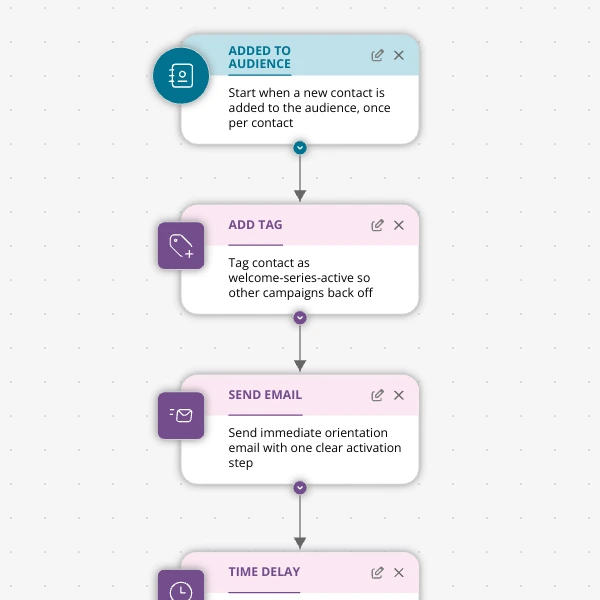
The Shopify app welcome series that turns installs into income
A step-by-step Shopify app welcome email journey for tools like CartSpark, showing how to turn new installs into activated, retained merchants using Spreeflo journeys, tags, and behavioral triggers so fewer trials quietly churn and more trials convert.
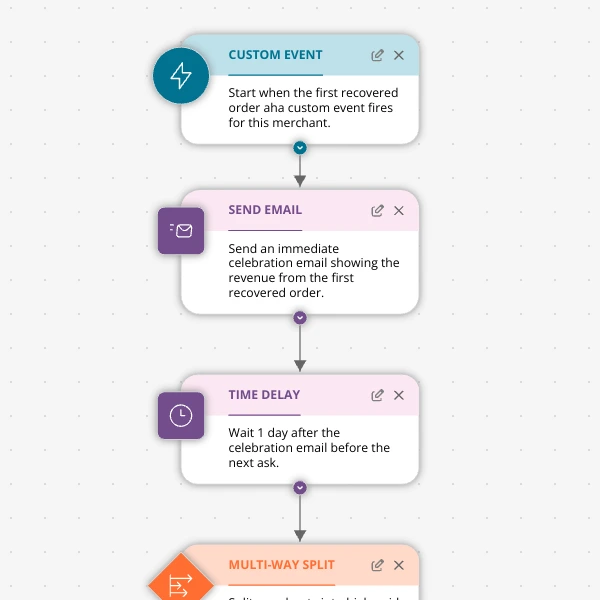
The Aha-Moment Playbook For Shopify Apps: Turn One Magic Action Into Months Of Revenue
A node-by-node playbook for Shopify and e‑commerce apps to center their lifecycle on one aha-moment custom event in Spreeflo, celebrate it, segment merchants by profile and engagement, and turn first recovered value into lasting revenue and retention.
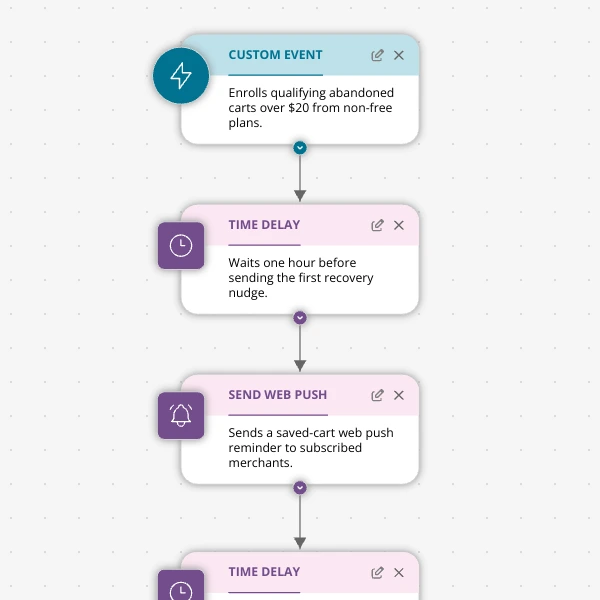
Stop Letting High‑Intent Carts Die: A 3‑Email Recovery Journey for Shopify Apps
A detailed, node-by-node walkthrough of a three-email (plus optional web push) cart-abandonment recovery journey for Shopify apps in Spreeflo, showing how to trigger events, branch on behavior, tag outcomes, and measure recovered carts and revenue.
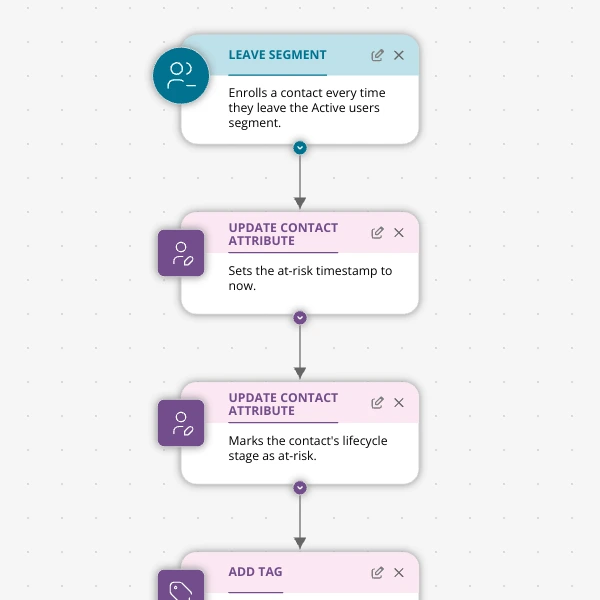
When Active Users Go Dark: A 4‑Touch Win‑Back Journey For Your Shopify App
A detailed, node-by-node Spreeflo journey for winning back previously active Shopify app users who stop engaging, using segment-based triggers, conditional logic, and a four-touch email plus internal alert sequence to recover usage and MRR.