Save Failing Trials: A Dormant-Day-One Nudge Journey for SEO SaaS
This playbook walks through a Spreeflo journey that detects dormant day‑one SEO SaaS trials, nudges them with persona‑specific emails, and routes reactivated users back into your main onboarding while tagging cohorts so you can measure reactivation and conversion.
Industry
Niche
Pattern
Loading sequence...
Half your trial signups probably never see your product twice. They land, poke around once, then vanish back into their tab graveyard.
For an SEO SaaS where lifetime value is measured in years, that day‑one drop-off is brutal. It’s also predictable enough that you can automate around it.
The sequence at the top of this page is the whole journey, end to end. In this article, we’ll unpack how it works and how to adapt it for your own app.
We’ll use a fictional SEO tool, “RankBeacon” — a 4‑person team at ~$60k MRR that offers rank tracking and content briefs — as the running example.
Why day-one drop-off quietly wrecks your trial math
Most SEO SaaS funnels already have a “happy path” trial onboarding:
Welcome email
A few feature tours
Maybe a weekly product tip
Those flows assume people keep logging in.
The hidden leak is everyone who:
Starts a trial
Logs in once on day one
Never comes back
In RankBeacon’s case, those dormant trials made up 40–50% of signups. They were cluttering up cohorts, depressing trial‑to‑paid conversion, and masking the true performance of the core onboarding.
The fix isn’t “send more email.” It’s to:
Detect the moment a trial is clearly dormant.
Route those users into a different journey: fewer features, more empathy, and a very specific “do this one thing first” nudge.
That’s what this Spreeflo journey does.
What this journey does that your main onboarding doesn’t
You should think of this as a sidecar journey that runs alongside your normal trial onboarding:
Your main onboarding still starts when a trial begins.
This separate journey watches for a particular profile state: “On trial, signed up recently, and hasn’t come back after day one.”
When someone falls into that bucket, they exit the standard drip and get this targeted dormant‑trial sequence instead.
Spreeflo handles that with a Criteria Match trigger, a few branches, and an email‑led sequence that bends around how each contact behaves.
Let’s walk it node by node.
Step 1: Define “dormant trial” with a Criteria Match trigger
The journey starts with a Criteria Match trigger. This is the brain of the whole pattern.
You’ll configure it using Spreeflo’s segment builder, and the goal is to capture:
“Trial users, added recently, who haven’t done anything meaningful after day one.”
In practice, RankBeacon tracks these custom events:
started_trial(when Stripe or the backend confirms the trial)logged_inadded_first_keywordconnected_search_console
Events come from two places:
In the web app frontend, the Spreeflo SDK fires things like
Spreeflo.track('logged_in', {...})when the user signs in.When the payment system starts a trial server‑side, the backend POSTs to the Spreeflo API with an event like
started_trial.
In the Criteria Match trigger, the condition group looks like this conceptually:
Contact has a
planortrial_statusattribute set to"trial"(or atrialtag).Custom event
started_trialhas triggered at least once over all time.Contact Added Date is within, say, the last 7 days (we only care about early‑stage trials).
Custom event
logged_inhas not triggered in the last 24 hours.Custom event
added_first_keywordhas not triggered over all time.Custom event
connected_search_consolehas not triggered over all time.
Because of the “has not triggered in the last 24 hours” condition, a contact will only newly match this criteria once they’ve gone a full day without coming back. That’s when the Criteria Match trigger fires and pulls them into the journey.
Two design details worth copying:
Re‑enrollment off. For this trigger,
isReEnrollmentstays false. Once someone has been treated as a “dormant trial” for this period, you don’t want them re‑entering this same sequence on day five or day ten.Tight time window. Keeping “Contact Added Date within last 7 days” ensures this is about early‑trial salvage, not general churn or long‑term inactivity.
This first step is how you “capture detail on every customer” in a way most tools never do: you’re not just labeling them “trial,” you’re capturing how their trial is going.
Step 2: Tag and log this moment for later analysis
The first action node after the trigger is an Add Tag:
Tag:
trial_dormant_day1(or whatever naming scheme you use)
Optional but recommended: follow it with an Update Contact Attribute node that sets a text attribute like onboarding_segment to the literal value "dormant_day1_sequence".
Why this matters:
You can later build a segment of “everyone who ever hit the dormant‑day‑one journey” and compare their conversion against the rest.
It keeps your analytics honest: trial performance isn’t one monolith; you know which conversions came from salvage flows vs happy‑path onboarding.
Remember that Update Contact Attribute writes a static value you choose at design time. In this case, "dormant_day1_sequence" is exactly what you want — a clear label you can reference everywhere else.
Step 3: Split messaging by persona so every nudge feels specific
Dormant trials usually aren’t a motivation problem. It’s a relevance problem.
RankBeacon collects a simple “Who are you?” question at signup, mapped to a contact attribute user_type with options like:
agencyin_housefounder_blogger
Right after tagging, the journey uses a Multi‑way Split process node on that user_type attribute:
Branch A: Agencies
Branch B: In‑house marketers
Branch C: Founders / bloggers
Else branch: Unknown / didn’t answer
Each branch will get different email copy but the same structure.
If you don’t have a persona attribute yet, it’s worth adding to your signup form and mapping to a contact attribute. Spreeflo’s audiences and segments are far more powerful when every contact carries simple, meaningful descriptors like this.
Step 4: First nudge email — a 3‑minute path to value
At the start of each branch is your first Send Email node: the dormant‑trial nudge.
You’ll build it in Spreeflo’s email builder. The exact copy changes by branch, but the structure is consistent:
Acknowledge reality briefly: “You signed up to RankBeacon yesterday but haven’t had a chance to dig in.”
Name their persona: “For agencies…” / “For in‑house SEO…” / “For founder‑bloggers…”
Offer a 3‑minute path to value with one or two concrete actions, for example:
Agencies: “Add one client domain and set up rank tracking for their main keyword. We’ll send you a report tomorrow.”
In‑house: “Connect your Search Console and we’ll surface the 10 pages with the easiest traffic wins.”
Founders: “Paste in your blog URL and get a prioritized list of content gaps.”
You can use AI inside the builder (or personalize with AI variables) to tailor subject lines and snippets to each persona, but the key is focus: one job to be done, not a tour of ten features.
Right after this Send Email node, insert a Time Delay:
Delay: 1 day
That small pause is critical. It respects inbox pacing rules and gives them time to click, log in, and (hopefully) take the guided action before you look again.
Step 5: React differently to clicks, opens, and silence
After the 1‑day delay, add a Check Email Activity process node that inspects that first nudge email.
Configure three outgoing branches:
Branch 1:
Link ClickedBranch 2:
Opened(but didn’t click)Branch 3:
Not Opened(this can be the Else branch)
Now each behavior gets its own micro‑strategy.
5A. They clicked: lean into in‑app activation
Contacts who clicked are interested. For them:
Add a Wait Condition node that waits up to 3 days for an activation signal:
After the Wait Condition, add an If/Else node using the same activation condition:
Condition: Custom event
added_first_keyword(or your primary activation event) triggered at least once.Timeout: 3 days.
If yes (they activated):
Add Tag:
trial_reactivated.Optional: Send Email “Nice work — here’s what to do next,” with a quick follow‑up step. Place this after a short Time Delay of 1 day to avoid back‑to‑back sends.
Then end the path and let your main onboarding or upgrade prompts take over via their own journeys (for example, a separate journey triggered by the
trial_reactivatedtag or an “Active trial” segment).Else (no activation after 3 days):
Go to a softer second nudge (explained in 5B) tailored to “clicked but didn’t complete.”
This is where you stop leaving retention to chance. You’re watching for the exact moment of activation instead of sending a fixed cadence regardless of behavior.
5B. They opened but didn’t click: lower friction
For the “Opened but didn’t click” branch:
Insert a Time Delay of 1 day.
Then a second Send Email:
Same promise as the first nudge, but even lower friction.
Examples:
Include a short GIF or screenshot showing the exact UI they’ll see.
Offer a 15‑minute “done with you” session if you have the bandwidth.
You might also switch the CTA from “Log in and…” to something like “Reply with your main domain and we’ll set it up for you,” if that fits your support model.
Follow that second email with another Wait Condition on the same activation event (added_first_keyword) for 3 days, then the same If/Else logic as above.
Message spacing still matters here: first email → 1‑day delay → second email → 3‑day wait. Every path includes at least one delay between emails.
5C. They never opened: try a different angle once
For the “Not Opened” branch:
Add a Time Delay of 1 day.
Then a third Send Email that changes both subject line and angle:
After that, you can choose to:
Short subject like “Still want rank tracking help this week?” tends to outperform the original.
Body can be very short: a single strong value proposition and one clear CTA.
Either send them into the same Wait Condition + If/Else block as 5A/5B, or
Accept that if they don’t open this one within a week, email isn’t the right channel and end the journey.
Either way, avoid piling on more emails. Non‑openers are often better handled with on‑site nudges when they eventually return.
Step 6: When they do activate, hand them back to “normal” onboarding
The “Yes, activated” branch after your Wait Conditions is where you graduate them out of the dormant flow.
A clean pattern:
Remove Tag:
trial_dormant_day1(so they no longer count as dormant).Add Tag:
trial_activated.End the path.
Separately, you’ll have your main trial onboarding / upgrade journey set up, perhaps with a Join Segment trigger for a saved “Active Trial Users” segment (for example: plan is trial AND added_first_keyword triggered at least once).
Because Spreeflo’s journeys can build a journey around segment membership, you’re effectively moving a contact from “dormant” to “active” streams automatically, without overlapping messages.
This is where founder‑led teams win on systems instead of headcount. You design the state machine once; Spreeflo routes every trial through the right branch forever.
Step 7: Treat true non‑responders as research, not dead weight
Some contacts will pass through all of this:
They matched the dormant criteria.
They didn’t click or activate after your nudges.
Their trial clock keeps ticking.
For that end‑of‑line branch, a simple pattern is:
Send Email with a short, honest subject like “Should we close your RankBeacon trial?” (after a final Time Delay of a few days to avoid crowding).
In the body:
Give them a one‑click way back in (“Extend my trial by 7 days”) that sends them to your app.
Or tell them you’ll tidy up their account unless they log in again.
Optionally, follow with:
An Add Tag like
trial_did_not_activate.A Webhook action (Professional plan) that POSTs to your CRM or internal tools so you can:
Exclude them from certain future promos.
Or queue them for a more manual outreach if you do occasional founder‑led check‑ins.
You’ve now turned a nebulous “we lose people early” problem into a well‑labeled, measurable state in your system.
Measuring whether this journey is actually working
Three metrics matter for this pattern:
Trial reactivation rate.
Day‑2‑back rate.
Eventual conversion.
Among contacts who entered with the trial_dormant_day1 tag, what percentage:
Later triggered your activation event (
added_first_keyword), andDid so after entering this journey?
You can express that as a segment and watch it over time.
The share of new trials who return on or after day two. Over a few weeks, you should see that curve bend upward as this journey starts catching more people.
Among dormant‑trial contacts who reactivated, how many eventually become paying customers? Your backend can push upgraded_plan events into Spreeflo via the Spreeflo API, which lets you build “Reactivated & converted” vs “Reactivated & churned” segments.
Because every flow step uses tags and attributes deliberately, you’re not guessing which cohort improved — you can see it.
Why this deserves a permanent place in your automation stack
Most SaaS teams obsess over acquisition and onboarding emails, then treat everyone who doesn’t cooperate as a write‑off.
For an SEO SaaS, that’s upside left on the table. Many of your “dead” trials are just busy marketers who couldn’t carve out 30 minutes on day one. Meet them where they are with:
A precise definition of “dormant”
One persona‑aware, 3‑minute path to value
A few behavior‑driven follow‑ups
A clean handoff back into your main onboarding when they do activate
Spreeflo makes this pattern feasible for a tiny team: Criteria Match triggers to spot the state change, web tracking and analytics to see real usage, and a visual journey that sends every future trial down the right branch without you touching it.
You’re not just nudging more people to log in once. You’re building a system that understands why each trial is stuck and responds accordingly — which is exactly how founder‑led SaaS wrings more lifetime value out of the same traffic.
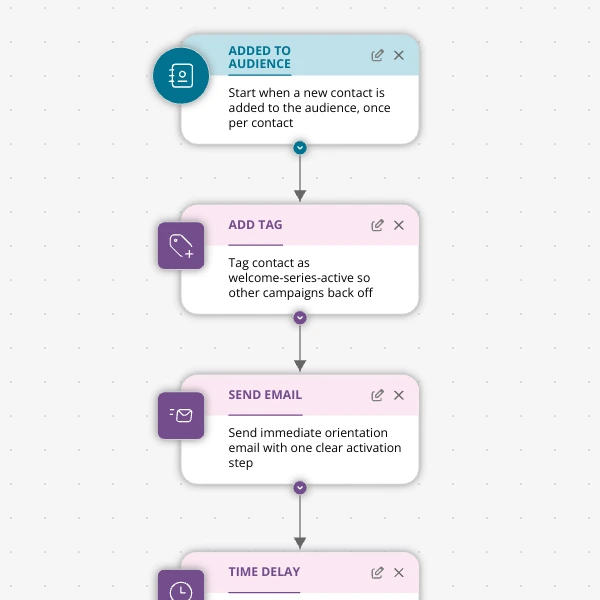
The Shopify app welcome series that turns installs into income
A step-by-step Shopify app welcome email journey for tools like CartSpark, showing how to turn new installs into activated, retained merchants using Spreeflo journeys, tags, and behavioral triggers so fewer trials quietly churn and more trials convert.
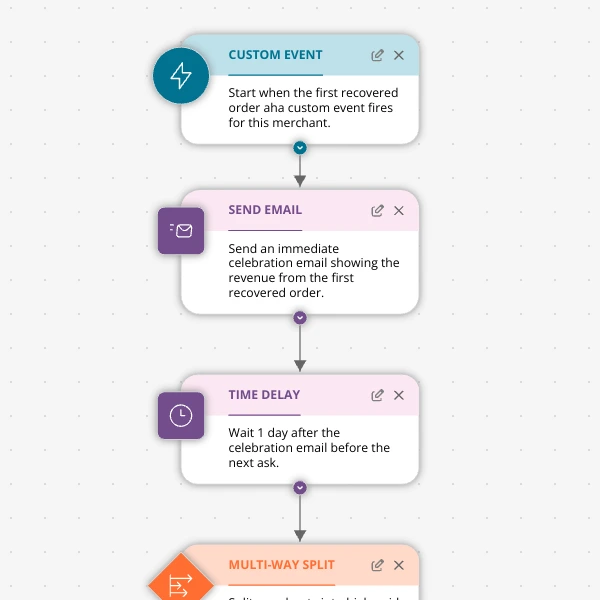
The Aha-Moment Playbook For Shopify Apps: Turn One Magic Action Into Months Of Revenue
A node-by-node playbook for Shopify and e‑commerce apps to center their lifecycle on one aha-moment custom event in Spreeflo, celebrate it, segment merchants by profile and engagement, and turn first recovered value into lasting revenue and retention.
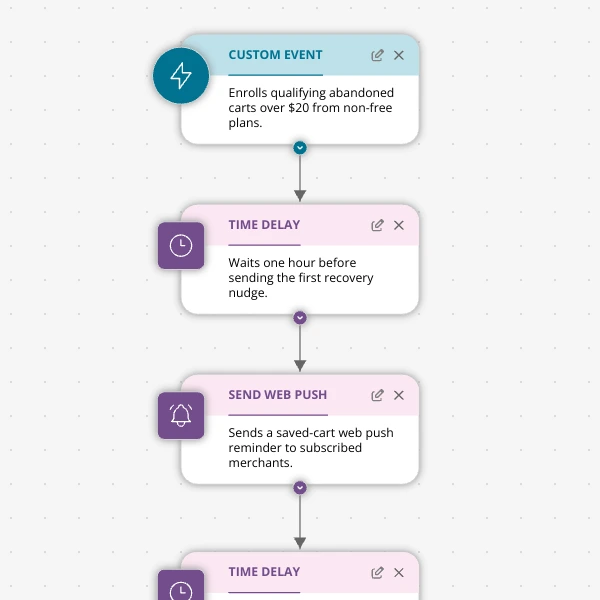
Stop Letting High‑Intent Carts Die: A 3‑Email Recovery Journey for Shopify Apps
A detailed, node-by-node walkthrough of a three-email (plus optional web push) cart-abandonment recovery journey for Shopify apps in Spreeflo, showing how to trigger events, branch on behavior, tag outcomes, and measure recovered carts and revenue.
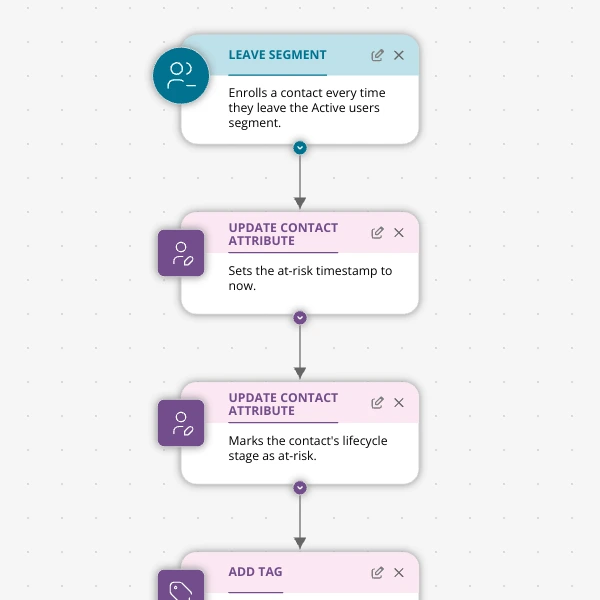
When Active Users Go Dark: A 4‑Touch Win‑Back Journey For Your Shopify App
A detailed, node-by-node Spreeflo journey for winning back previously active Shopify app users who stop engaging, using segment-based triggers, conditional logic, and a four-touch email plus internal alert sequence to recover usage and MRR.