Stop Hoping They See It: A Push‑First Alert System For Your SEO SaaS
Design a Spreeflo journey that sends critical SEO alerts via web push first, then automatically falls back to email, so your SEO SaaS customers notice rank drops and anomalies quickly and act before they churn.
Industry
Niche
Pattern
Loading sequence...
Your rank-tracking system spots a critical drop overnight, fires off an email alert… and the customer reads it three hours later, after the damage is already done.
That gap between “we noticed” and “they acted” is where churn lives. The sequence at the top of this page is the whole journey, end to end, for fixing that gap with coordinated web push and email.
Let’s walk through how an SEO SaaS like RankPulse or BrieflySEO can send time‑sensitive alerts on push first, then automatically fall back to email for everyone who didn’t see or click the notification.
You’ll see exactly how each node in the journey is configured, why it sits where it does, and how to tweak it for your own stack.
Why SEO alerts belong on push, not just email
As an SEO SaaS founder, a big part of your value is catching issues before your customers do:
Rank drops for money keywords
Coverage spikes in Search Console
Sudden SERP volatility or traffic anomalies
Technical issues that break tracking or reporting
These are time‑sensitive. An email alone is not ideal:
Inbox load means notifications get batched, snoozed, or buried.
Push can light up the browser even when they’re not currently in your app.
Some of your users obsessively watch alerts; others only check email twice a day.
You already have both channels available in Spreeflo:
Web push on the Professional plan for instant, high‑intent nudges
Email journeys for deeper context and calls to action
The trick is coordinating them so each contact gets the right channel automatically, based on what they actually did.
That coordination is exactly what this journey does.
When this cross‑channel pattern actually matters
You don’t need push‑first coordination for every marketing broadcast. It shines when three conditions are true:
The content is time‑sensitive.
Examples: “Primary keyword dropped from #2 to #7”, “Your daily SERP volatility crossed threshold”, “Your report failed to generate”.You already have meaningful web push coverage.
You’ve run through web push setup, shipped the service worker, and use the bell/dialog pattern to get opt‑ins.You care which channel drove the save.
You want to know if your “we caught this” alerts perform better on push or by email, so you can tune both.
RankPulse, for instance, uses this for critical rank alerts and pre‑launch SERP volatility warnings for their agency segment. The same pattern would work for BrieflySEO’s “keyword gaps detected in your content plan this week”.
The core idea of the journey
At a high level, the sequence at the top of this page does this:
Your backend detects an urgent issue for a given account.
It sends a custom event into Spreeflo via the Spreeflo API.
A journey with a Custom Event trigger fires.
The journey sends a targeted web push notification about the issue.
It waits an hour.
A Check Web Push Activity node asks, “Did they click that notification?”
If yes, they’re tagged as “push responders” and the journey ends.
If no (including not delivered / not sent cases), the journey routes them to an email fallback with more detail and a stronger call to action.
From there, you can optionally measure which channel drove engagement by tagging the responders and slicing them with the segment builder.
Now let’s go node by node.
Step 1: Trigger the journey from your alerting logic
This is a behavioural pattern, so we start with a Custom Event trigger.
In your SEO SaaS, you already have alerting code that calculates anomalies or thresholds. When that logic fires, your backend posts a JSON payload to Spreeflo’s events endpoint (see the Spreeflo API doc for the exact shape).
Design the event like this:
Event name:
critical_rank_alert(or whatever fits your taxonomy)Identifying field: customer’s email
Properties:
-site_url
-primary_keyword
-severity(number or string)
-reason("rank_drop","serp_volatility", etc.)
In the journey:
Node type: Custom Event trigger
Event name:
critical_rank_alertProperty conditions: e.g.
severity > 7so you only alert for truly urgent issuesRe-enrollment: On
Why re-enrollment must be on: the same customer can have multiple critical events over time. With re-enrollment enabled, they’ll run through this journey every time a new alert event hits, as long as they’re not currently mid‑journey. Because this flow is short (push → 1‑hour wait → branch → maybe email), that “mid‑journey lock” won’t block you for long.
If your alerts can fire very frequently for noisy accounts, ask whether they should be transactional instead. Anything that truly must send every single time, regardless of journey state, is a better fit for your transactional setup rather than a journey.
Step 2: Send a tight, urgent web push
From the trigger, your first action node is Send Web Push.
Configuration:
Template: “Critical rank alert”
Title: Clear, action‑oriented:
“Critical rank drop for {primary_keyword}”
Body: One line, no fluff:
“{site_url} fell from #{old_position} to #{new_position}. Review and adjust now.”
Click URL: Deep link into the exact report or alert page in your app
Because Spreeflo ties web push subscriptions to contacts via the SDK’s Spreeflo.identify, you don’t need to guess who is eligible. The action will attempt to send to everyone; only those with a valid subscription will receive it. Others will show up later as “Not Sent” or “Not Delivered” in Check Web Push Activity.
Why push first here:
It’s visible when they’re in the browser, even if they’re not in your app right now.
It respects people who raised their hand for faster notifications.
It lets you keep the email fallback richer and more occasional instead of piling on multiple emails.
If you haven’t yet, make sure your app has the SDK installed and your sites are visible in web tracking and analytics. Then walk through web push setup so subscriptions are available before you turn this journey on.
Step 3: Add a Time Delay so push can do its job
Next, insert a Time Delay.
For time‑sensitive but not minute‑by‑minute SEO alerts, 1 hour is a sensible default:
Unit: Hour
Value: 1
This does two things:
It gives the browser notification a real chance to be seen and acted on before you clutter the inbox.
It keeps you within best practices for message pacing. In Spreeflo, you should never have two Send Web Push nodes or two Send Email nodes back to back without at least an hour in between.
If your customers mostly sit in front of dashboards all day, you might experiment with 2 hours instead. If you’re dealing with truly urgent outages, consider a shorter window fired via a transactional route; the journey floor is one hour.
Step 4: Check who actually engaged with the push
After the delay, add a Check Web Push Activity process node.
This is the heart of the pattern. You point it at the “Critical rank alert” notification you just sent, and it branches your journey based on how each contact interacted.
Minimal configuration:
Web push notification: “Critical rank alert”
Activities to branch on:
- Clicked
That creates:
One explicit branch for “Clicked”
An automatic “Else” branch for everyone who did anything else:
- Notification delivered but not clicked
- Dismissed
- Not sent (no subscription)
- Not delivered (blocked, invalid subscription, etc.)
Why this is enough for most SaaS:
You only need to treat one group differently in this pattern: those who already clicked the push.
Everyone else is “still in the dark” from your perspective, so they should receive the fallback email.
If you later want to distinguish between “never got the push” and “got it but ignored it”, you can add extra activities like “Not Sent” or “Not Delivered” as separate branches and send them through their own path. Functionally, though, they’ll already land in the Else branch and get the email.
On the “Clicked” branch, you have two recommended actions.
Add Tag
- Tag:responded_to_critical_push
This lets you build segments of users who interact well with push alerts, so you can double down on this channel for them in the future.End the path
These people already clicked through to the alert. Sending them a duplicate email would be noisy and unnecessary.
On the Else branch, you go to email.
Step 5: Email everyone still in the dark
From the Else branch of Check Web Push Activity, add a Send Email node.
The job of this email is different from the push:
It needs a bit more context, since you’re not interrupting them mid‑session.
It should surface the impact and next step very clearly.
It should make it obvious why your product caught this and what to do next.
Configuration ideas:
Subject line:
- “Heads up: {primary_keyword} just dropped in the SERPs”Body structure:
1. One‑sentence summary of what happened
2. Short “why it matters” with an impact estimate (traffic, revenue, CTR)
3. One primary call‑to‑action button that deep links into the same alert page as the push
4. Optional snippet linking to a help article on “How to respond to rank drops”
Because Spreeflo emails can use AI‑driven personalization, you can pull in contact attributes like site type, segment, or plan to tailor this message. The help doc on AI variables for hyper-personalized copy walks through how to insert those variables without hand‑coding templates.
Two practical notes when configuring this node:
Keep “Send only once” turned on. If a contact ever re‑enters this step because of future alerts, you don’t want them receiving multiple copies of the same template for the same event. Instead, use the alerts’ own event properties to create fresh, unique copies when needed.
Make sure your sending domain and identity are set up correctly (see the help docs on domain setup) so these critical emails reach the inbox reliably.
At this point, your core pattern is complete:
Push first, to everyone who can receive it
Email fallback only if push wasn’t effective
Everything after this is measurement and refinement.
Step 6: Measure which channel pulled its weight
The metrics you care about with this pattern are:
Cross‑channel conversion rate: “Of all alerts we sent, how many led to a meaningful action?”
Channel attribution: “Did push or email tend to drive that action more often?”
Because Spreeflo keeps every email, push, tag, and event on one contact record, you can get surprisingly far with a few extra nodes.
Here is a simple extension after the Send Email node:
Add a Time Delay of 1 day.
This gives recipients a fair chance to open and click the email.Add a Check Email Activity node.
- Marketing email: your “Critical rank alert” email
- Activities:
- Link ClickedOn the “Link Clicked” branch, Add Tag
responded_to_critical_email.
On the Else branch, do nothing.
Now you have:
A tag for contacts who respond to push (
responded_to_critical_push)A tag for contacts who respond to the fallback email (
responded_to_critical_email)
With those in place, you can:
Build segments in the segment builder to compare performance by plan, country, or customer type.
Calculate rough channel attribution:
- Push‑first responders vs email‑first respondersDecide, over time, whether some segments should skip email for these alerts or need a different cadence entirely.
If you want to go deeper, add a “success” event from your app—like alert_investigated or issue_resolved—and segment by “has this event after an alert” to define true conversions.
Why this earns its place in your stack
This pattern does more than improve CTR on one message. It changes how you talk to customers at a detail level:
Push subscribers get instant, skimmable nudges tied to the exact event that matters.
Non‑subscribers or push‑silent users get a richer, more persuasive email instead of a blind broadcast.
Your team gets clear data on which channel each customer actually responds to for urgent issues.
That’s exactly the kind of granular understanding the platform is built around: capture detail on every customer so you can speak to each of them uniquely, without needing a growth team the size of Ahrefs.
Once you have this journey live, you can reuse the same structure for:
Live webinar starting soon: push first, then email calendar links to non‑clickers.
New feature launches relevant only to power users: push to those who used
generated_content_briefrecently, email if they miss it.Trial‑to‑paid nudges when engagement suddenly drops.
Each new version is just a fresh trigger and a tweak to the copy, not a brand‑new build.
If your SEO SaaS is already generating critical insight for customers, this is how you make sure they actually see it, act on it, and remember which tool had their back when it mattered.
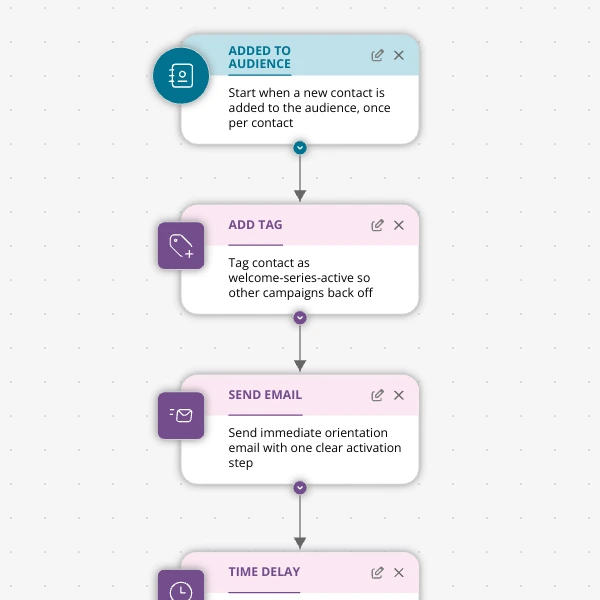
The Shopify app welcome series that turns installs into income
A step-by-step Shopify app welcome email journey for tools like CartSpark, showing how to turn new installs into activated, retained merchants using Spreeflo journeys, tags, and behavioral triggers so fewer trials quietly churn and more trials convert.
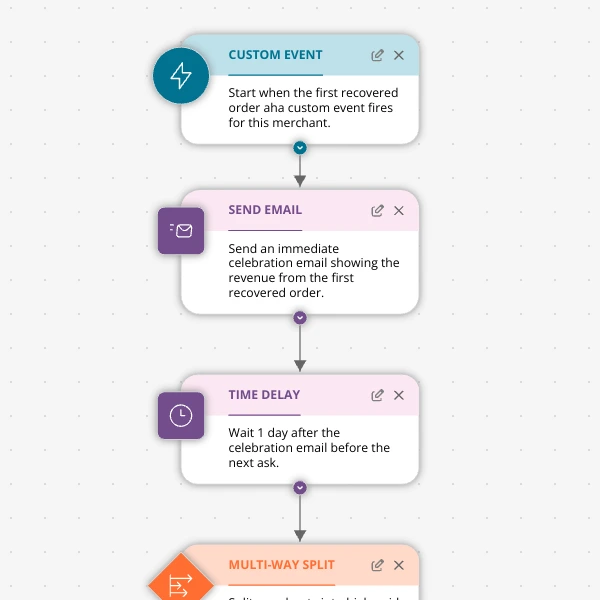
The Aha-Moment Playbook For Shopify Apps: Turn One Magic Action Into Months Of Revenue
A node-by-node playbook for Shopify and e‑commerce apps to center their lifecycle on one aha-moment custom event in Spreeflo, celebrate it, segment merchants by profile and engagement, and turn first recovered value into lasting revenue and retention.
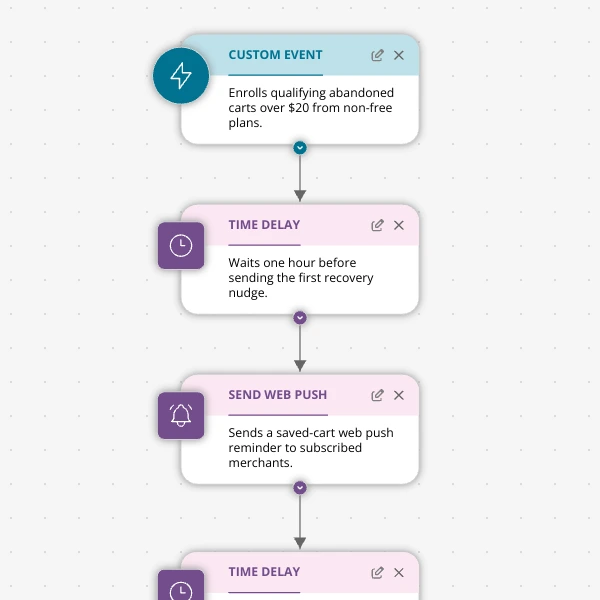
Stop Letting High‑Intent Carts Die: A 3‑Email Recovery Journey for Shopify Apps
A detailed, node-by-node walkthrough of a three-email (plus optional web push) cart-abandonment recovery journey for Shopify apps in Spreeflo, showing how to trigger events, branch on behavior, tag outcomes, and measure recovered carts and revenue.
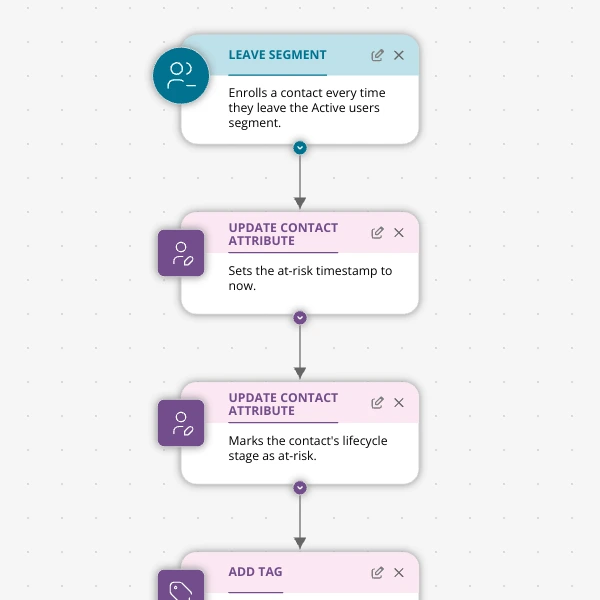
When Active Users Go Dark: A 4‑Touch Win‑Back Journey For Your Shopify App
A detailed, node-by-node Spreeflo journey for winning back previously active Shopify app users who stop engaging, using segment-based triggers, conditional logic, and a four-touch email plus internal alert sequence to recover usage and MRR.