Stop Letting Half-Finished Checkouts Bleed Your SEO SaaS MRR
This playbook shows SEO SaaS teams how to use Spreeflo events, journeys, and messaging to recover revenue from checkout drop-offs, turning half-finished checkouts into recurring MRR with a respectful, automated sequence of emails, waits, and web push.
Industry
Niche
Pattern
Loading sequence...
Most of your lost MRR never hits Stripe — it dies on the checkout page.
For an SEO SaaS, that hurts twice. You paid to get someone from “reading a blog post about SERP volatility” all the way to “typing their card details”… and then nothing. No subscription, no trial conversion, no LTV. The sequence at the top of this page is the whole journey, end to end, for fixing that specific leak.
Let’s walk through how a rank-tracking SaaS like “RankPulse” can recover those half-finished checkouts automatically using Spreeflo — and turn them into real, recurring revenue.
Why checkout drop-off is your highest-intent leak
Abandoned carts are annoying. Checkout drop-offs are expensive.
In a typical SEO SaaS flow:
Visitor hits /pricing
Picks “Pro – $89/mo”
Lands on the payment page (billing details, card, confirm)
Closes the tab, gets distracted, “will do it later”
By the time someone reaches step 3, they’ve already:
Chosen a plan
Accepted your price point
Decided your product is worth trying
They’re not vaguely browsing; they’re actively trying to give you money. When that person disappears, it’s almost never about intent. It’s friction: a Slack ping, a credit-card issue, a question about billing, a toddler yelling in the background.
Ignoring that behaviour is classic “leaky bucket” territory. You’re pouring trial signups and demo traffic into the top and quietly losing your most valuable prospects at the bottom, without a single nudge to come back.
This is exactly where automation shines: plug the hole once, and every future checkout-start event is handled for you.
The signals you need before you automate
A checkout drop-off flow relies on two behavioural signals:
“Checkout started” — they reached your payment form
“Checkout completed” — the subscription is active / payment succeeded
You can capture them in Spreeflo two ways, depending on your stack.
On the frontend, when a user hits your payment page, your app fires a
checkout_startedevent via the Spreeflo SDK in the browser.On the backend, when Stripe (or Paddle, Braintree, etc.) confirms payment, your server POSTs a
checkout_completedorsubscription_activatedevent to the Spreeflo API.
That combination matters:
The browser knows when they started checkout.
The backend knows if they actually paid.
Once those two events are flowing into Spreeflo and tied to a contact’s email (either from your app’s sign-up flow or from a required email field before checkout), the rest is journey design. If you haven’t wired in tracking yet, start with Spreeflo’s web tracking and analytics guide so checkout_started and checkout_completed land on the right contact.
The recovery flow, at a glance
Here’s the intent behind the sequence you see at the top of this page:
Enter when a
checkout_startedevent fires.Wait 1 hour to let natural completions happen.
Check whether a
checkout_completedevent exists. If yes: exit quietly (or tag for reporting). If no: send a helpful reminder email.Wait up to 24 hours watching for a completed checkout. If they pay in that window: tag as “recovered by email”. If not: send a web push reminder (for subscribers).
Wait another day, check again. If they still haven’t paid: send a final, gentle “last chance” email. Then stop. No nagging beyond that.
This is not an aggressive sales funnel. It’s three context-aware nudges over ~48 hours, only to people who started checkout and haven’t finished.
Now let’s unpack each node.
Trigger: Custom Event `checkout_started` with re-enrollment on
We anchor the journey with a Custom Event trigger:
Event name:
checkout_startedProperty conditions: optional, depending on your product
Re-enrollment: on
Why it’s checkout_started, not “visited pricing” or “added card”:
Anyone who hits
/pricingis still shopping.Anyone who added a keyword or connected Search Console is “engaged”, but not necessarily ready to pay.
checkout_startedis the first unambiguous “I’m trying to pay you” moment.
If you sell multiple products or plans, you can narrow the trigger with property conditions:
Only recover annual plans (
billing_interval = "yearly")Only recover plans above a certain MRR (
amount > 49)
The re-enrollment toggle is the subtle but important bit. Set it to true so that if someone bails on checkout today, comes back two months later, and starts checkout again, they can enter the journey again. Spreeflo still prevents duplicate concurrent enrollments, so the same contact can’t be in two copies of this journey at once.
Time Delay: give them an hour to finish on their own
Next is a Time Delay node:
Delay:
1hour
You don’t want to ping someone while they’re still actively wrestling with their credit card. An hour is long enough that:
If they intended to finish, they probably already did.
If they got pulled into a meeting, your reminder hits once they have breathing room again.
This delay also respects the pacing rule: there’s clear space between the behavioural trigger and your first message.
If/Else: did they complete checkout anyway?
After the 1-hour delay, we add an If/Else node to branch based on whether they actually paid.
In the condition, you use the Custom Events filter inside the segment builder:
Type: Custom Events
Event:
checkout_completed(or your equivalent)Operator: “triggered at least 1 time”
Time window: “over all time”
Anyone with at least one checkout_completed event goes down the “yes” branch; everyone else goes down “else.”
Why “over all time” instead of “in the last X hours”? Because the journey is already time-bound by your 1-hour delay. If they ever successfully completed checkout — even if your events arrived slightly late — they should not get recovery emails.
Yes-branch: buyers
For the “yes” path, you have options:
Do nothing and let them exit the journey.
Or attach a short analytics tail: an Add Tag node setting something like
tag = "self-completed-checkout". That gives you a basic split later between “needed recovery” and “didn’t”.
Either way, this branch should end quickly. No recovery emails; they’re already a paying customer.
Else-branch: genuine drop-offs
Everyone down the else branch has:
Started checkout at least 1 hour ago
No record of a completed payment
These are your true checkout drop-offs. This is where the recovery messaging begins.
Email 1: fast, helpful reminder (not a hard sell)
First action on the drop-off path is a Send Email node:
Template: your “Checkout reminder #1”
Send only once: leave this toggled on
Use your email builder or a saved template. Keep the content short and practical:
Subject:
- “Still want to monitor your rankings with RankPulse Pro?”
- “You were 1 step away from live rank tracking”Body:
- Remind them which plan they picked and why (“Pro plan — daily SERP checks for up to 500 keywords”).
- Include a single, clear button to “Return to your secure checkout.”
- Reassure them about billing (no long-term contracts, easy cancellation, etc.).
No discount yet. At this point, they already thought the price was fair. You’re mainly fighting distraction and friction, not persuasion.
The “send only once” toggle ensures that if they start checkout multiple times over the next year, they don’t keep getting the exact same reminder email over and over.
Wait Condition: give the email room to work
After Email 1, we add a Wait Condition:
Condition: “Custom event
checkout_completedhas triggered at least 1 time over all time”Timeout:
1day
Spreeflo will hold each contact here until either:
A
checkout_completedevent arrives (they paid), or24 hours pass with no payment event
This step accomplishes two things:
It creates natural spacing before any next message.
It minimizes false positives. If Email 1 nudged them over the line, they’ll hit the “paid” condition inside the Wait Condition and move forward as buyers, not as non-responders.
Right after the Wait Condition, we drop in another If/Else node with the same condition as before (“has completed checkout over all time”).
If yes: they paid in the last 24 hours.
If no: they still haven’t converted.
Tag + internal alert for recovered checkouts
On the “yes, they paid after Email 1” branch:
Add Tag — e.g.
tag = "recovered-by-email-1"Optional Send Internal Email — notify your team (or just yourself) about high-value recoveries.
That internal notification can include:
Email and name
Plan they picked
MRR amount
For a small SEO SaaS, this is a simple morale and feedback loop: you see concrete evidence that your automation is saving subscriptions you would’ve otherwise lost.
Then terminate this branch. No further nudges; they’re paying.
Time Delay + Web Push: a quiet browser nudge for non-responders
On the “still no checkout” branch, we don’t want to slam them with another email immediately. Instead:
Time Delay —
1hourSend Web Push — a checkout reminder notification
Web push requires your workspace to be on the Professional plan and your site to have web push configured. The web push setup guide walks through the service worker and permission prompt; once that’s in place, you can include push touches in any journey.
The notification itself should be even lighter than the email:
Title: “Ready to start tracking your rankings?”
Body: “Your RankPulse Pro checkout is still open. Complete your subscription in a few clicks.”
Click URL: your checkout-resume URL
Only visitors who opted into notifications will see this. For those who did, it’s a low-friction reminder that appears exactly where they got distracted in the first place: their browser.
Second Wait Condition: catch push-driven conversions
After the web push, we mirror the earlier pattern:
Wait Condition:
- Condition:checkout_completedhas triggered at least 1 time over all time
- Timeout:1dayIf/Else on the same condition.
On the “yes” branch:
Add Tag:
tag = "recovered-by-push"Optionally another Send Internal Email if you care about channel attribution.
On the “no” branch, we send one final email.
Email 2: a last, respectful nudge
The “still no checkout after email + push” crowd gets a second Send Email node:
Template: “Checkout reminder #2 — final”
Send only once: on
This is your last touch in the sequence. Make it count, but keep it respectful.
Angle ideas that work well for SEO SaaS:
Risk reversal: remind them of trial terms, refund policy, or cancellation ease.
Value clarity: “Here’s what you’ll see in your first 7 days with RankPulse: live SERP charts, quick wins in existing content, and alerts for ranking drops.”
Soft urgency: “We’ll hold your setup details for another 48 hours; after that, you’ll need to restart checkout.”
No countdown GIFs, no fake scarcity. These are sophisticated buyers. Treat them accordingly.
After this email, you can optionally:
Add Tag:
tag = "checkout-recovery-exhausted"Use that tag later to exclude them from future aggressive promos or to study friction points.
Then end the journey. If they still don’t convert, you’ve done enough for this cycle.
Tuning the journey for your pricing and plans
The default journey assumes all checkouts are created equal. In reality, a $29/mo “Starter” seat and a $199/mo “Agency” plan deserve different treatment.
You can tune this flow by:
Narrowing the Custom Event trigger with property conditions:
- Only annual plans:billing_interval = "year"
- Only higher-value tiers:plan_name CONTAINS "Pro"oramount > 99Adding an early Multi-way Split after the trigger, with branches for:
- Starter
- Pro
- Agency
Each branch can then:
Adjust timing (e.g., a longer wait before discounts on higher plans).
Adjust copy (agencies care about client reporting; solo SEOs care about time saved).
Use different tags for later segmentation.
Because all of this logic lives in a single campaigns and journeys view, you still maintain a coherent picture of your recovery system rather than three unrelated flows.
Measuring recovered revenue in Spreeflo
A recovery flow only earns its keep if you can see what it’s doing for your MRR.
Here’s a simple way to quantify impact using the segment builder:
Segment A — “Checkout starters”
- Custom Eventcheckout_startedtriggered at least 1 time over all time.Segment B — “Pure self-serve buyers”
- In Segment A
- Custom Eventcheckout_completedtriggered at least 1 time
- Did not have tagrecovered-by-email-1orrecovered-by-push.Segment C — “Recovered by checkout journey”
- Has tagrecovered-by-email-1OR tagrecovered-by-push.
Then:
Recovery rate =
|Segment C| / |Segment A|Recovered MRR ≈
average first-month revenue * |Segment C|(or better yet, use plan-specific values if you pass plan amount as an attribute).
Even modest numbers move the needle. If RankPulse has:
300 checkout starters a month
10% of them (30) recovered by this journey
Average plan $69/mo
That’s ~$2,070 in monthly MRR saved by a flow you built once.
That’s exactly the kind of compounding, low-maintenance system founder-led businesses need: it keeps working while you’re building features or writing the next SEO guide.
The bigger lesson: plug the leaks where intent is highest
For SEO SaaS founders, it’s tempting to obsess over traffic and trial volume. But most teams leak lifetime value in quieter places:
Users who never add their first keyword
Teams that stop logging in after a successful audit
Prospects who stall on the payment screen
This checkout drop-off journey goes after the last group — the people who already decided you were worth paying for. By capturing a bit more detail on their behaviour and reacting intelligently via email and push, you stop leaving that revenue on the floor.
Set this sequence up once in Spreeflo, test your copy for a few weeks, and then mostly let it run. For a small team, that’s the kind of leverage that frees you to focus on product and content while your automations quietly keep MRR from slipping away.
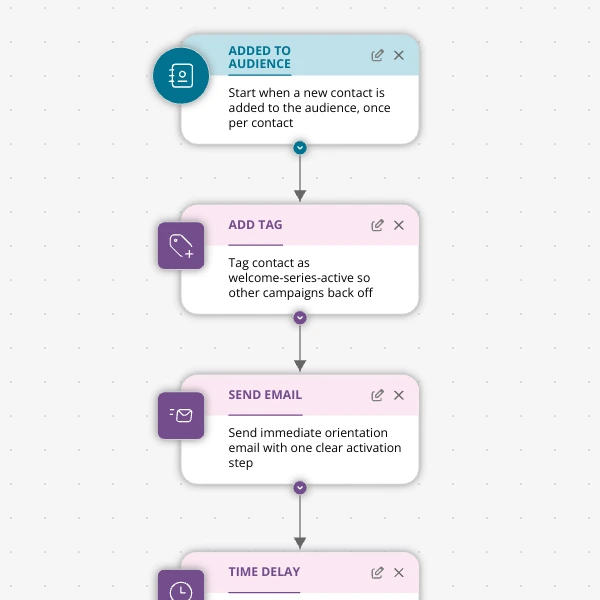
The Shopify app welcome series that turns installs into income
A step-by-step Shopify app welcome email journey for tools like CartSpark, showing how to turn new installs into activated, retained merchants using Spreeflo journeys, tags, and behavioral triggers so fewer trials quietly churn and more trials convert.
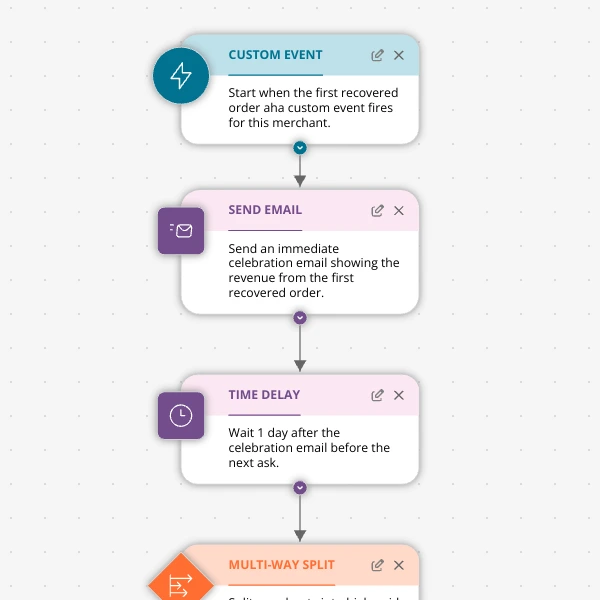
The Aha-Moment Playbook For Shopify Apps: Turn One Magic Action Into Months Of Revenue
A node-by-node playbook for Shopify and e‑commerce apps to center their lifecycle on one aha-moment custom event in Spreeflo, celebrate it, segment merchants by profile and engagement, and turn first recovered value into lasting revenue and retention.
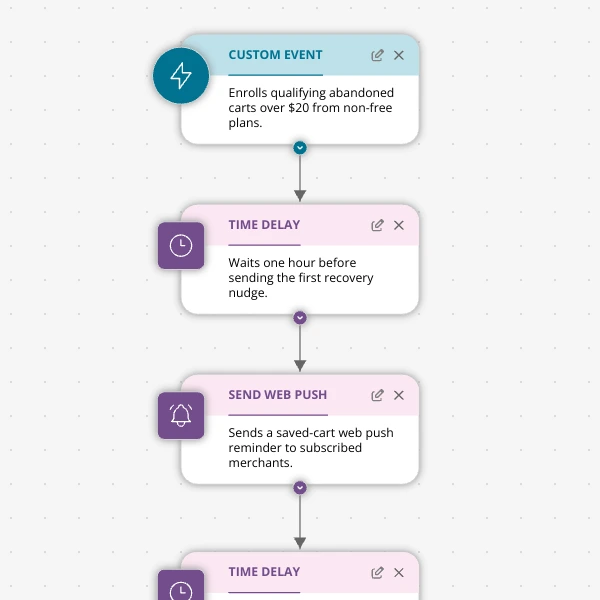
Stop Letting High‑Intent Carts Die: A 3‑Email Recovery Journey for Shopify Apps
A detailed, node-by-node walkthrough of a three-email (plus optional web push) cart-abandonment recovery journey for Shopify apps in Spreeflo, showing how to trigger events, branch on behavior, tag outcomes, and measure recovered carts and revenue.
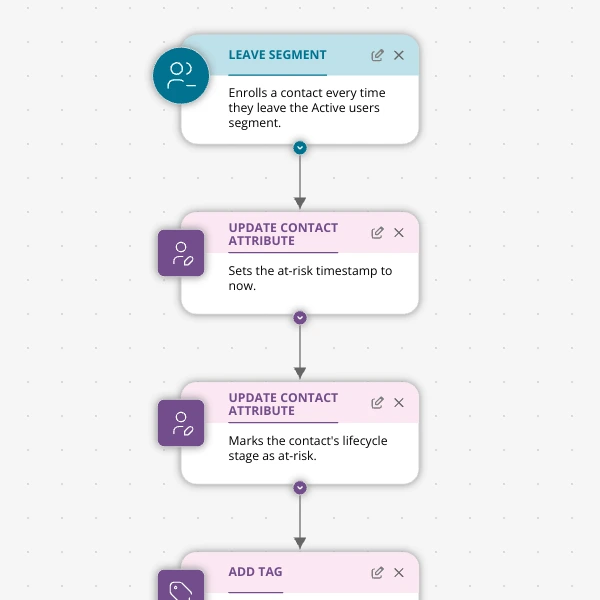
When Active Users Go Dark: A 4‑Touch Win‑Back Journey For Your Shopify App
A detailed, node-by-node Spreeflo journey for winning back previously active Shopify app users who stop engaging, using segment-based triggers, conditional logic, and a four-touch email plus internal alert sequence to recover usage and MRR.