Stop Silent Churn: A Predictive Rescue Journey For Your SEO SaaS
Walks through a predictive churn-rescue journey for SEO SaaS teams, showing how to turn usage signals into a churn-risk flag, route accounts by value, automate rescue emails, involve humans where it counts, and measure saved MRR.
Industry
Niche
Pattern
Loading sequence...
A customer doesn’t churn when they click “Cancel.” They churn two weeks earlier when they stop adding keywords, stop checking rankings, and stop opening your “weekly SEO wins” email.
By the time they reach your billing page, they’ve already decided. The only question is whether you notice before it happens. The sequence at the top of this page is the whole journey, end to end, for catching those accounts while you still have a shot.
For a team like RankPulse, a 3‑person rank-tracking SaaS sitting around $40k MRR, this is the difference between a flat line and compounding growth: a lightweight, fully automated rescue flow that wakes up when a customer looks like they’re going to churn, not after they’ve left.
This article walks through that journey node by node inside Spreeflo, and shows how to wire it to the usage signals you already have.
Why churn is so predictable in SEO SaaS (and still catches you off guard)
SEO tools are habit products. Healthy customers:
Log in at least weekly
Add or adjust keywords as campaigns evolve
Generate briefs, exports, or reports
Click through ranking or traffic alerts
Unhealthy customers don’t fall off a cliff overnight. Their behavior decays in clear patterns:
Rank checks drop from daily to once a month
No new projects or keywords created
No GSC integration even after a month
Zero logins for 14+ days
You already track most of this in your app, but it often sits in your own database or Google Analytics without driving any action.
This journey turns those signals into a single “churn risk” flag, then uses that flag to:
Enroll the contact automatically when they become predictively at risk
Nudge them with targeted emails tied to their actual behavior
Alert your team for high‑value accounts
Tag outcomes so you can measure churn reduction and reactivation rates
Under the hood, it leans on two Spreeflo ideas:
Capture detail on every customer so you can speak to each uniquely.
Most businesses leak lifetime value by not nurturing engagement; this plugs that leak.
Let’s break it down.
Step 0: Turn behavior into a churn‑risk signal
Before the rescue journey starts, you need a way to tell Spreeflo “this account is at risk.”
For an SEO SaaS, you already have strong predictors:
No
checked_rankingsorgenerated_content_briefevents in 14 daysFewer than X projects or tracked keywords
Trial nearing end with low usage
No GSC or GA integration after N days
You’ll feed those into a simple model and store the result as contact attributes in Spreeflo, for example:
churn_risk_score(NUMBER, 0–100)churn_risk_tier(TEXT: "low", "medium", "high")
There are two practical ways to do this.
Option A: Score in your own backend, sync via the Spreeflo API
This is usually the cleanest approach.
Track in-app behavior to Spreeflo:
- Frontend events likechecked_rankings,generated_content_brief,exported_reportgo through the Spreeflo SDK and show up in web tracking and analytics.
- Server-side events likeplan_upgraded,plan_downgraded,subscription_canceledgo into Spreeflo via the Spreeflo API.In your own database, run a daily job that:
- Calculateschurn_risk_scorefor each active customer.
- Maps that to achurn_risk_tier(for example, 0–39 = low, 40–69 = medium, 70–100 = high).The same job upserts those attributes into Spreeflo using an “update contact” call over the API.
By the time the journey runs, every customer has current risk attributes ready to use.
Option B: Simple rule-based risk tiers inside Spreeflo
If you don’t want a custom model yet, you can fake a simple tier system with Spreeflo itself:
Create a daily Cyclic journey that runs for all paying contacts.
Use the segment builder to match “Active plan AND no
checked_rankingsevent in the last 14 days” (or similar).On matches, use an Update Contact Attribute action to set
churn_risk_tierto the literal "high".
Because Update Contact Attribute writes a static value, you’re not building a sophisticated score here, but it’s enough to say “this account has clearly slipped.”
Either way, the predictive piece is the same: a contact attribute that tells you when someone is in the danger zone.
Step 1: Criteria Match trigger – who enters the rescue flow?
Now you build the actual rescue journey.
Create a new Journey in Spreeflo (not a Campaign; this needs to run continuously). From the triggers panel, drop in a Criteria Match trigger.
Configure its criteria with the segment builder:
Contact Attribute
churn_risk_tieris "high"AND Email Subscription Status is
SubscribedAND Contact is tagged with
customerAND (optional)
last_rescue_attimestamp is blank OR is before 30 days ago
Turn Re-enrollment ON for this trigger.
Why it matters:
With re-enrollment on, a customer can flow through this journey again if they recover and then slip back into “high risk” months later.
The mid‑journey lock still protects them from being enrolled twice at once; they must exit before they can re-enter.
This is the backbone of the pattern: any time your scoring logic sets someone to “high risk,” they automatically enroll in the predictive rescue.
From the trigger, the journey flows into an Add Tag action:
Tag:
churn-risk-active-journey
That tag gives you an easy way to filter and analyze contacts currently going through the rescue.
Step 2: Route by account value with a Multi-way Split
Not every at‑risk user deserves the same level of attention.
An agency on a $299 plan and a solo blogger on $29/mo should not trigger the same internal response. Use a Multi-way Split to separate them.
Right after the Add Tag node, drop in a Multi-way Split with two main branches:
high_value
- Condition:
- Plan type is "Agency" OR
- MRR attribute ≥ 199standard
- Catch-all else branch (no condition; everyone else lands here)
This uses the same criteria engine as segments, just inline. It lets you design a slightly richer flow for your best accounts without cloning the whole journey.
Step 3: High-value path – alert humans, then send a personalized rescue email
On the high_value branch, start with an internal heads-up and then a customer-facing email.
Send Internal Email
- Recipient: your success team or a shared “alerts” inbox
- Content: include the customer’s company, plan, MRR, last login date, and a link to their account in your admin UI
- Purpose: tells a human “this $299 agency account looks shaky; here’s why.”Time Delay – 1 hour
- Gives your team a small window to reach out manually if they want, and avoids the customer getting an email at the exact millisecond your system flags them.Send Email – Rescue Email #1
- Build this with our email builder so it looks like a normal product email, not a generic marketing blast.
- Tone: “We want to help you get more from RankPulse,” not “We see you’re about to churn.”
- Content ideas for SEO SaaS:
- Reference one feature they have used (“You’ve been checking rankings for [domain]…”) and one they haven’t yet tried (“…but haven’t generated a content brief yet. Here’s a 2‑minute walkthrough.”).
- Offer a 15‑minute audit call for agencies.
- Include one or two concrete “quick wins” they can get this week.
If you’re on the Professional plan, this is a great place to use AI-powered personalization. The help doc on how to personalize with AI variables shows how to pull in industry, use case, or feature-usage to shape subject lines and body text without writing variants by hand.
Step 4: Wait for signs of recovery, then branch with If/Else
You’ve sent the first rescue email. Now you wait to see if they bounce back.
Drop in a Wait Condition action after that email:
Condition group:
- Email Activity: that rescue email opened at least 1 time in the last 7 days
- OR Custom Eventchecked_rankingstriggered at least 1 time in the last 7 days
- OR Custom Eventgenerated_content_brieftriggered at least 1 time in the last 7 daysTimeout: 7 days
This does two things:
If they re-engage quickly, the journey doesn’t wait a full week; it moves on as soon as the condition is met.
If they don’t, you still move forward after 7 days so the contact doesn’t get stuck.
Right after the Wait Condition, add an If/Else node with the same condition group. This is where you split the flow into “rescued” vs “still at risk.”
If branch: rescued
These are the people who opened/clicked or used key features again.
On the “then” (true) branch:
Update Contact Attribute – lower their risk
-churn_risk_tier→ "medium" or "low" (static text value)Update Contact Attribute – record the rescue timestamp
-last_rescue_at(TIMESTAMP) with update type “Set to now”Add Tag –
churn-rescued(Optional) Send Internal Email
- Brief note to the team: “High‑value at‑risk account re-engaged; risk tier lowered.”
Then end the path or run it into a Merge node if you want both “rescued” branches (high‑value and standard) to share a final step.
Else branch: still at risk
If they neither open nor use the product meaningfully in 7 days, you escalate slightly.
On the “else” branch:
Send Email – Rescue Email #2
- More direct and concise:
- Acknowledge they might be busy.
- Offer a quick-options list: book a call, watch a 5‑minute video, or even pause their account if that’s part of your product.Time Delay – 3 days
Check Email Activity – for Rescue Email #2
- Activities to branch on:
-clicked→ they showed intent to engage
-unopened→ they are ignoring you
For the clicked branch:
Send Internal Email
- “They clicked the second rescue email; follow up within 24 hours if you can.”Add Tag:
churn-followup-priority
For the unopened (or else) branch:
Add Tag:
churn-watchlistOptionally update
churn_risk_tierto "very_high" for your own reporting.
Then end the journey on both paths.
Step 5: Standard accounts – a lighter, fully automated variant
On the standard branch from your Multi-way Split, you can keep the same structure but skip the early human involvement.
A simple version:
Time Delay – 2 hours after entering the journey
- Avoids hitting them while they’re in the app.Send Email – Standard Rescue Email #1
- Focused on 1–2 underused features and a short checklist like:
- “Add 5 more keywords using this template”
- “Connect GSC so we can surface low‑hanging fruit”Wait Condition – up to 5 days for “opened/clicked or used key features” (same condition style as above).
If/Else – using that condition:
- “then” branch (rescued):
- Updatechurn_risk_tierto "medium"
- Setlast_rescue_atto now
- Tagchurn-rescued
- “else” branch (still at risk):
- Send Email – Standard Rescue Email #2 (a final check‑in)
- Tagchurn-watchlist
No internal emails here; the flow is fully automated, which is right for lower‑MRR accounts.
Step 6: Measuring the impact – and keeping it honest
You’re doing this to move numbers, not just to feel more “customer centric.” There are three key metrics to track:
Churn reduction for at‑risk accounts
- Compare churn rate among customers who hitchurn_risk_tier = highand entered the journey versus a prior period before it existed.
- That tagchurn-risk-active-journeymakes this easy to filter.Reactivation rate
- Of those who entered, what percentage ended up taggedchurn-rescuedwithin 30 days?
- This tells you if your content is actually nudging behavior, not just getting opens.Campaign ROI
- Look at the MRR saved from rescued accounts versus the time your team spends on follow-ups.
- If high‑value accounts show a strong ROI, you can justify more human time there.
If you want to get fancy, you can even A/B test your rescue copy:
Insert a Random Split right before Rescue Email #1 to send two different subject lines or offers to different percentages.
Use the email-level metrics plus downstream churn outcomes to pick a winner.
All of this lives inside the same visual canvas when you build a journey, so you can evolve the flow without rewriting code.
Why this pattern fits founder-led SEO SaaS so well
As a small team, you can’t watch every account manually. You also don’t want to bolt a huge “customer success platform” onto your stack just to run a few key plays.
This predictive churn journey hits a sweet spot:
It uses the detailed behavioral data you already have to speak to each customer based on what they’re actually doing (or not doing).
It nudges engagement before churn, so you’re compounding LTV instead of constantly finding new users to replace the ones silently leaving.
It gives you clear hooks to pull humans in only where it matters most.
You’re building a system once, then letting it run. That’s how founder-led businesses win on leverage, not headcount.
If you already have usage events flowing and a rough sense of what “healthy” looks like in your SEO tool, you’re a couple of afternoons away from wiring up this journey. The combination of the segment builder, web tracking and analytics, the Spreeflo API, and our email builder gives you everything you need.
The hard part isn’t the tooling. It’s deciding that churn prevention deserves the same attention you already give to acquisition — and then encoding that decision into an automation that never sleeps.
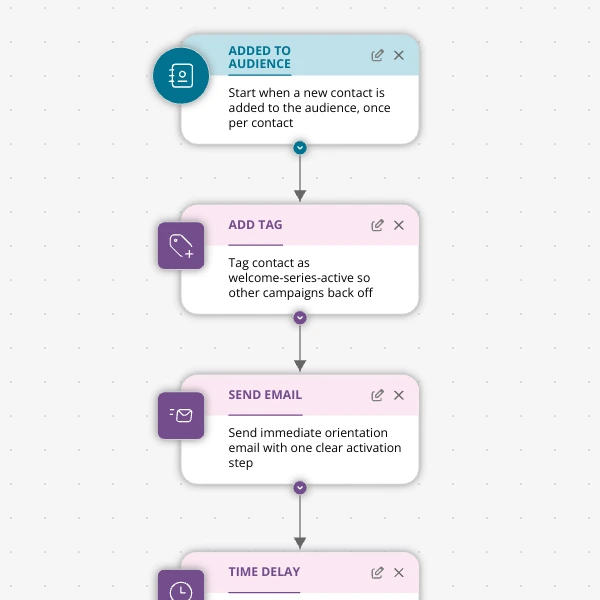
The Shopify app welcome series that turns installs into income
A step-by-step Shopify app welcome email journey for tools like CartSpark, showing how to turn new installs into activated, retained merchants using Spreeflo journeys, tags, and behavioral triggers so fewer trials quietly churn and more trials convert.
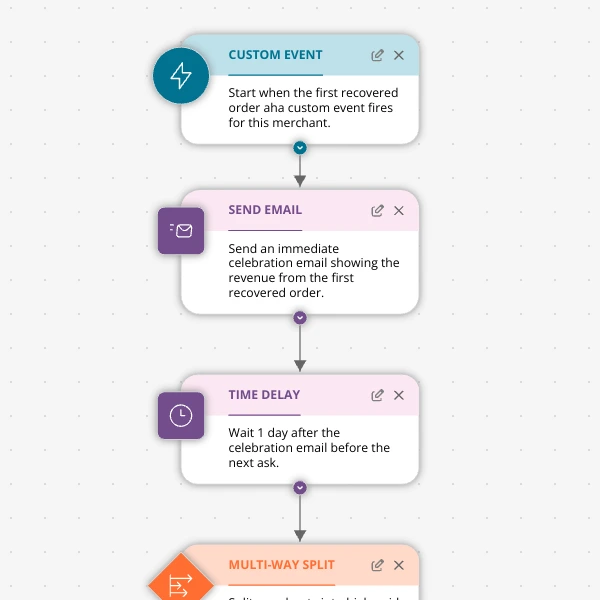
The Aha-Moment Playbook For Shopify Apps: Turn One Magic Action Into Months Of Revenue
A node-by-node playbook for Shopify and e‑commerce apps to center their lifecycle on one aha-moment custom event in Spreeflo, celebrate it, segment merchants by profile and engagement, and turn first recovered value into lasting revenue and retention.
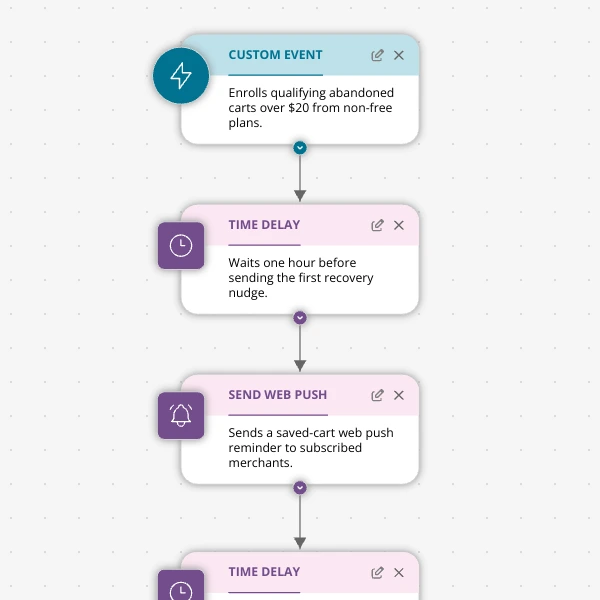
Stop Letting High‑Intent Carts Die: A 3‑Email Recovery Journey for Shopify Apps
A detailed, node-by-node walkthrough of a three-email (plus optional web push) cart-abandonment recovery journey for Shopify apps in Spreeflo, showing how to trigger events, branch on behavior, tag outcomes, and measure recovered carts and revenue.
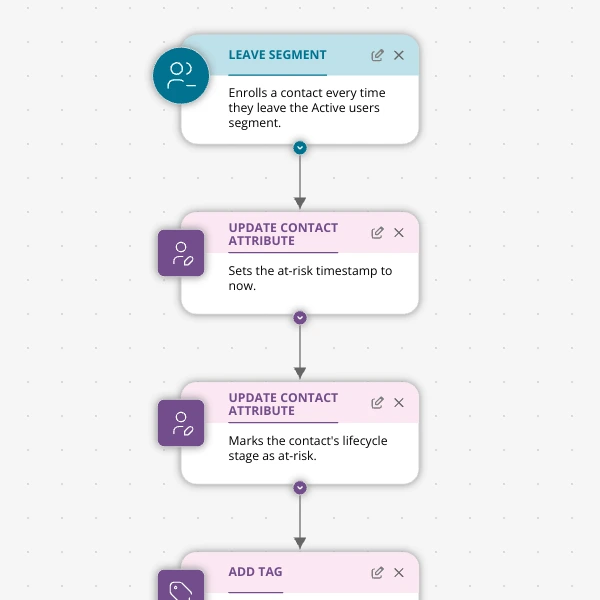
When Active Users Go Dark: A 4‑Touch Win‑Back Journey For Your Shopify App
A detailed, node-by-node Spreeflo journey for winning back previously active Shopify app users who stop engaging, using segment-based triggers, conditional logic, and a four-touch email plus internal alert sequence to recover usage and MRR.