Stop Wasting Newsletter Signups: A Simple Flow for Welcome + First Issue
This playbook shows SEO SaaS founders how to connect a signup form, instant welcome email, and cyclic newsletter in Spreeflo so every new subscriber receives context, engages with issues, and can be measured through retention.
Industry
Niche
Pattern
Loading sequence...
A lot of SEO SaaS founders treat newsletter signups like a scoreboard: new emails go up, MRR somehow goes up later. In between, there’s a big fog.
The usual pattern: someone joins your list, gets a generic welcome a few days late (if at all), then is dropped cold into whatever issue happens to go out next quarter. No context, no bridge from “I just met you” to “I trust your SEO product with my clients.”
The sequence at the top of this page is the whole journey, end to end. It fixes that gap with one simple promise: every new subscriber gets an immediate, tailored welcome and then flows smoothly into your next scheduled issue.
We’ll walk through how to build it in Spreeflo, step by step, and what to watch in the numbers for an SEO tool like RankPulse or BrieflySEO.
Why the first two emails decide your newsletter ROI
For an SEO SaaS, the newsletter is not just “content distribution.” It’s:
How you teach trial users what “good usage” looks like (e.g. weekly rank checks, regular content briefs).
How you keep agencies from churning once a project ends.
How you stay top of mind when budgets get reviewed.
But most of that upside lives or dies on two touches:
The welcome: Did they actually open it? Did it confirm they made a smart decision by subscribing?
The first real issue: Did they get to see what the newsletter feels like in practice, not just the promise?
That’s why this pattern measures three things:
Welcome open rate
First-issue engagement (opens and clicks)
Retention through issue 5
If you can get someone to open five issues, odds are good they’ll still be around when you launch a new feature or bump pricing.
The overview: one journey, two entry points
Inside Spreeflo, this pattern is a single journey with two separate trigger paths:
A Form Submission trigger for your “SEO newsletter signup” form:
A Cyclic trigger that runs on your newsletter cadence (weekly, bi-weekly, etc.):
Tags and updates the contact.
Sends a tailored welcome immediately.
Finds everyone who is currently a newsletter subscriber.
Sends the next issue to all of them, including brand-new signups.
Both sequences live in one journey so you see the full lifecycle in one place. If you’re new to journeys, this is a great first serious automation to build a journey around.
Let’s walk the canvas node by node.
Step 1: Build a clean newsletter signup that feeds automation
Start where the contact first appears: your signup form.
For anything you control (homepage, blog sidebar, exit-intent popup on your pricing page), this should be a Spreeflo form, not a custom form wired to the API. That keeps capture, consent, and automation on the same rails.
In the form builder:
Create a new form: “SEO Newsletter Signup”.
Turn Map to contacts on so every submission creates/updates a contact.
Make Email required.
Turn Save as marketing contact on so they’re eligible for journeys.
Optionally enable Double opt-in if you want explicit confirmation before sending marketing email.
Then add one or two profiling questions that will actually change how you talk to them. For an SEO SaaS, good ones are:
“What’s your primary focus right now?” (Rank tracking / Content / Technical SEO)
“Are you an agency or in-house?”
Map each answer to a contact attribute via Map to attribute. You’ll use those later to personalize.
Finally, embed the form:
Inline on your blog sidebar or landing page via the lightweight
embed.jssnippet.Or as a popup on key pages (e.g. blog posts about “rank tracking”) using a popup form embed.
Spreeflo’s help guide on how to create and embed forms walks through both options.
Once the form is published, every submission will:
Add the contact to your audience.
Capture their attributes for segmentation.
Fire the Form Submission trigger in your journey.
That’s your first entry point.
Step 2: Fire the welcome the second they subscribe
In the journey canvas, drop a Form Submission trigger and select your “SEO Newsletter Signup” form.
Configure it:
Re-enrollment: off. You don’t want the same person going through the welcome every time they re-enter their email.
Only trigger for new contacts: on, unless you intentionally want existing users who join the newsletter later to also run through this.
From that trigger, your path looks like this:
Update Email Subscription Status
Set status to “Email subscribed”. Even if the form runs double opt-in, this makes your intent explicit and helps with later segmentation (e.g. “send only to subscribed”).Add Tag
Add a tag likenewsletter:seo-weekly. This is the simplest way to build the audience for your ongoing issues, and it doubles as a safety filter everywhere else (“don’t send this to non-newsletter contacts”).Update Contact Attribute (optional but useful)
Two attributes worth creating:
-newsletter_joined_at(Timestamp): use Set to now so you can later filter “joined in the last 30 days”.
-newsletter_focus(Text): this is already populated from your form mapping, but you can standardize or append markers if needed.
These attributes let you group and compare subs later in the segment builder.Send Email — Your welcome
This is the first actual message. Use Spreeflo’s email builder to create a template like “Welcome to RankPulse Weekly”.
A simple structure that works well for SEO SaaS:
- Short confirmation: “You’re in. Here’s how this will help your rankings.”
- One “quick win” resource tailored to their focus (rank tracking, content, technical).
- One product-specific outcome: e.g. “How an agency used RankPulse alerts to save 6 hours/week.”
- Set expectations: “Issues go out every Thursday. First one lands within a week.”
This is where Spreeflo’s AI personalization helps: pull in theirnewsletter_focusorroleattribute to generate subject lines and intros that speak directly to an agency vs in-house marketer. See the guide on AI variables for personalization for configuration.
Configure the Send Email node with “Send only once” on. Nobody should ever get two welcomes.
At this point, your new subscriber has:
Explicitly opted in.
Been tagged as a newsletter subscriber.
Received a high-signal welcome that tells them what to expect.
Now you need them to actually see a real issue.
Step 3: Let a Cyclic trigger handle every issue (including their first)
The second entry point on the canvas is what actually sends your newsletter.
Drop a Cyclic trigger as a separate starting node. Configure it roughly like this:
Interval: every 1 week (or whatever cadence you run).
Time: e.g. Thursday at 09:00 in your primary timezone.
Criteria (via Segment Builder):
- Tag isnewsletter:seo-weekly.
- Email subscription status is “Subscribed”.
Crucially, set Re-enrollment to on. This tells Spreeflo to process the same contact every time the schedule ticks, as long as they still match the criteria. They flow in, get the issue, exit, and are ready again next week.
From this trigger, the simplest version of the path is one node:
Send Email — The issue
Attach a template like “SEO Weekly Issue”.
Before each send, your team updates this email in the template editor with:
- The latest article or case study.
- Product news (e.g. “We now support daily SERP snapshots”).
- A behavioral nudge: “Haven’t added your first keyword set yet? Here’s how to do it in 2 minutes.”
Because Spreeflo journeys use the live content of the attached template, you can keep this one Send Email node and just refresh the content before the Cyclic trigger fires. The next tick sends the updated issue to all matching subscribers — including anyone who signed up minutes before.
You’ve now met the pattern’s requirement:
Welcome immediately on signup.
Next scheduled issue automatically, with no manual juggling of “who already got which.”
Step 4: Track who sticks around through issue 5
Building the flow is only half the job. You need to know whether it’s actually turning newsletter signups into engaged users, not just vanity subscribers.
Here’s how to read the three core metrics in Spreeflo.
1. Welcome open rate
Create a segment:
Email Activity: “opened” at least 1 time in the last 30 days.
Marketing email: your welcome template.
Compare segment size to the total number of contacts with tag newsletter:seo-weekly added in the last 30 days.
If welcome opens are low, your subject line or sender identity probably feels “generic SaaS” rather than “this will make you better at SEO.” Use AI variables to test more specific lines keyed to their focus or role.
2. First-issue engagement
Because the Cyclic trigger reuses the same template, you can track “first-issue engagement” by looking at subs who:
Joined in the last 7 days (via
newsletter_joined_at).Opened or clicked the newsletter template at least once.
In the segment builder, that’s:
Contact attribute
newsletter_joined_atis within last 7 days.AND Email Activity “SEO Weekly Issue” opened at least 1 time.
These are the people your welcome successfully carried into the real content. If this number is weak but welcome opens are strong, the welcome is selling something different from what the issue delivers.
3. Retention through issue 5
Think in behaviors, not strict “issue numbers.” The cleanest proxy is:
Email Activity: “SEO Weekly Issue” opened at least 5 times in the last 90 days.
AND tag
newsletter:seo-weekly.
That gives you “retained through roughly five issues.” You can get fancier by layering newsletter_joined_at to isolate new cohorts, but this alone will already tell you whether your newsletter genuinely holds attention or just spikes on sign-up bribes.
From there you can:
Compare churn between “opened ≥5 issues” and “opened <5 issues”.
Export that segment to see which plans / user types stick around longer.
Most SEO SaaS tools leak lifetime value here: trials convert, but users never build a habit of engaging with content or product. This is where you plug that leak.
Variations worth testing for SEO SaaS products
Once the core pattern is in place and stable, there are a few easy upgrades that still keep the flow simple.
Branch copy by use case
Right after the Form Submission trigger, add an If/Else node that checks the newsletter_focus attribute from your form:
If
newsletter_focusis “Content”: send the content-focused welcome version.Else if it’s “Technical SEO”: different angle and example.
Else: generic / rank tracking flavor.
Each branch has its own Send Email node as the welcome, but every branch still merges back into the same tag and Cyclic-driven issues. You’re talking to each subscriber in their language without creating three separate newsletters.
This is the essence of capturing detail on every customer so you can speak to each uniquely. You did the work of asking what they care about at signup — it’s wasteful not to use it.
Tag based on engagement
After the Cyclic → Send Email node, you can insert:
A Time Delay of 2 days.
A Check Email Activity process node on the same issue template.
Branch on:
Clicked: Add Tag
newsletter:engaged.Did not open: Add Tag
newsletter:cold.
That gives you a live “warm vs cold” view of your audience and lets you test reactivation sequences later. Just remember not to stack another Send Email immediately after; always respect at least a small delay between sends in any path.
Closing: nurture is how you earn the lifetime value you already paid for
If you’re paying in time or money to get people onto your SEO SaaS site, every newsletter signup is already an acquisition cost. The welcome + first-issue pattern is how you give that cost a chance to compound.
It doesn’t require a marketing team. It asks you to:
Capture the right details at signup.
Respond instantly with a welcome that feels specific.
Keep a steady cadence where every subscriber, new or old, sees the same live issue.
Spreeflo’s journeys, forms, and segmentation are built for exactly this kind of lifecycle work: the quiet automation that keeps your product in the habit loop of agencies and in-house teams.
Set this journey up once, watch the numbers for a month, and adjust. You’ll have turned “another newsletter signup” into a much clearer story: welcome opened, first issue engaged, still with you at issue five — and far more likely to stay a paying customer.
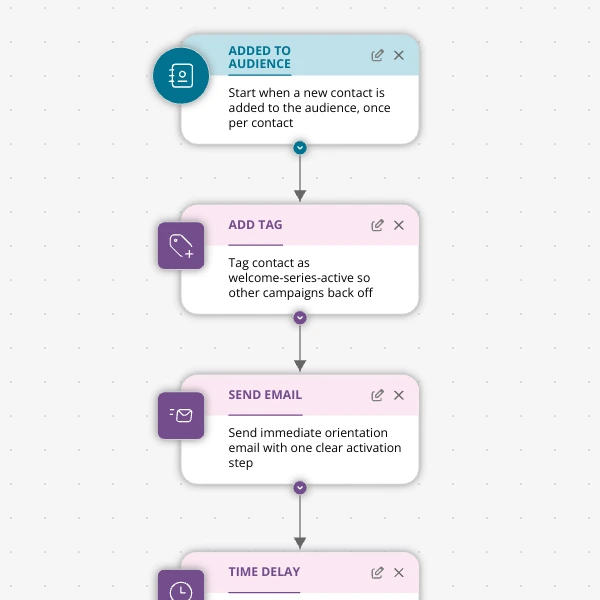
The Shopify app welcome series that turns installs into income
A step-by-step Shopify app welcome email journey for tools like CartSpark, showing how to turn new installs into activated, retained merchants using Spreeflo journeys, tags, and behavioral triggers so fewer trials quietly churn and more trials convert.
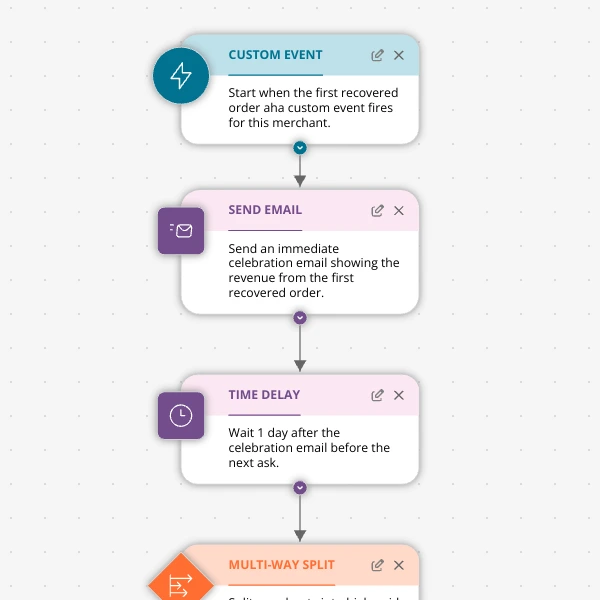
The Aha-Moment Playbook For Shopify Apps: Turn One Magic Action Into Months Of Revenue
A node-by-node playbook for Shopify and e‑commerce apps to center their lifecycle on one aha-moment custom event in Spreeflo, celebrate it, segment merchants by profile and engagement, and turn first recovered value into lasting revenue and retention.
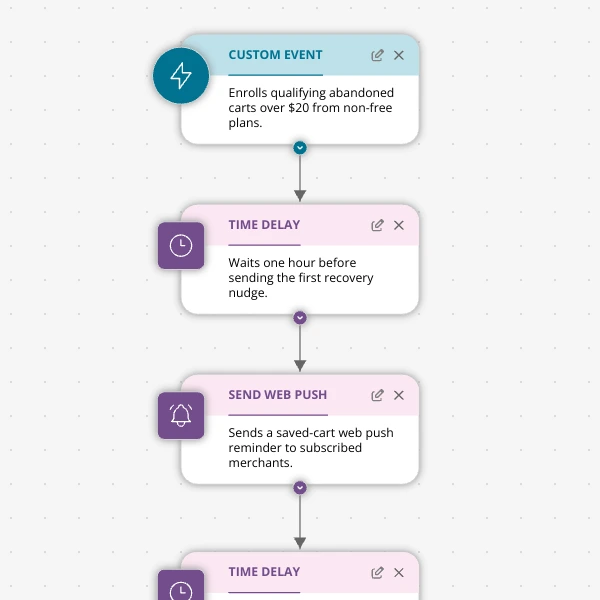
Stop Letting High‑Intent Carts Die: A 3‑Email Recovery Journey for Shopify Apps
A detailed, node-by-node walkthrough of a three-email (plus optional web push) cart-abandonment recovery journey for Shopify apps in Spreeflo, showing how to trigger events, branch on behavior, tag outcomes, and measure recovered carts and revenue.
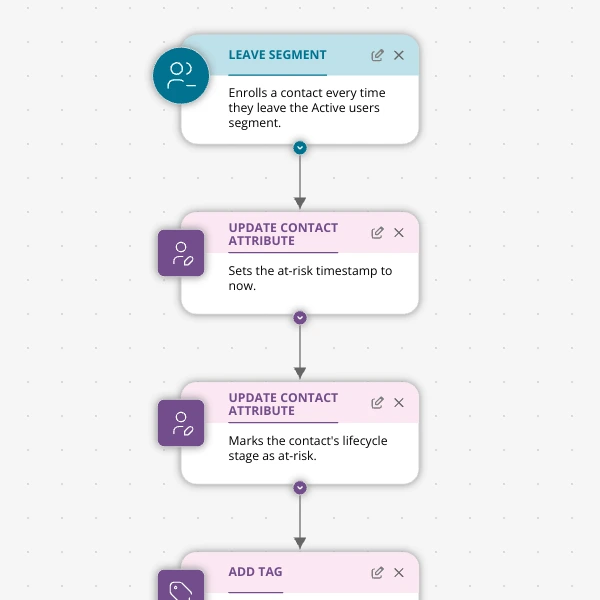
When Active Users Go Dark: A 4‑Touch Win‑Back Journey For Your Shopify App
A detailed, node-by-node Spreeflo journey for winning back previously active Shopify app users who stop engaging, using segment-based triggers, conditional logic, and a four-touch email plus internal alert sequence to recover usage and MRR.