The SEO SaaS Welcome Flow That Turns Anonymous Visitors Into Trial-Ready Leads
This playbook walks SEO SaaS teams through building a Spreeflo-powered email capture and welcome journey that turns anonymous organic visitors into known contacts, personalizes messages by role and intent, and nudges them toward trial-ready, in-app activation.
Industry
Niche
Pattern
Loading sequence...
A lot of SEO tools pull 20k–50k organic visits a month and still watch 98% of that traffic bounce without starting a trial. For a business that lives and dies on recurring revenue, that’s a painful leak.
The sequence at the top of this page is the whole journey, end to end. It turns those anonymous visitors into known, qualified email subscribers and then walks them toward a first session that actually converts.
We’ll anchor this in a concrete example: BrieflySEO, a 5‑person content‑brief SaaS doing ~$60k MRR. They get thousands of visitors to “content brief template” posts, but only a small slice start a trial on the first visit. They use Spreeflo to put an email capture on those pages and drop new subscribers into a tightly designed welcome series.
This playbook is how to do the same for your SEO SaaS.
Why email capture is your real SEO growth lever
If you rely only on “visit → trial → paid” in a single session, you’re fighting uphill:
Prospects are multitasking and tab‑hoarding.
Agencies might be researching on behalf of a client and not ready to commit.
In‑house marketers are comparing three other tools beside yours.
You don’t need them to start a trial immediately. You need two things:
Their email address, mapped to a real contact record.
Enough context to speak to their actual SEO job to be done.
Once you have that, you can stop shouting into the void and start sending focused messages that match what they were doing when they found you. That’s the first brand message in action: capture detail on every customer so you can speak to each of them uniquely.
The journey you see above does exactly that:
A Spreeflo form on your site captures the email (and a tiny bit of context).
An Add to Audience trigger starts a welcome series.
A short sequence of emails nudges people from “interested” to “trial user” and filters out low‑intent signups without spamming anyone.
Let’s walk it node by node.
Step 0: Build the capture surface with a Spreeflo form
Start where your SEO traffic actually lands: blog posts, comparison pages, and feature explainer pages.
For BrieflySEO, one of their highest‑intent posts is “How to write an SEO content brief in 15 minutes.” They add an inline form halfway down the article offering:
“Get our content brief template (and a 5‑email workflow that shows how to use it).”
Here’s how that form is set up in Spreeflo:
In the Forms area, create a new form.
Turn on "Map to contacts" so submissions create or update contact records.
Add fields:
- Email (required).
- Role (dropdown: Agency, In‑house, Freelancer).
- Main goal (dropdown: "Rank faster", "Scale content production", "Client reporting").For Role and Main goal, use Map to attribute so each answer writes straight into contact attributes like
roleandprimary_goal.
You can embed this either inline or as a popup:
Inline embed is ideal for long‑form blog content and landing pages.
Popup (modal or slider) works for exit‑intent or “after 10 seconds” prompts.
The create and embed forms guide walks through both options in detail, including the embed.js snippet for inline and SDK‑based popups.
Because forms are on the free plan with unlimited responses, you can add this capture pattern across your most important SEO pages without worrying about cost.
Every submission now:
Adds a contact to your audience.
Stores their email, role, and main goal on the contact record.
That’s the data foundation your welcome journey builds on.
Step 1: Trigger the journey with "Add to Audience"
Now switch to automation.
Create a new journey in Spreeflo (Journeys live under Campaigns & Journeys in the app; the campaigns and journeys overview has the full breakdown if you’re new to it).
Add your first trigger:
Trigger type: Add to Audience.
Re-enrollment: Off.
With re-enrollment off, each contact runs through this journey once. That’s exactly what you want for a “new subscriber” welcome: a clean, one‑time experience, even if that contact submits other forms later.
The catch: Add to Audience fires for every new contact, not just this specific form.
So the next node in the sequence is a routing step that filters for the people who came from your SEO capture form.
Step 2: Route only SEO form signups into this flow
Because your form mapped a field like acquisition_source or primary_goal, you can use that to narrow the path.
Right after the Add to Audience trigger, add a Multi-way Split:
Condition group A:
Contact attribute acquisition_source is blog-lead-magnet.Else branch: everyone else.
In the segment builder, this reads as a simple attribute rule. The Multi-way Split lets you send people who match that rule down your SEO welcome branch, while the Else branch can either:
Go to a different welcome flow (for trial signups, integrations, etc.), or
Go straight to a terminal node if you want this journey to handle only SEO form leads.
This keeps the journey reusable without letting an imported CSV or a manually‑added investor email accidentally get all your nurture content.
Step 3: Email 1 – deliver the thing you promised
For the branch that matched acquisition_source = blog-lead-magnet, the next step is your first Send Email node.
Configuration:
Template: "SEO Starter Kit – Your Content Brief Template Inside".
Send only once: On.
From: your main marketing identity (e.g., hello@yourdomain).
Use the email builder to create this:
Open with exactly what they requested: clear link or button to the template.
Below that, a short section that reframes the problem your tool solves:
- "Most teams spend 45+ minutes writing a brief; here’s how to get it under 10."A single primary CTA:
- If you don’t have a trial yet: "Create your free account to use this brief directly inside the app.".
- If you do: "Log in and import this template in one click.".
Personalization here matters. You already captured role and primary_goal, so reference them:
“Because you selected ‘Agency’, this template focuses on client approvals and reporting.”
“Because you selected ‘Rank faster’, this walkthrough prioritizes how to surface quick‑win pages.”
Or use Spreeflo’s AI personalization to vary a section of copy based on those attributes; the AI variables guide shows how to feed contact data into dynamic text.
Why no delay before this email?
They just raised their hand. Waiting even an hour before sending the asset and a first CTA burns intent you already earned with your SEO content.
Step 4: Add breathing room, then segment by role
You don’t want back‑to‑back messages in the inbox, so the next node after Email 1 is a Time Delay:
Time Delay: 1 day.
After that 24‑hour pause, add another Multi-way Split by Role:
Branch 1: Role is Agency.
Branch 2: Role is In‑house.
Branch 3: Role is Freelancer.
Else: everyone who skipped the role question.
Each branch gets its own Send Email node.
For agencies: focus on recurring client value.
Subject: "How agencies keep SEO clients for 18+ months with [Your Tool]".
Body: talk about reporting, shared dashboards, and approvals.
For in‑house marketers: focus on internal alignment and predictable rankings.
For freelancers: focus on speed and perceived expertise.
The structure of each email is the same; the examples and proof points change. This is where that first brand message (“speak to each customer uniquely”) starts to pay off. You collected role and goal up front so you can write like you know who they are, because you do.
Merge all branches back into a single path with a Merge node after those emails. That keeps your canvas clean and ensures everyone, regardless of role, rejoins the same flow.
Step 5: Aim for the first meaningful in-app action
Welcome sequences often die after “here’s your download” and one generic follow‑up. For SEO SaaS, the real goal is different: get them to a first in‑app action that correlates with retention.
For a rank tracker, that might be “added_first_keyword”. For a content brief tool, it could be “generated_first_brief”.
The next three nodes in the journey do the heavy lifting here:
Time Delay:
- Wait another 2–3 days. This gives people time to consume the asset and poke around your site.Send Email 3:
- Subject: "Set up your first [core action] in under 5 minutes".
- Content: a screenshot‑driven walkthrough or short loom‑style GIF.
- CTA: straight into the in‑app "Add keyword" or "Create brief" screen.Wait Condition:
- Condition: Custom Eventgenerated_first_brief(or your equivalent) has triggered at least once in the last 3 days.
- Timeout: 3 days.
Under the hood, your app fires that event via the Spreeflo API whenever a user completes that core action. The Spreeflo API guide has the exact JSON shape, but conceptually your backend sends:
Contact identifier (email).
Event name (
generated_first_brief).Optional properties (project size, word count target, etc.).
The Wait Condition pauses each contact until either:
They perform that core action, or
Three days pass without it.
You’ve just created a clean fork: people who engaged deeply vs. people who didn’t.
Step 6: Branch on engagement and tidy up low-intent signups
Immediately after the Wait Condition, add an If/Else node that checks the same condition again via the segment builder:
If: Custom Event
generated_first_brieftriggered at least once in the last 7 days.Else: everyone else.
Path A (Engaged):
Add Tag:
activated_from_seo_lead.Optional Send Internal Email to yourself or your success lead:
- Subject: "New activated SEO lead: {{contact.email}}".
- Body: include role, main goal, and which lead magnet they came from.End this journey for them. You’ll likely have a separate onboarding or expansion journey triggered by “feature used” events or segment joins.
Path B (Not yet engaged):
Time Delay: 1 day (to keep spacing from Email 3).
Send Email 4: a more direct offer.
- For example: "Want us to set up your first brief for you?" with a Calendly link, or a short video showing real‑world results.Optionally, after another delay, you can:
- Add Tagcold_seo_lead.
- Suppress them from regular broadcasts for a while, or move them into a lower‑frequency nurture.
This is how you avoid hammering everyone with the same weekly newsletter. You separate people who are genuinely exploring the product from those who just wanted the template and haven’t budged.
That’s brand message three in practice: most businesses leak lifetime value by not nurturing engagement. You’re now nurturing it deliberately, while also protecting your list quality.
Step 7: Keep an eye on capture rate and opt-in quality
Once this journey is live, you’ll want to iterate. Two sets of metrics matter:
Email capture rate
- At the page level: look at how many form submissions each embed collects over a fixed period.
- Try variations on:
- Offer ("template" vs "checklist" vs "mini‑course").
- Placement (mid‑article vs end‑of‑article).
- Popup timing (exit intent vs after 15 seconds).
You can make changes directly in the form builder and on your page embeds; you don’t have to touch the journey for each test.Opt‑in quality
- Build a segment like: "Email subscription status is Subscribed AND custom eventgenerated_first_brieftriggered at least once".
- Compare the size and growth of that segment against total signups from this form.
- Monitor open and click rates for your welcome emails separately from broadcast campaigns.
The web tracking and analytics help doc shows how to see which pages drive the most identified visitors and key events. Combined with Spreeflo’s segments, that gives you a clear picture of which SEO posts and offers are actually producing trial‑ready leads, not just traffic.
If you want to go further, you can use a Random Split node early in the journey (right after the first Time Delay) to A/B test different second‑email angles:
Branch A: product‑focused “how it works”.
Branch B: outcome‑focused “how an agency cut reporting time by 40%”.
Keep an eye on downstream behavior (core event fired, trials started) rather than just opens.
Adapting the pattern for in-app email capture
So far we’ve focused on turning anonymous SEO traffic into known leads. There’s a second angle for SEO SaaS teams: logged‑in users who aren’t yet marketing contacts.
Maybe they signed up for a trial through your app’s own form before you connected it to Spreeflo, or you imported a list of existing customers without their marketing preferences set.
For these cases:
Use Spreeflo popup forms in‑app to invite them to a "product updates + SEO tactics" newsletter.
Those forms don’t need to ask for email again; the SDK already knows who’s logged in.
Map a "wants_marketing_emails" question to a boolean attribute.
Trigger a separate journey on Form Submission or Join Segment when that attribute flips to true.
Use an Update Email Subscription Status node inside that journey to set them to "Subscribed".
The rest of the welcome content can mirror what you’ve already built, but tuned for people who are closer to the product.
Bringing it together
SEO SaaS founders are usually excellent at driving traffic and building product. The gap is almost always somewhere in between: anonymous traffic that never becomes a relationship, and signups that never find their way to the features that keep them paying.
A simple, data‑rich email capture journey closes that gap. You:
Capture the email at the moment of highest intent.
Add just enough context (role, goal, source) to talk to them like a real person.
Use a short sequence of spaced emails to guide them to a first meaningful in‑app action.
Split engaged from non‑engaged, so you can nurture without burning out your best leads.
You build this once and it runs for every future visitor who drops an email into that form. That’s the kind of system small teams win with: detailed on every customer, deliberate about engagement, and light on ongoing effort.
When your SEO content starts not just ranking, but reliably feeding a welcome journey like the one above, you stop treating traffic as a vanity metric and start treating it as a pipeline of future retained customers.
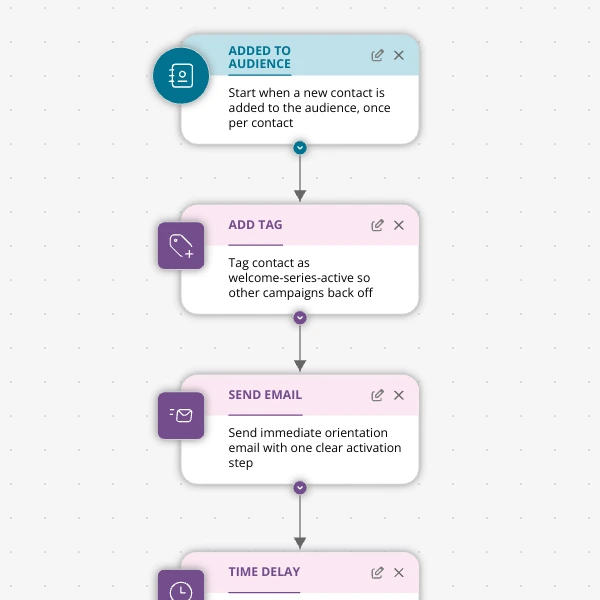
The Shopify app welcome series that turns installs into income
A step-by-step Shopify app welcome email journey for tools like CartSpark, showing how to turn new installs into activated, retained merchants using Spreeflo journeys, tags, and behavioral triggers so fewer trials quietly churn and more trials convert.
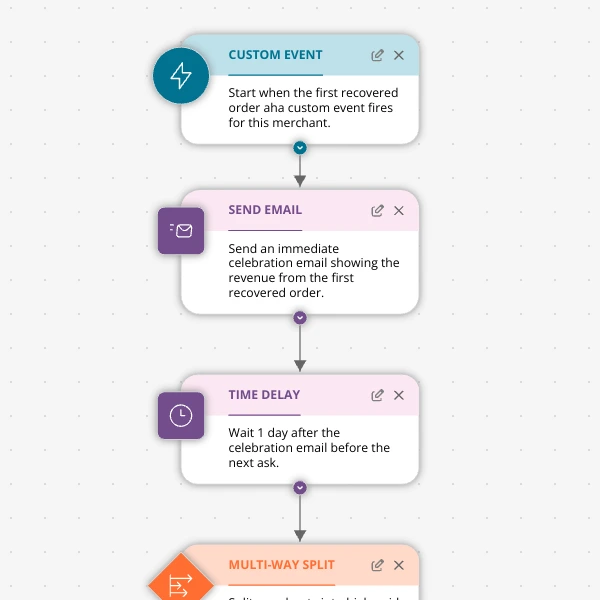
The Aha-Moment Playbook For Shopify Apps: Turn One Magic Action Into Months Of Revenue
A node-by-node playbook for Shopify and e‑commerce apps to center their lifecycle on one aha-moment custom event in Spreeflo, celebrate it, segment merchants by profile and engagement, and turn first recovered value into lasting revenue and retention.
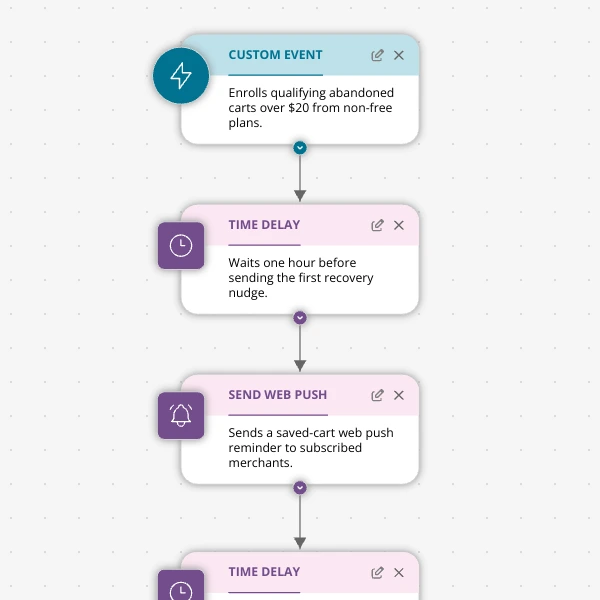
Stop Letting High‑Intent Carts Die: A 3‑Email Recovery Journey for Shopify Apps
A detailed, node-by-node walkthrough of a three-email (plus optional web push) cart-abandonment recovery journey for Shopify apps in Spreeflo, showing how to trigger events, branch on behavior, tag outcomes, and measure recovered carts and revenue.
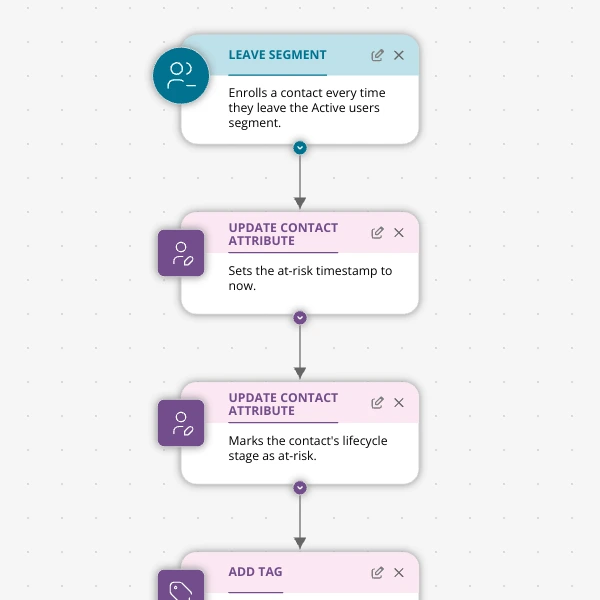
When Active Users Go Dark: A 4‑Touch Win‑Back Journey For Your Shopify App
A detailed, node-by-node Spreeflo journey for winning back previously active Shopify app users who stop engaging, using segment-based triggers, conditional logic, and a four-touch email plus internal alert sequence to recover usage and MRR.