The Stalled-Onboarding Email That Saves Your SEO Trials
A step-by-step Spreeflo journey for SEO SaaS trials that stall before activation, pausing generic onboarding on day three and routing users into a targeted rescue email path to lift activation, retention, and conversion.
Industry
Niche
Pattern
Loading sequence...
Two days into a new trial and… nothing. No keywords added, no site crawled, no content brief generated. You can almost see the churn coming.
The sequence at the top of this page is the whole journey, end to end, for catching that moment and doing something about it.
For our example, imagine RankPulse: a 3‑person SEO rank tracking SaaS doing ~$35k MRR. They get plenty of signups from blog posts and comparison pages. But 40–50% of those trials never add a first keyword. Those accounts almost always cancel or quietly lapse at the end of the trial.
This playbook is about one specific fix: if a trialist hasn’t hit a meaningful “aha” action by day 3, pause their regular onboarding drip and send a tailored re‑activation email instead.
Done well, this one journey:
Saves stalled trials that would otherwise slip away.
Lifts week‑one retention.
Gives you cleaner data on what actually drives activation.
And because you’re building it in Spreeflo, it doesn’t add work once it’s live.
When a free trial stalls, it rarely recovers by itself
Most SEO SaaS onboarding looks like this:
Day 0: “Welcome to RankPulse, here’s a tour.”
Day 1: “Five ways agencies use RankPulse.”
Day 3: “How to scale your reporting.”
Those emails assume the user is already doing something in the app. If they haven’t added a site or a keyword yet, all of that is noise.
For an SEO founder, this is where a lot of lifetime value quietly leaks away. You paid to acquire the signup. You put engineering time into onboarding. Then you let high-intent users churn simply because nothing nudged them at the moment they were drifting.
The fix is not another generic tip email. It’s a different branch for people who have stalled:
Recognize they haven’t reached activation by a specific day.
Pause the normal drip.
Send a short, specific email that removes friction for their use case.
Spreeflo’s journeys exist for this kind of pattern. You define what “stall” means using the same segment builder you’d use for audiences, then route people down a rescue path instead of the generic one.
Step 1: Decide what “meaningful activation” means for your SEO tool
The stalled-onboarding journey only works if you’re clear about the milestone you care about.
For SEO SaaS, that’s usually one of:
Rank tracking: user adds at least one domain and one keyword.
Content briefs: user generates their first content brief.
Technical SEO: user runs their first site audit.
Pick one primary activation event. Make it concrete and binary:
“Has added at least one keyword” is good.
“Is using the tool regularly” is not.
For RankPulse, we’ll treat “added_first_keyword” as the activation event. That can be a custom event you send to Spreeflo from your app when a user adds their first keyword.
Later, you can refine with more nuance (for example, different milestones for agencies vs in-house marketers), but start with a single definition so you can move quickly.
Step 2: Track the right events into Spreeflo
To run this journey, Spreeflo needs two facts for each contact:
When they became a trial user.
Whether they’ve hit the activation event yet.
You can send those into Spreeflo in two ways:
Frontend: from your web app using the Spreeflo SDK.
Backend: from your server using the Spreeflo API.
A typical pattern for an SEO SaaS:
When someone signs up or starts a trial, create/update a contact and mark them as a trial user.
- If you do this in the browser, callSpreeflo.identify('user@example.com', { plan: 'trial' }).
- If you do it in your backend, POST to the contacts endpoint of the Spreeflo API with their email and attributes.When they hit your activation milestone, track a custom event.
- In the browser:Spreeflo.track('added_first_keyword', { project_id: '...', keyword_count: 1 }).
- On the backend: POST to the events endpoint of the Spreeflo API with{ event: 'added_first_keyword', email: 'user@example.com', properties: { ... } }.
Spreeflo stores that as a custom event tied to the contact. You’ll use that both in the Wait Condition node and the If/Else branch in the journey.
If you also install the web SDK on your marketing site or app, you get extra context from web tracking and analytics: which pricing pages they viewed, how often they returned, and so on. That detail lets you speak to each stalled trial in a much more specific way.
Step 3: Build the stalled-onboarding journey, node by node
Now to the fun part: wiring this into a journey that runs 24/7.
The sequence at the top of this page shows the full flow. Here’s how each node is configured and why it’s placed where it is.
3.1 Trigger: add new trial users into the journey
Node: Add to Audience trigger
Re-enrollment: off
You want every new trialist to enter this journey once.
Most SaaS apps already create a contact when a user signs up or starts a trial, either via the SDK’s identify call or via the API. The Add to Audience trigger fires as soon as that contact is added.
If you keep non-trial contacts in the same workspace (for example, newsletter-only leads), narrow this journey to trialists by adding a quick filter right after the trigger:
Option A: Add a dedicated “trial” tag at signup and use an If/Else node to only continue if the contact has that tag.
Option B: Store
plan = 'trial'as a contact attribute and route based on that in an If/Else.
Either way, the “yes” branch contains the rest of this sequence; the “else” branch can simply terminate.
3.2 Send the day‑0 welcome that points straight at the milestone
Node: Send Email (welcome)
“Send only once”: on
This is your standard welcome email, but focused tightly on getting them to the activation step.
For RankPulse, that might be:
Clear CTA: “Add your first site and keyword – it takes 2 minutes.”
One screenshot of the rank-tracking dashboard.
A short line acknowledging who they are, using any attributes you’ve already captured (agency vs in-house, target region, etc.).
This is a good moment to use Spreeflo’s email builder to set up a clean template you can reuse for other onboarding journeys.
You’re already seeing Brand Message 1 at work here: the more detail you capture on each contact, the more pointed that welcome can be.
3.3 Give them space: a one‑day Time Delay
Node: Time Delay
Configuration: 1 day
After the welcome, insert a Time Delay of one day.
Two reasons:
It respects pacing. You avoid back-to-back sends, which read as spammy.
It gives motivated users time to self-serve. Many people will hit activation in the first 24 hours without any extra nudges.
Anyone who reaches the next step either has activated and will be caught by the condition, or they haven’t and need help.
3.4 Wait up to two more days for activation
Node: Wait Condition
Condition: Custom event “added_first_keyword” triggered at least 1 time over all time
Timeout: 2 days
This is the heart of the pattern.
You use a Wait Condition to pause each contact until one of two things happens:
They trigger the activation event (
added_first_keyword).Two more days pass without that event.
In the Wait Condition:
Set the condition using the Segment Builder interface:
- Category: Custom Events
- Event:added_first_keyword
- Frequency: at least 1 time
- Time window: over all timeSet the timeout to 2 days.
They already waited 1 day after the welcome. With a 2‑day Wait Condition, the total window is effectively 3 days from signup. That matches the pattern: “If no meaningful action by day N, intervene.”
As soon as either branch is true (event happened or time ran out), they move to the next node.
3.5 Branch: activated vs stalled
Node: If/Else
Condition: same as Wait Condition
Right after the Wait Condition, add an If/Else node with the exact same condition:
Condition: Custom event
added_first_keywordtriggered at least 1 time over all time.
Why repeat it? Because the Wait Condition only controls when they move on, not how they move on. The If/Else lets you branch the flow based on whether they actually hit the milestone.
“Yes” branch: they have activated within the 3‑day window.
“Else” branch: they did not, so they’re stalled.
From here, you can treat them like two different audiences, which they are.
3.6 The “activated” branch: continue your regular drip
For contacts who have hit the milestone, you probably want:
(Optional) Add Tag
- Tag:activated_user
- Use this for later segments and reporting (e.g., “activation-rescue rate among rescued vs non-rescued”).Send Email (onboarding step 2)
This is where your regular “how to get more value” drip continues:
- Advanced features (alerts, reporting, integrations).
- Use-case specific tips based on who they are (agency vs in-house, content vs technical focus).
You can build that drip out as a longer sequence if you like. The important point for this playbook is that these “activated” users do not see the stalled‑onboarding rescue email. They don’t need it.
3.7 The “stalled” branch: pause drip and send the rescue email
The else branch from the If/Else is where the pattern really earns its keep.
Recommended nodes:
Update Contact Attribute
- Attribute:onboarding_status(a custom TEXT attribute).
- Update type: Update.
- Value:"stalled".(Optional) Add Tag
- Tag:stalled_onboarding.Send Email (stalled-onboarding rescue)
“Send only once”: on.Time Delay
Configuration: 2 days.Wait Condition
Condition: Custom eventadded_first_keywordtriggered at least 1 time over all time
Timeout: 2 days.If/Else
Condition: same as the Wait Condition.
This attribute makes it easy to exclude stalled users from other journeys (“only send this campaign if onboarding_status is not stalled”) and to build segments later.
Some people prefer tags over attributes for this. Either works; the goal is to mark them.
This email should feel very different from your generic onboarding content. For RankPulse, something like:
Subject: “Want us to set up your first keywords for you?”
Body:
- One sentence acknowledging they signed up but haven’t tracked anything yet.
- A single CTA: either a “Set up in 2 clicks” deep link, or an offer to do concierge setup if that fits your model.
- Optional: a P.S. asking a one-click question like “Are you an agency or in-house?” that clicks through to a page you track, enriching their profile for later.
Because you’re capturing detail on each contact, you can tailor this further:
Agencies might see copy about client reporting and white-label exports.
In-house teams might see copy about showing SEO wins to their boss.
This is exactly Brand Message 1 in practice: speak to each customer uniquely, not as a flat list of “trials.”
Give them a bit of time to read the email and act before you decide what to do next.
Same pattern as before. You’re now waiting to see whether the rescue email worked.
Branch again:
“Yes” branch (rescued): they finally added their first keyword.
“Else” branch: they’re still stalled.
For the “rescued” branch, you might:
Add Tag:
rescued_by_onboarding.Update
onboarding_statusto"activated".Merge them back into your main onboarding journey at an appropriate step, or start a shorter “here’s how to get value quickly” sequence.
For those who remain stalled even after the rescue:
You can end the journey gracefully, perhaps with a final low-pressure check-in email later in the trial.
Or simply tag them as
trial_churn_riskso you can analyze and retarget later.
Either way, you’ve prevented the worst-case: continuing to blast a generic drip at people who never made it out of the starting gate.
Step 4: Measure activation-rescue rate and week‑one retention
The point of this pattern is outcomes, not elegance.
Three metrics to watch:
Activation-rescue rate
Among users who reached the stalled branch and received the rescue email, what percentage eventually fired the activation event?
- Build a segment: tagrescued_by_onboardingORonboarding_statusis"activated"and taggedstalled_onboarding.
- Compare that count to the total count ofstalled_onboardingcontacts over the same period.Week‑one retention
Among activated users, what percentage are still logging in or triggering key events seven days after signup?
You can get this from Spreeflo’s web analytics and custom event history:
- Segment on contacts who triggered activation.
- Add criteria for at least one meaningful event (rank check, brief generation, crawl) in the 7 days after activation.Assisted conversion
How many paying customers touched the rescue path?
- Add abecame_customerevent or attribute when they convert.
- Build contrasting segments:
- Customers who were never taggedstalled_onboarding.
- Customers who were taggedstalled_onboardingand laterrescued_by_onboarding.
If you’re a small team, it’s tempting to skip this analysis. But this is where Brand Message 3 comes into focus: most businesses leak lifetime value because they don’t nurture engagement. Once you see the lift from this one journey, it’s much harder to ignore.
Step 5: Adapting the pattern to your funnel
A few variations you can borrow for your own SEO product.
Different activation milestones by persona
If you capture user type on signup (agency vs in-house vs solo founder), you can:
- Branch early on that attribute.
- Use different activation events (for example, “invites a client” for agencies, “connects Search Console” for in-house).
- Route each persona to its own stalled-onboarding rescue email.Using page views when you don’t have deep event tracking yet
If you haven’t wired all your in-app events, you can still approximate activation with web behavior:
- Use a Wait Condition that looks for “Page Visited URL contains/projectsat least 1 time over all time” within a timeframe.
- It’s less precise, but still better than treating every stalled trial the same.Backfilling existing stalled trials with Criteria Match
When you first roll this out, you may already have a bunch of mid-trial users. Spin up a one-off journey using a Criteria Match trigger:
- Criteria: taggedtrial, activation event has not triggered over all time, and contact added date is before a certain date.
- Action: send the same rescue email (and mark them so you don’t send it twice).
You define that stalled segment with the same segment builder and let it run until that legacy cohort clears.
Why this one journey is worth your time
As an SEO SaaS founder, you’re already juggling acquisition, product, support, and the actual work of keeping up with search changes. You can’t afford to micromanage every trial.
That’s precisely where a targeted journey like this shines.
You:
Capture enough detail on each user to know when they’re stuck and what they care about.
Let Spreeflo route them into a tailored path the moment they stall.
Free yourself from manually chasing down every inactive trial while still saving the ones that can be saved.
You build it once and let it run alongside your existing onboarding and campaigns. And every week, a few more stalled users quietly cross that activation line instead of drifting away.
If you already have events flowing in via the Spreeflo API or the SDK, you have everything you need to build a journey like the one at the top of this page. Start with your highest-intent activation step, wire in the stalled-onboarding branch, and watch what happens to your next month’s retention curve.
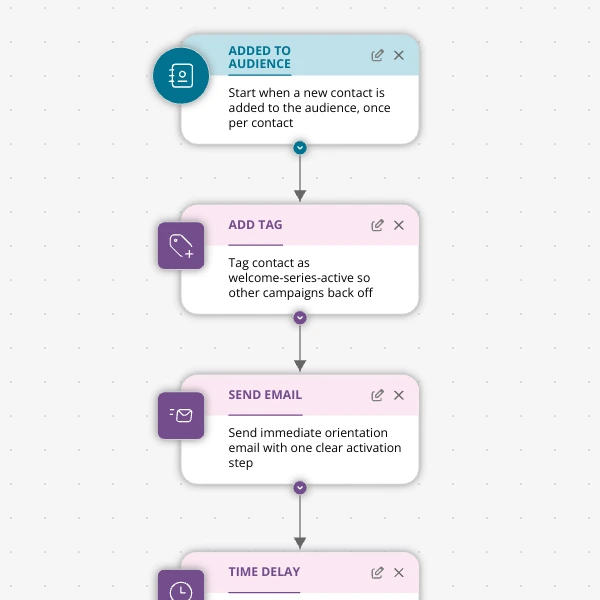
The Shopify app welcome series that turns installs into income
A step-by-step Shopify app welcome email journey for tools like CartSpark, showing how to turn new installs into activated, retained merchants using Spreeflo journeys, tags, and behavioral triggers so fewer trials quietly churn and more trials convert.
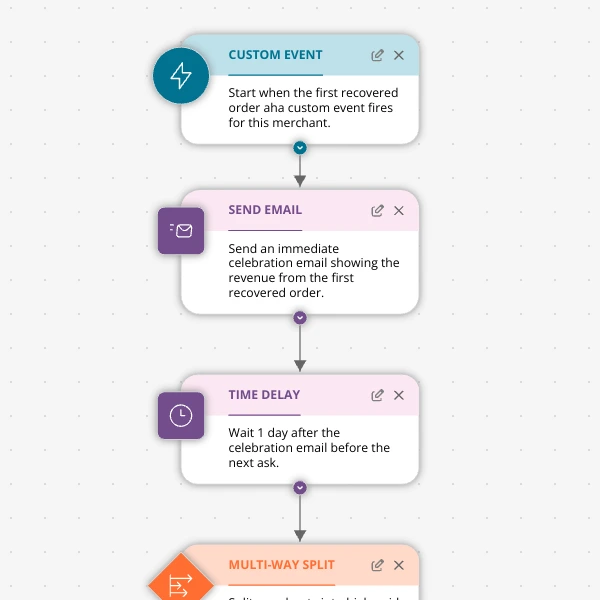
The Aha-Moment Playbook For Shopify Apps: Turn One Magic Action Into Months Of Revenue
A node-by-node playbook for Shopify and e‑commerce apps to center their lifecycle on one aha-moment custom event in Spreeflo, celebrate it, segment merchants by profile and engagement, and turn first recovered value into lasting revenue and retention.
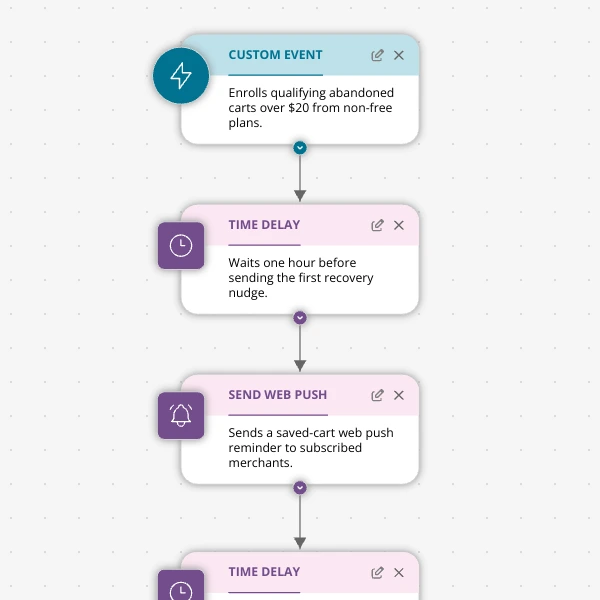
Stop Letting High‑Intent Carts Die: A 3‑Email Recovery Journey for Shopify Apps
A detailed, node-by-node walkthrough of a three-email (plus optional web push) cart-abandonment recovery journey for Shopify apps in Spreeflo, showing how to trigger events, branch on behavior, tag outcomes, and measure recovered carts and revenue.
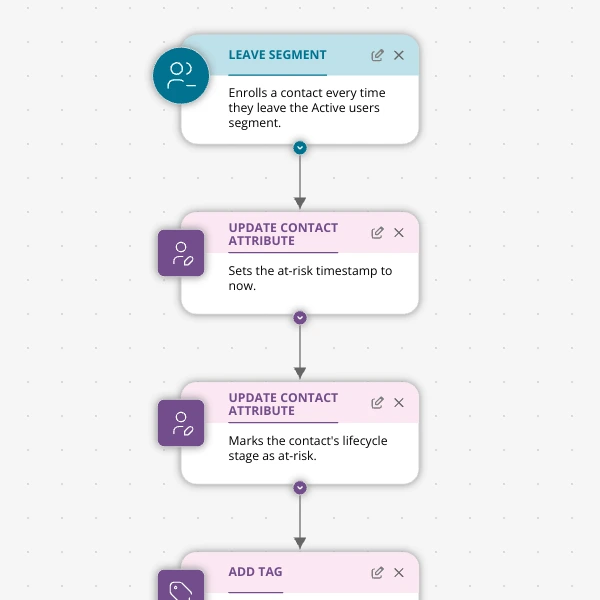
When Active Users Go Dark: A 4‑Touch Win‑Back Journey For Your Shopify App
A detailed, node-by-node Spreeflo journey for winning back previously active Shopify app users who stop engaging, using segment-based triggers, conditional logic, and a four-touch email plus internal alert sequence to recover usage and MRR.