The “You Haven’t Tried AI Search Yet” Journey Flyweight Should Be Running
A lifecycle journey design for Flyweight merchants, showing how to use Spreeflo to identify heavy chat users who haven’t tried AI Search, nudge them with contextual emails, and measure adoption, engagement, and retention impact.
Industry
Niche
Pattern
Loading sequence...
About this playbook. This is a proposal written for Flyweight, showing how Spreeflo could support their business. It is not an account of how Flyweight operates today. It was assembled from publicly available information on their website, so the lifecycle stages, events and thresholds described below are informed assumptions rather than verified facts about their systems. Treat it as a starting point to react to and correct.
A Flyweight merchant can be deep into AI-driven chat on Shopify, raving about reduced support pressure, and still churn a few months later because they never discovered one of your strongest value drivers.
For a lot of your AI Pro and AI Leader brands, that feature is AI Search: always-on, product-aware search that should be doing quiet, compounding work in the background. If they never switch it on, they’re running Flyweight in “demo mode” without realising it.
The sequence at the top of this page is the whole journey, end to end. It’s built to catch those partial adopters and send a single, surgical nudge: “You haven’t tried AI Search yet — here’s why it matters and how to turn it on.”
What follows is how to build it in Spreeflo, why each node is there, and where you can adapt it for other Flyweight features.
Why partial adoption is a retention leak for Flyweight
Your commercial model is simple: merchants pay monthly, and AI Interactions are the metered unit. Merchants who stick around are the ones who push more and more customer journeys through Flyweight: support, pre‑purchase questions, recommendations, post‑purchase help.
The danger zone is merchants who:
Install
Get chat live
Use it heavily
Then stall before trying higher‑leverage features like AI Search
They still generate interactions, but they’re not getting the full upside you advertise on your site. When churn happens later, the story is almost always “we didn’t get enough value” rather than “the AI wasn’t good enough.”
This journey attacks that specific leak:
It uses detailed product telemetry (who’s using what, how much, and where)
It targets only merchants for whom AI Search is both relevant and still unused
It nudges them with one or two contextual emails, then gets out of the way
You’re not blasting “New feature! Turn on AI Search” to everyone. You’re speaking uniquely to a small subset of high‑fit merchants — exactly the kind of data‑driven targeting the Spreeflo platform is built for.
What this journey does in plain language
Before we zoom into the nodes, here’s the behaviour you want:
Detect merchants on AI Pro or AI Leader who:
- Are already heavy chat users (lots of AI Interactions recently)
- Have never used AI SearchSend them a personalised, deep‑linked email: “AI Search is ready for you; here’s what it could do and how to flip it on.”
Watch how they interact with that email:
- If they click the CTA, assume high intent and give them time to adopt
- If they open but don’t click, follow up once with a more educational angle
- If they ignore it completely, don’t nag — just mark them for softer nudges laterTag those who eventually adopt AI Search so you can:
- Measure adoption rate and deep‑link CTR
- Compare retention between “AI Search adopters” and “non‑adopters”
- Feed later journeys (“now that AI Search is live, here’s what’s next…”)
All of this runs as a continuous journey in Spreeflo, using a Criteria Match trigger as the entry point. Let’s walk it step by step.
Step 1: Criteria Match trigger – define “power user, hasn’t tried AI Search”
Node: Criteria Match (trigger), re‑enrollment off.
This journey should only ever run once per merchant. Once they’ve tried AI Search, they’re no longer eligible, so set re‑enrollment to false.
Inside the Criteria Match trigger, you use the segment builder to express your ideal “nudge” profile. A clean starting point:
Group connector: AND
Contact Attributes:
- Plan attribute is AI Pro or AI Leader
(assuming you’re mapping Shopify billing plan into a contact attribute such asflyweight_planvia your backend and the Spreeflo API)Email Subscription Status:
- is Subscribed
(you don’t want to send marketing email to merchants who have opted out)Custom Events:
- Custom eventai_interactiontriggered at least N times in the last 30 days
(N is your “power user” threshold — many teams start with 200–500, but you can tune it)
- Custom eventai_search_usedhas not triggered over all time
The two custom events above assume you’re already posting Flyweight telemetry into Spreeflo’s events API (e.g. one ai_interaction event per AI reply, one ai_search_used event the first time AI Search serves results). If you’re not doing this yet, wiring those two in is the prerequisite for this whole pattern.
Why Criteria Match, not a Custom Event trigger? Because this is about profile state, not a point‑in‑time action. The right moment to nudge is “when a merchant has become a heavy user but still hasn’t used AI Search,” not “when we see the 200th AI interaction exactly.”
Step 2: Add a trail of tags so you can report later
Node: Add Tag.
First action after the trigger: apply a tag like ai-search-nudge-started.
Configuration:
Tags:
ai-search-nudge-startedForce Tag Trigger: off (you don’t need to fire any other journeys on this tag)
This gives you an easy way to:
Count how many merchants ever qualified for this nudge
Exclude them from future AI Search promos
Build reporting segments in Spreeflo Audiences
Tags are cheap, and they’re the backbone of later analysis.
Step 3: Send the first, highly contextual email
Node: Send Email (marketing).
This is the hero touch. Use Spreeflo’s email builder with a template scoped specifically to AI Search adoption.
Configuration highlights:
From: your usual Flyweight sender identity
Send only once: on (you never want this email to repeat on re-entry)
Subject line and body using Liquid to pull in context, for example:
- “You’ve had {{ ai_interactions_30d }} chats. Ready for AI Search?”
- “Brands like you turn X% of store searches into revenue with AI Search.”
(X% can be a generic benchmark, not a specific customer claim)
The key is to make it obvious that this isn’t a generic product update:
Reference their recent activity (“You’ve handled a lot of chat volume with Flyweight in the last month”)
Explain what AI Search does for that existing success (“Answer the long‑tail questions before chat even starts”)
Limit the CTA to one clear action: “Turn on AI Search” with a deep link into the AI Search setup page in your own app
Because the contact set is pre‑filtered so tightly, this email will read like a helpful suggestion, not a feature pitch.
Step 4: Give them space, then branch on email behaviour
Node: Time Delay → Check Email Activity.
You don’t want to hammer merchants immediately after sending the first email. Insert a Time Delay:
Delay: 3 days
Unit: Days
After that, add a Check Email Activity process node wired to the AI Search email template you just used.
Configure three branches:
Branch A: Link Clicked
Branch B: Opened (but didn’t click)
Branch C: Not Opened
Spreeflo’s Check Email Activity node lets you pick those actions explicitly. The node automatically adds an “Else” branch; you can treat it the same as “Not Opened” for this journey.
Why this pattern:
Clicked: strong intent signal — they’ve at least looked at AI Search setup
Opened: they read the pitch, but something (time, friction, uncertainty) held them back
Not Opened: email is probably not the right channel or timing for them on this topic
Each path deserves different treatment.
Step 5: When they click, wait for adoption (then celebrate it)
Path: “Link Clicked” branch
Nodes: Wait Condition → If/Else → Add Tag (+ optional Internal Email)
On the “clicked” path, assume they’re interested and give them time to self‑serve.
First, a Wait Condition:
Condition: Custom event
ai_search_usedtriggered at least 1 time over all timeTimeout: 7 days, unit Days
Spreeflo will hold the contact here until either:
You post an
ai_search_usedevent for that merchant via the Spreeflo API, or7 days pass without that event
Immediately after the Wait Condition, add an If/Else process using the same condition:
If branch: merchants where
ai_search_usedhas triggered at least onceElse branch: everyone else
On the “yes, adopted” branch:
Add Tag with
ai-search-adopted(Optional for high‑value brands) Send Internal Email to your team with context:
- Who they are
- How many AI Interactions they’ve run
- That AI Search just went live
On the “no adoption yet” branch:
Send one short follow‑up email focused on de‑risking:
- A 2–3 bullet “this is what happens when you flip AI Search on”
- A link to a short help article or videoConsider tagging them
ai-search-clicked-no-adoptfor later product‑led outreach
Then end the journey for them. They’ve seen two touches and had a full week to act; anything more starts veering into spam.
This whole path turns a noisy stream of product signals into a small, meaningful slice of merchants you can treat as “AI Search champions in progress.”
Step 6: For the “opened but didn’t click” crowd, teach once then stop
Path: “Opened” branch
Nodes: Time Delay → Send Email → Add Tag
These merchants were curious enough to open, but the first CTA wasn’t enough. Maybe they read from their phone, maybe adoption requires a technical teammate. You don’t know — but they’re warmer than the “ignored” group.
Flow:
Time Delay:
- 4 days after the first email
(gives them breathing room and avoids feeling pushy)Second Send Email:
- Angle: education and proof over urgency
- Content ideas:
- A short story of how a typical brand uses AI Search (no named customer metrics needed)
- Screenshots or GIFs of the search experience
- Clear statement: “You can turn this on in about 2 minutes”
- Same deep link CTA to the AI Search setup pageAdd Tag:
ai-search-educational-nudge-sent
After this, stop. They’ve had two chances to engage. Whether they adopt or not, you now have:
A sub‑segment of merchants who showed some curiosity
A tag you can use later if you roll out in‑app banners or Copilot suggestions specifically for AI Search
You can always compare later whether this group’s retention curves differ from those who never saw the journey.
Step 7: Quietly mark the completely cold recipients
Path: “Not Opened” (and Else) branch
Node: Add Tag.
For merchants who never opened the first email, skip further email. They might be overloaded, mis‑timed, or prefer in‑product guidance.
Add a simple tag like ai-search-nudge-unopened and end their path.
This tag is still valuable:
You avoid re‑adding them to future AI Search email campaigns
You can target them later via in‑app cues inside your admin, or via your own Copilot flows, without doubling emails
Again, the point is to treat each merchant based on what you know about them, not to treat every inbox as identical.
The data you need in Spreeflo for this to work
Everything above assumes two categories of data are flowing cleanly into Spreeflo:
Who the merchant is:
- A contact per store, with the owner or ecom manager’s email as the identifier
- Attributes likeflyweight_plan(Free / AI Starter / AI Pro / AI Leader), locale, and maybe catalogue size
- Email subscription status managed via onboarding (and synced into Spreeflo)What they’re doing in Flyweight:
- A customai_interactionevent every time your AI agent sends a response (chat or AI Search) to a shopper
- A customai_search_usedevent at least the first time AI Search serves results for that store (you can also fire it on every search if you prefer)
- Optionally, aknowledge_graph_builtevent so you can exclude installs where the Knowledge Graph never finished building
Because Flyweight runs server‑side, these events should be POSTed from your backend into the Spreeflo events API rather than using the JavaScript SDK. Once the events land, you can reference them in both the Criteria Match trigger and in conditions inside Wait Condition and If/Else nodes.
This is the “capture detail on every customer” part of the brand message: the richer your contact records, the sharper your automations can be.
Measuring success: adoption, clicks, and retention
With the journey live, you can track impact at three levels.
Feature adoption rate
- Numerator: contacts taggedai-search-adopted
- Denominator: contacts taggedai-search-nudge-started
- This is the cleanest measure of “how many of our ideal targets actually turned AI Search on after this flow.”Deep‑link click‑through
- Use email analytics plus theLink Clickedbranch volume from the Check Email Activity node
- Compare CTR between the first and second email to see if the educational follow‑up is worth the extra complexityRetention by feature use
- Build two segments in Spreeflo:
- Segment A: merchants with tagai-search-adopted
- Segment B: merchants inai-search-nudge-startedbut notai-search-adopted
- Over time, compare churn, AI Interaction growth, and plan‑upgrade rates across those two segments using your own billing data
Even if you don’t run formal experiments, this split gives you evidence for a pattern every product‑led team intuits: merchants who adopt deeper features stick around longer. Once you can quantify it, it’s much easier to justify more journeys like this.
If your assumptions change, the pattern still holds
Two common variations you might run into:
If AI Search is available on more plans: adjust the Criteria Match trigger to include those plan values. The rest of the journey is unchanged.
If you can’t track
ai_search_usedyet: as an interim step, use a coarser indicator such as aai_search_enabledflag on the contact. The Wait Condition and If/Else nodes can just as easily key off a contact attribute instead of a custom event.
The structural idea remains the same: find the merchants for whom a feature is obviously relevant, confirm they haven’t used it, then send a couple of targeted nudges and watch what happens.
The broader lesson: don’t treat your own merchants like a flat list
Flyweight is, by design, an AI‑first product. Your merchants buy you because they believe in automation on their own storefronts. It’s easy to forget that the same logic applies to your own funnel.
The journey you’ve just seen is a small but sharp correction to the default pattern of “announce features to everyone and hope the right people notice.” Instead, you:
Track who uses what, and how much
Define very specific eligibility states
Let automation speak to each merchant based on their actual behaviour
Do this well for AI Search today, then reuse the pattern for Copilot, Smarter Chat Scenarios, or future channels tomorrow. Every time you close one of these “you haven’t tried X yet” gaps, you’re not just driving feature adoption — you’re protecting lifetime value from the quiet decay of partial use.
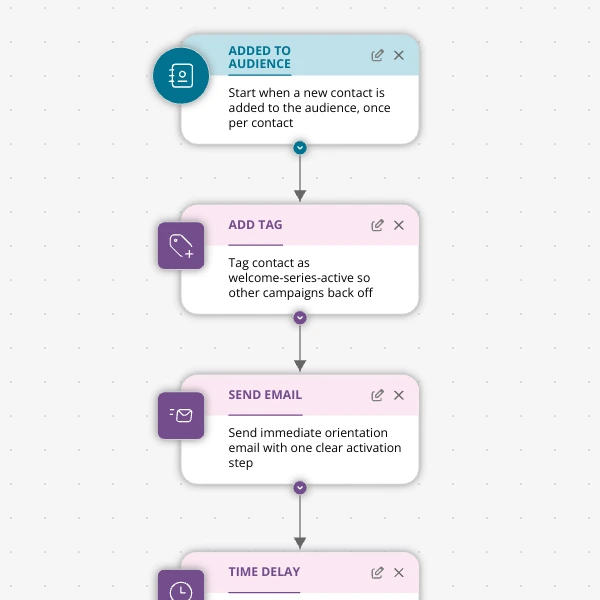
The Shopify app welcome series that turns installs into income
A step-by-step Shopify app welcome email journey for tools like CartSpark, showing how to turn new installs into activated, retained merchants using Spreeflo journeys, tags, and behavioral triggers so fewer trials quietly churn and more trials convert.
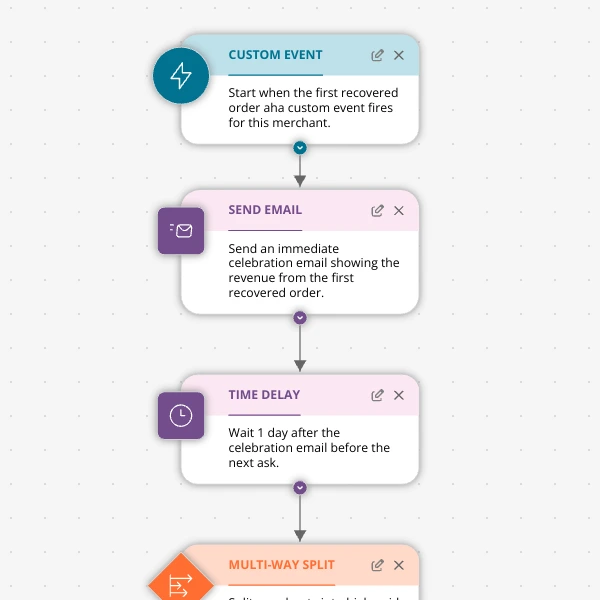
The Aha-Moment Playbook For Shopify Apps: Turn One Magic Action Into Months Of Revenue
A node-by-node playbook for Shopify and e‑commerce apps to center their lifecycle on one aha-moment custom event in Spreeflo, celebrate it, segment merchants by profile and engagement, and turn first recovered value into lasting revenue and retention.
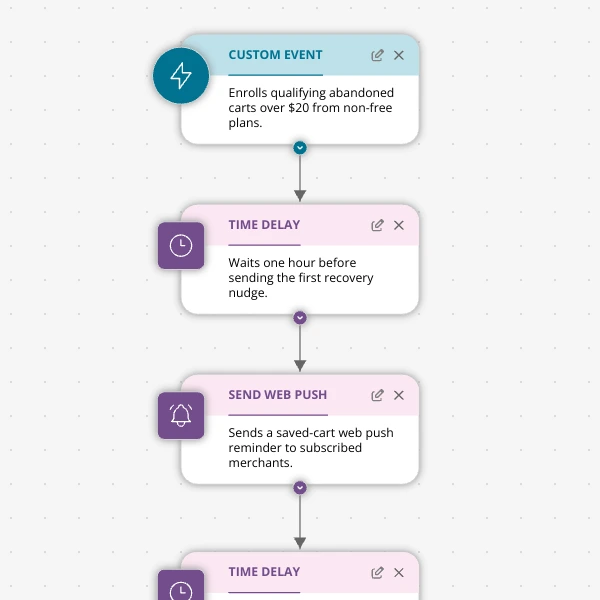
Stop Letting High‑Intent Carts Die: A 3‑Email Recovery Journey for Shopify Apps
A detailed, node-by-node walkthrough of a three-email (plus optional web push) cart-abandonment recovery journey for Shopify apps in Spreeflo, showing how to trigger events, branch on behavior, tag outcomes, and measure recovered carts and revenue.
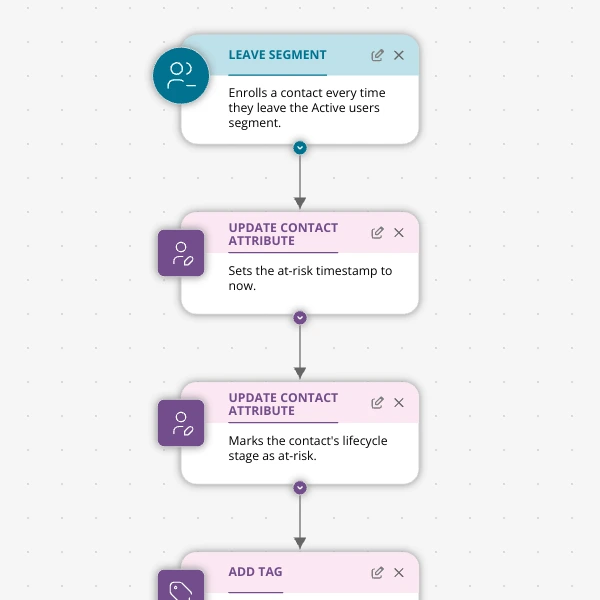
When Active Users Go Dark: A 4‑Touch Win‑Back Journey For Your Shopify App
A detailed, node-by-node Spreeflo journey for winning back previously active Shopify app users who stop engaging, using segment-based triggers, conditional logic, and a four-touch email plus internal alert sequence to recover usage and MRR.