Turn Collaboration Friction Into Seat Expansion: A Team-Invite Journey for SEO SaaS
This playbook shows SEO SaaS teams how to turn collaboration friction into predictable seat expansion using Spreeflo. You’ll wire a behaviour-triggered journey that nudges users to invite teammates, measure upgrades, and quietly compound expansion revenue.
Industry
Niche
Pattern
Loading sequence...
Your solo-plan customers are managing five client sites and still paying you $49.
At RankPulse, our fictional rank-tracking SaaS doing ~$40k MRR, that’s exactly what the founder saw in Stripe: agencies using the product like crazy, bumping into collaboration limits, but almost never upgrading beyond a single seat. The in-app “upgrade” banner was invisible. Expansion revenue was leaking out through a crack no one had instrumented.
This playbook closes that crack with a behavioural journey: the moment a single-seat account hits a collaboration limit, they get a contextual, low-friction invite-your-team nudge by email. The sequence at the top of this page is the whole journey, end to end.
Below, we’ll walk through that journey node by node in Spreeflo, and show how to adapt it to your own SEO SaaS.
Why collaboration limits are secretly your best upsell trigger
If you sell rank tracking, content briefs, or technical audits, your best customers are rarely solo operators. They’re:
Agencies juggling multiple clients
Content teams coordinating writers, editors, and SEOs
In-house marketers looping in founders, devs, and freelancers
Your product already reflects that reality: shared projects, report links, client folders, content briefs that pass between people. But your pricing often starts with a “solo” or “single seat” plan.
That creates a perfect moment:
A user tries to invite someone or share a collaboration feature.
Your app blocks the action: “You’re on the Solo plan. Upgrade to add teammates.”
They’re frustrated; you’re invisible.
Most tools stop at step 2. A bit of in-app copy, maybe a modal. Then they assume “if they really want seats, they’ll upgrade.”
That’s how you leave lifetime value on the table.
With Spreeflo, you can capture that behavioural signal as a Custom Event, recognise who this account is, and send a targeted, timely email that says:
“Looks like you’re trying to get your team into RankPulse. Here’s a frictionless way to do it.”
That’s the pattern we’re about to build.
What this journey does (and what you’ll measure)
At a high level, the journey:
Listens for a “collaboration limit hit” Custom Event.
Checks what type of customer this is (agency vs in-house, etc.).
Sends a contextual invite-your-team email one hour later.
Waits a week to see if they actually add a teammate.
Sends a softer follow-up to holdouts and quietly tags the accounts who expanded.
You’ll watch two core metrics:
Invite-sent rate: proportion of “limit hit” events that result in a team invite.
Seat expansion revenue: additional MRR from accounts that upgraded or added seats after entering this journey.
Spreeflo doesn’t magically know what “seats” are in your app. Your job is to capture the right data; Spreeflo’s job is to react to it. The rest is just wiring.
Step 1: Fire a Custom Event when a user hits the collaboration wall
This pattern lives or dies on one behavioural signal: “this user just tried to collaborate and couldn’t.”
In RankPulse, that’s when a Solo user clicks “Invite teammate” in the UI and the backend rejects it. In a content-brief tool like BrieflySEO, it might be “tried to assign a brief to another user” on a single-seat plan.
Implement this server-side using the Spreeflo events API:
Event name:
collaboration_limit_hitFired from: your backend (e.g., Rails, Node, Laravel) when the action is blocked
Identifying field: the contact’s email address
Useful event properties:
plan_tier:solo,team,agency, etc.current_seat_count: numbermax_seats_allowed: numberaccount_mrr: numberrole:founder,marketer,agency_owner(if you collect it)
The help doc on the Spreeflo API walks through the exact JSON shape.
In your journey, add a Custom Event trigger configured to:
Event name:
collaboration_limit_hitProperty conditions:
Re-enrollment: off (so each contact runs this journey only once)
plan_tier is solocurrent_seat_count is 1
Now every single-seat user who hits that wall is eligible for the nudge.
Step 2: Tailor the upsell for agencies vs in-house teams
Not every “solo” account is equal. An agency running 20 domains is a very different expansion opportunity from a small in-house marketer testing your tool.
Before you send anything, branch.
Add an If/Else process node right after the trigger and use Spreeflo’s segment builder to define the condition:
Condition group:
Contact Tags:
contact is tagged with agency(or a custom attribute likecustomer_type is agency)
Your branches:
Yes branch: “Agency-like account”
Else branch: “Everyone else”
Why bother?
Agencies respond well to positioning around “client collaboration” and “seat bundles.”
In-house teams may care more about “bring your founder and dev into the same view” and staying aligned on SEO priorities.
We’re not changing the mechanics of the journey yet — just creating room for differentiated copy a moment later.
Step 3: Give it an hour, then send the contextual email
A notification fired the second someone hits a paywall can feel like a slap. Give them a little breathing room.
On each branch:
Add a Time Delay node:
Then add a Send Email node.
Delay:
1 hour
Use Spreeflo’s email builder to create two variants:
Agency branch email:
Subject: “Add your writers and clients to RankPulse in one click”
Body angle:
Acknowledge the behaviour: “We saw you tried to invite someone to your workspace.”
Highlight benefit: shared rank reports, faster approvals, fewer “can you screenshot this?” emails.
Pricing clarity: show how extra seats work on your plans.
CTA: a single button to your in-app “Team” or “Users” page.
In-house branch email:
Subject: “Bring your team into your SEO dashboard”
Body angle:
Acknowledge behaviour, but lean into alignment: “Loop in your founder, dev, and copywriter so everyone sees the same rankings and briefs.”
Emphasise how adding 1–2 seats reduces status meetings and Slack pings.
CTA: same “Manage seats” link.
In both emails:
Keep it short. This is closer to a transactional nudge than a newsletter.
Make the plan math explicit: “Add up to 3 more seats for $19/seat/month.”
Reassure them they’re in control: “You can remove seats anytime; billing updates instantly.”
Set “Send only once” on each Send Email node so a contact never receives the same email twice, even if you later choose to allow re-enrolment in the trigger.
After each Send Email, connect to a Merge node. This keeps your canvas clean: both paths now rejoin into a single flow for the follow-up logic.
Step 4: Wait up to a week to see if they actually invite someone
Now you want to know: did that email do its job?
Back in your app’s backend, fire a second event whenever someone successfully brings in a teammate:
Event name:
team_member_invited(orseat_added)Fired when:
Important: include the inviter’s email so the event ties back to the right contact.
A new user is invited by the account owner, or
A new active seat is billed against the account
In the journey, add a Wait Condition node after the Merge:
Condition (using the segment builder):
Timeout:
7 days
Custom Events:
team_member_invitedOperator:
AT_LEAST 1 timeTime window:
in the last 7 days
What this does:
If the contact invites someone within 7 days of hitting the limit, they move on as soon as that
team_member_invitedevent arrives.If they don’t, they move on after 7 days anyway.
Crucially, this Wait Condition also acts as the buffer between your first and any potential second email, so you stay clear of spammy back-to-back sends.
Step 5: Split again: invite sent vs no invite
The Wait Condition doesn’t tell you how it completed — only that time passed or the condition became true. So add a Multi-way Split right after.
Configure two branches:
“Invite Sent” branch
Else branch
Condition:
Custom Events:
team_member_invitedOperator:
AT_LEAST 1 timeTime window:
in the last 7 days
Everyone who didn’t meet the above condition.
Order matters. Put the “Invite Sent” branch first, then let the else branch catch the rest.
Step 6A: For invite-senders, log the win and (optionally) alert your team
On the “Invite Sent” branch, the goal isn’t more nudging — it’s data.
Add two nodes:
Add Tag
Update Contact Attribute
Tag:
team-expansionThis lets you later build segments like “customers who expanded seats” for case studies, NPS surveys, or future VIP campaigns.
Attribute:
seat_expansion_source(a custom text attribute)Update type: Update (overwrite)
Value:
collab_limit_journey
Because the Update Contact Attribute node writes a fixed literal at design time, you use it as a simple label for where this expansion came from.
Optionally, if you run higher-touch customer success for large accounts:
3. Send Internal Email
Recipient: your team alias
Subject: “Seat expansion from Solo plan”
Body: include the contact’s name, company, and account MRR so someone can reach out with a personal thank-you.
Then end the branch. These contacts achieved the behaviour you wanted; they don’t need more upsell copy here.
Step 6B: For holdouts, send a softer follow-up and stop
On the else branch — where no invite happened in that 7-day window — add a single Send Email node.
Because the Wait Condition already provided a 7-day gap, you don’t need an extra Time Delay for pacing.
This follow-up email should feel like a helpful reminder, not a hard sell:
Subject: “Still want your team in your SEO dashboard?”
Body angle:
Reiterate the original intent: “You tried to loop someone into your workspace last week.”
Offer a tiny bit more context: a short bullet list of what teams typically share: rank reports, content briefs, technical audit results.
Surface objections: remind them they can start with one extra seat and remove it anytime.
Keep it to a single screen. One CTA to your Team/Seats page. Then end the journey.
You’ve given them two well-timed chances around a clear behavioural signal. Anything more risks irritation rather than expansion.
Optional: A/B test your upsell pitch
If seat expansion is a meaningful revenue line, you’ll eventually want to experiment with the copy and framing of that first email.
Right after the trigger and before the agency/in-house If/Else, you can insert a Random Split:
Path A: 50% of contacts
Path B: 50% of contacts
Each path can lead to different Send Email nodes (e.g., one emphasising “save time across your team,” another emphasising “sell more retainers per SEO seat”), then converge back into the same Merge node before the Wait Condition.
Because Spreeflo campaigns and journeys share the same visual editor, you can reuse this pattern in a one-off campaign later if you want to test expansion angles on a fixed list of accounts. The campaigns and journeys overview explains when each automation type makes sense.
Optional: Layer on web behaviour for smarter targeting
You can keep this journey simple — or get more precise as your data matures.
A few ideas:
Restrict to engaged accounts: in the first If/Else, add a condition like “Total visits at least 5 in the last 30 days” so you don’t upsell truly inactive users.
Prioritise high-value logos: create a saved segment of “MRR > $200” accounts and use a Join Segment trigger in a separate journey that adds a white-glove layer for them.
If you’re already using the Spreeflo SDK for web tracking and analytics, those behaviour-based filters are available right inside the segment builder. That’s how you move from “everyone who hit a limit” to “the right people at the right time.”
Making the numbers visible
Because you’re an SEO founder, you’ll want to sanity-check this like any experiment.
Three simple views to build:
A segment for “Collaboration limit hit”
A segment for “Team invited after limit”
A segment for “Expanded seats but journey didn’t run”
Custom Events:
collaboration_limit_hitOperator:
AT_LEAST 1 time over all timeThis shows how many accounts are hitting the wall in the first place.
Contacts who both:
Triggered
collaboration_limit_hitat least once, andTriggered
team_member_invitedat least once after that date.
Useful for catching instrumentation issues: if people are adding seats without a prior
collaboration_limit_hit, maybe your API calls are misaligned.
From there, you can roughly back into invite-sent rates and expansion-driven MRR by cross-checking with your billing tool. If you want a tighter loop, add a Webhook node on the “Invite Sent” path that POSTs to an internal endpoint, tagging those accounts in your CRM or data warehouse for deeper revenue analysis.
Why this pattern compounds your LTV
Seat expansion isn’t a glamorous feature. It’s easy to hand-wave it away: “We have a pricing page and some in-app prompts. It’s fine.”
But the highest-margin revenue in SaaS comes from two places: customers who stay and customers who grow. SEO tools are particularly ripe for both — agencies add clients, in-house teams pull in adjacent functions, technical work expands into content and vice versa.
By:
Capturing the exact moment collaboration friction appears,
Understanding who is hitting that limit, and
Responding with a tailored, well-timed invite-your-team email,
you stop treating all accounts as “one user on one plan” and start speaking to each in the context of their behaviour. That’s the heart of Spreeflo’s philosophy: use detailed customer data to talk to every contact uniquely, and you stop leaking lifetime value through avoidable drop-offs.
Set this journey up once, and every future “I tried to invite someone but couldn’t” turns into a considered upsell attempt — without you or your team lifting a finger.
That’s the kind of automation a lean SEO SaaS can rely on: specific, behaviour-driven, and directly tied to revenue, not vanity metrics.
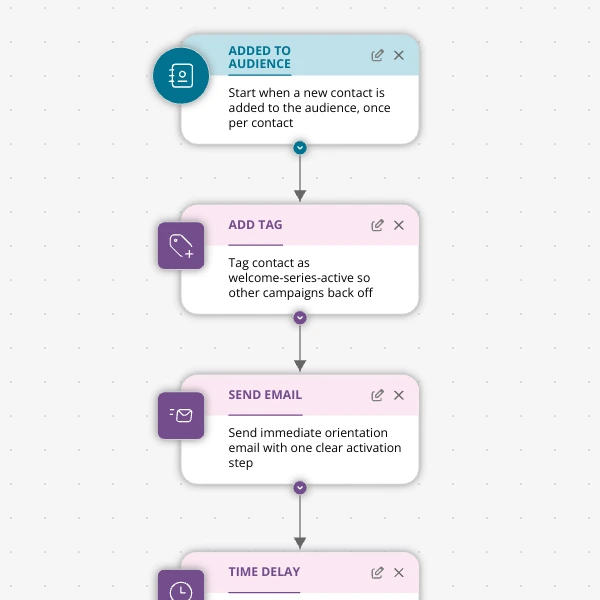
The Shopify app welcome series that turns installs into income
A step-by-step Shopify app welcome email journey for tools like CartSpark, showing how to turn new installs into activated, retained merchants using Spreeflo journeys, tags, and behavioral triggers so fewer trials quietly churn and more trials convert.
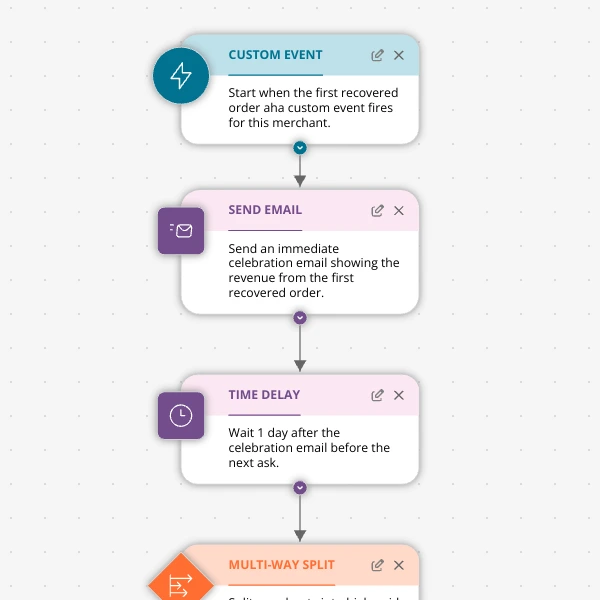
The Aha-Moment Playbook For Shopify Apps: Turn One Magic Action Into Months Of Revenue
A node-by-node playbook for Shopify and e‑commerce apps to center their lifecycle on one aha-moment custom event in Spreeflo, celebrate it, segment merchants by profile and engagement, and turn first recovered value into lasting revenue and retention.
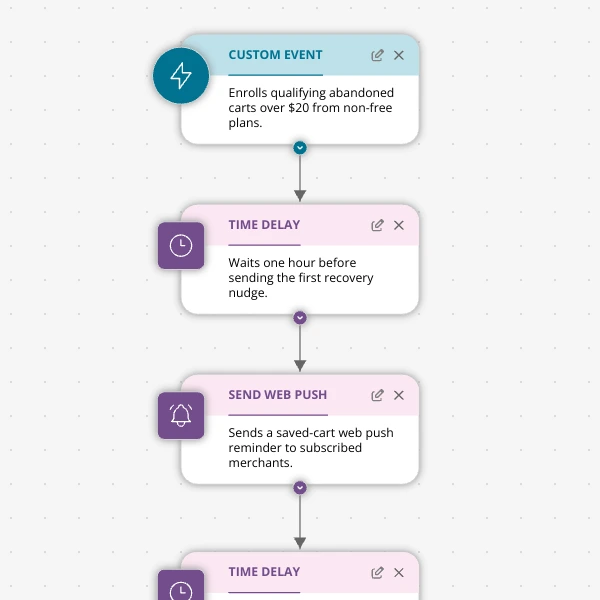
Stop Letting High‑Intent Carts Die: A 3‑Email Recovery Journey for Shopify Apps
A detailed, node-by-node walkthrough of a three-email (plus optional web push) cart-abandonment recovery journey for Shopify apps in Spreeflo, showing how to trigger events, branch on behavior, tag outcomes, and measure recovered carts and revenue.
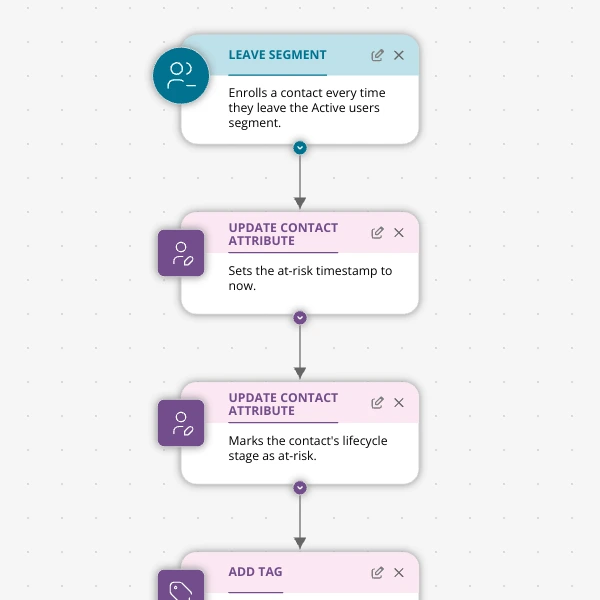
When Active Users Go Dark: A 4‑Touch Win‑Back Journey For Your Shopify App
A detailed, node-by-node Spreeflo journey for winning back previously active Shopify app users who stop engaging, using segment-based triggers, conditional logic, and a four-touch email plus internal alert sequence to recover usage and MRR.