Turn Every Unsubscribe Click Into Actionable Feedback (Without Being Shady)
A detailed Spreeflo journey pattern for SEO SaaS founders to turn unsubscribe clicks into compliant feedback loops, capture reasons for disengagement, and rescue subscribers by adjusting email frequency and content preferences automatically.
Industry
Niche
Pattern
Loading sequence...
When someone clicks “unsubscribe” from your SEO SaaS emails, they’re telling you the truth your dashboards can only hint at: something about your communication isn’t working anymore.
For a product like RankPulse or BrieflySEO, every one of those clicks is both a risk (early signal of churn) and a gift (clear, high-intent feedback). The pattern in this article turns that moment into a tiny, compliant feedback loop that runs on autopilot. The sequence at the top of this page is the whole journey, end to end.
We’ll wire Spreeflo so that:
An “unsubscribe intent” event is captured the moment they click.
They’re immediately unsubscribed (no dark patterns).
A one-question in-app form asks why, and offers a simple way to stay with lower frequency or narrower topics.
Their choice is recorded on the contact, and your list/segments update automatically.
By the end, you’ll have an unsubscribe flow that protects trust, saves some would‑be churners, and gives you hard data on why people are bailing.
Why unsubscribe clicks are gold for an SEO SaaS
For most SEO tools, the email list carries a lot of weight:
New feature announcements that drive expansion.
Deep-dive content that keeps agencies engaged between projects.
“We found an issue in your site” alerts that pull people back in.
When someone unsubscribes:
You lose the cheapest reactivation channel you have.
You lose context on why they’re pulling away (pricing? relevance? too frequent?).
You often lose the chance to intervene before they churn from the product itself.
Most tools treat that click as a dead end: update status to “unsubscribed,” call it a day.
Spreeflo’s whole philosophy is the opposite: capture detail on every customer so you can speak to each uniquely, and don’t leak lifetime value by dropping engagement on the floor. This pattern leans all the way into that: one journey that both ensures people can leave cleanly and extracts the maximum learning from those who do.
The high-level flow: from intent to outcome in under 30 seconds
At a birds-eye level, the journey you see in the sequence at the top of this page works like this:
A contact clicks an unsubscribe or “manage preferences” link in an email.
Your app logs a
unsubscribe_intentevent into Spreeflo.A journey triggered by that Custom Event:\n- Immediately updates their email subscription status to Unsubscribed.\n- Adds an “unsubscribe-intent” tag for analytics.\n- Shows a tiny Spreeflo popup form on your unsubscribe/preferences page asking what they want to do.
The journey waits a short window for the form to be submitted, then:\n- Branches if they submitted vs. ignored it.\n- For submitters, splits again on outcome:\n - “Leave the list” → keep them unsubscribed, record reason.\n - “Stay, but with fewer/different emails” → re-subscribe and adjust tags/attributes.
Optionally, high-value “saved” accounts trigger an internal alert.
All of this is built visually in Spreeflo’s campaigns and journeys editor. Let’s walk through it node by node.
Step 1: Track unsubscribe intent as a Custom Event
The journey starts with a Custom Event trigger:
Trigger type: Custom Event
Event name:
unsubscribe_intentRe-enrollment: on (so if someone re-subscribes months from now and later clicks unsubscribe again, they can re-enter this journey)
How you emit that event depends on your stack:
If your unsubscribe link routes through your backend (common for SaaS), have that handler POST to the Spreeflo events API with an event named
unsubscribe_intent, plus the contact’s email.If you land people on a web page you control, with the Spreeflo SDK installed, that page can emit the same event in the browser when it loads.
Either way, the moment the event hits, the contact enters this journey. The Spreeflo API and the web SDK both treat unsubscribe_intent as a first-class Custom Event the trigger can listen for.
Why Custom Event and not “email link clicked”? Because it keeps your automation clean and explicit:
The event name documents intent: they started an unsubscribe flow.
You can reuse the same trigger even if you change your email provider or URLs.
You can enrich the event later (e.g., with plan, MRR band, source email) without touching the journey.
Step 2: Immediately respect the unsubscribe (and tag it)
First action node after the trigger:
Update Email Subscription Status\n- Status: Email unsubscribed
This is about trust and simplicity. The second they express intent, you mark them as Unsubscribed in Spreeflo. No conditions, no delay.
This node guarantees:
They won’t receive future marketing emails unless they explicitly opt back in.
You stay on the right side of “one-click to unsubscribe” expectations, even if your flow continues with a feedback form.
Next, an Add Tag node:
Add Tag\n- Tag:
unsubscribe-intent
This tag is your core analytics hook. It:
Lets you compare “contacts who ever showed unsubscribe intent” against churn and expansion cohorts.
Makes it trivial to build segments later (e.g., “Saved from unsubscribe in the last 90 days”).
You could also use this tag as a Trigger in other journeys, but for this pattern, its main job is attribution and reporting.
Step 3: Show a one-question feedback + preferences form (in-app)
Now you want to ask two things without being obnoxious:
What do you want to do?
Why?
You do this with a Spreeflo form delivered via a Popup Form action:
Popup Form\n- Form:
Unsubscribe feedback & preferences\n- Popup embed: modal or slider targeting your unsubscribe/preferences URL\n- Show on: only URLs that match your unsubscribe or email-preferences page\n- Frequency cap: 1 per contact\n- Attempt window: short (for example, 2 days)
Build the form itself in the form builder (see create and embed forms) with:
A required multiple-choice question mapped to a contact attribute, for example:\n- “What do you want to do?” → attribute
unsubscribe_outcome\n - Option A: “Unsubscribe from all marketing emails” (value:leave)\n - Option B: “Stay subscribed, but send fewer emails” (value:stay_low_freq)\n - Option C: “Stay subscribed, only product updates” (value:stay_product_only)A second single-choice or dropdown mapped to
unsubscribe_reason, e.g.:\n- “Too many emails”\n- “Content not relevant”\n- “Already using another SEO tool”\n- “No longer responsible for SEO”\n- “Other”
Because the visitor arrived from a tracked email, you can have your unsubscribe/preferences page identify them to Spreeflo in the browser. That means:
The form doesn’t need to ask for an email address again.
Every response automatically maps onto the correct contact.
Why a popup instead of embedding the form directly? Two reasons:
The Popup Form action lets the journey choose when to show it (directly after intent, and only once).
You get Form Activity data (Shown, Submitted, Dismissed) that other nodes can branch on.
Step 4: Wait briefly for a response, then branch on form activity
Not everyone will answer instantly. You don’t want the journey to hang forever, but you also don’t want to move on so fast that slower readers are missed.
Next two nodes:
Wait Condition\n- Condition: this contact has Form Activity “Submitted” for the
Unsubscribe feedback & preferencesform\n- Timeout: 1 dayCheck Form Activity\n- Form:
Unsubscribe feedback & preferences\n- Branches:\n - Branch 1: Submitted\n - Else: Everyone else
This tells Spreeflo: “Pause here until they submit this form, or 1 day passes, whichever comes first.”
This gives you two simple paths:
Path A (Submitted): they saw the form and gave you structured feedback.
Path B (No submission): they ignored or dismissed it.
Path B is easy: you already unsubscribed them. All you might do here is:
Add Tag
unsubscribe-no-feedbackfor analytics.End the journey.
Path A is where the interesting routing happens.
Step 5: Split submitted users by “leave vs stay” outcome
For contacts who submitted the form, the next node is a Multi-way Split, using the unsubscribe_outcome attribute the form wrote:
Multi-way Split\n- Branch “Leave”:\n - Condition:
unsubscribe_outcomeisleave\n- Branch “Stay (low frequency)”:\n - Condition:unsubscribe_outcomeisstay_low_freq\n- Branch “Stay (product only)”:\n - Condition:unsubscribe_outcomeisstay_product_only\n- Else: anything unexpected
Each of these branches then gets its own tiny tail.
Leave branch: keep them unsubscribed, but capture the why
They already are Unsubscribed, so you mainly want to preserve context:
Add Tag\n- Tag:
unsubscribed-via-survey(Optional) Update Contact Attribute\n- Attribute:
unsubscribe_handled_at\n- Update type: Set to now
You now have:
A clean group of people who definitively left by choice.
Structured reasons (
unsubscribe_reason) you can slice in the segment builder. For example:\n- “Too many emails” vs “Content not relevant” vs “Using another tool”.
Those reasons can feed roadmap debates (“Are we losing list subscribers because content is off, or volume is too high?”) rather than guesswork.
Stay branches: re-subscribe with clear preferences
For the “Stay, but…” paths, you explicitly convert their survey choice into new preferences and consent.
For “Stay (low frequency)”:
Update Email Subscription Status\n- Status: Email subscribed
Add Tag\n- Tag:
email-frequency-lowUpdate Contact Attribute\n- Attribute:
email_frequency\n- Value: literallow
From now on, you can exclude email-frequency-low from your weekly SEO tips and only include them in larger product and feature launches, using Spreeflo’s audiences and segments.
For “Stay (product only)”:
Update Email Subscription Status\n- Status: Email subscribed
Add Tag\n- Tag:
pref-product-onlyUpdate Contact Attribute\n- Attribute:
content_preference\n- Value: literalproduct_updates_only
In both “stay” branches, you’ve:
Respected their original unsubscribe click by taking them off everything immediately.
Let them explicitly opt back in, with much sharper preferences than before.
Given yourself segmentation hooks so every future campaign can speak to them uniquely.
You don’t need to send a confirmation email here for the pattern to work, and keeping this journey email-free avoids any whiff of over-communication. The journey’s job is to adjust data; future campaigns will reflect those changes.
Step 6: Optional internal alerts for high-value accounts
For an SEO SaaS, certain unsubscribes hurt more than others:
Agencies on your highest-tier plan.
Accounts with very high MRR or long tenure.
You can handle that inside this same journey with a short side-branch off the “Leave” and “Stay” paths:
Insert an If/Else node after the Multi-way Split, with a condition like:\n- “Plan is Agency Pro” OR “MRR greater than 300”.
On the “yes” side, add a Send Internal Email node to alert your team.
That internal email can include:
The contact’s name, company, plan, and MRR.
The
unsubscribe_reasonthey picked.A link to their record in your own admin.
Because Send Internal Email is separate from Send Email, it doesn’t affect the customer’s inbox at all. It just gives your team a tight loop for manual outreach where it’s justified.
Measuring what matters: survey completion and save rate
Once this journey runs for a few weeks, you get two really useful metrics almost for free.
1. Survey completion rate
Definition:
Numerator: contacts with tag
unsubscribed-via-surveyor any path that passed through the “Submitted” branch.Denominator: contacts with tag
unsubscribe-intent.
This tells you what percentage of unsubscribers are giving you structured feedback. If it is low, it usually means:
The form feels like work (too many questions, open-ended first).
The popup placement is off (not appearing reliably on the unsubscribe/preferences page).
The copy doesn’t make it clear that unsubscribe is still one click away.
Because the form is a Spreeflo form, its Results tab already shows completions; you’re just lining that up against your tagged intent population.
2. Save rate from unsubscribe intent
Definition:
Numerator: contacts who entered via
unsubscribe_intentand ended the journey with Email Subscription Status = Subscribed.Denominator: contacts who entered via
unsubscribe_intent.
You can approximate this simply by segmenting:
Segment A:
has tag unsubscribe-intentAND Email Subscription Status is Subscribed.Segment B:
has tag unsubscribe-intent(all).
The ratio A/B is your save rate.
For a small SEO SaaS, even a 10–15% save rate can be meaningful. That is a non-trivial chunk of your audience that would have vanished silently, but instead opted into a more sustainable communication pattern.
Adapting the survey for an SEO SaaS reality
The exact wording of your form matters. For SEO tools, some tailored options tend to surface useful insight:
For the “Why?” question:
“We already get this insight from Ahrefs/SEMrush.”
“We’re pausing active SEO work.”
“Too many promotional emails.”
“Tutorials and content didn’t feel relevant to our situation.”
“We use the product, but don’t want emails.”
“Other (free text).”
Over a few hundred responses, you’ll start to see patterns:
If “too many promotional emails” dominates, tighten cadence or make lower-frequency the default.
If “content not relevant” shows up often, segment better by company type, traffic level, or use case.
If “we’re pausing SEO” is high for agencies, that’s a signal for seasonal or project-based nurture series.
Because every answer is mapped to attributes on the contact, you’re not locked into one analysis. You can spin up new segments over time in the segment builder and ask: “Show me all unsubscribes from agencies citing ‘content not relevant’ in the last 90 days.”
That is exactly the kind of granularity founder-led businesses can put to work without a large team: a couple of hours building the journey and form yields months (or years) of structured input into both marketing and product.
The deeper win: every unsubscribe makes the list smarter
A flat unsubscribe link treats your audience as a blob: someone left, shrug, onto the next.
This pattern does the opposite:
It captures the detail of who they are and why they want to change their relationship with you.
It gives every contact a way to shape how you talk to them, instead of a binary on/off.
It feeds back into smarter segmentation and more relevant campaigns, so fewer people feel the need to unsubscribe in the first place.
For an SEO SaaS founder, that is exactly the kind of leverage you want: a system you design once in Spreeflo that quietly protects lifetime value, one unsubscribe at a time.
If you already have the SDK or events API wired in, this journey is a small lift in the grand scheme of your stack. Open the sequence editor, recreate the flow from the sequence at the top of this page, and the next time someone clicks “unsubscribe,” you’ll actually learn something useful.
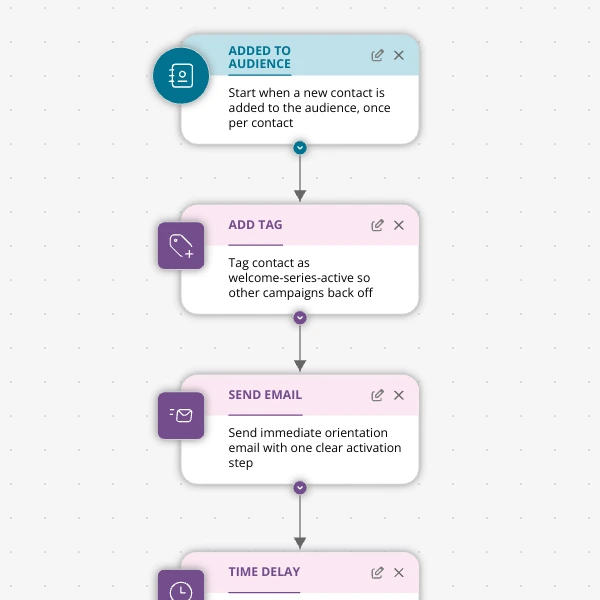
The Shopify app welcome series that turns installs into income
A step-by-step Shopify app welcome email journey for tools like CartSpark, showing how to turn new installs into activated, retained merchants using Spreeflo journeys, tags, and behavioral triggers so fewer trials quietly churn and more trials convert.
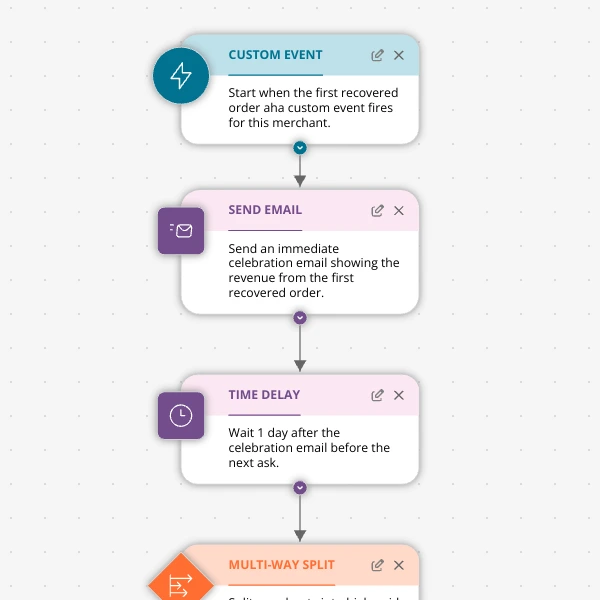
The Aha-Moment Playbook For Shopify Apps: Turn One Magic Action Into Months Of Revenue
A node-by-node playbook for Shopify and e‑commerce apps to center their lifecycle on one aha-moment custom event in Spreeflo, celebrate it, segment merchants by profile and engagement, and turn first recovered value into lasting revenue and retention.
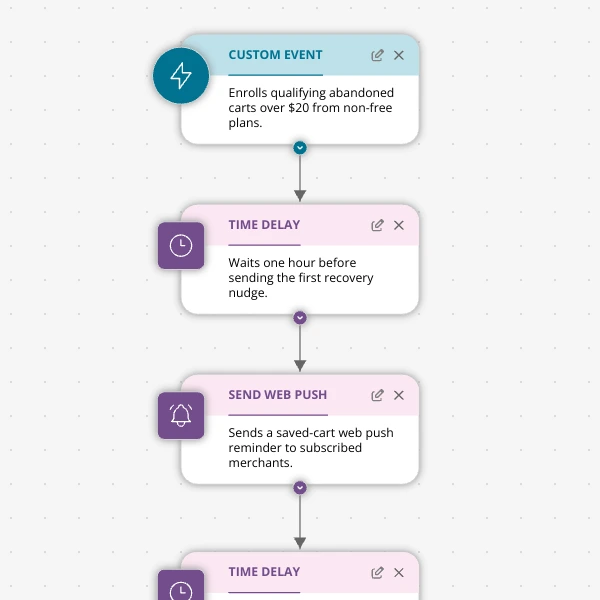
Stop Letting High‑Intent Carts Die: A 3‑Email Recovery Journey for Shopify Apps
A detailed, node-by-node walkthrough of a three-email (plus optional web push) cart-abandonment recovery journey for Shopify apps in Spreeflo, showing how to trigger events, branch on behavior, tag outcomes, and measure recovered carts and revenue.
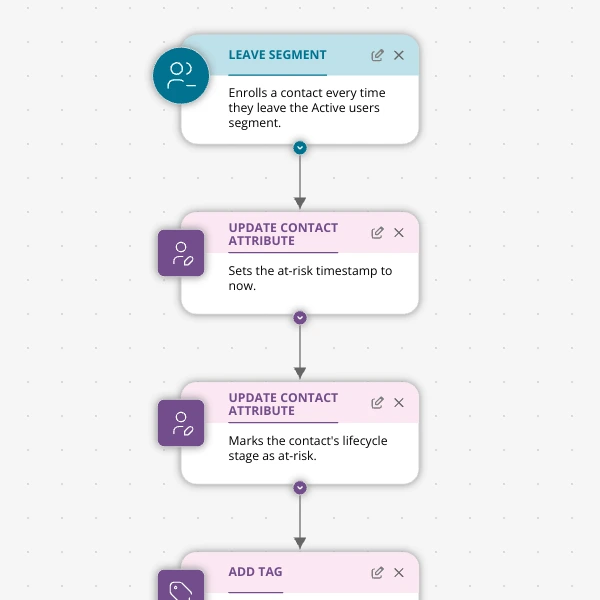
When Active Users Go Dark: A 4‑Touch Win‑Back Journey For Your Shopify App
A detailed, node-by-node Spreeflo journey for winning back previously active Shopify app users who stop engaging, using segment-based triggers, conditional logic, and a four-touch email plus internal alert sequence to recover usage and MRR.