Turn Old “No’s” into New Pipeline: A Lost‑Deal Reactivation Journey for SEO SaaS
Walkthrough of setting up a recurring lost-deal reactivation journey in Spreeflo for SEO SaaS, using cyclic triggers, behavioral branching, and thoughtful “fresh eyes” email copy to turn old “no’s” into new, trackable pipeline.
Industry
Niche
Pattern
Loading sequence...
Six months after a prospect tells you “not right now,” your CRM is full of ghosts: closed-lost deals that nobody has time to revisit, even though your product, pricing, and their needs have all moved on.
For an SEO SaaS—rank tracking, briefs, audits—that’s a quiet but very real leak in your pipeline. Agencies churn through clients, in‑house teams change tools, budgets reset. A small slice of those old “no’s” are now perfect fits. You just never go back.
The sequence at the top of this page is the whole journey, end to end. This article walks through how to build it in Spreeflo so your old closed‑lost deals get a thoughtful, quarterly “fresh eyes” outreach without you lifting a finger.
Why your “no for now” list is leaking revenue
Take RankPulse, a fictional 3‑person rank tracking SaaS doing $40k MRR.
Over two years, they’ve had 1,200 opportunities reach “serious conversation” stage. Roughly 60% didn’t close. That’s 700+ people who:
Knew the product
Had a concrete SEO problem
Cared enough to jump on a call or trial
Most of those contacts now sit in a “Closed Lost” view, completely untouched.
Meanwhile, RankPulse has shipped new features, added GSC integration, improved speed, maybe even tweaked pricing. Their ideal customer profile has sharpened. A subset of those 700 are now better prospects than they were on the original call.
If you’re not systematically re‑engaging them, you’re doing expensive acquisition work twice and still leaving lifetime value on the table. That’s the core brand belief here: most businesses leak LTV not because they can’t sell, but because they stop nurturing once someone says “no.”
The fix is simple: a date‑based reactivation journey that runs every quarter, finds old closed‑lost deals, and reaches out with something genuinely new.
Step 0: Make “closed‑lost” show up in Spreeflo
Before you can automate, Spreeflo needs to see who your lost deals are and when you lost them.
In your CRM (HubSpot, Pipedrive, whatever you use), you likely already track:
Deal stage:
Closed LostLost reason: price, missing feature, competitor, timing
Closed date
Mirror just enough of that into Spreeflo’s audiences so you can target intelligently:
Create a tag for closed‑lost deals, for example
closed_lost.Create a custom TIMESTAMP attribute like
closed_lost_at.Create a custom TEXT attribute for
lost_reason.
Now, whenever you mark a deal as closed‑lost in your CRM, have your backend send an event into Spreeflo using the Spreeflo API:
Custom event name:
deal_closed_lostProperties:
lost_reason,plan_size, anything usefulContact fields: email (to tie it to the right person)
At the same time, update the contact in Spreeflo to:
Add the
closed_losttagSet
closed_lost_atto the current timestampSave
lost_reasonas an attribute
You can do that via API or via a regular CSV import if you’re earlier‑stage and okay with some manual work. What matters is that every lost deal ends up as a contact Spreeflo can target and segment.
Once this “data plumbing” is in place, the rest of the journey is pure configuration.
Step 1: A Cyclic trigger that only wakes up old deals
This pattern is a journey, not a one‑off campaign. You want it to run forever in the background and surface old deals every quarter. Journeys plus the Cyclic trigger are built exactly for this use case; if you’re new to them, skim the overview on campaigns and journeys first.
Inside Spreeflo, create a new journey called something like “Lost‑deal reactivation (6+ months)”.
Add a Cyclic trigger with:
Repeat interval: every 3 months
Time of day: something sane for your main market (e.g. 10:00 am)
Timezone: where most of your deals sit (e.g.
America/New_York)Re-enrollment: on (so qualifying contacts can re‑enter every quarter, as long as they’re not mid‑journey)
Now define the trigger’s Criteria using the segment builder:
You want:
Contacts who are genuinely closed‑lost
- Tag rule: “contact is tagged withclosed_lost”Who are still legal to email
- Email subscription status: “is Subscribed”Whose deal was lost more than 6 months ago
This is where yourdeal_closed_lostevent is useful. Add:
- Custom eventdeal_closed_lost“has not triggered” in the last 6 months
- AND the same event “triggered at least 1 time” over all time
Those two rules together mean: they were closed‑lost at least once, and nothing has moved to closed‑lost in the last 6 months. In practice: they’re an old “no.”
Optional but smart filters:
Exclude tiny deals: e.g. only include
plan_size≥ your mid‑tierExclude people you’ve permanently disqualified by adding a
do_not_nurturetag and filtering them out
This trigger now wakes up only those older, qualified lost deals on a quarterly rhythm.
Step 2: Send a “fresh eyes” email that doesn’t feel canned
Right after the trigger, your first action is a Send Email node. This is the core of the journey: a single, thoughtful email that tells them it’s worth taking another look.
Build the email in the email builder, and keep a few principles in mind:
Acknowledge the history
You’re not a stranger. Lead with context:
- “We spoke last year about using RankPulse to monitor your agency clients’ rankings.”
- “You trialed BrieflySEO in January but decided not to move forward then.”Reflect their original objection
Use thelost_reasonattribute directly in your copy:
- “You mentioned pricing was the blocker.”
- “At the time we didn’t support multi‑location tracking.”
This is where personalization matters. You can also use AI text suggestions from Spreeflo’s AI variables to adapt phrasing based on plan size or role.Show what’s changed
Be concrete—this is the value of waiting 6+ months instead of chasing immediately after loss:
- New features that directly address the objection (e.g. “We now support GSC integration and bulk imports”)
- Pricing changes (e.g. annual discounts, new mid‑tier)
- Proof points (logos, ROI bullets, quick stats)Make the ask small
You’re not asking them to “rethink their whole stack,” you’re asking for:
- A 15‑minute “what’s changed on both sides” call, or
- A low‑friction re‑trial tailored to their use case
Structurally, keep the email tight: 3–5 short paragraphs, a scannable bullet list of changes, one clear CTA.
From a node configuration point of view:
Template: Name it something like “Lost‑deal fresh eyes Qx”
From: whichever sending identity you use for sales‑ish email (founder or AE)
“Send only once”: leave it on—if they ever re‑enter this step via some future refactor, they shouldn’t see the same email twice.
This first email is where most reactivations start. Everything that follows is about responding to their behavior.
Step 3: Wait a week, then branch on engagement
You don’t want to pile on. Insert a Time Delay after the first email:
Delay: 7 days
Unit: days
That spacing keeps you well within reasonable cadence, especially as this journey only runs quarterly.
After the delay, add a Check Email Activity node referencing the “Lost‑deal fresh eyes” template you just sent.
Configure three branches:
Branch “clicked”
- Activity: Link ClickedBranch “opened”
- Activity: OpenedElse branch
- Everyone else (no open, no click, not delivered, etc.)
This gives you three clear intent buckets.
Branch A: Hot interest → alert a human, stop automation
For contacts in the “clicked” branch (and optionally “replied” if you add that as another branch), automation’s job is to hand off, not keep talking.
On this branch:
Add Tag
- Tag:reactivated_interest
- This makes it easy to build a CRM view or report later.Send Internal Email
Configure it to go to whoever handles sales:
- Subject: “Reactivated lost deal: {{contact.company}}”
- Body: include key context: their email, company, original lost reason, plan size, and which link they clicked. You can pull these into the template the same way you do for marketing email.Optionally, Time Delay and then Add Tag like
reactivation_touchedif you want a marker that this contact has moved through the journey.
And that’s it. No more marketing emails in this branch. They’ve raised a hand; your team (even if that’s just you) takes it from here.
Branch B: Warm but hesitant → one more helpful nudge
Contacts who opened but didn’t click are in the gray zone. They recognized your name, maybe remembered the tool, but didn’t see enough to act.
Here, a gentle second email makes sense.
For the “opened” branch:
Time Delay
- Delay: 1 day
- Unit: hours or days (use 1 day to keep things human‑paced)Send Email
This second email should be even more value‑forward:
- Lead with: “Saw you opened my note yesterday—figured I’d share something concrete you can use whether or not you revisit us.”
- Share a short, tactical asset that aligns with why they talked to you originally:
- A teardown of a SERP in their vertical
- A case study from a similar customer
- A simple template (e.g. content brief outline, audit checklist)
- Close with a softer CTA:
- “If this is still on your roadmap, reply and I’ll tailor a quick walkthrough to your setup.”
From a node perspective, this is a second Send Email node spaced at least one day after the first, so you stay within healthy send pacing.
After this second email, you can:Add Tag
- Tag:reactivation_nurtured
- Useful for later segmentation: you might treat these differently in other campaigns.
Then end the branch. They’ll stay eligible for future quarterly runs of the journey unless they unsubscribe, convert, or you add them to a do‑not‑nurture segment.
Branch C: No engagement → mark and move on
For everyone in the Else branch (no open, no click), more email is unlikely to help. They may have changed roles, left the company, or simply be uninterested.
Keep it simple:
Add Tag
- Tag:reactivation_coldEnd the branch.
Because your Cyclic trigger runs only quarterly, this means the absolute worst case is one email touch every three months to someone who never opens you. Anyone who unsubscribes will drop out automatically because of the subscription‑status filter in your trigger criteria.
If you find this still feels too aggressive over time, you can always update the trigger’s criteria to exclude contacts with reactivation_cold who also haven’t opened any email from you in, say, 12 months.
Measuring whether this is worth the calendar space
For a founder‑led SEO SaaS, a journey is only “worth it” if it moves real numbers with minimal maintenance. This one does, if you track the right things.
Some concrete metrics to watch:
Reopened opportunity rate
Among contacts who enter the journey in a quarter, what % get taggedreactivated_interest? Even a 3–5% rate on a few hundred old deals is new pipeline every quarter.Pipeline reactivated
Sum the potential deal values (from your CRM) for everyone taggedreactivated_interest. Compare that to your net‑new-demo pipeline. The ratio is often surprising.Response rate
Measure replies to the “fresh eyes” email and the warm‑nudge email. This is where Spreeflo’s email activity rules shine: you can build a small segment of “responded to reactivation journey” and see how they behave long‑term.Downstream conversion
Tag closed‑won deals that came via this journey in your CRM. Over a few months, you’ll know if lost‑deal reactivation is punching above its weight or needs tweaking.
Because all of this runs inside one journey, updating it is cheap: tweak the email copy, adjust the criteria, or change the schedule without re‑architecting anything.
Adapting the pattern to your SEO SaaS reality
Every SEO SaaS has its own nuance. Here’s how to tune this skeleton to your world:
High‑ACV agency plans
Restrict the Cyclic criteria to only include deals above a certainplan_sizeto keep sales focused on the biggest upside.Feature‑driven product (e.g. content briefs, AI writing)
Use thelost_reasonattribute heavily in your copy and examples. If someone left because you lacked content briefs, make that the hero of the reactivation email.Product‑led motion with minimal sales
You can skip the Send Internal Email step and instead send reactivated contacts into a higher‑touch onboarding series, or show them a popup form when they next log in offering a 1:1 strategy session.
The core stays the same: a Cyclic journey, a small number of well‑paced emails, and branching logic that treats people differently based on behavior.
The deeper win: stop letting attention decay kill your pipeline
Most SEO SaaS founders obsess over acquiring new trials, clicks, and demos. That’s fine—you need top of funnel.
But a quiet, compounding win comes from refusing to let attention decay kill relationships you already invested in. Someone who once cared enough to get on a call about rank tracking or content briefs is far warmer than that anonymous visitor you’re trying to retarget on LinkedIn.
This lost‑deal reactivation journey is a small expression of a bigger idea: when you keep showing up, thoughtfully and infrequently, you recover deals and retain mindshare without more headcount.
You build it once in Spreeflo, and every quarter it walks your old “no’s” back onto your radar. That’s what founder‑led businesses need: systems that keep nurturing engagement long after the sales call ends, so lifetime value isn’t dictated by who happened to remember to follow up.
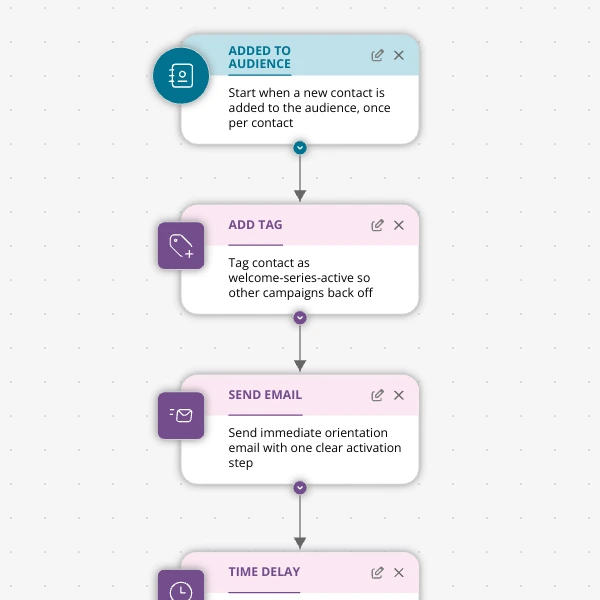
The Shopify app welcome series that turns installs into income
A step-by-step Shopify app welcome email journey for tools like CartSpark, showing how to turn new installs into activated, retained merchants using Spreeflo journeys, tags, and behavioral triggers so fewer trials quietly churn and more trials convert.
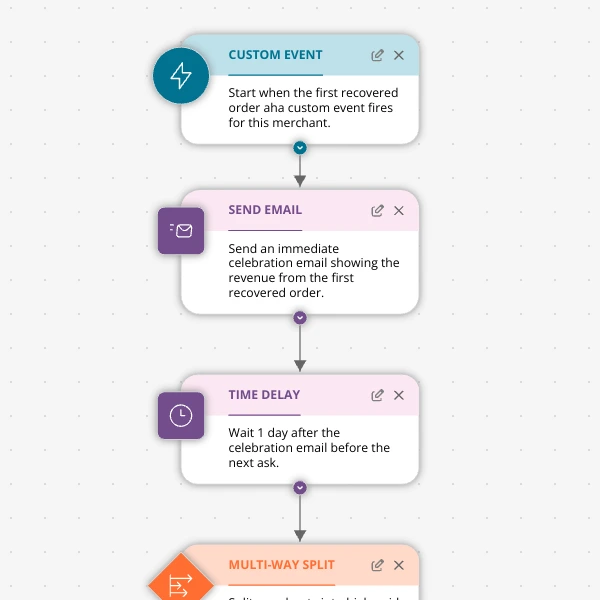
The Aha-Moment Playbook For Shopify Apps: Turn One Magic Action Into Months Of Revenue
A node-by-node playbook for Shopify and e‑commerce apps to center their lifecycle on one aha-moment custom event in Spreeflo, celebrate it, segment merchants by profile and engagement, and turn first recovered value into lasting revenue and retention.
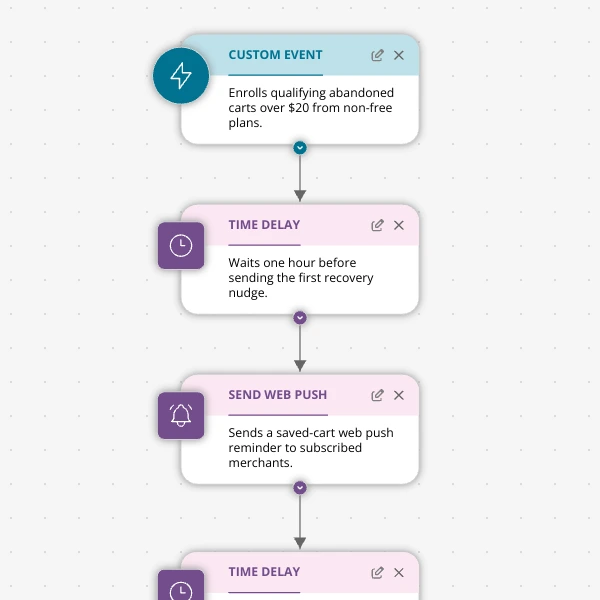
Stop Letting High‑Intent Carts Die: A 3‑Email Recovery Journey for Shopify Apps
A detailed, node-by-node walkthrough of a three-email (plus optional web push) cart-abandonment recovery journey for Shopify apps in Spreeflo, showing how to trigger events, branch on behavior, tag outcomes, and measure recovered carts and revenue.
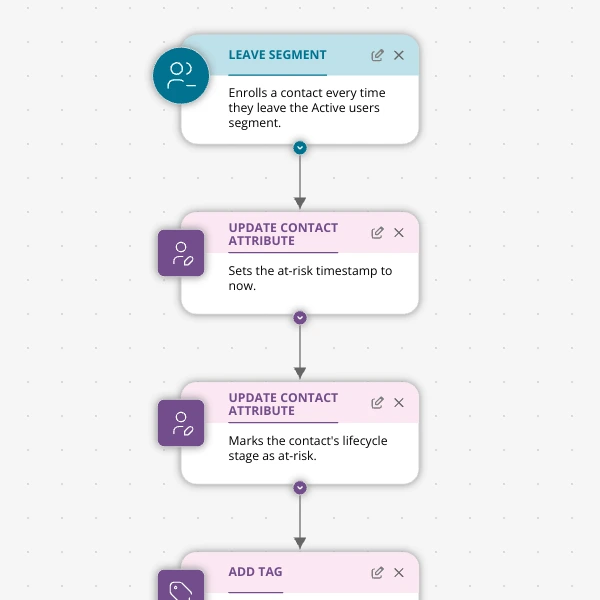
When Active Users Go Dark: A 4‑Touch Win‑Back Journey For Your Shopify App
A detailed, node-by-node Spreeflo journey for winning back previously active Shopify app users who stop engaging, using segment-based triggers, conditional logic, and a four-touch email plus internal alert sequence to recover usage and MRR.