Turn Pricing-Page Lurkers into Trial Users: A Browse-Abandonment Journey for SEO SaaS
This playbook walks through a browse-abandonment journey for SEO SaaS pricing-page lurkers, showing how to track behavior in Spreeflo and trigger targeted emails that turn repeated interest into trials, upgrades, and attributable recovered revenue.
Industry
Niche
Pattern
Loading sequence...
Someone hits your pricing page five times in a week, compares plans, scrolls your FAQs, then disappears without starting a trial. You see it in GA, feel a little sick, and move on to the next task.
Those visitors are where a lot of SEO SaaS MRR quietly dies.
The sequence at the top of this page is a browse‑abandonment journey built specifically for that moment: repeated interest in pricing or product pages with no trial start or upgrade. In this article we’ll walk through it node by node, so you can recreate it inside Spreeflo and adapt it for your own SEO tool.
For a concrete picture, imagine RankPulse: a 3‑person rank‑tracking SaaS around $35k MRR. After adding this flow, they turned a trickle of “pricing lurkers” into a steady stream of trial signups, with about 8–10% of emailed visitors eventually starting a trial or upgrading.
Let’s break down how.
Why pricing-page lurkers are your quietest high-intent segment
If you run SEO software, your funnel is simple on paper:
Visitor → Reads content → Visits pricing → Starts free trial → Activates → Upgrades.
Reality is messier. Prospective customers:
Skim a comparison page at 11pm.
Revisit your pricing after a bad experience with a competitor.
Open your pricing on mobile, then again at their desk, then again before a quarterly review.
They are thinking about buying you. They just aren’t ready yet, or they’re stuck on very specific questions: “Is this worth switching from Ahrefs?” “Will this work for agencies with 50+ clients?” “Is there an annual discount?”
Most tools leave this intent on the floor. At best, they throw generic retargeting ads at everyone who bounced.
A browse‑abandonment journey does something smarter:
It watches for repeated views of high‑intent pages (pricing, “compare us vs X”, advanced features).
It filters to people you can actually email and who have consented.
It sends a context‑rich, soft nudge within a few days of that repeated interest.
It backs off if they convert, and nudges again (once) if they don’t.
Because this flow is built on top of real behavior via Spreeflo’s web tracking and analytics, it lets you speak to each person as the individual they are, not just “another address on the newsletter list.”
What this journey does, in one sentence
It waits until someone has viewed your pricing (or similar) page multiple times without starting a trial or upgrading, then sends a short, targeted email sequence that answers the questions implied by their behavior and nudges them to act.
The metrics you’ll care about:
Click rate on the browse‑abandonment emails.
Browse‑to‑trial (or browse‑to‑upgrade) rate.
Browse‑to‑purchase revenue you can attribute back to the flow.
Now let’s walk through how the sequence at the top of this page is put together.
Step 1: Capture the signals that prove intent
Before you build the journey, you need the right events coming into Spreeflo.
You’ll use two kinds of data:
Pricing / product page views
On your frontend, the Spreeflo SDK tracks pages automatically. For this pattern we also define a custom event, saypage_view, with aurlorpage_typeproperty so we can be precise about pricing and comparison pages.
For example, your React app might call something likeSpreeflo.track('page_view', { url: '/pricing', page_type: 'pricing' })when someone hits your pricing page. That event lands on the contact’s record, ready for the Custom Event trigger to listen for it.Conversion events
You need to know when someone starts a trial or upgrades a plan, so the journey can stop nudging once they’ve paid or committed.
- If trial start and upgrades are handled in your web app, you can track them via the SDK (Spreeflo.track('trial_started', ...)).
- If they’re driven by Stripe webhooks or backend processes, post those events to the Spreeflo API from your server when a subscription is created or upgraded.
You’re building the data foundation that lets Spreeflo treat “visited pricing 3 times, still not on a trial” differently from “read two blog posts once, bounced forever.” That’s how you capture detail on every customer so you can speak to each uniquely.
Step 2: Custom Event trigger on high-intent page views
The journey starts with a Custom Event trigger listening to your page_view event.
Configuration:
Event name:
page_viewProperty conditions:
urlcontains/pricing
ORpage_typeispricing
(You can extend this tourlcontains/compareor/plansif you have those pages.)Re‑enrollment: On
Re‑enrollment is important. The same contact might revisit pricing months after churning, or after their contract with a competitor ends. With re‑enrollment on, they can enter the journey again once they’re out of it.
Every time someone who’s known to Spreeflo hits a pricing‑like page, they enter this journey at that trigger.
Step 3: Wait until it’s really browse abandonment, not curiosity
The pattern is “browse abandonment,” not “anyone who ever glanced at pricing once.”
To avoid jumping too early, the next node is a Wait Condition:
Condition (using the segment builder):
Page Visited → URL contains/pricing
Frequency: at least 2 times
Time window: in the last 7 daysTimeout: 7 days, unit: Days
This does two things:
If they come back to pricing again within a week, the condition becomes true and the journey immediately continues.
If they never return, the timeout expires after 7 days and the journey moves on anyway.
Immediately after the Wait Condition, we add an If/Else:
Same condition as above (page visited pricing at least 2 times in last 7 days).
Branches:
Yes: true browse‑abandoners (multiple recent views).
Else: people who only glanced once.
On the “only glanced once” branch, you can either:
Do nothing and end the journey, or
Add an Add Tag node (e.g. “pricing_single_view”) for later analysis, then end.
The sequence at the top of this page chooses the second option so you can measure how many first‑time pricing visitors never deepen their interest.
Only the “Yes” branch continues into the active recovery emails.
Step 4: Filter to people you can safely email
Now you have “visited pricing multiple times in a week.” Next question: can you email them?
Remember, web tracking is cookie‑based. A visitor might be anonymous, or might be a known contact because they:
Signed up for your newsletter via a Spreeflo form.
Started a trial.
Previously booked a demo.
So the next node on the “Yes” branch is another If/Else that checks:
Email field is not blank.
Email Subscription Status is “Subscribed.”
You define this as a Segment Builder condition on:
Contact Attributes → Email → is not blank.
Email Subscription Status → is → Subscribed.
“Subscribed” gives you consent. “Email not blank” ensures you actually have an address.
Yes branch: They’re known and opted‑in; continue to email.
Else branch: End the journey (or, in a Pro account, you might later add a Popup Form branch to convert anonymous repeat visitors, but that’s optional and out of scope for the core email pattern).
If you use Spreeflo’s own forms for your newsletter and lead capture, with _Map to contacts_ on, this filter neatly lines up with anyone who has submitted those forms. You can read more about that in the guide on how to create and embed forms.
Step 5: A/B test your first nudge email
Now you have the right people:
Known contact.
Subscribed.
Repeated pricing views in the last 7 days.
No trial start or upgrade yet.
This is the moment to send a context‑aware email. The sequence uses a Random Split to A/B test two different angles:
Branch A: “Outcome‑driven” nudge (“How RankPulse helps agencies keep clients past month 3”).
Branch B: “Risk‑removal” nudge (“Exactly what happens after you start a 14‑day trial”).
Random Split configuration:
A Branch ID:
aB Branch ID:
bPercentage weight: 0.5 (50% of contacts see each variant)
Each branch flows to its own Send Email node:
Template A: Case‑study‑heavy, aimed at agencies or serious in‑house teams.
Template B: Simple breakdown of plans, FAQs about limits, and a clear “Start trial” or “Book demo” CTA.
You build the content using Spreeflo’s email builder, ideally with a bit of personalization:
Reference their role or company size if you capture it on signup.
Mention the feature set most relevant to their segment (e.g. content briefs vs technical audits).
Because both variants live as separate Send Email nodes, you can later compare open and click rates in Spreeflo and adjust the mix. Over time, one may outperform; you can switch to 70/30 or retire the loser.
From each Send Email node, the paths recombine into a Merge node so the rest of the journey treats both variants identically.
Step 6: Give them a chance to convert on their own
After the Merge, we don’t immediately send a second message. That would feel pushy.
Instead, we add a Wait Condition that listens for conversion:
Condition:
Custom Eventtrial_startedhas triggered at least 1 time in the last 2 days
OR
Custom Eventplan_upgradedhas triggered at least 1 time in the last 2 daysTimeout: 2 days
You’re telling Spreeflo: “For up to two days after this email, watch to see if they start a trial or upgrade. As soon as that happens, move them forward. If nothing happens after two days, move them forward anyway.”
This assumes you’re already posting those events into Spreeflo from your backend or app via the SDK or the Spreeflo API.
Right after the Wait Condition, another If/Else checks whether the conversion condition is now true:
Yes branch: They converted within two days of the nudge.
Else branch: Still browsing, still not trialing or paying.
Step 7: Celebrate wins, and give non-converters one more shot
On the “Yes, converted” branch, you have two simple steps:
Add Tag — apply something like
pricing_browse_recovered.
This lets you:
- Build a segment later of “wins from browse‑abandonment.”
- Prove to yourself (and investors) that this journey pulls its weight.Optionally, fire a Send Internal Email to a founder or sales inbox with context (“Jamie from Agency X started a trial after 4 pricing views and one browse‑abandon email. Here’s their site.”). For higher‑value leads, that can justify a personal welcome.
You usually won’t send an external confirmation email here, because your normal onboarding/on‑trial journey should already handle that. The tag is mostly for analytics and future personalization.
On the “Else, still not converted” branch, we give them one final, softer nudge:
Time Delay — wait 1 more day.
Configuration: 1 day.Send Email — a second, more consultative message.
This might offer:
- A short loom walkthrough of the app.
- A link to your most relevant case study (“How we helped an agency manage 200+ client sites in one dashboard”).
- An invitation to reply directly with questions.
Because there is a Time Delay between the first and second Send Email nodes, you respect pacing and avoid coming off as spammy.
After that second email, the journey ends. If they still don’t act, you’ve done enough in this context; future touchpoints can happen via your regular newsletter or other lifecycle flows.
Behind the scenes, the whole path takes advantage of Spreeflo’s ability to run campaigns and journeys continuously: once you set it live, every new pricing‑page lurker is treated the same way, without you touching it again.
Measuring whether your browse-abandonment flow is worth it
Two weeks after turning this on, don’t just eyeball open rates. Check three things:
Email performance on the nudge itself
- Open rate and click rate per variant (if you’re A/B testing).
- Replies — especially from agencies asking detailed questions.
If the metrics are weak, you might be contacting the wrong people (tighten the pricing‑visit rule) or sending the wrong message (revise subject/body).Browse‑to‑trial and browse‑to‑upgrade
Build a segment for “pricing page repeat visitors who entered the browse‑abandonment journey” vs a historical baseline before you had the flow. Compare:
- Trial start rate.
- Upgrade rate.
- Time‑to‑trial.
You can define those segments using the same segment builder criteria you used in the journey.Recovered revenue
With thepricing_browse_recoveredtag applied on conversion, you can run a quick MRR tally:
- Total MRR from contacts with that tag.
- Average MRR per recovered account.
Even a handful of saved or upgraded accounts per month can more than cover what you pay for Spreeflo, especially given how modest Spreeflo’s pricing is relative to most SaaS‑oriented email tools.
What you’re really looking for is confirmation of a simple idea: most businesses leak lifetime value by not nurturing engagement. Pricing‑page lurkers are one of the cleanest examples of that leak.
Why this matters for a small SEO SaaS team
You already know how hard it is to get someone to your site, teach them enough SEO context to care, and persuade them to even contemplate switching tools.
When they show up on your pricing page again and again, they’re practically waving. They’re saying, “Convince me this is the right move.”
A browse‑abandonment journey is how you answer that wave automatically:
It uses detailed behavioral data to understand who is asking and how serious they are.
It sends the right message, to the right person, based on that detail.
It runs every day without another human hour spent.
Set it up once, and it quietly keeps more of those high‑intent visitors in your orbit, nudging them into trials and upgrades that would otherwise never happen.
For a founder‑led SEO SaaS, that’s the kind of system that compounds. And it’s exactly what Spreeflo was built to make straightforward.
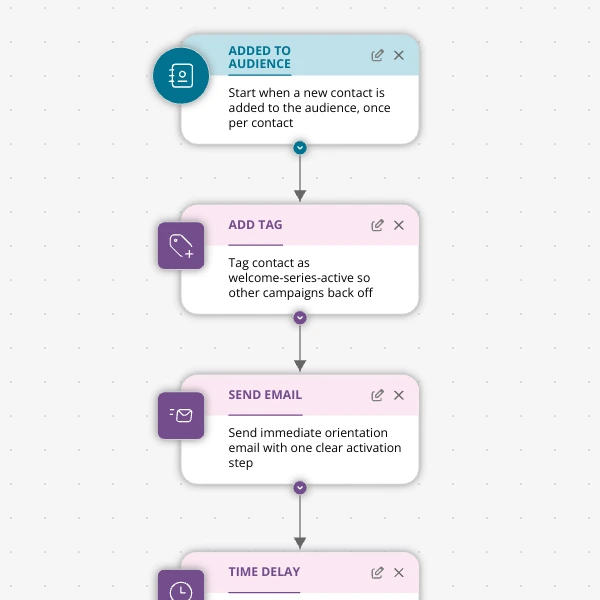
The Shopify app welcome series that turns installs into income
A step-by-step Shopify app welcome email journey for tools like CartSpark, showing how to turn new installs into activated, retained merchants using Spreeflo journeys, tags, and behavioral triggers so fewer trials quietly churn and more trials convert.
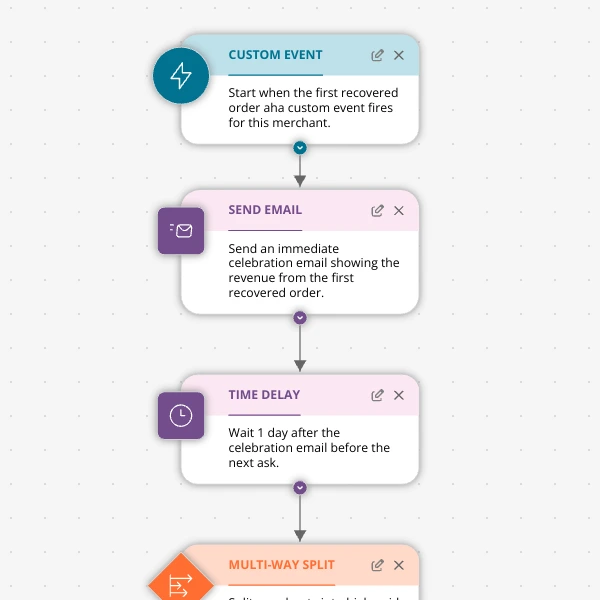
The Aha-Moment Playbook For Shopify Apps: Turn One Magic Action Into Months Of Revenue
A node-by-node playbook for Shopify and e‑commerce apps to center their lifecycle on one aha-moment custom event in Spreeflo, celebrate it, segment merchants by profile and engagement, and turn first recovered value into lasting revenue and retention.
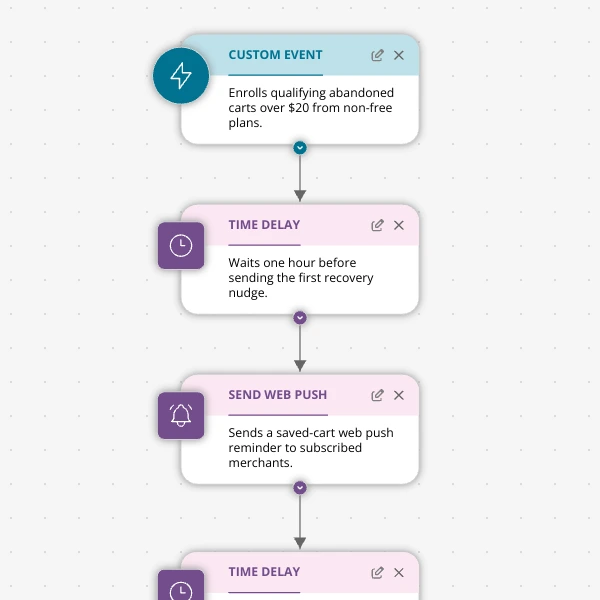
Stop Letting High‑Intent Carts Die: A 3‑Email Recovery Journey for Shopify Apps
A detailed, node-by-node walkthrough of a three-email (plus optional web push) cart-abandonment recovery journey for Shopify apps in Spreeflo, showing how to trigger events, branch on behavior, tag outcomes, and measure recovered carts and revenue.
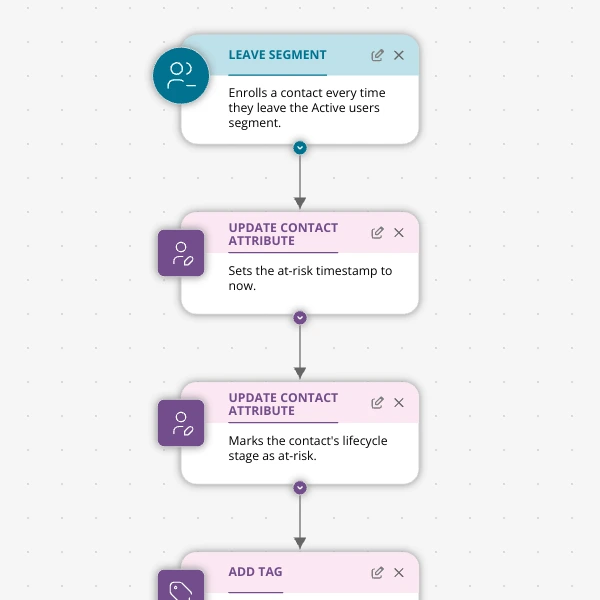
When Active Users Go Dark: A 4‑Touch Win‑Back Journey For Your Shopify App
A detailed, node-by-node Spreeflo journey for winning back previously active Shopify app users who stop engaging, using segment-based triggers, conditional logic, and a four-touch email plus internal alert sequence to recover usage and MRR.