Webhook Enrichment for SEO SaaS: Turn Every Trial into a Qualified Lead
A detailed Spreeflo journey for SEO SaaS teams to webhook trial events into an enrichment service, segment agencies vs in-house vs others, and personalize onboarding, alerts, and measurement so every new signup is qualified automatically.
Industry
Niche
Pattern
Loading sequence...
You probably know the feeling: Stripe says “15 new trials today,” but you have no idea which ones are agencies, which ones are in‑house teams, and which are weekend side projects that will churn in a week.
So you send everyone the same onboarding, the same nudges, the same upgrade pitch—and watch trial‑to‑paid conversion plateau.
This playbook fixes that by wiring enrichment into your automation itself. The sequence at the top of this page is the whole journey, end to end: a Custom Event from your app kicks off a webhook-driven enrichment pass, then the rest of the journey branches based on what you learn.
We’ll walk through it node by node, using a fictional SEO SaaS—BrieflySEO, a content-brief tool at ~$60k MRR—as the running example. The goal: every new signup lands in Spreeflo already segmented (agency vs in‑house vs “other”), so your onboarding and sales attention go where they matter most.
Why enrichment belongs inside your journeys, not your CRM
Most SEO SaaS teams bolt enrichment onto their CRM or data warehouse:
New signup hits your backend.
You ping Clearbit / Apollo / your own enrichment stack.
Hours later, enriched data trickles into the CRM.
Marketing automation sees some of it, some of the time.
Meanwhile, your onboarding sequences fire blind.
Spreeflo’s angle is different. You treat enrichment as just another step in a journey you build:
The app sends a
trial_startedevent into Spreeflo.A Webhook action sends that contact to your enrichment service.
Your service writes enriched attributes back via the Spreeflo API.
The journey waits for enrichment to finish, then branches and personalizes.
Two things happen at once:
You capture rich detail on every customer so you can speak to each one uniquely.
You build the system once and it quietly works for every future signup—classic founder-led “win on leverage, not headcount.”
Let’s map out the exact flow.
The core use case: qualify SEO trials at the moment of signup
For BrieflySEO, the big levers are:
Are they an agency or in‑house team?
How big is their company?
What’s their primary domain?
Those three answers change everything. An agency with 20+ employees might warrant a founder‑intro email and a calendar link. A solo blogger should see a lighter, product‑led onboarding.
We’ll assume your app already has:
A backend that knows when someone starts a trial.
Access to some enrichment (internal or via a vendor).
The ability to call Spreeflo’s events API server-side.
Now we’ll wrap it in an automation that looks like the sequence at the top of this page.
Step 1: Trigger on a Custom Event from your app
First node: a Custom Event trigger.
You configure it to listen for something like trial_started:
Event name:
trial_startedProperty conditions (optional): e.g.
source is not "internal_test"Re-enrollment: On
Why re-enrollment on?
Because in B2B SaaS, the same human might spin up multiple workspaces over time (a freelance SEO who later joins an agency, for example). You want enrichment to re-run whenever this event fires with new context, but the mid-journey lock prevents double-enrolling them while they’re already flowing through.
On the backend, your app POSTs that event into the events endpoint documented in the Spreeflo API. The key thing: the payload includes the contact’s email and any initial properties you have (workspace domain, plan, country).
As soon as the event lands, the contact enters this journey.
Step 2: Flag contacts that are pending enrichment
Next node: Add Tag.
Configuration:
Tags:
enrichment_pendingForce tag trigger: Off
The purpose of this tag is operational, not marketing:
It gives you a fast way to build segments like “stuck in enrichment.”
It’s a sanity check when you’re debugging (e.g. did the journey fire?).
You don’t need the tag to drive branching later, but it’s cheap visibility and pays for itself the first time enrichment has an outage.
Step 3: Webhook out to your enrichment service
This is the heart of the pattern: a Webhook action node.
Configuration:
Method: POST
Webhook URL: your enrichment endpoint (e.g. a Cloudflare Worker, small Rails app, or serverless function you control)
Contact fields: all contact attributes, or a subset (email, domain, name)
Authentication: API key or bearer token, depending on how you secure the endpoint
When this node fires, Spreeflo sends a JSON payload to your endpoint with the contact’s details.
Your enrichment service then:
Reads the payload (at minimum email and domain).
Calls your enrichment provider(s) with that information.
Maps the response into attributes that exist in your Spreeflo workspace, for example:
Uses the Spreeflo contacts or events API to write those attributes back onto the same contact.
company_type:agency/in_house/freelancercompany_size: numericmonthly_organic_traffic: numeric or text band
The important constraint from Spreeflo’s side: the Update Contact Attribute action in journeys can only write static design-time values. It cannot read data from webhook responses. That’s why the enrichment happens in your own service and writes directly via the API.
If you haven’t worked with webhooks in Spreeflo before, the automation side is covered in the campaign and journey automation help, and field-level API details live in the API docs.
Step 4: Wait just long enough for enrichment to finish
After the Webhook node, drop in a Wait Condition.
Configuration:
Condition (using the segment builder):
company_type is not blankOR tag
enrichment_failedis present (more on that in a second)Timeout: 1 day (or shorter if your enrichment is usually fast)
In English: “Pause this contact here until they have a non-blank company_type attribute, or until a failure tag appears, but give up after 24 hours.”
Why this pattern works:
It lets enrichment be asynchronous. Your worker can take a few seconds or a few minutes.
It avoids contacts getting stuck forever in a waiting step.
It builds in a way to handle errors (the failure tag) instead of silently dropping them.
On the enrichment-service side, if something goes wrong (vendor error, rate limit, missing data), you can skip updating attributes and instead call the Spreeflo API to add a tag like enrichment_failed. The Wait Condition’s OR rule then sees that and moves the contact along the “failed enrichment” path.
Step 5: Split success vs failure
Next, an If/Else node:
Condition:
company_type is not blankThen branch: “Enriched”
Else branch: “Unenriched”
Anyone who flowed past the Wait Condition because enrichment succeeded will go down the Enriched branch. Anyone who timed out or had a failure tag (and still has a blank company_type) takes the Unenriched one.
You’ll use these two paths for both personalization and measurement:
Enriched: high-confidence routing and targeted messaging.
Unenriched: generic onboarding, plus optional self-segmentation later.
Step 6: Use Multi-way Split to treat agencies and in‑house differently
On the Enriched branch, drop a Multi-way Split node to branch on company type:
Branches:
agency:company_type is "agency"in_house:company_type is "in_house"Else: everyone else (freelancers, unknown, edge cases)
You can express these conditions cleanly in the segment builder that lives inside the Multi-way Split node.
Now you have three clean paths:
Agencies: usually higher LTV, might run multiple client projects.
In-house SEO teams: often care about reporting to leadership and integrations.
Other: still valuable, but less structured.
Let’s see how that changes your actions.
Step 7: Tailor onboarding emails per segment
Inside each branch, you use Send Email and optionally Send Internal Email.
Example for the “agency” branch:
Send Email:
- Template: “Agency trial welcome”
- From: founder or head of growth
- Content: speaks to client reporting, team collaboration, and multi‑project workflows.
- You can start with simple merge fields, then layer in personalize with AI variables later to adapt subject lines or intros to the specific company.Optional If/Else inside this branch:
- Condition:company_size greater than 10
- Then: Send Internal Email to the founder: “New agency trial with 10+ employees,” with contact details and suggested next steps.
- Else: skip the internal alert.
For “in_house”:
Send Email:
Template: “In-house SEO trial welcome”
Focus on time saved, collaboration with content teams, and how to show results to your CMO.
Maybe link to your three best “how we increased organic traffic by X%” case studies.
For “else”:
Send Email:
Template: “Quick-start guide”
More generic but still tailored by use case where possible (e.g. based on their first project setup inside the product).
Spacing matters. If you plan a longer nurture (e.g. three emails per branch), always insert a Time Delay of at least 1 day between each Send Email node to avoid overwhelming new trials.
Once each branch runs its specific actions, connect them all into a Merge node so the journey recombines into a single path for the rest of your onboarding.
Step 8: Handle unenriched contacts gracefully
Back on the “Unenriched” branch from Step 5, you don’t want to punish these contacts. Data is missing; intent might still be high.
A simple pattern here:
Add Tag:
unenrichedSend Email: a generic onboarding welcome that doesn’t lean on segment-specific assumptions.
Optionally later in your broader onboarding journey, you can use a Popup Form action (on Professional plans) to show a short in‑app “Tell us about your team” form, targeted only at contacts with the
unenrichedtag. Because Spreeflo forms map answers directly to contact attributes, that popup can backfill some of what enrichment missed—without ever emailing a form link.
All paths—enriched agencies, enriched in-house, others, and unenriched—then flow through a Merge into the same downstream onboarding flow.
Step 9: Measure enrichment success and attribute completeness
The pattern doesn’t earn its keep unless you can see whether enrichment is actually working.
Two simple metrics:
Enrichment success rate
- Numerator: contacts who entered this journey and havecompany_type is not blankwithin X days of triggering.
- Denominator: all contacts who triggeredtrial_startedwithin the same window.
Build both groups as segments using the segment builder (with a filter on yourtrial_startedevent and contact added date), then compare counts. Even a basic weekly spreadsheet can show whether you’re at 40%, 70%, or 90% enrichment coverage.Attribute completeness after pass
For your must-have fields (e.g.company_type,company_size,monthly_organic_traffic), create a segment per attribute:
- “company_type present”
- “company_size present”
- “monthly_organic_traffic present”
Over time, you’ll see where your enrichment provider is thin. Maybe company size is strong, but organic traffic is missing for long-tail bloggers. That’s feedback to either adjust your vendor mix or add a self-segmentation step for those cohorts.
Because all of this lives on one contact record in Spreeflo’s audiences model, the same attributes and tags you enriched here are instantly usable in other journeys, campaigns, and analytics.
Why this pattern suits SEO SaaS in particular
For SEO tools, the difference between a random blogger and an agency running 30 client sites is the difference between $29 MRR and a five-figure annual contract.
A webhook-driven enrichment journey turns that difference into data you can actually act on:
Agencies get onboarding that speaks to reporting, client communication, and scalability.
In-house teams see workflows around content ops and stakeholder reporting.
High-employee-count companies trigger internal alerts so you don’t miss a chance to reach out personally.
Everyone else still gets a clean, product-led experience.
You’re no longer guessing which trials matter. You’re using firmographic and behavioral detail to make every email, notification, and internal follow-up more specific.
And because the enrichment is inside the journey—not bolted onto a separate CRM—you set it up once and it silently works on every future sign-up. That’s the kind of automation that actually compounds for a small team.
Bringing it back to the bigger picture
Underneath this pattern is a simple idea: the more you know about each customer, the more precise your marketing can be.
Webhook-driven enrichment inside Spreeflo is one concrete way to do that. It takes what you already have—a backend, an enrichment provider, a trial flow—and wraps it in a journey that:
Captures richer detail on every signup.
Routes them into the right onboarding path instantly.
Surfaces the big opportunities without more manual triage.
If you’re already tracking product events and sending basic campaigns, this is a natural next step. Start with trial_started, wire up the Webhook, and build just two branches—agencies vs everyone else. As results come in, you can deepen the splits, improve the email builder templates, and add more nuanced checks.
The goal isn’t complexity. It’s clarity: knowing who you’re talking to, and letting automation do the busywork so your small team can focus on the conversations that move MRR.
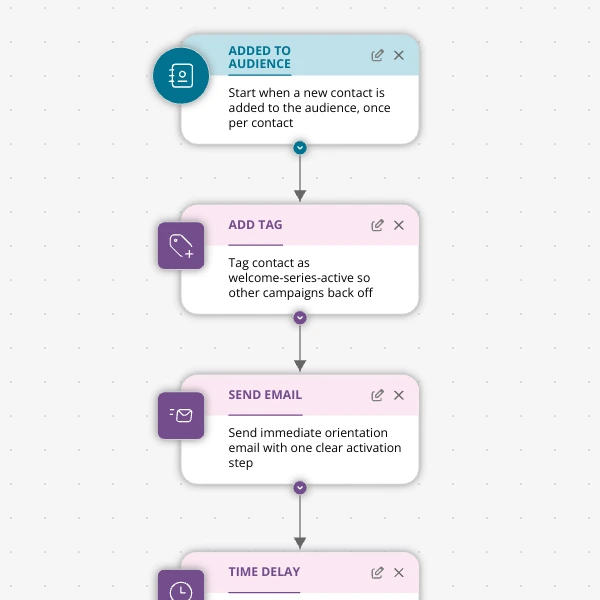
The Shopify app welcome series that turns installs into income
A step-by-step Shopify app welcome email journey for tools like CartSpark, showing how to turn new installs into activated, retained merchants using Spreeflo journeys, tags, and behavioral triggers so fewer trials quietly churn and more trials convert.
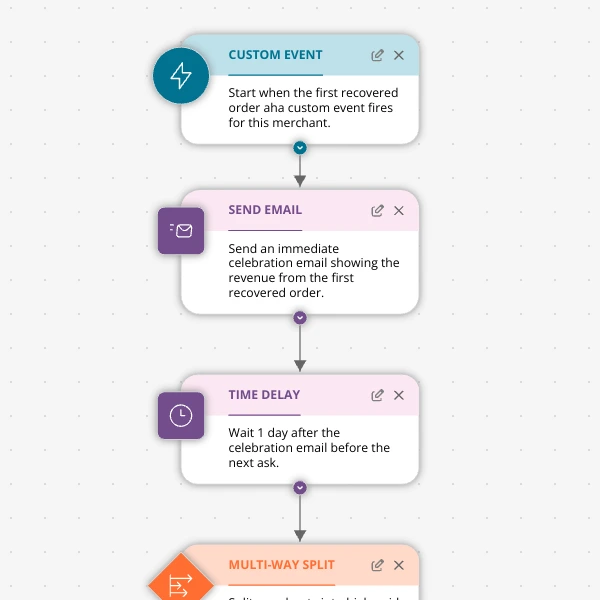
The Aha-Moment Playbook For Shopify Apps: Turn One Magic Action Into Months Of Revenue
A node-by-node playbook for Shopify and e‑commerce apps to center their lifecycle on one aha-moment custom event in Spreeflo, celebrate it, segment merchants by profile and engagement, and turn first recovered value into lasting revenue and retention.
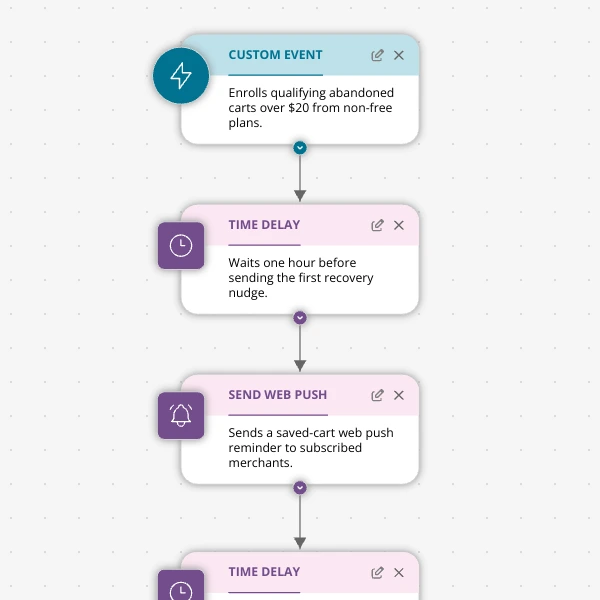
Stop Letting High‑Intent Carts Die: A 3‑Email Recovery Journey for Shopify Apps
A detailed, node-by-node walkthrough of a three-email (plus optional web push) cart-abandonment recovery journey for Shopify apps in Spreeflo, showing how to trigger events, branch on behavior, tag outcomes, and measure recovered carts and revenue.
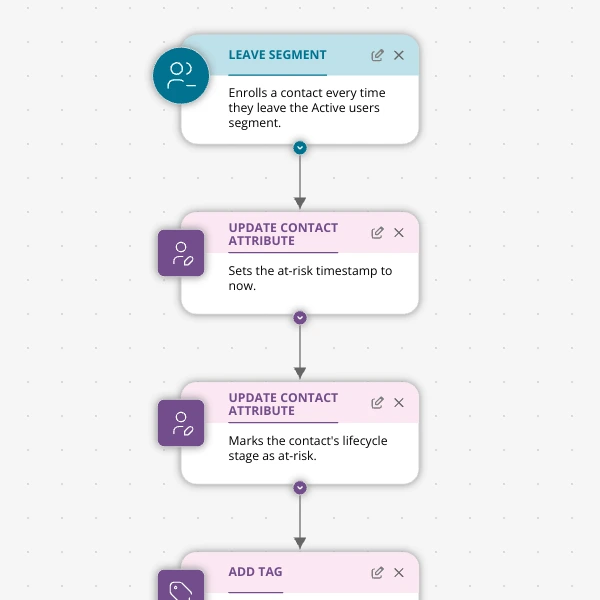
When Active Users Go Dark: A 4‑Touch Win‑Back Journey For Your Shopify App
A detailed, node-by-node Spreeflo journey for winning back previously active Shopify app users who stop engaging, using segment-based triggers, conditional logic, and a four-touch email plus internal alert sequence to recover usage and MRR.