When Stripe Fails, Your Emails Shouldn’t: Event‑Triggered Journeys for SEO SaaS
Explains how RankWave, a four-person SEO SaaS, wires Stripe billing events into Spreeflo using Custom Event triggers and journeys so failed payments automatically trigger clear emails, recovery paths, and precise account pauses that quietly protect recurring revenue.
Industry
Niche
Pattern
Loading sequence...
The worst time to discover a failed payment is in your churn report.
For a team like RankWave, a four-person SEO SaaS doing $45k MRR on Stripe, a handful of quiet card failures each week meant agencies waking up to paused rank tracking, scrambling, then cancelling out of frustration. Support tickets spiked, MRR leaked, and nobody had time to chase payments manually.
The sequence at the top of this page is the whole journey, end to end. It shows how RankWave wired Stripe’s webhooks into Spreeflo so every billing hiccup triggers the right email, to the right customer, in near real time — without anyone on the team touching a keyboard.
This playbook walks through that journey node by node, and how you can adapt it for your own SEO SaaS.
Why external events belong inside your marketing automation
Your product and billing systems already know everything that matters:
When a trial starts or ends
When a card fails or recovers
When an agency adds its 50th client site
When a user hasn’t checked rankings in 30 days
Most teams keep that data trapped in Stripe, the app backend, or a help desk. Marketing runs separately: generic newsletters, broad “we miss you” campaigns, maybe a manual dunning email once a month.
For subscription SEO tools, that gap is expensive. One quiet billing failure on a $199/mo agency plan is $2,388/year if it quietly churns. You can’t afford to wait for a weekly report.
Spreeflo’s answer is simple: push those external events into the platform via the Spreeflo API, then use a Custom Event trigger to start or branch a journey the moment something meaningful happens.
The pattern we’ll build here uses one specific case (Stripe invoice_payment_failed) because it is universal, painful, and measurable. Once you have it working, the same pattern works for:
Big usage milestones (
added_100_keywords,connected_gsc)Contract changes (
upgraded_plan,cancelled_subscription)Support situations (
high_priority_ticket_opened)
The journey is the same idea each time: external event in, targeted message out.
The billing failure journey at a glance
Before we dive node by node, here’s the story your customer experiences in this flow:
Their card fails on renewal.
Within minutes, they get a calm, clear email from your team explaining what happened and how to fix it.
You wait a few days.
If they pay successfully in that window, they get a confirmation email and you quietly clear any “at risk” flags.
If they still haven’t fixed it, they get a firmer reminder with a clear deadline, and your backend is told it’s time to pause the account.
You design this once inside Spreeflo’s campaigns and journeys builder. After that, your billing events run the whole thing.
Let’s walk through the sequence on the canvas.
Step 1: A Custom Event trigger listening for Stripe
First node in the journey: a Custom Event trigger.
This is wired to an event your backend sends to Spreeflo when Stripe fires a webhook. In RankWave’s case, they have a small webhook handler that:
Receives Stripe’s
invoice.payment_failedeventExtracts the customer’s email and relevant metadata (plan, amount, currency, maybe failure reason)
Sends an HTTPS POST to the Spreeflo events endpoint with:
eventName = "invoice_payment_failed"email = customer_email@example.comproperties = { plan_tier: "Agency", amount: 199, currency: "USD", ... }
In the Custom Event trigger configuration:
Event name:
invoice_payment_failedAdd property conditions: on
Property rule, for example:
Property
productisrankwave_app(so you don’t accidentally trigger on some other Stripe product)Re-enrollment: on (true)
Why re-enrollment is on
A single customer can fail renewal more than once over their lifetime. With re-enrollment enabled, every time Stripe sends another invoice_payment_failed for that contact, the trigger can fire again once they’re out of the journey. That makes this a reusable, evergreen safety net instead of a one-and-done flow.
If you later add other external-event triggers in the same journey (for example, invoice_payment_succeeded), remember that re-enrollment is journey-wide: at least one trigger must allow it, or later passes will silently be ignored.
This node is where Brand Message #1 starts to show up: you’re not just tracking “billing went wrong.” You’re capturing plan tier, amounts, and context so you can speak to each customer in a way that fits their account.
Step 2: First dunning email — fast, factual, and personal
From the trigger, the sequence flows straight into a Send Email node.
Configuration-wise:
Template: something like “Payment failed – keep your rankings live”
Built with Spreeflo’s email builder
Send only once: on (you never want this specific template to hit the same person twice within one run)
Content choices that matter:
Subject that states the event, not drama:
“We couldn’t process your RankWave payment”First line that confirms nothing is deleted yet:
“Your projects and keyword data are safe, but we couldn’t process your latest payment.”One clear CTA button:
“Update billing details” linking to your billing page.Optional context using attributes:
- Plan tier (“Agency plan”)
- Billing frequency (“billed monthly”)
Those attributes should already live on the contact from your signup and upgrade flows. Spreeflo doesn’t pull values out of the event payload and drop them into contact attributes automatically, so if you want to personalize against plan, keep it updated on the contact via your normal API flows.
Why this node sits right after the trigger
You care about trigger latency here: the time from Stripe’s webhook to the email being delivered. The flow is intentionally lean at the start so the customer hears from you almost instantly, while the problem is top-of-mind and before they bump into a paused account.
From a small-team angle, this is pure leverage: every billing failure is handled with the same calm, precise message, even at 2am.
Step 3: Time Delay — give them space to act
After the first dunning email, the sequence uses a Time Delay node.
Configuration:
Delay: 3 days
Unit: Days
You can choose 2–5 days depending on how aggressive your billing policy is, but avoid anything shorter than 24 hours. People travel, cards get replaced, accounting teams batch payments. Hammering them every day feels spammy and increases unsubscribes.
This node exists for two reasons:
It guarantees healthy spacing between the first and second emails, so you never fire back-to-back messages on the same issue.
It sets a clear observation window for whether the customer sorted billing out on their own.
Alternative for more advanced setups
Once you’re comfortable, you might test replacing this with a Wait Condition that waits “up to 7 days” for a successful payment event instead of a fixed delay. That lets the flow react as soon as the card is updated. The sequence on this page keeps it simple with a fixed delay plus a check.
Step 4: If/Else — did they fix the payment?
Next comes an If/Else process node.
The condition uses the segment builder to ask:
“Has this contact triggered the custom event
invoice_payment_succeededat least 1 time in the last 3 days, withproduct=rankwave_app?”
In builder terms, that’s a Custom Event rule:
Type:
Custom EventsEvent name:
invoice_payment_succeededOperator:
AT_LEAST1 timeTime window:
in the last3daysProperty condition:
productisrankwave_app
The Yes branch is “Recovered payment”; the Else branch is “Still unpaid”.
Why this check lives in Spreeflo instead of billing alone
You could look only at Stripe to decide what to do, but putting the logic in the journey means your marketing brain is attached to your billing brain:
You can A/B test copy on the recovery vs. non-recovery paths.
You can build segments later like “contacts who have failed at least twice but recovered each time” for proactive outreach.
You give yourself a single canvas where data, condition, and messaging live together.
This is the pattern in action: external event in, smarter decisions out.
Step 5A: Recovery path — reassure and reset risk flags
On the “Recovered payment” branch, you send a second Send Email.
Configuration:
Template: “You’re all set – payment received”
This is the only email on this branch, and it comes at least 3 days after the first dunning email because of the Time Delay.
Content:
Short confirmation that payment went through and service remains active
Reassurance that no data was lost
Optional subtle reminder of value:
- “Your rank tracking and weekly reports will keep running as normal.”
Immediately after that email, RankWave adds a bit of state with two action nodes:
Remove Tag – clear any existing
billing_past_duetagAdd Tag – apply
billing_okorbilling_recovered
Those tags power future segmentation (for example, a quarterly “billing health” review, or a special nurture for historically fragile accounts). They also make it trivial for support to see billing context at a glance when someone opens a chat.
Why not just stop after the first email?
Because this branch is a chance to deposit trust. When someone fixes a problem quickly, a short “you’re good” note closes the loop and makes your automation feel like a service, not a nag.
Step 5B: Still-unpaid path — clear deadline and next steps
On the Else branch (“Still unpaid”), the journey sends a second Send Email with a different tone.
Configuration:
Template: “Action needed – we’ll pause your RankWave account in 48 hours”
Again, this hits at least 3 days after the first email thanks to the Time Delay.
Copy guidelines:
Plain statement of the situation: “We still can’t process your latest payment.”
Clear consequence and timeline: “Unless you update your card in the next 48 hours, we’ll pause your account and stop pulling fresh rankings.”
Same single CTA back to billing.
Then the branch adds state:
Add Tag –
billing_past_due
This tag can drive support views (flag these users as “fragile”) and additional journeys later (for example, a reactivation campaign for accounts paused due to non-payment).
To actually act on the consequence, the branch then uses:
Time Delay – 2 days (to honour the 48-hour warning)
Webhook action (Professional plan)
The Webhook node calls your backend with:
Method: POST
URL: an internal endpoint such as
https://app.rankwave.com/api/spreeflo/pause-accountPayload: the contact’s email and any fields you selected in the node
Your server then performs the real pause in your app: stop crawling, stop scheduling reports, and show an in-app banner. Spreeflo doesn’t control your product; it tells your product when to act.
Why pause via Webhook instead of Stripe directly?
Stripe handles billing, but it doesn’t know about your crawl queues, keyword limits, or dashboards. Using a Webhook lets you wire this journey into the exact product experience you want when an account goes unpaid.
How this pattern reinforces customer detail and founder leverage
Two of Spreeflo’s core beliefs are baked into this journey:
Capture detail on every customer so you can speak to each uniquely.
You aren’t sending a vague “billing issue” email to a list. You’re:
Filtering on a precise external event (
invoice_payment_failed)Narrowing by product or plan through event properties
Branching on a second event (
invoice_payment_succeeded) to decide tone and messageTagging contacts based on what happened for future segmentation
That stack of detail makes your messaging feel like it’s written for that account, not “dear customer”.
Founder-led businesses win on leverage, not headcount.
RankWave didn’t hire a billing specialist. They invested a day wiring Stripe into Spreeflo, crafting two strong emails, and wiring a Webhook to their backend. Now:
Every failure is chased automatically
Every recovery is acknowledged
Pauses happen on time, with a clear audit trail
The founder sees fewer surprise churns and spends more time shipping features
That’s the trade you want as a small SEO SaaS: fixed setup cost, compounding benefit.
Extending the same flow beyond billing
Once you’re comfortable with this journey, it’s straightforward to spin up siblings that use the same external‑event trigger pattern:
Usage milestones from your app backend
Fire akeywords_tracked_threshold_reachedevent via the API when an account crosses 1,000 tracked keywords. Use a Custom Event trigger to send them an “agency best practices” guide and a quiet upsell to your higher tier.Trial-to-paid nudges for complex setups
If you use an external onboarding partner or a separate provisioning system, send atrial_blocked_by_setupevent when something stalls. Trigger a journey that offers white-glove help from your team instead of hoping they reach out.Support-led saves from your help desk
If your support tool lives outside Spreeflo and exposes webhooks, sendhigh_priority_ticket_openedto the API. Start a journey that alerts your team via Send Internal Email, tags the account, and follows up with a human-style check‑in once the ticket is resolved.
One important boundary: when you control the capture surface on your own site or app (a waitlist, demo request, onboarding survey), use Spreeflo forms and a Form Submission trigger instead of inventing a Custom Event. Reserve Custom Event triggers for genuine behavioral events coming from external systems like Stripe, your backend, or third‑party tools you don’t control.
Measuring whether this journey is doing its job
Three metrics tell you if your external-event journey is pulling its weight:
Trigger latency
- How long between Stripe’sinvoice.payment_failedtimestamp and Spreeflo’s first dunning email being delivered?
- Aim for minutes, not hours. If it’s slower, check your webhook handler and how quickly it calls the Spreeflo API.Delivery and engagement
- Delivery rate, opens, and clicks on the two dunning emails.
- If opens are low, test subject lines and sender identity. If clicks are low, simplify the email and make the billing CTA more prominent.Data completeness
- Periodically inspect a sample ofinvoice_payment_failedevents in Spreeflo: do they all have the properties you rely on (product, plan, amount)?
- Use the segment builder to spot anomalies: for example, a segment of “contacts who failed payment in the last 30 days with no plan_tier attribute” suggests missing data in your upstream system.
As this instrumentation matures, you can make smarter decisions about who to let churn quietly, who to escalate, and where to tighten or relax policy. And because the data, logic, and messages live in one tool, those changes are a matter of editing a journey, not rewriting backend logic.
Bringing it home
Card failures and external system events are not just “ops” problems. For an SEO SaaS, they are moments where you either earn trust or quietly lose a customer.
By pulling Stripe and backend events into Spreeflo, you turn those moments into structured journeys: precise triggers, thoughtful branches, and emails that speak to the real situation of each account. You capture the detail you need to talk like a human, and you set up a system that runs 24/7 on your behalf.
If you’re already tracking product behavior with Spreeflo’s web tracking and analytics, wiring in external events is the next logical step. And because Spreeflo’s pricing is built for founder‑led teams, you can design flows like this long before you’d ever hire someone to manage them.
Design the journey once. Let your external systems feed it. Then let it quietly protect your MRR while you focus on building the best SEO tool in the market.
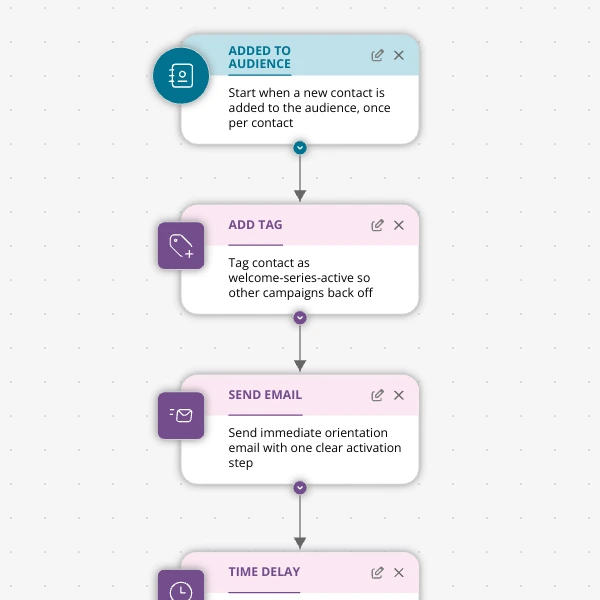
The Shopify app welcome series that turns installs into income
A step-by-step Shopify app welcome email journey for tools like CartSpark, showing how to turn new installs into activated, retained merchants using Spreeflo journeys, tags, and behavioral triggers so fewer trials quietly churn and more trials convert.
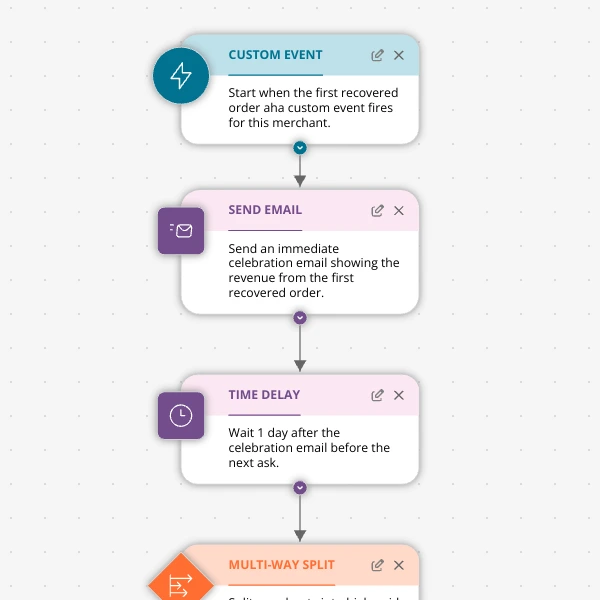
The Aha-Moment Playbook For Shopify Apps: Turn One Magic Action Into Months Of Revenue
A node-by-node playbook for Shopify and e‑commerce apps to center their lifecycle on one aha-moment custom event in Spreeflo, celebrate it, segment merchants by profile and engagement, and turn first recovered value into lasting revenue and retention.
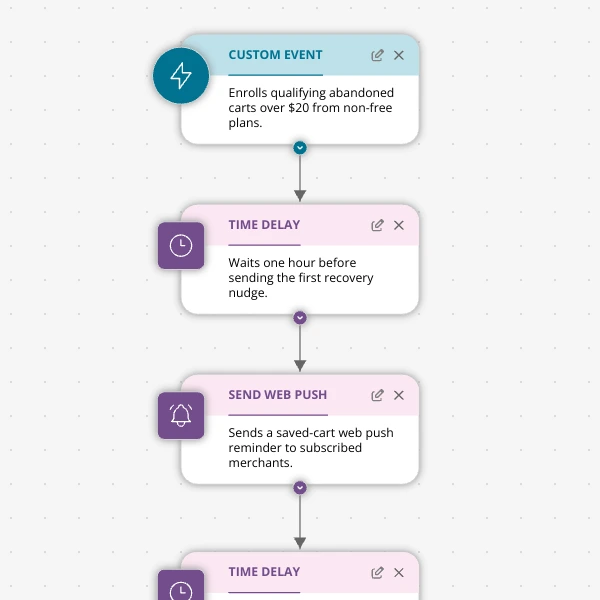
Stop Letting High‑Intent Carts Die: A 3‑Email Recovery Journey for Shopify Apps
A detailed, node-by-node walkthrough of a three-email (plus optional web push) cart-abandonment recovery journey for Shopify apps in Spreeflo, showing how to trigger events, branch on behavior, tag outcomes, and measure recovered carts and revenue.
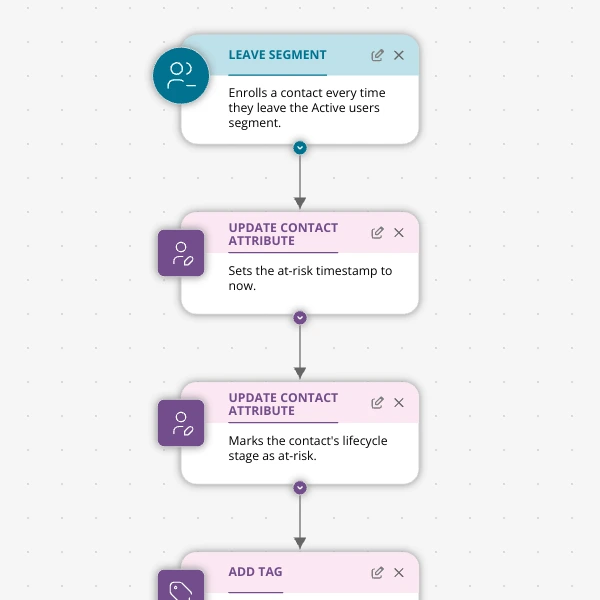
When Active Users Go Dark: A 4‑Touch Win‑Back Journey For Your Shopify App
A detailed, node-by-node Spreeflo journey for winning back previously active Shopify app users who stop engaging, using segment-based triggers, conditional logic, and a four-touch email plus internal alert sequence to recover usage and MRR.