When Your Pricing Page Starts Buzzing: A High‑Intent Alert Playbook for SEO SaaS
A detailed playbook for SEO SaaS teams to automatically detect high-intent pricing-page behavior in Spreeflo and trigger rich internal alerts, so sales and success can act on expansion and new-logo opportunities without manual monitoring.
Industry
Niche
Pattern
Loading sequence...
The scariest graph for an SEO SaaS founder isn’t traffic or signups. It’s the “opportunity created” line that stays flat while your pricing page activity quietly spikes.
At RankPulse, a fictional rank-tracking SaaS doing ~$35k MRR, the founder noticed later-stage deals all shared one thing: prospects kept coming back to /pricing. Three, four, sometimes eight times in a week. But sales only heard about those accounts if someone manually spotted the activity in analytics and dropped a Slack note.
The sequence at the top of this page is the fix: an always-on journey that watches for repeated pricing visits and fires an internal email to sales with rich context the moment someone crosses your “high-intent” threshold.
This article walks through that journey node by node, explains why it’s configured that way, and shows how to adapt it to your own SEO SaaS.
Why pricing-page behavior is your sharpest intent signal
If you sell rank tracking, content briefs, or technical SEO tooling, you already know most of your signups are self-serve. Your buyer reads a few posts, maybe tries the product, then disappears back into their tab maze.
The only place they reliably reveal buying intent is your pricing page.
A single visit could be curiosity. Three or more visits within a week, especially from someone who has already started a trial or integrated Google Search Console, is something else. It’s:
An agency comparing plans for a client retainer
An in-house SEO fighting for budget
A solo founder trying to justify upgrading beyond “just enough” tools
That’s when a timely, human follow-up changes the outcome: a quick “Want to walk through how this fits your stack?” email, a Loom, or a short call.
The problem is catching that moment without sitting in Google Analytics all day.
Spreeflo gives you the ingredients: web tracking, segmentation, and internal emails inside one automation canvas. This pattern connects them so your team gets a clean, contextual alert whenever a contact demonstrates serious pricing interest.
The journey you’re about to build
Before we zoom into each node, here’s the flow in plain English:
A contact who is already known to you (email on file) visits your pricing page at least three times in seven days.
A Criteria Match trigger enrolls them in the journey the moment that condition becomes true.
An If/Else node checks whether they’re already a paying customer or still a lead.
Each branch:
Adds a tag to record “pricing high intent”.
Sends a tailored Send Internal Email alert to the right owner (AE for new leads, AM/CSM for existing customers).
You can build and run this as a Journey using the visual editor described in the campaign and journey platform overview. Let’s go step by step.
Step 1: Make sure pricing visits show up in Spreeflo
This journey relies on web activity, so you need two pieces in place:
The Spreeflo SDK installed on your marketing site or app so page views are tracked into the Web Analytics dashboard.
A way for those page views to be tied to a contact (email) so automation can act on them.
If you haven’t already, follow the web tracking and analytics guide to:
Add the SDK snippet across your site.
Confirm that page views are appearing in Analytics.
Use
Spreeflo.identifysomewhere in your app once a visitor signs up or logs in, so their activity links to a contact record.
Once that’s done, every time an identified contact hits /pricing, Spreeflo records it as a page view associated with that contact. On the Free plan, you can see this in Analytics; on Professional, you can also use it in segments and as a trigger for automations, which is what this pattern uses.
If you prefer more explicit tracking, your frontend can also fire a custom pricing_viewed event whenever someone views the pricing page. Either way, the journey works the same — what matters is that repeated pricing interest is visible inside Spreeflo.
Step 2: Define “high intent” with a Criteria Match trigger
Open the journey editor and add a Criteria Match trigger. This is where you describe the behavior that counts as “sales-worthy pricing interest.”
Inside the Criteria Match node, you’re using the same engine as the segment builder. Configure a group with an AND connector and add a rule like:
Category: Page Visited
URL: contains
/pricingFrequency: at least 3 times
Time window: in the last 7 days
What this does:
The journey does nothing the first or second time a known contact visits pricing.
The moment they hit that third visit within seven days, they enter the journey.
If they keep visiting, they won’t be re-enrolled (we’ll keep the trigger’s re-enrollment toggle off) so sales doesn’t get spammed.
Why Criteria Match, not a simple “Page view” event trigger?
Because Criteria Match lets you express both:
Frequency: “at least 3 times”
Recency: “in the last 7 days”
in one place, using the same logic you’ll re-use across other segments and journeys.
A couple of important design choices here:
Trigger only for known contacts. Criteria Match runs on contacts, not anonymous visitors, which is what you want. An internal handoff is useless if you don’t have an email or company.
Re-enrollment off. Set
isReEnrollmentto false so each contact only ever triggers this alert once for this journey. If you later want recurring alerts (say, every quarter), you can duplicate the journey with a different window.
At this point, any contact who meets that high-intent definition flows into the next node.
Step 3: Split new leads from existing customers
Next, drop an If/Else node right after the trigger.
Your condition: “Is this contact already a customer?”
There are several ways to express this in the If/Else condition using the segment builder:
Contact Tags: contact is tagged with
customerOR a custom attribute, e.g.
plan_type is not blankOR membership in a “Customers” segment
For our RankPulse example, they push plan information from their billing system into a plan_name contact attribute via the Spreeflo API, so their rule is:
Contact Attributes →
plan_name→ is not blank
Any contact with a plan name is treated as an existing customer. Everyone else is a lead.
Why bother splitting?
A net-new lead hitting pricing three times probably needs a classic sales follow-up: qualification, discovery, demo.
A paying customer doing the same thing may be thinking about upgrading, adding seats, or renegotiating a contract. That’s more of a success/expansion motion than a cold outbound.
The If/Else keeps this intent clear so you can send the right internal email to the right owner.
Step 4: On the “lead” path, tag and alert sales
On the “Else” branch (not a customer), you’ll build the core handoff.
Add an Add Tag action
- Tag:pricing-high-intent(or similar)Add a Send Internal Email action right after the tag
This tag gives you a permanent marker that this person once showed serious buying behavior. You can:
Build a segment of “pricing-high-intent AND hasn’t converted in 30 days” for future campaigns.
Exclude them from lower-intent nurture sequences that don’t respect their urgency.
This is the actual alert to your sales inbox or the assigned AE. Internal emails use the same email builder as marketing emails, but they go to your team, not the contact.
When you create the internal email template, make sure it includes:
Contact basics: name, email, company, country, current plan or trial status.
Pricing behavior: “Visited /pricing X times in the last 7 days.”
Recent in-app activity that matters for SEO SaaS:
Suggested next action, e.g.:
“Reply with this 3-step migration guide.”
“Offer a 15-minute ‘is this the right fit?’ call.”
“Send the agency white-label explainer if they’re tagged as agency.”
Because internal emails can pull in contact attributes and event counts, the AE is not guessing. They see exactly what the prospect has done and why they’re getting the alert.
For RankPulse, one of their most effective templates looks like:
Subject: “{Company} has been comparing RankPulse plans again”
Body: a short summary of trial age, number of pricing visits, keywords tracked, and whether Search Console is connected, followed by a one-sentence recommended outreach.
The point is not to flood sales. It’s to give them a small, highly curated stream of “these few people are thinking hard about price right now” notifications with enough context to respond intelligently.
Step 5: On the “customer” path, route expansion opportunities
Now handle the “Then” branch from your If/Else — the contacts whose plan_name (or equivalent) is set.
Here, you’ll usually want a different tag and a different internal recipient:
Add Tag
Tag: something likepricing-expansion-signalSend Internal Email
Recipient: account manager, CSM, or a shared “expansion” inbox.
Content: tuned for expansion, not new-logo sales. Include:
- Current plan and MRR
- Team size or seat count (if tracked)
- Key usage metrics (projects, keywords, briefs, audits run)
- The same pricing-visit count and window
For an SEO SaaS that sells multi-seat plans to agencies, that email might drive a very different play:
“They’ve hit their project limit three times this month and are back on pricing; offer the ‘agency+’ add-on.”
“They’re on the lowest plan but keep reading the annual pricing; nudge them toward a discount for annual commit.”
You’re still acting on the same behavior (pricing visits), but the owner, script, and timing differ. The If/Else keeps that separation clean.
Step 6: Close the loop and measure what sales does with these alerts
The journey above gets alerts out. To make it a real system, you also want feedback: did sales work the lead, create an opp, close it?
There are a few lightweight ways to do this using tags, attributes, and (optionally) another journey:
Ask AEs to apply tags in their CRM like
accepted-pricing-signalandrejected-pricing-signal, then mirror those back to Spreeflo via the Spreeflo API.Or, have them click specific tracked links in their follow-up emails (e.g., “accept this lead” vs. “not a fit”). Those link clicks can tag the contact automatically using separate journeys wired to an Email Action trigger.
Or, when your backend creates an opportunity, send a
opp_createdcustom event into Spreeflo’s events API keyed to that contact.
Once that feedback hits Spreeflo, you can:
Build segments like “pricing-high-intent AND opp_created in the last 30 days” to calculate opp creation rate from alerts.
Measure AE acceptance by comparing “alerts sent” vs. “accepted-pricing-signal tag present.”
Use a Cyclic journey to send yourself a weekly internal email summarizing how many alerts converted to opportunities.
None of this requires extra tools; you’re just wiring your usage and CRM events back into the same contact record and using the automation canvas to answer, “Is this alert pattern actually working?”
Adapting the pattern to your SEO SaaS reality
The exact “3 visits in 7 days → alert” rule is a starting point. You’ll likely tweak it based on your audience and sales motion.
Some variations that map well to SEO SaaS:
Lower or raise the threshold.
If you sell high-ticket agency plans, “2 visits in 14 days” might be enough. For low-cost tooling with lots of casual curiosity, you might go “5 visits in 7 days.”Combine pricing with product usage.
In Criteria Match, AND together:
- Page Visited/pricingat least 2 times in 7 days
- AND Custom Eventcreated_content_briefat least 3 times in 14 days
That says, “This person is using briefs seriously and is shopping plans.”Differentiate by source.
Add a rule on alead_sourceattribute (pushed from your signup form or backend) so, for example, “agency directory leads” get a stricter threshold than “organic blog readers.”Swap Criteria Match for a join-segment trigger.
If multiple journeys depend on “pricing high intent,” you might first create a saved segment using the segment builder and then trigger this journey with a Join Segment trigger when contacts join it. The logic of “what is high intent?” lives in one reusable place.
The key is that you’re no longer guessing based on gut feelings or generic “MQL scores.” You’re encoding a concrete definition of intent, grounded in the actual behaviors that predict buying for your product.
Why this pattern is founder‑friendly leverage
As a small SEO SaaS team, you don’t have people to sit in dashboards, spot patterns, and route leads manually. You need systems that:
Watch for the same high-value behaviors all day.
Ping the right human at the right moment with the right context.
Do it without another headcount.
That’s exactly what this journey does.
By combining Spreeflo’s web tracking, the segment builder, and internal emails inside a single journey, you’re capturing fine-grained detail on each customer and turning it into specific, human outreach — without extra operational overhead.
You build it once. It keeps catching the prospects who are quietly agonizing over your pricing page while you’re focused on product and distribution.
If you already know that “people who keep revisiting /pricing are the ones who close,” this is the simplest way to stop missing them.
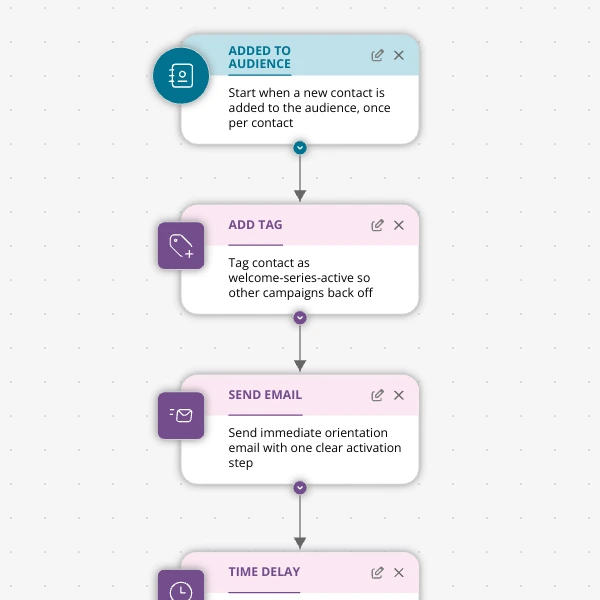
The Shopify app welcome series that turns installs into income
A step-by-step Shopify app welcome email journey for tools like CartSpark, showing how to turn new installs into activated, retained merchants using Spreeflo journeys, tags, and behavioral triggers so fewer trials quietly churn and more trials convert.
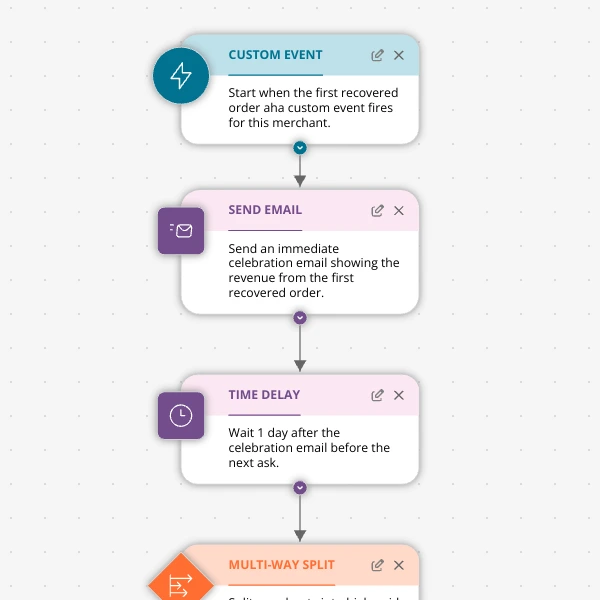
The Aha-Moment Playbook For Shopify Apps: Turn One Magic Action Into Months Of Revenue
A node-by-node playbook for Shopify and e‑commerce apps to center their lifecycle on one aha-moment custom event in Spreeflo, celebrate it, segment merchants by profile and engagement, and turn first recovered value into lasting revenue and retention.
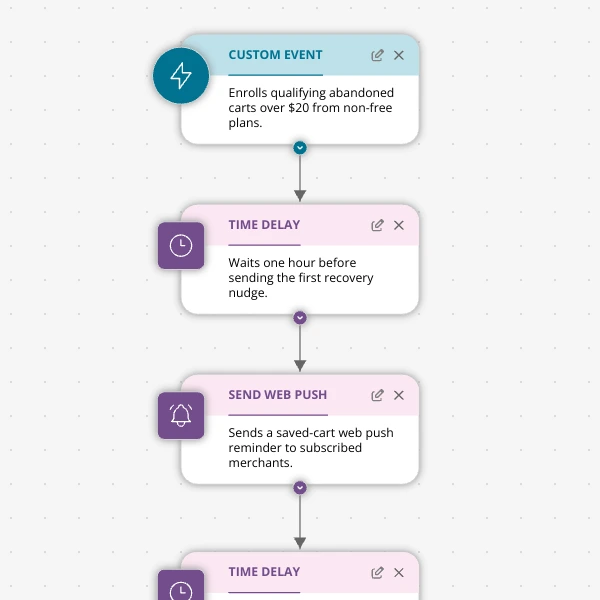
Stop Letting High‑Intent Carts Die: A 3‑Email Recovery Journey for Shopify Apps
A detailed, node-by-node walkthrough of a three-email (plus optional web push) cart-abandonment recovery journey for Shopify apps in Spreeflo, showing how to trigger events, branch on behavior, tag outcomes, and measure recovered carts and revenue.
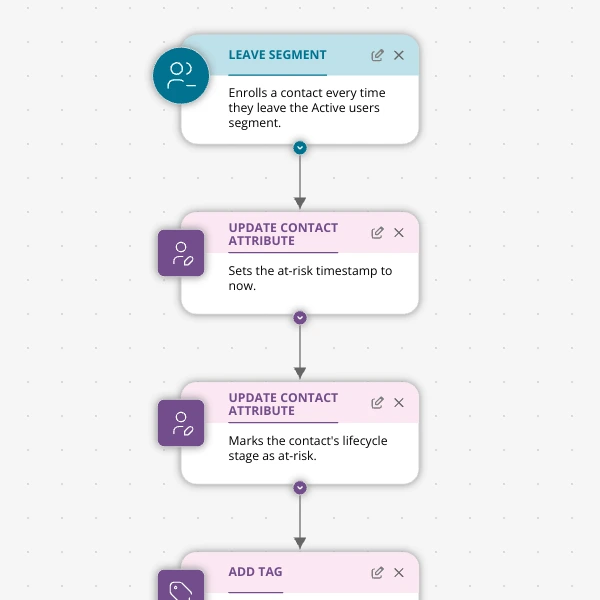
When Active Users Go Dark: A 4‑Touch Win‑Back Journey For Your Shopify App
A detailed, node-by-node Spreeflo journey for winning back previously active Shopify app users who stop engaging, using segment-based triggers, conditional logic, and a four-touch email plus internal alert sequence to recover usage and MRR.