Catch Churn Months Before It Happens: A Renewal‑at‑Risk Early Warning System for SEO SaaS
Playbook for SEO SaaS founders to build an early‑warning renewal‑at‑risk system in Spreeflo that combines product usage, support signals, and human outreach so you catch churn risk weeks earlier and systematically run save plays.
Industry
Niche
Pattern
Loading sequence...
A big agency account doesn’t churn when they click “cancel.” They churn the month they stop checking rankings, ignore your reports, and start sending frustrated tickets about “data not matching Ahrefs.”
By the time your billing system fires a failed renewal email, you’re reacting to a decision that was made weeks ago.
The sequence at the top of this page is the whole journey, end to end. It turns all those early signals into one clear “this account is at risk” moment — then kicks off a save play your tiny team can actually run.
Let’s walk through it, using a fictional SEO SaaS, RankPilot, doing $60k MRR with a 4‑person team and a mix of agencies and in‑house marketers on $99–$299 plans.
Why you keep getting blindsided by cancellations
Most SEO SaaS churn is quiet.
A content team at an agency stops generating briefs. An in‑house marketer lets reports go stale. A technical SEO lead has a rough onboarding, opens several tickets, then silently reverts to their old stack.
As the founder, you see:
Usage decline: fewer
checked_rankings, fewer logins, fewer projects created.Support friction: more tickets per month, angrier tones, recurring “why is this metric off?” questions.
Missed milestones: they never connected Google Search Console, never invited teammates, never tried your site audit.
But those signals are scattered: buried in product analytics, helpdesk, and spreadsheets. So you only act when the Stripe “subscription_cancelled” webhook hits.
This is classic lifetime‑value leak. You already paid to acquire these customers. You just aren’t nurturing engagement when it matters.
The goal of this journey is simple:
Turn noisy behavioral data into a clean “at‑risk” profile.
Enroll that contact the moment they tip into risk.
Run a short, human‑backed save sequence that either restores healthy usage or gives you a clear warning that renewal is unlikely.
We’ll use Spreeflo’s campaigns and journeys, the segment builder, and detailed events from your product to do it.
Step 1: Instrument the signals that actually predict churn
Before we touch the journey canvas, you need the right data inside Spreeflo.
For an SEO SaaS like RankPilot, three categories matter:
Usage decline
Track product events server‑side via the Spreeflo API. For example:Ticket volume and severity
Most SEO SaaS founders already get webhook pings from Intercom, Help Scout, or Zendesk. Have that webhook relay into Spreeflo’s events API with something like:Milestones completed (or not)
These are the things that correlate with long‑term retention:
loginchecked_rankingsgenerated_content_briefran_technical_auditexported_client_report
Each event is a POST from your backend to Spreeflo’s events endpoint with { event: 'checked_rankings', email: 'user@agency.com', properties: {...} }.
The web SDK can handle general browsing and marketing pages, but your app’s core usage telemetry belongs in the API.
support_ticket_createdwith properties:priority,topic,plan,is_bug.support_ticket_closedwith properties:satisfaction_score,first_response_time.
connected_search_consoleinvited_teammatecreated_first_projectcompleted_onboarding_checklist
Again, send them from your backend into Spreeflo’s events API as they happen.
This is Brand Message #1 in practice: capture detail on every customer so you can speak to each uniquely. Without this, your “at‑risk” signal is a guess.
Step 2: Build an “at‑risk” profile with the segment builder
The primary trigger for this journey is a Criteria Match trigger, which embeds the same segment builder you’d use for a saved segment.
For a mid‑market SEO SaaS, a solid starting “at‑risk” definition might be:
They’re a paying, subscribed contact:
Email subscription status is “Subscribed” (so you’re allowed to email them).
Contact attribute
plan_tieris not “trial”.Healthy history, weak recent activity:
Custom event
logintriggered at least 30 times over all time.Custom event
logintriggered at most 1 time in the last 14 days.This combination captures “once‑active users who have now gone dark,” not folks who never really onboarded.
Friction with support:
Custom event
support_ticket_createdtriggered at least 3 times in the last 30 daysOR the same event triggered at least 1 time where property
priorityishigh.Missed or regressing milestones:
Custom event
connected_search_consolehas not triggered in the last 60 daysOR
generated_content_briefhas not triggered in the last 30 days.
You wire all of this up inside the Criteria Match trigger’s condition group:
Use Custom Events rules with frequency operators like “at least N times” and “has not triggered.”
Add property filters for
priorityonsupport_ticket_created.Combine them with AND/OR groups so a contact must have both historic activity and recent decline plus support friction.
This is your early‑warning definition. Adjust it over time as you see which combinations of signals correlate with actual churn.
Step 3: Criteria Match trigger — the moment they flip to “at risk”
On the canvas, the journey starts with:
Trigger: Criteria Match
Criteria: the at‑risk profile you just defined.
Re‑enrollment: on.
Why re‑enrollment on?
Because you want this journey to run every time an account falls back into risk, not just the first time ever. Spreeflo prevents parallel enrollments, so if a contact is already inside the journey, a second at‑risk match won’t start a duplicate path. Once they exit, a future at‑risk state can trigger another run.
This is your “risk score crossed a threshold” moment, expressed as a set of concrete rules instead of a magic number.
Step 4: Tag and classify the contact for analytics
From the trigger, the first two actions are about labeling:
Add Tag:
at-risk
Use the tags feature to apply a simpleat-risktag.
Don’t force the trigger — you want this to reflect genuine, new risk events.Update Contact Attribute:
success_status = "at_risk"
Create a custom TEXT attribute likesuccess_status.
In the node, set update type to “Update” and new value to the literal string"at_risk".
Why bother?
Because your future reporting depends on this structure. You’ll later compare:
How many contacts were tagged
at-riskin a quarter.Of those, how many fired a
subscription_renewedevent vssubscription_cancelled.
That’s your at‑risk‑to‑renewed rate — the core metric for this play.
Step 5: Alert a human immediately
Next, you send an internal alert:
Send Internal Email to your success owner / founder
Subject line: something like “⚠ At‑risk account: {{company_name}}”
Body: pull in contact attributes like
plan_tier,MRR, and link to their account in your app.
This is not busywork. It’s a triage step.
Automation catches the pattern; a human decides whether this is a strategic account worth extra effort (for example, a $499/mo agency seat vs a $29/mo solo plan). Founder‑led businesses win on leverage, not headcount — and this is exactly the kind of situation where software should do the watching so humans can spend time on the save calls that matter.
Step 6: Send a context‑aware rescue email
You don’t wait weeks. After the internal alert, insert a short Time Delay of 1 hour (so your team isn’t surprised by customer replies before they see the alert), then:
Send Email to the account owner.
Use Spreeflo’s email builder and, if you’re on Professional, AI personalization to:
Acknowledge their context: “I noticed your team hasn’t generated content briefs or checked rankings much this month.”
Reassure: “SEO tools only pay off when they’re part of a workflow. I’d like to help you get back there.”
Offer clear options:
Book a 15‑minute workflow audit.
Ask a specific question (“What’s blocking you from using RankPilot weekly right now?”).
Share a short Loom or playbook tailored to their plan.
This is not a generic “we miss you” blast. It’s a high‑signal, low‑volume email sent only when your at‑risk criteria fires.
Spreeflo’s “Send only once” toggle on the email node should stay on, so the same at‑risk event doesn’t blast the same message twice if your rules change later.
Step 7: Pause, then branch on their email engagement
After that rescue email:
Insert a Time Delay of 7 days.
Then add a Check Email Activity process node:
Target marketing email: the rescue email template.
Activities to branch on:
Branch A:
openedElse: everyone else (unopened, bounced, etc.).
Now your flow splits:
Path 1: Engaged enough to open the email.
Path 2: Didn’t engage at all.
Both will eventually re‑join via a Merge node, but their treatment in the middle is different.
Step 8A: For engaged accounts, watch for behavioral recovery
For those who opened the email, you’re optimistic. They’re still reading your messages.
On the “opened” branch:
Add a Wait Condition node.
Immediately after, add an If/Else node with the same “recovered usage” condition.
Condition: any of these in the last 14 days:
Custom event
loginat least 3 times, ORCustom event
generated_content_briefat least 1 time, ORCustom event
ran_technical_auditat least 1 time.
Timeout: 14 days.
Spreeflo will move the contact forward as soon as the condition is true or the timeout hits, whichever comes first.
Now there are two clear outcomes:
Then‑branch: they hit the recovery threshold.
Else‑branch: the timeout expired without enough activity.
For recovered accounts (Then‑branch):
Remove Tag:
at-risk.Add Tag:
recovered-from-risk.Update Contact Attribute:
success_status = "healthy".Optionally, send a short Send Internal Email to your team:
“Good news: {{company_name}} was at risk but just bounced back — usage is back to normal. No further action needed.”
Then route this branch into the Merge node.
For still‑struggling accounts (Else‑branch):
Send Email: a more direct, plain‑text style check‑in.
Add a Time Delay of 7 days.
Then send a second Send Internal Email:
“{{company_name}} remains at risk despite outreach. If they’re high MRR, consider a personal call.”
After that, route them into the Merge node as well.
Every path here respects pacing: no back‑to‑back marketing emails without at least a delay.
Step 8B: For unresponsive accounts, escalate internally
For contacts who never opened the first rescue email, more automation won’t magically fix it.
On the “unopened” path from Check Email Activity:
Send Internal Email right away:
Add a Time Delay of 2 days.
Optionally, send one final Send Email:
Subject: “At‑risk account did not open rescue email: {{company_name}}.”
Body: include plan, MRR, last active date, and a quick suggestion: “Consider a short Loom or LinkedIn DM if strategic.”
Keep it extremely short, one or two sentences.
Offer a direct opt‑out or downgrade path to reduce bad‑fit churn and resentment.
Then send them into the Merge node.
If you’re on Professional and comfortable with browser notifications, you could add a Send Web Push node instead of that final email for contacts who are web‑push subscribed. But for most SEO SaaS founders, email plus internal follow‑up is plenty.
Step 9: Merge and finalize the journey
All three paths (recovered, still struggling, unresponsive) feed into a Merge node.
From there, add one last action:
Add Tag:
risk-play-complete.
Now any contact who entered this journey has:
A
at-risktag (possibly removed later).A
recovered-from-risktag if they bounced back.A
success_statusattribute that records their final state.A
risk-play-completetag marking that you ran the full save attempt.
That structure is exactly what you’ll use to measure performance.
Measuring whether this early‑warning system works
Two simple metrics tell you if this journey is worth the effort:
At‑risk‑to‑renewed rate
Instrument two more billing events into Spreeflo via the API:
subscription_renewed(properties:plan,mrr,term).subscription_cancelled(properties:plan,mrr,reasonif you collect it).
Now you can create a segment like:
Tag
at-riskCustom event
subscription_renewedtriggered at least 1 time in the last 12 months
vs another where subscription_cancelled fired instead.
Even in a tiny SaaS, you’ll quickly see patterns:
Are recovered accounts significantly more likely to renew?
Are certain plan tiers under‑responding to the playbook?
Tighten your at‑risk criteria and messaging based on those answers.
Early‑detection lead time
For a sample of cancelled accounts, compare:
Timestamp of last
at-risktag applied (you can store it in a timestamp attribute likelast_risk_flagged_atusing Update Contact Attribute with “Set to now”).Timestamp of
subscription_cancelled.
The number of days between these is your early‑detection lead time. Push it earlier over time by:
Requiring less severe usage drops.
Looking for weaker but earlier predictors, like “never invited a teammate” for team plans.
This is Brand Message #3 in numbers: most businesses leak lifetime value by not nurturing engagement. When you can say, “We now spot risk 45 days before churn instead of 7,” you’re actively plugging that leak.
Why this matters more for SEO SaaS than most tools
SEO results are slow. Your customers often won’t feel wins for months, which makes it very easy for them to blame the tool when progress stalls.
That’s why a renewal‑at‑risk early warning journey is so valuable:
It uses detailed behavioral data to spot when your product is no longer part of the workflow.
It prompts timely, specific outreach instead of generic “How’s it going?” emails.
It gives your tiny team a clear list of accounts that deserve human attention right now.
If you’re still relying on gut feel and end‑of‑month MRR reports to see churn risk, you’re operating blind.
Wire up the events, define your at‑risk criteria, and recreate the sequence at the top of this page inside a Spreeflo journey. With a weekend of work and the free‑to‑start stack (forms, tracking, and analytics), you’ll stop being surprised by cancellations and start having the right conversations while there’s still time to save the account.
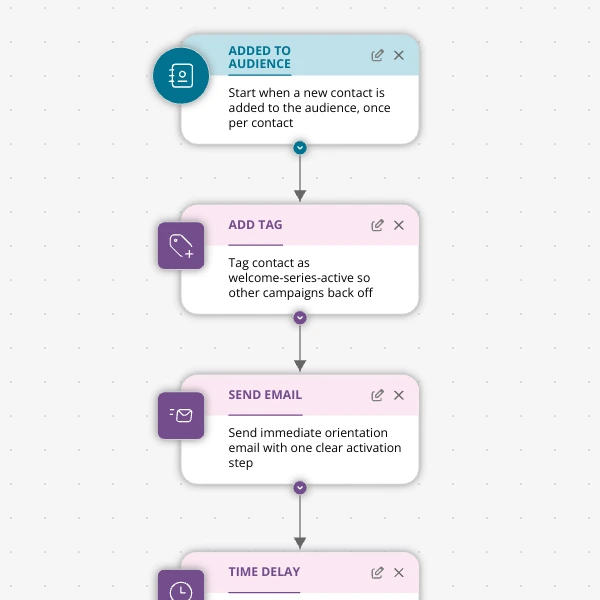
The Shopify app welcome series that turns installs into income
A step-by-step Shopify app welcome email journey for tools like CartSpark, showing how to turn new installs into activated, retained merchants using Spreeflo journeys, tags, and behavioral triggers so fewer trials quietly churn and more trials convert.
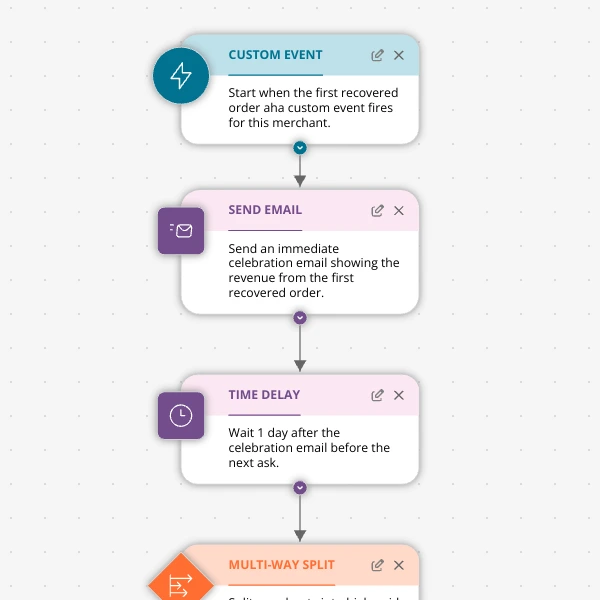
The Aha-Moment Playbook For Shopify Apps: Turn One Magic Action Into Months Of Revenue
A node-by-node playbook for Shopify and e‑commerce apps to center their lifecycle on one aha-moment custom event in Spreeflo, celebrate it, segment merchants by profile and engagement, and turn first recovered value into lasting revenue and retention.
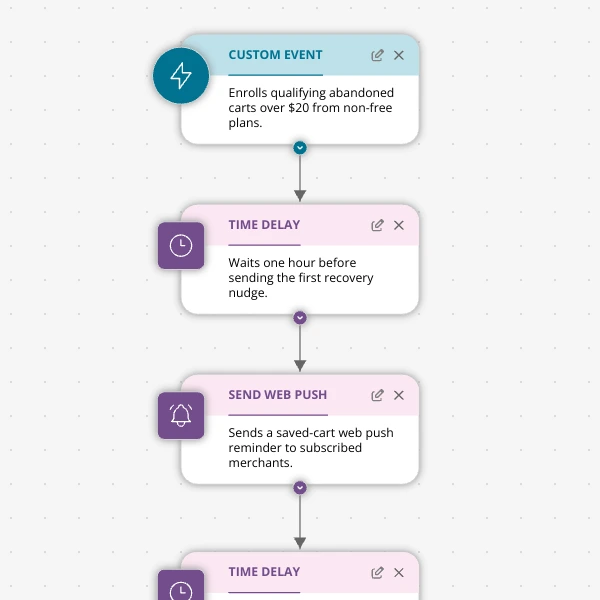
Stop Letting High‑Intent Carts Die: A 3‑Email Recovery Journey for Shopify Apps
A detailed, node-by-node walkthrough of a three-email (plus optional web push) cart-abandonment recovery journey for Shopify apps in Spreeflo, showing how to trigger events, branch on behavior, tag outcomes, and measure recovered carts and revenue.
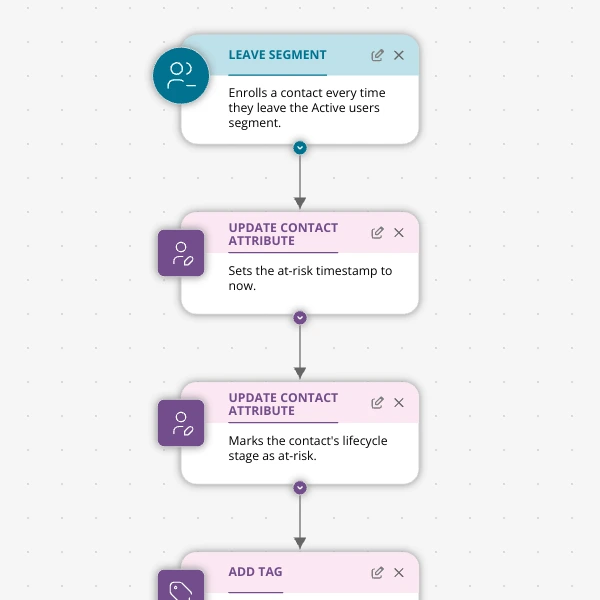
When Active Users Go Dark: A 4‑Touch Win‑Back Journey For Your Shopify App
A detailed, node-by-node Spreeflo journey for winning back previously active Shopify app users who stop engaging, using segment-based triggers, conditional logic, and a four-touch email plus internal alert sequence to recover usage and MRR.