Catch Quiet SEO Prospects Who Bounce Before They Even See Your Product
Design and implement an “abandoned site (no product view)” journey in Spreeflo for SEO SaaS, using custom events, waits, splits, and targeted emails to re-engage known visitors who bounce early and recover otherwise invisible top-of-funnel revenue.
Industry
Niche
Pattern
Loading sequence...
You know the pain: organic traffic and referral clicks are healthy, but a depressing slice of visitors arrive, poke around for seconds, and disappear before they hit your features page, pricing, or a single case study.
For an SEO SaaS like RankPulse or BrieflySEO, that’s not “just” lost traffic. A meaningful chunk of those visitors are already on your list: agency leads from last quarter, webinar registrants, existing users checking something quickly. They showed up, didn’t find what they needed fast enough, and left.
The sequence at the top of this page is the whole journey, end to end. It turns those quiet, bounced sessions into a soft, well‑timed nudge: “Hey, saw you stopped by. Need help finding the right SEO workflow?”
This article walks through how to build that journey in Spreeflo for an SEO SaaS, why each node is there, and how to adapt it to your own funnel.
Why “abandoned site” matters for SEO SaaS
Ecommerce teams obsess over cart abandonment. SaaS teams tend to ignore an equally painful leak: abandoned sessions where a known contact visited the site, didn’t reach any core product content, and left.
For an SEO tool, those visitors often include:
Agency SEOs checking you out after a conference mention
In‑house marketers who clicked a blog CTA from months ago
Trial users who typed your domain looking for help, then bounced when it wasn’t obvious where to go
They’re warmer than strangers, but cooler than active evaluators. Perfect candidates for a single, helpful nudge.
If you’re only emailing broadcasts to your whole list, you miss them entirely. Spreeflo lets you instead:
Capture detailed behavior for each contact (who visited, what they did, what they skipped).
Nudge only the people who bounced early, with copy tailored to their role or plan.
That’s exactly what this “abandoned site (no product view)” journey does.
Step 0: Get the right data flowing into Spreeflo
Before you build the automation, you need Spreeflo to actually see those site visits.
Install web tracking and identify known visitors
Add the Spreeflo SDK snippet to your marketing site and app so page views and custom events are tracked. The setup steps live in the web tracking help doc: the web tracking and analytics guide.
In your app (or wherever you know a user’s email), call
Spreeflo.identifyon the frontend to tie the browser session to a contact. Once identified, any page views and events from that browser map to their contact record.
Anonymous traffic still shows up in the analytics dashboard, but this journey only runs for contacts with an email address.
Track a site_visit custom event for known contacts
For this pattern, we want a consistent behavioral trigger: “a known contact visited the site.”
On the frontend, when an identified visitor lands on your marketing site (for example, on the home page, a pricing URL, or after clicking a newsletter link), fire a custom event via the SDK such as:
site_visitwith properties likeentry_url,utm_source,utm_campaign.
If some of your traffic comes from server‑side flows (for example, you log visits in your own backend and want to mirror them), send the same event to Spreeflo using the Spreeflo API. Backend code should POST to the events endpoint with event: 'site_visit' and the contact’s email.
Web analytics and custom events are available on the Free plan, but this journey uses web‑activity triggers and conditions, which live on the Professional tier; details are on Spreeflo’s pricing.
Once site_visit events are coming in for known, identified contacts, you’re ready to wire the journey.
Step 1: Custom Event trigger – “known contact visited the site”
In the journey canvas (under the campaigns and journeys builder), start with a Custom Event trigger:
Event name:
site_visitRe-enrollment: On
Re‑enrollment stays on because the same contact might bounce today, come back in a month, and bounce again. You want the journey to be eligible each time, but Spreeflo’s mid‑journey lock ensures they can only be inside one copy of the journey at a time.
If you’ve added properties to the event, you can narrow it further:
Exclude app‑only visits: property
entry_urldoes not contain/app/Focus on marketing landings: property
entry_urlcontains/, but not/loginor/reset-password
Keep it simple for a first pass: any site_visit from a known contact is enough.
Step 2: Wait Condition – give them time to self‑serve
You don’t want to pounce with an email the moment someone hits your homepage. The next node is a Wait Condition:
Condition: Page Visited
- URL contains any of:/features,/pricing,/case-studies,/blog(use multiple rules in an AND/OR group via the segment builder)
- Frequency: at least 1 time
- Time window: in the last 1 dayTimeout duration: 1 day (unit: Day)
This does two things:
If they come back later the same day and finally click into Features or Pricing, the condition becomes true and the journey proceeds without sending a “you left early” email.
If they never reach any key page within 24 hours, the timeout fires and the journey also proceeds.
Either way, after up to one day we move on to the next node. The next step decides what to do based on whether the condition was satisfied.
Step 3: If/Else – did they view any meaningful content?
Immediately after the Wait Condition, drop an If/Else node with the same condition:
If condition (Yes branch):
- Page Visited URL contains/featuresOR/pricingOR/case-studiesOR/blog
- At least 1 time in the last 1 dayElse branch: everyone who didn’t match
Why repeat the condition? Because the Wait Condition only controls when we move forward; the If/Else controls which path they take:
Yes branch (they engaged): They eventually found their way to product content. At this point, you can safely end this journey for them or do something lightweight, like:
- Add Tag:site_engaged
- Then terminate the path
That tag becomes useful later for segmentation: for example, “subscribers who have visited pricing but haven’t started a trial.”Else branch (no product view): These are your “abandoned site (no product view)” visitors. The rest of the flow focuses entirely on them.
This simple split is the heart of the pattern: same trigger, totally different treatment based on actual behavior.
Step 4: If/Else – are they allowed to receive marketing email?
Before you send anything, sanity‑check consent.
On the Else branch, add a second If/Else node:
Condition: Email Subscription Status is
Subscribed
Branches:
Yes: Proceed to email.
Else: End the path.
Contacts who are unsubscribed or non‑subscribed still get tracked, but this journey doesn’t email them. That keeps your list clean and avoids turning a helpful nudge into a compliance headache.
Step 5: Send Email #1 – a helpful “find what you need” nudge
Now comes the main action node: Send Email.
Use Spreeflo’s email builder to create a short, friendly message. Think support, not sales. Examples for an SEO SaaS:
Subject lines:
“Looking for the right SEO workflow?”
“Can I help you pick the best way to track rankings?”
“Quick help finding what you need in [Your Tool]”
Body ideas:
A one‑sentence acknowledgment: “You were on our site recently but didn’t get as far as our Features or Pricing pages.”
Two or three micro‑paths based on typical use cases:
“If you’re an agency: here’s how most agencies use [Product] to keep client rankings in check.”
“If you’re in‑house: start with these dashboards to track organic growth.”
One primary CTA: “See how rank tracking works” linking to your best explainer page.
If you store attributes like persona (“Agency”, “In-house”, “Freelancer”), use Spreeflo’s AI personalization to vary the copy automatically so an agency SEO sees different examples than a solo blogger. That’s where capturing detailed attributes for each contact stops being “nice to have” and starts increasing click‑throughs.
Make sure the node is configured with “send only once” scoped to this email so the same contact doesn’t get duplicate copies if they somehow re‑enter this exact step later.
Step 6: Time Delay – let the first email breathe
After the first Send Email, insert a Time Delay:
Delay: 3 days
Unit: Day
This respects pacing. You’ll use this window both to give them a chance to engage and to decide whether a follow‑up is needed.
Step 7: Check Email Activity – opened vs not opened
Next, add a Check Email Activity node targeting the first email:
Marketing email: the template you just sent
Activities to branch on:
OpenedNot Opened(Spreeflo exposes this as “Not Opened” / “did not open”)
That creates two behavioral branches:
Opened branch: They saw your message and at least skimmed it.
Not Opened branch: They never saw it (or it got buried).
The Else branch can either go nowhere (if you only care about these two outcomes) or act as a catch‑all, but in most cases you won’t need it here.
Step 8A: Opened branch – tag and cool down
For contacts who opened the email, the job of this journey is effectively done.
Add an Add Tag action:
- Tag:abandoned_site_email_openedThen connect to a Merge node (which will also receive the
Not Openedpath).
That tag gives you:
A quick way to build a segment of “people who cared enough to open the abandoned‑site email”.
A signal you can feed into other journeys, like “send a trial offer if they’ve opened 3+ education emails but haven’t started a trial.”
No more emails in this branch; you already re‑engaged them enough.
Step 8B: Not Opened branch – a single alternate follow‑up
For the Not Opened branch, it’s reasonable to try one more time with a different angle.
On the Not Opened path:
Add a Send Email node for Email #2.
After that email, connect to the same Merge node used above.
Content tweaks:
New subject that frames the value more concretely:
“3 ways SEOs use [Product] in under 10 minutes”
“See your current keyword rankings in a single dashboard”
Ultra‑short body, maybe even a plain‑text style, so it feels personal.
You’ve now sent at most two emails about this abandoned site session, with a clear behavioral rule for who gets the second.
Step 9: Merge and cooldown – avoid over‑messaging frequent visitors
The Merge node recombines:
Opened branch (Email #1 only)
Not Opened branch (Email #1 + Email #2)
From the Merge, you add a final Time Delay:
Delay: 7 days
Unit: Day
This seven‑day delay has an important side effect: while a contact is sitting in this step, they’re “mid‑journey” and can’t be re‑enrolled even if they trigger site_visit again.
Add the delay, then end the journey path.
Net effect:
A bounced visitor can receive this abandoned‑site series at most once every ~10 days (1 day initial wait + up to 3 days to the open check + 7 days cooldown).
You avoid hitting engaged users, unsubscribed contacts, and repeat visitors who are already exploring your product deeply.
If you want even more explicit tracking, you can add an Update Contact Attribute node before the final delay to increment a numeric abandoned_site_count attribute by 1. That lets you later spot chronic bouncers versus one‑off cases.
Adapting the “no product view” definition for your SEO SaaS
The example above watches for a handful of generic URLs, but you should tune the definition of “meaningful content view” to your own product:
Rank tracking tools:
/rank-tracking,/alerts,/integrations/google-search-consoleContent brief generators:
/content-briefs, template gallery, success stories pagesTechnical SEO tools: live audit examples, API docs, “how crawling works” pages
Update both:
The Wait Condition and
The If/Else condition
to match your key pages. If you have multiple personas (agencies, in‑house, affiliates), you can even replace the simple If/Else with a Multi-way Split that routes based on a persona attribute and sends slightly different copy per segment.
The core idea stays the same: the journey cares less about how they arrived and more about whether they ever got to content that sells your value.
How to tell if this journey is paying off
Three metrics matter most for this pattern:
Return-visit rate
Among contacts who entered the “no product view” branch, how many came back to the site within, say, 7–14 days?
Build a segment using the Segment Builder:
- Tag containsabandoned_site_email_opened
- AND Page Visited URL contains/featuresOR/pricing
- At least 1 time in the last 14 days
Watch the size of that segment over time and compare it to a control group (for example, similar contacts from before you enabled the journey).First-purchase (or trial-start) conversion
Make sure your app fires a custom event likestarted_trialorplan_purchasedusing the SDK or the Spreeflo API. Then compare:
- Contacts who flowed through this journey
- Versus similar contacts who didn’t
Even a small lift in trial starts from previously “lost” visitors can be meaningful at $49–$199/month ARPU.Unsubscribe rate
Keep an eye on how many people unsubscribe from these emails relative to your usual campaigns. If unsubscribe rate is significantly higher, soften the messaging or increase the cooldown window. The goal is a helpful check‑in, not pressure.
Over time, you can get more ambitious: A/B test subject lines using Random Split nodes, or try alternative time windows in the Wait Condition for different traffic sources.
The bigger win: no more invisible leaks at the top of the funnel
Most SEO SaaS teams obsess over rankings, trial conversion, and churn. The quiet leak they miss is all the half‑interested people who show up, fail to find the right page, and vanish without ever seeing what the product actually does.
By wiring this abandoned‑site journey once, you:
Use the behavioral detail Spreeflo collects to speak to each contact in context, not as a random subscriber.
Turn anonymous‑feeling bounces into a small but steady stream of second chances.
Close a lifecycle gap where you were previously leaving lifetime value on the table.
You’ll still have to sweat technical SEO, write good content, and build a product SEOs actually want. But with a journey like this running in the background, every visit from a known contact gets the thoughtful follow‑up it deserves. That’s the kind of automation a small, founder‑led team can set up once and let compound quietly in the background.
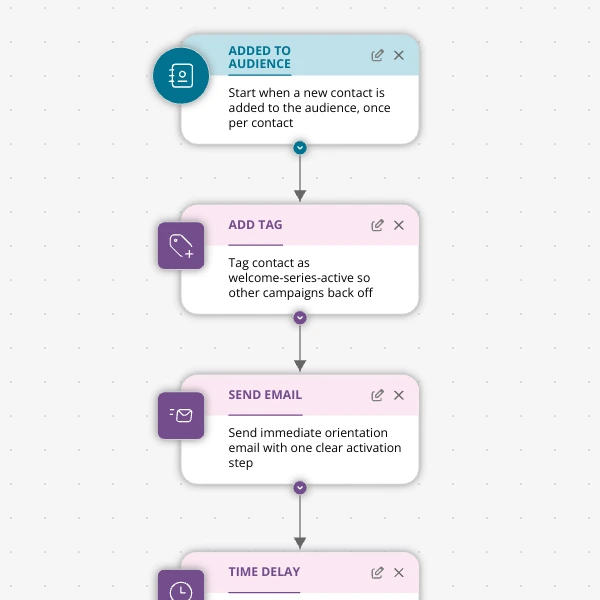
The Shopify app welcome series that turns installs into income
A step-by-step Shopify app welcome email journey for tools like CartSpark, showing how to turn new installs into activated, retained merchants using Spreeflo journeys, tags, and behavioral triggers so fewer trials quietly churn and more trials convert.
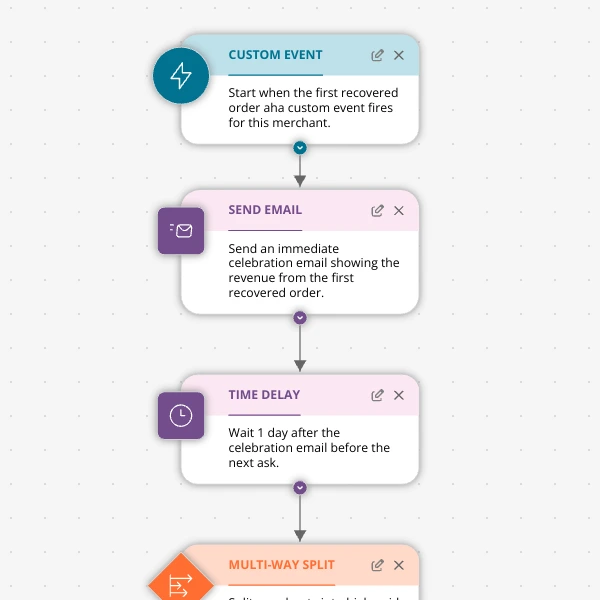
The Aha-Moment Playbook For Shopify Apps: Turn One Magic Action Into Months Of Revenue
A node-by-node playbook for Shopify and e‑commerce apps to center their lifecycle on one aha-moment custom event in Spreeflo, celebrate it, segment merchants by profile and engagement, and turn first recovered value into lasting revenue and retention.
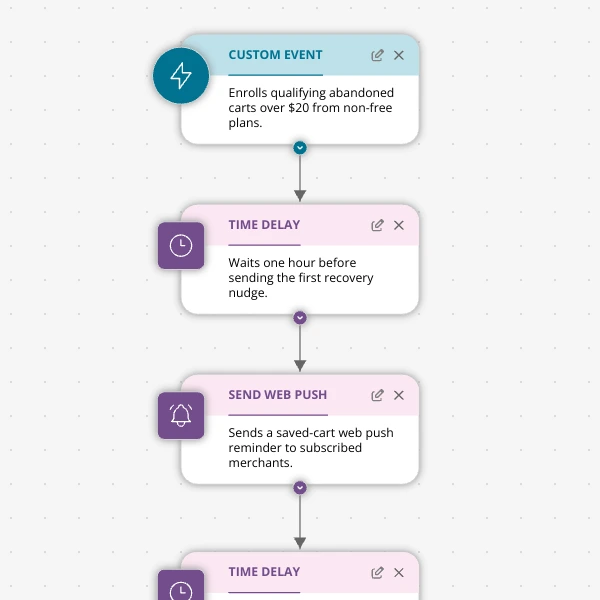
Stop Letting High‑Intent Carts Die: A 3‑Email Recovery Journey for Shopify Apps
A detailed, node-by-node walkthrough of a three-email (plus optional web push) cart-abandonment recovery journey for Shopify apps in Spreeflo, showing how to trigger events, branch on behavior, tag outcomes, and measure recovered carts and revenue.
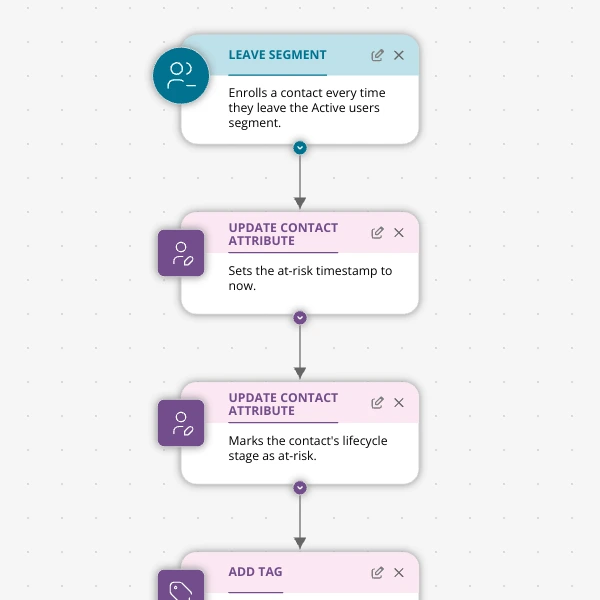
When Active Users Go Dark: A 4‑Touch Win‑Back Journey For Your Shopify App
A detailed, node-by-node Spreeflo journey for winning back previously active Shopify app users who stop engaging, using segment-based triggers, conditional logic, and a four-touch email plus internal alert sequence to recover usage and MRR.