Long vs Short: How SEO SaaS Founders Can Actually Test Email Length (Not Guess)
This playbook walks SEO SaaS founders through wiring a Spreeflo journey that A/B tests long versus short upgrade emails, tags every behavior, and produces reliable CTR, conversion, and unsubscribe data they can reuse across future campaigns.
Industry
Niche
Pattern
Loading sequence...
The founder at RankPulse is staring at two upgrade emails. One is a tight 90-word nudge. The other walks through a full mini case study with screenshots and objections addressed. Both feel “right” in different ways, and the launch is tomorrow.
So they pick one based on gut.
The sequence at the top of this page is how you stop doing that. It’s a journey that automatically splits trial users into long and short versions of the same offer, tracks what happens, and quietly builds a dataset you can trust.
For an SEO SaaS in the $10k–$150k MRR range, that kind of always-on experiment is worth more than one more blog post. You run it once, get the answer, and reuse that learning across every future campaign.
This article walks through that journey node by node, why it’s wired the way it is, and how to adapt it to your own product.
Why email length is a real question for SEO SaaS (not a copywriter debate)
Your product isn’t a $9 impulse buy. It’s a rank tracker, content brief generator, or technical audit tool with:
Multiple personas (agency lead, in‑house marketer, solo founder)
Several “aha” moments (add first keyword, connect Search Console, run first crawl)
Nuanced objections (data quality, pricing, integration work, feature overlap with Ahrefs)
Long emails give you room to show how a serious team uses your tool to move organic traffic and revenue. Short emails respect busy marketers who triage inboxes between client calls.
Both stories are plausible. But your trial users, your pricing, your feature set, and your brand tone are unique. You need your own answer.
Spreeflo’s journeys and Random Split node turn that question into a controlled experiment instead of an argument.
The core experiment you’re running
We’ll use this scenario:
Niche: SEO SaaS (rank tracking and content briefs).
Moment: Trial user visits your pricing page but doesn’t upgrade.
Goal: Get them to choose a paid plan within seven days.
Experiment: Same subject line and offer, but two email bodies:
Variant A: Long form, story plus proof plus FAQ.
Variant B: Short, three bullets and one CTA.
The journey you see in the sequence at the top of this page does three things:
Enrolls high‑intent trial users automatically.
Randomly assigns them to long vs short.
Tags each contact based on what they did (clicked, converted, unsubscribed) so you can compare variants later using the segment builder.
Let’s walk through each step.
Step 1: Trigger on a real buying signal
First, you need a behavioral trigger. For this pattern we’ll use a Custom Event trigger configured on an event like pricing_page_viewed.
How that event actually arrives in Spreeflo:
If your app is browser‑based, fire it from the frontend with the Spreeflo SDK, for example when a logged‑in trial user views
/pricingusingSpreeflo.track('pricing_page_viewed', {...}).If your pricing screen lives partly server‑side, have your backend POST that event into the Spreeflo API with the user’s email and payload.
Then in your journey canvas (see build a journey):
Drag in a Custom Event trigger.
Set Event name to
pricing_page_viewed.Leave property conditions off for a first version (you can later narrow it to specific plans or countries).
Keep Re-enrollment off, so each trial user only enters this experiment once, no matter how often they check pricing.
Why this trigger?
Pricing views are high intent for SaaS.
You don’t have to guess timing; the user has just been thinking about money.
It’s neutral with respect to your experiment; you’re not pre‑biasing who sees long vs short.
Immediately after this trigger in the sequence you’ll see a Time Delay of one hour. That pause matters:
It avoids emailing someone while they’re still on the pricing page.
It gives your system time to catch any immediate upgrades that happen right after the visit.
Configure the Time Delay node to:
Unit: Hours
Value: 1
If someone upgrades during that hour, it’s fine if they still enter the journey; our conversion logic later will account for that.
Step 2: Use Random Split to assign variants
Next comes the core of the pattern: the Random Split process node.
Drop a Random Split right after the one‑hour delay and configure it like this:
Percentage weight: 0.5 (50% of contacts go down branch A, 50% down branch B).
Name the branches clearly in the node:
Branch A id:
longBranch B id:
short
Why Random Split instead of, say, “odd IDs get long, even get short” logic?
It’s simple and unbiased.
Spreeflo handles the assignment; you don’t need to maintain your own bucketing logic.
You can change the ratio later (for example, 80/20 once you have a winner) without touching event instrumentation.
From this point on, every contact in the journey permanently belongs to one variant. No one will ever receive both versions.
Step 3: Tag the variant before you send anything
On each branch, the first thing you’ll see is an Add Tag action.
On the long branch:
Add Tag:
exp_upgrade_email_long
On the short branch:
Add Tag:
exp_upgrade_email_short
Configuration details:
Use the Add Tag node.
Select the appropriate tag or create it on the fly.
You don’t need to toggle “Force tag trigger” on; we’re not chaining off tag events here.
Why tag before sending?
It gives you a durable record of which variant a contact was assigned, even if they ignore the email.
Later, you’ll use these tags in the segment builder to compare click, conversion, and unsubscribe behavior without guessing who saw what.
It’s resilient. Even if you change email templates down the line, those variant tags stay as your experiment “group markers.”
Step 4: Build the two Send Email nodes (same offer, different depth)
Now comes the content work.
On each branch, add a Send Email action:
Long branch:
Template: “Upgrade to Pro — full story”
Short branch:
Template: “Upgrade to Pro — quick version”
Using Spreeflo’s email builder, create two templates with the same:
Subject line
From name and address
Primary offer (for example, “Upgrade to Pro and track 5x more keywords”)
And different body length and framing:
Long:
Short narrative of an SEO agency using your tool
2–3 annotated screenshots
Objection handling (pricing, data trust, feature overlap)
Single clear CTA
Short:
One‑sentence recap of benefit
3 bullets tied to your product’s core outcome (rankings, content, reporting)
Single clear CTA
In the Send Email node options:
Pick the right template for each branch.
Set the correct sender identity.
Leave “Send only once” on, so even if you later turn re‑enrollment on at the trigger, the same contact will never get the same variant twice.
No other emails are attached to these nodes on either path. Every contact receives one upgrade email, long or short, never both.
Step 5: Give people time, then record who clicked
After each Send Email, the sequence uses a Time Delay of three days:
Unit: Days
Value: 3
Three days is long enough for most people to see, skim, and act on the email, but short enough that the pricing visit is still fresh.
Then comes a Check Email Activity node on each branch, wired to that branch’s template:
Marketing email: your long or short template.
Activities to branch on:
“Link Clicked”
“Link Not Clicked”
This creates two paths below each variant:
Clicked path (they engaged with the CTA).
Not clicked path (they opened and didn’t click or never opened).
Immediately after those branches, each path runs another Add Tag:
On the long side:
For “Link Clicked”: Add Tag
exp_upgrade_long_clickedFor “Link Not Clicked”: Add Tag
exp_upgrade_long_not_clicked
On the short side:
For “Link Clicked”: Add Tag
exp_upgrade_short_clickedFor “Link Not Clicked”: Add Tag
exp_upgrade_short_not_clicked
Then each pair of branches reconverges through a Merge node per variant. The Merge keeps your canvas tidy and ensures that every contact re‑joins a single path per variant for the conversion wait that follows.
Why bother with click tags when Spreeflo already knows who clicked?
Tags make later analysis simpler. You can build segments like “Long variant clickers” with a single tag condition instead of repeating complex activity logic everywhere.
They freeze the experiment state. Even if you later send other campaigns, those experiment tags stay as ground truth.
Step 6: Wait for upgrades, then tag converters and non‑converters
From each variant’s Merge node, the sequence adds a Wait Condition:
Condition: “Custom event
plan_upgradedtriggered at least 1 time over all time.”Use the Custom Events category in the condition builder.
Set frequency to “at least 1 time.”
Time window: “over all time” is fine here; you only care whether they ever upgraded.
Timeout: 7 days (unit: Days, value: 7).
Your backend should POST a plan_upgraded custom event into the Spreeflo API whenever Stripe or Paddle creates an active subscription for that user. That same event likely powers other lifecycle automations too.
What the Wait Condition does here:
If the user upgrades within seven days, they move forward as soon as the event arrives.
If they don’t, they move forward when the timeout hits.
Immediately after the Wait Condition, each variant uses an If/Else process node with the same condition:
If condition: “Custom event
plan_upgradedtriggered at least 1 time over all time.”Then branch: “Converted”
Else branch: “Did not convert”
Then, tag again:
For the long variant:
Converted branch: Add Tag
exp_upgrade_long_convertedDid not convert branch: Add Tag
exp_upgrade_long_not_converted
For the short variant:
Converted branch: Add Tag
exp_upgrade_short_convertedDid not convert branch: Add Tag
exp_upgrade_short_not_converted
After these tags, the journey ends for this experiment. You can optionally add more nurture for non‑converters later; just remember to insert a Time Delay before any further Send Email nodes on each path.
Step 7: Measuring CTR, conversion, and unsubscribe rate per variant
With this wiring in place, analysis becomes simple. You don’t need exports or spreadsheets; you just need a few segments and basic math.
Use the segment builder to define:
Long variant audience
Condition: Contact is tagged withexp_upgrade_email_long.Short variant audience
Condition: Contact is tagged withexp_upgrade_email_short.
Within each of those, you can filter further:
Click‑through rate:
Long clicks: tag
exp_upgrade_long_clicked.Short clicks: tag
exp_upgrade_short_clicked.CTR = clickers / total in that variant audience.
Conversion rate:
Long conversions: tag
exp_upgrade_long_converted.Short conversions: tag
exp_upgrade_short_converted.Conversion rate = converters / total in that variant audience.
Unsubscribe rate:
Long unsubscribes: conditions:
Tag
exp_upgrade_email_longEmail Subscription Status is “Unsubscribed”
Short unsubscribes: same with
exp_upgrade_email_short.Unsubscribe rate = unsubscribers / total in that variant audience.
Because every contact was randomly assigned and the logic for both arms is symmetrical, differences between these rates are believable, not an artifact of timing or targeting.
If your sample sizes are still small, keep the experiment running. Journeys in Spreeflo are continuous by design, and this one doesn’t require maintenance once set up.
Step 8: Adapting the same pattern across your SEO SaaS
The nice thing about this structure is that almost everything is reusable. Only the trigger, email templates, and tags change.
A few SEO‑specific places to reuse the long vs short pattern:
Onboarding tips
Trigger: Custom Eventadded_first_keyword.
Test long “onboarding guide” vs short “3 things to do next” email.Feature adoption
Trigger: Custom Eventgenerated_content_brief.
Test a long tutorial on the rank tracker vs a short, benefit‑led nudge.Churn‑risk reactivation
Trigger: Criteria Match where “Custom eventlogged_inhas not triggered in the last 30 days.”
Test a long “what you’re missing” email vs a short “resume where you left off” email.
In each case, you can reuse the same Random Split, Add Tag, Time Delay, Check Email Activity, Wait Condition, and If/Else skeleton from the journey described above. Only the content and conversion event change.
This is where brand message 2 comes in: founder‑led businesses win on leverage, not headcount. You don’t need a growth team to run structured experiments, just a clear pattern, decent instrumentation, and an automation builder that lets you capture the result once and act on it forever.
Knowing instead of guessing
Most SEO SaaS teams over‑optimize subject lines and ignore body length entirely. Others default to walls of copy for everything because that’s what their favorite blog does.
A month from now, you could be in a different position:
You know, for your audience, whether long or short drives more upgrades off pricing visits.
You can confidently standardize on that format for future upgrade campaigns.
You have tags sitting on every contact that align with real behavior, not imagined personas.
And any time the answer seems to be changing, you can adjust the offer, swap in new templates, and keep the same journey running.
If you’re already sending a generic upgrade blast out of an email tool you’ve outgrown, this is the next step. Spreeflo was built so founder‑led SaaS teams can run experiments like this without bolting together five tools or tripling their software bill. You define the behavior, set up the journey, and let the data tell you which story really converts.
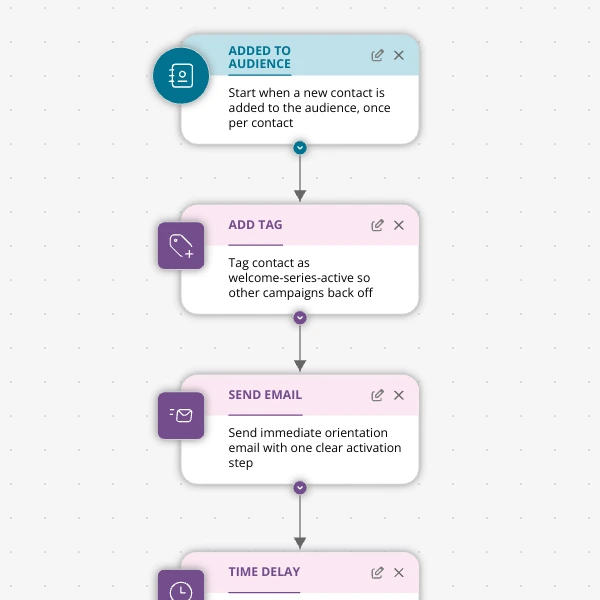
The Shopify app welcome series that turns installs into income
A step-by-step Shopify app welcome email journey for tools like CartSpark, showing how to turn new installs into activated, retained merchants using Spreeflo journeys, tags, and behavioral triggers so fewer trials quietly churn and more trials convert.
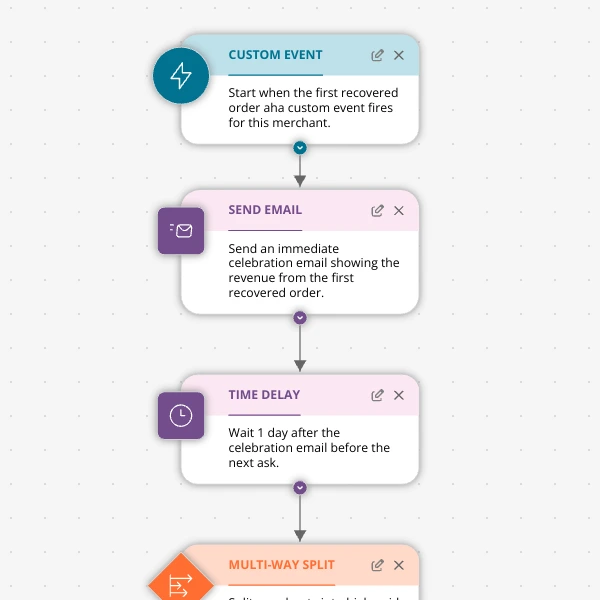
The Aha-Moment Playbook For Shopify Apps: Turn One Magic Action Into Months Of Revenue
A node-by-node playbook for Shopify and e‑commerce apps to center their lifecycle on one aha-moment custom event in Spreeflo, celebrate it, segment merchants by profile and engagement, and turn first recovered value into lasting revenue and retention.
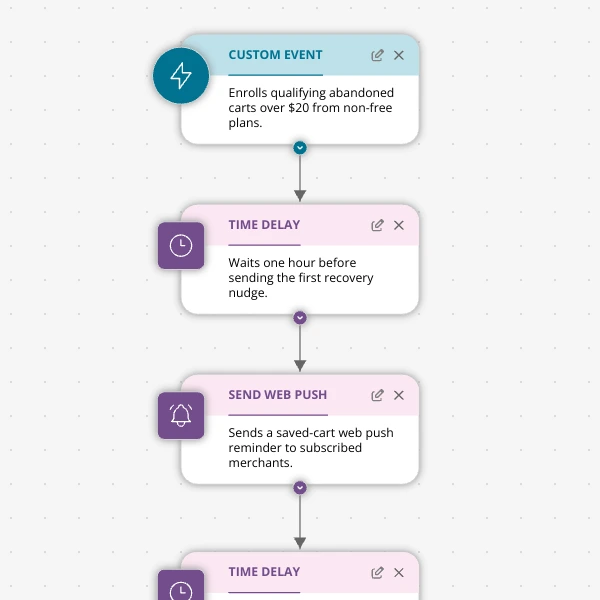
Stop Letting High‑Intent Carts Die: A 3‑Email Recovery Journey for Shopify Apps
A detailed, node-by-node walkthrough of a three-email (plus optional web push) cart-abandonment recovery journey for Shopify apps in Spreeflo, showing how to trigger events, branch on behavior, tag outcomes, and measure recovered carts and revenue.
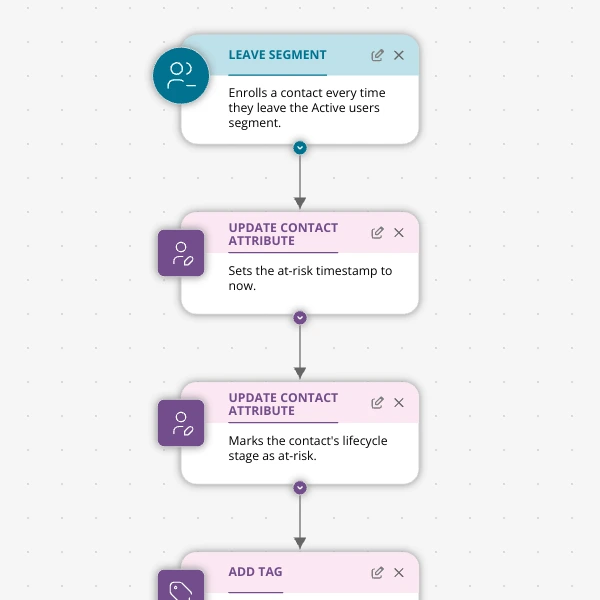
When Active Users Go Dark: A 4‑Touch Win‑Back Journey For Your Shopify App
A detailed, node-by-node Spreeflo journey for winning back previously active Shopify app users who stop engaging, using segment-based triggers, conditional logic, and a four-touch email plus internal alert sequence to recover usage and MRR.