Make Your SEO Tool a Monday Habit: Weekly Active-Customer Digest in Spreeflo
A detailed Spreeflo journey for SEO SaaS teams to send a personalized weekly digest to active customers, using cyclic triggers, segments, and simple automation to reduce quiet churn and make their tool a Monday habit.
Industry
Niche
Pattern
Loading sequence...
Most SEO tools don’t lose customers because the product is bad. They lose them because people quietly stop logging in.
Your agency users finish a sprint, move on to a new client, and suddenly your rank tracker or brief generator is no longer part of their Monday routine. The sequence at the top of this page is the whole journey, end to end, for fixing that with one simple pattern: a weekly active-customer digest.
In this playbook, we’ll use a fictional SEO SaaS called RankPulse — a 3-person rank-tracking tool doing ~$35k MRR — to walk through the exact Spreeflo journey that sends a personalized weekly digest to every active customer, automatically, every Monday at 8am.
Why a weekly digest quietly kills churn for SEO SaaS
If you’ve ever used Ahrefs or Google Search Console, you already know the pattern: short, regular digests that say “Here’s what changed, here’s what to care about.”
For an SEO SaaS, a good weekly digest does three jobs at once:
Reminds customers your product exists, at the exact cadence they think about SEO.
Proves ongoing value even when they’re too busy to log in themselves.
Keeps them emotionally invested in “their” data and progress, so cancelling feels like backsliding.
Most founder-led SaaS teams know they should “nurture engagement,” but it turns into an occasional newsletter instead of a ritual. A weekly, behavior-tied digest is the retention engine you can actually ship in an afternoon and let compound for years.
Spreeflo’s Cyclic trigger is built for exactly this: a recurring journey that sweeps over a subset of your audience and nudges them on a schedule.
Step 1: Decide who counts as an “Active Customer”
Before you touch automation, define the audience with some precision. “Active” should mean more than just “has a paid subscription.”
For RankPulse, a pragmatic Active Customers definition might be:
On a paid plan (not trial)
Email subscription status is Subscribed
Has recently used the product in a meaningful way
In Spreeflo, you’d create a saved segment under Audience → Segments using the segment builder. For example:
Contact Attributes:
planisProorAgencyEmail Subscription Status:
is
SubscribedCustom Events:
Event
checked_rankingstriggered at least 1 time in the last 30 daysOR
Event
generated_content_brieftriggered at least 1 time in the last 30 days
Those custom events come from your app. If you track front-end behavior in the browser, your web app calls Spreeflo.track('checked_rankings', {...}) via the Spreeflo SDK when a user runs a report. If the event is generated on the backend (for example, from a cron or background worker), your server sends it into the Spreeflo API as a JSON POST instead.
Either way, once those events exist, the segment builder can use them for your “Active Customers” definition. Give that segment a clear name like Active Customers (30d) — you’ll reference it a lot.
This is the first place you stop leaking lifetime value: people who use the product regularly get treated differently from everyone else.
Step 2: Build a weekly journey instead of another campaign
A digest is recurring by nature. That means this lives as a Journey, not a one-off campaign.
From the Campaigns & Journeys area, create a new journey (not campaign). If you need a refresher on the difference, the overview of how to build a journey walks through it: journeys have triggers and run continuously; campaigns are one-shot blasts to a fixed snapshot.
The journey you see at the top of this page has five key pieces:
A Cyclic trigger that runs every Monday at 8am.
Criteria inside that trigger that limit it to your Active Customers segment.
A Random Split for optional subject-line A/B testing.
Two Send Email actions (variant A and B of the digest) — one per branch.
A MERGE node followed by an Update Contact Attribute to stamp when the last digest went out.
Let’s go through each one.
Node 1: Cyclic trigger – your Monday 8am sweep
The heart of this pattern is the Cyclic trigger.
Configuration for RankPulse:
Repeat interval: every 1 week
Time of day: 08:00
Timezone: whatever matches your main customer base (e.g.
America/New_York)Criteria: contacts who are members of the
Active Customers (30d)segment, and whose Email Subscription Status is Subscribed
In Spreeflo’s Cyclic trigger, those criteria are defined with the same segment builder you used earlier. You’d add:
Segment Membership: is member of segment
Active Customers (30d)Email Subscription Status: is
Subscribed
Then the crucial toggle:
Re-enrollment: ON
With re-enrollment on, every Monday at 8am, anyone who currently matches those criteria enters the journey again. Someone can receive the digest 52 times a year if they stay active. Someone who lapses out of the segment (no product use for 30 days) automatically stops receiving it until their behavior changes.
That’s the retention loop you want: the journey follows usage instead of your wishlist.
Node 2: Random Split – lightweight A/B testing baked in
Next in the sequence is a Random Split process node. This is your built-in A/B test.
Configuration:
Branch A: 50%
Branch B: 50%
You can label the two branches something like subject_line_A and subject_line_B to keep things clear.
Why put this here?
You’re going to send an email every week anyway. You might as well treat it as a series of experiments and improve over time.
Because the split happens before any Send Email action, you can change subject lines or layouts independently in each branch without touching the schedule logic.
Critically, the Random Split node doesn’t send anything by itself; it just routes contacts down one of two paths, keeping the flow clean and respecting the “no back-to-back sends” rule.
Nodes 3A and 3B: Send Email – the digest itself
Each branch from the Random Split leads to its own Send Email action:
Branch A → Send Email (Digest v1)
Branch B → Send Email (Digest v2)
Each contact only ever hits one of these per week, since they came through a 50/50 split.
Inside each Send Email node you’ll:
Pick the sending identity (e.g.
updates@rankpulse.com).Select or build the template in our email builder.
Keep “Send only once” ON — there’s no scenario where the same contact should hit the same digest node twice in a single run.
What goes inside the digest?
For an SEO tool like RankPulse, a tight structure works well:
A one-line summary:
- “Quick SEO snapshot for [project name]”One “win” to anchor the value:
- “5 keywords moved into the top 10 this week.”One risk to watch:
- “Your /pricing page dropped 3 positions for ‘seo audit software’.”One recommended action:
- “Add internal links from these 3 blog posts to your /pricing page.”One product nudge:
- “Set up alerts for keywords that hit the top 5 so you don’t miss wins.”
You can personalize subject lines and intros using contact attributes (plan, company type, primary use case) and, on higher tiers, AI-generated copy. The help doc on AI personalization and variables covers how to reference those attributes directly in the content so each customer feels like you wrote the email for them.
Version A and B might differ by:
Subject style: “Your weekly SEO snapshot” vs “This week’s ranking changes for [site]”
Layout: list-first vs chart-first
Call-to-action: straight “View full report” vs “Review these 3 issues”
Because each path has just one Send Email node and there’s no second send immediately after, you stay clear of spammy back-to-back email patterns.
Node 4: MERGE – keeping the canvas tidy
Both branches from the Random Split converge into a MERGE process node.
The MERGE itself doesn’t change behavior; it’s there to:
Keep the graph readable.
Give you one place downstream to add shared actions, instead of duplicating them on both branches.
In this pattern, everyone who received some version of the digest eventually flows into this node, whether they were in the A or B group.
Node 5: Update Contact Attribute – stamping last_digest_sent_at
From MERGE, the flow continues into an Update Contact Attribute action.
Here, RankPulse has created a custom timestamp attribute called last_digest_sent_at. The Update Contact Attribute node is configured to:
Attribute:
last_digest_sent_atUpdate type: Set now
That “Set now” option is special: it writes the current timestamp when the node executes, rather than a static value you typed in earlier.
Why bother?
You can later build segments like “Received a digest in the last 14 days but didn’t open any” without relying solely on email logs.
You can exclude people in a future one-off campaign if they just received a digest yesterday.
This node doesn’t send or show anything to the contact; it simply keeps your data sharp so later automation stays honest.
What this journey does — and just as important, what it doesn’t
Put together, the journey is intentionally simple:
Every Monday at 8am in your chosen timezone, Spreeflo grabs whoever currently counts as an Active Customer.
Each of them receives exactly one version of your digest email.
The system quietly records when that happened.
A few deliberate choices here:
It doesn’t email trials or inactive accounts. Those need their own flows.
It doesn’t pause or wait for engagement inside the same journey. That’s by design; this flow’s job is predictable cadence, not reactive branching.
It doesn’t send follow-up emails on the same path. If you later want a “didn’t open” nudge, that lives in a separate journey keyed off Email Activity.
Simple systems are easier to run every week for years. That’s the point.
Step 3: Make the digest content worth opening
Automation just gets you into the inbox. Retention comes from the content.
For SEO SaaS, a few principles make the weekly digest habit-forming:
Lead with movement, not metrics
Tie every “bad” thing to an easy next step
Mix human commentary with product capabilities
Keep it scannable
“3 keywords up, 1 down” is more compelling than a static chart. Agencies want client-ready talking points in a glance.
Don’t just say “this page dropped.” Add “Consider updating the title tag to match [kw]” with a deep link into that report.
Use AI variables to rephrase raw data into plain language: “Your top discovery this week: [AI summary of new keyword opportunities].” Even if you start with simple canned text by plan, it nudges customers to think of your tool as the analyst, not just the database.
Most recipients will skim on mobile between meetings. Short sections, clear headings, one primary CTA.
All of that is implementation detail inside the email templates. Spreeflo just guarantees it reaches the right people on time.
Step 4: Measure, segment, and evolve over time
Once the digest has been running for a few weeks, you’ll want to tighten it based on real behavior.
Spreeflo gives you two levers for that:
Email Activity filters in segments
Check Email Activity process nodes
In the segment builder, you can define groups like:
“Opened the digest at least 3 times in the last 6 weeks.”
“Did not open any digest in the last 4 weeks.”
Those become segments you can target with different journeys later (for example, asking super-engaged users for testimonials, or sending a “Still want these digests?” check-in to the cold group).
In a separate optimization journey, you could add a Check Email Activity node after a Time Delay to branch based on:
Clicked
Opened but didn’t click
Didn’t open
And respond with different nudges or surveys. That’s outside the core weekly digest journey in the sequence at the top, but it’s where you’ll squeeze more lifetime value from the same recurring touchpoint.
For section-level CTR, use consistent link structures inside your digest (e.g., one URL pattern for “wins,” another for “risks,” another for “how-to content”), then use the Link Clicked filter in the segment builder to see who engages with which type of content.
Over a quarter, you’ll know:
Digest open rate trend
Which sections actually deserve space
Which users are “newsletter loyalists” vs “product loyalists”
That feedback loop is what turns a generic update into a real retention asset.
Step 5: Wire in the product data once, then forget about it
The lift that feels heavy is usually “How do we keep this personalized without writing it by hand every Sunday night?”
Two pragmatic options for an SEO SaaS:
Start with behavior-only personalization
Gradually enrich contact attributes from your app
Use event-driven segments (e.g., people who used rank tracking vs brief generation) to decide which blocks show in the digest version for that segment. Even if the content itself is mostly static, matching the theme to what they actually use already beats a generic blast.
As your backend computes useful summaries (“top_mover_kw”, “worst_drop_url”), write them to contact attributes via the Spreeflo API. Then reference those attributes in your digest templates, or feed them into AI variables for natural-language summaries.
Either way, the journey itself doesn’t change. The Cyclic trigger and email nodes keep running. You just feed them better data over time.
The bigger game: plugging your quiet churn leak
For a founder like RankPulse’s, the deeper point isn’t “set up a nice email.” It’s this:
Most of your lost MRR never sends a cancellation rant. It just… stops logging in, then quietly churns months later when procurement finally notices.
A weekly, behavior-driven digest is the cheapest possible safety net against that. It:
Keeps your tool top-of-mind in the exact context customers care about (their rankings, their content, their clients).
Gives agencies an easy artifact to forward to their own clients, turning your digest into their status report.
Lets a tiny team punch way above its weight: one flow in Spreeflo runs the same thoughtful touch for hundreds or thousands of accounts, without another hire.
Design the segment once. Configure the Cyclic trigger once. Build two digest templates you’d be proud to receive yourself. Then let the journey run.
That’s how founder-led businesses stop leaking lifetime value: not with a massive “CRM overhaul,” but with small, well-designed automations that nudge engagement every single week.
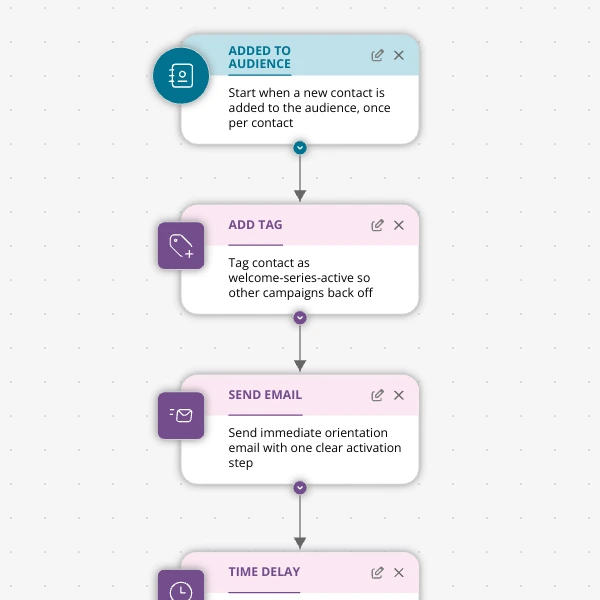
The Shopify app welcome series that turns installs into income
A step-by-step Shopify app welcome email journey for tools like CartSpark, showing how to turn new installs into activated, retained merchants using Spreeflo journeys, tags, and behavioral triggers so fewer trials quietly churn and more trials convert.
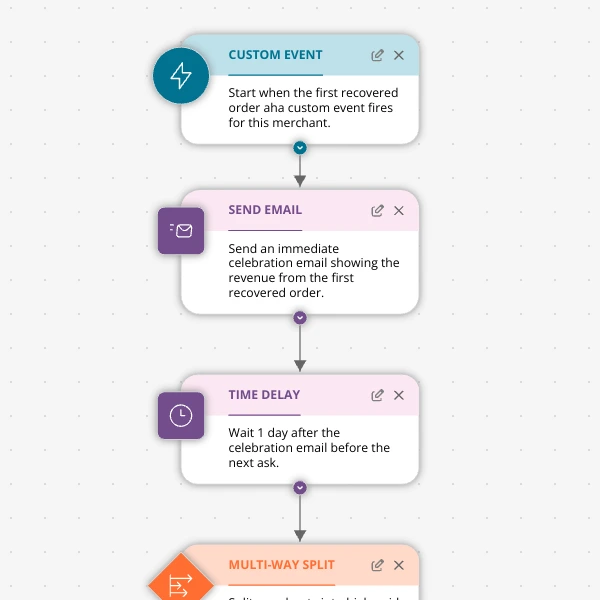
The Aha-Moment Playbook For Shopify Apps: Turn One Magic Action Into Months Of Revenue
A node-by-node playbook for Shopify and e‑commerce apps to center their lifecycle on one aha-moment custom event in Spreeflo, celebrate it, segment merchants by profile and engagement, and turn first recovered value into lasting revenue and retention.
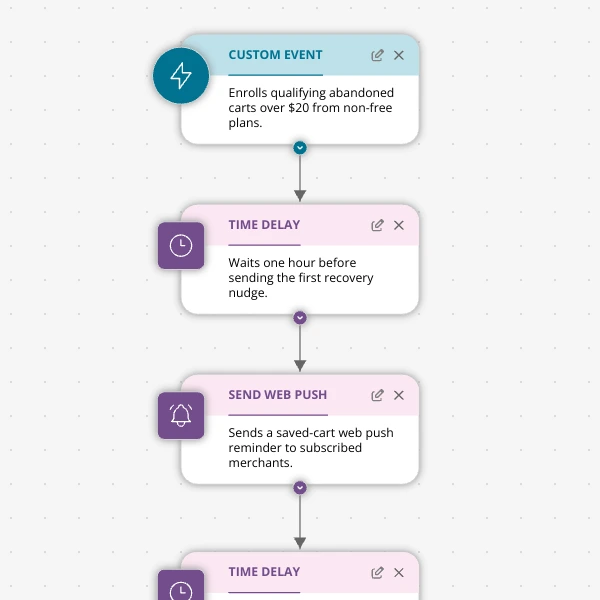
Stop Letting High‑Intent Carts Die: A 3‑Email Recovery Journey for Shopify Apps
A detailed, node-by-node walkthrough of a three-email (plus optional web push) cart-abandonment recovery journey for Shopify apps in Spreeflo, showing how to trigger events, branch on behavior, tag outcomes, and measure recovered carts and revenue.
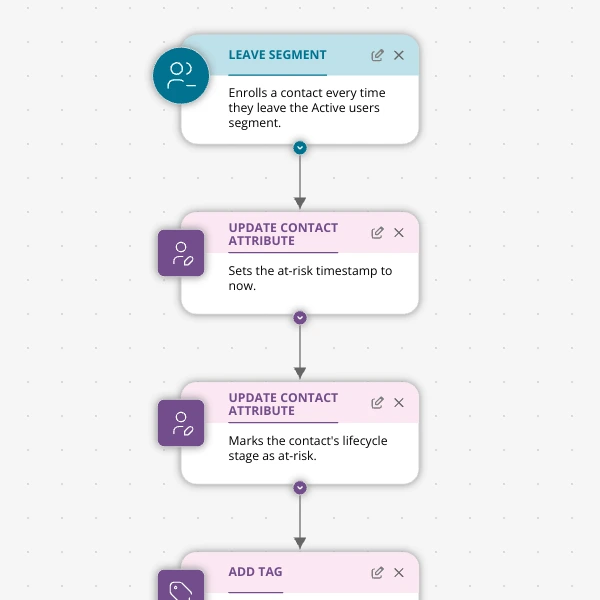
When Active Users Go Dark: A 4‑Touch Win‑Back Journey For Your Shopify App
A detailed, node-by-node Spreeflo journey for winning back previously active Shopify app users who stop engaging, using segment-based triggers, conditional logic, and a four-touch email plus internal alert sequence to recover usage and MRR.