Set-and-forget blog digests for your SEO SaaS
How to set up an automated weekly blog digest in Spreeflo for an SEO SaaS, using cyclic triggers, segmentation, and tagging so trials, customers, and alumni see relevant content and you turn content into a retention engine.
Industry
Niche
Pattern
Loading sequence...
You probably ship more good content than your customers ever see.
The blog post that breaks down a 120% organic traffic lift, the teardown of a competitor’s SERP, the feature walkthrough that would halve support tickets — they go live, get a little spike from Twitter and RSS, and then vanish into your archive.
Meanwhile, your trial users churn quietly because they never see what your product can actually do.
The pattern on this page fixes that: a recurring “new posts since last week” digest that goes out automatically, to the right people, with minimal weekly effort. The sequence at the top of this page is the whole journey, end to end.
We’ll walk that journey node by node, using a fictional SEO SaaS — RankPulse, a 3‑person rank tracker sitting at ~$35k MRR — as our example.
Why a scheduled digest matters more than another blog post
If you’re running an SEO SaaS, you’re already investing in content:
Case studies that show traffic and ranking lifts
Deep dives into search intent, internal linking, programmatic SEO
Product tutorials on “how to use our tool for X”
But distribution is where most teams quietly leak lifetime value.
A typical pattern:
You publish consistently.
You might tweet the post, add it to your changelog, and mention it in a generic monthly newsletter.
Trialists and light users never see the content that would move them from “curious” to “convinced”.
A recurring digest solves three problems at once:
It turns your content archive into an evergreen nurture engine. Every new subscriber gets a steady flow of your best thinking without you rebuilding an email from scratch each time.
It keeps you top-of-mind at the exact cadence you choose, so “I forgot about that tool” stops being a churn reason.
It lets you speak differently to different customers: agencies vs in‑house, trials vs power users, content brief heavy users vs technical SEOs.
With Spreeflo, this isn’t “another campaign to remember to send.” It’s a single journey, powered by a Cyclic trigger, that runs forever.
The flow in plain language
Before we zoom into each node, here’s the shape of the journey you see in the visual sequence:
A Cyclic trigger runs once a week, pulling in everyone who should get the digest.
A Multi-way Split routes contacts by lifecycle: trial, paying customer, churned/past user.
Each branch sends a tailored Send Email digest with content and CTAs tuned to that group.
After a short Time Delay, a Check Email Activity node watches who clicked vs who didn’t.
Simple Add Tag actions on each branch record engagement, so you can refine segments, lower frequency for cold subscribers, or retarget high-intent readers elsewhere.
Once published, the journey just runs. Your only “work” each week is dropping links to new posts into a reusable digest template (or automating even that with a small RSS-to-API script, which we’ll get to).
Let’s unpack why each node is there and how you’d configure it.
Node 1: Cyclic trigger — the heartbeat of your digest
The journey starts with a Cyclic trigger. This is what turns a one-off campaign into an evergreen program.
Configuration for RankPulse:
Repeat interval: every 1 week
Time of day: Monday, 09:00 in your main customer timezone
Criteria (using the segment builder):
- Email Subscription Status is “Subscribed”
- Tag containsblog-digest
Re-enrollment: on.
Why this setup:
Weekly is a good default for SEO content: frequent enough to stay relevant, not so frequent that you spike unsubscribes.
Filtering by Email Subscription Status keeps you compliant automatically; anyone who unsubscribes is dropped from the digest on the next tick.
Using a
blog-digesttag gives you a clean way to manage opt-in from forms, in-app toggles, or onboarding flows.Re-enrollment must be on here. You want the same contact back in this journey every Monday as long as they still match the criteria. The journey is short (a single send plus a brief wait), so everyone has exited well before the next weekly tick; there’s no risk of parallel enrollments being blocked.
You’ve now defined who gets a digest and when. Next: speaking to different groups differently.
Node 2: Multi-way Split — trials vs customers vs alumni
For a generic newsletter, everyone gets the same copy. For an SEO SaaS, that wastes data you already have.
Right after the Cyclic trigger, the sequence uses a Multi-way Split:
Three branches, each defined in the embedded segment builder:
Trial users
- Tag containstrial
- Email Subscription Status is “Subscribed”Paying customers
- Tag containscustomer
- Email Subscription Status is “Subscribed”Else branch: everyone else
- Leads, past customers, and subscribers tagged broadly but not in trial or customer
Order matters. You’d define “trial” and “customer” first, in that sequence, and let the else branch catch the rest.
Why it’s worth splitting here:
Trials should see content and CTAs focused on activation and “aha” moments: playbooks using your tool, quick wins, feature walkthroughs.
Customers should see content that deepens usage: advanced workflows, new features, agency case studies.
Past users or colder leads benefit more from broad, high-impact stories that refresh interest in the category and your unique approach.
This is brand message 1 in action: you’ve captured detail on each customer (tags, lifecycle) so you can speak to them uniquely — without building three separate journeys.
Nodes 3–5: Persona-tailored digest emails
Each branch now gets its own Send Email action. In the journey canvas you’ll see three separate Send Email nodes, one per branch, but the pattern is identical.
For the trial branch:
Email: “Your weekly RankPulse SEO playbook (for trials)”
Built with Spreeflo’s email builder using a reusable template:
- Section 1: “This week’s posts you’ll actually use in trial”
- e.g., “How agencies set up alerts in under 15 minutes”
- Section 2: “1 feature to try today”
- Deep link into your app’s onboarding checklist
- Section 3: Quick CTA: “Add your first 10 keywords” or “Connect Search Console”
For the customer branch:
Email: “This week in RankPulse SEO wins”
Same template structure, but:
- Posts highlight advanced workflows, client reporting, or new features.
- CTA nudges expansion: “Invite your team”, “Monitor more markets”, “Upgrade for daily tracking”.
For the else branch:
Email: “New SEO breakdowns from the RankPulse team”
Focused on storytelling and proof, not product-heavy nudges.
Configuration details shared across all Send Email nodes:
“Send only once” toggled on. If someone ever re-enters this node because of future edits or re-runs, they won’t get a duplicate of the exact same template.
Each node uses its own marketing email template ID so you can track metrics per lifecycle group.
Crucially, there are no back-to-back Send Email nodes on any path. Each branch sends one digest per weekly cycle, then moves into a wait-and-measure block.
Nodes 6–7: Time Delay — let engagement happen
Immediately checking whether someone clicked an email is pointless; most opens and clicks happen in the first 24–72 hours.
After each Send Email, the journey uses a Time Delay:
Delay: 3 days
Unit: Days
Why 3 days:
It gives your global audience time to open at their convenience.
It keeps the measurement window tight enough that you can use engagement for meaningful segmentation without waiting weeks.
Every contact now sits in this delay, then flows into a measurement step.
Node 8: Check Email Activity — tagging engagement
Next up in each branch is a Check Email Activity process node, tied to that branch’s digest email.
Configuration:
Marketing email: the specific digest template for this branch.
Activities to branch on:
- Branch “clicked”: Link Clicked
- Branch “opened”: OpenedElse branch: auto-created and used as “unopened”.
At this point, the journey has three possible outcomes per lifecycle branch:
Clicked: high-intent, engaged with at least one article.
Opened but didn’t click: they saw your brand and subject, but content or timing didn’t earn a click.
Unopened: they didn’t engage at all.
You don’t need to send more emails here. The job of this node is to enrich your contact data.
Nodes 9–11: Add Tag — building a behavioral memory
For each path out of Check Email Activity, you attach a simple Add Tag action:
Clicked branch → Add Tag:
digest_clickedOpened branch → Add Tag:
digest_openedUnopened branch → Add Tag:
digest_unopened
“Force tag trigger” stays off; we only need these tags when they change.
Why bother with this tagging if Spreeflo already tracks opens and clicks?
Because tags:
Make it trivial to define new segments later (“has
digest_clickedat least 3 times in the last 60 days”).Let you adjust future automation behavior. For example:
- A separate re-engagement journey triggered when someone accumulatesdigest_unopenedthree times in a row.
- A VIP content sequence fordigest_clickedheavy users who are also on higher-priced plans.Are easy to export or push downstream via Webhook to other tools.
This is brand message 3 in practice. You’re not just “sending a newsletter”; you’re systematically reducing the number of people who drift away without you noticing.
After tagging, each path can safely end. Everyone exits the journey until the Cyclic trigger brings them back next week.
How you actually build the email content each week
So where do the new posts come from?
There are two practical levels here.
Level 1: Reusable template + 5‑minute manual update
For most SEO SaaS teams, this is more than enough:
Keep a single digest template per branch in the email builder.
Each week, before the Cyclic trigger fires, update the “This week’s posts” section:
- Paste 3–5 new articles that went live since the last send.
- Drop in one feature CTA relevant to that group.
You never touch the journey, the triggers, or the segments. You’re not rebuilding the email from scratch — you’re just swapping out a handful of links in a fixed layout.
This keeps cognitive load low while still giving you weekly SEO-relevant touchpoints.
Level 2: Light RSS/CMS automation via the Spreeflo API
If you want to go further and remove even that manual step, you can:
Have a tiny backend script or Zapier/Make scenario watch your blog’s RSS feed or CMS API.
Once a week, it:
- Queries for posts published since the last digest send.
- Assembles a short HTML snippet or text block listing those posts.
- Uses the Spreeflo API to create or update a marketing email template, or to send a one-off transactional email to you/your team with preformatted content you can paste in.
Spreeflo doesn’t pull RSS natively, and the journey itself doesn’t call your feed. The automation pattern here is: let the Cyclic trigger and segmentation handle who/when, and use a lightweight integration to prepare what goes into the digest.
You stay within the platform’s capabilities while still getting most of the benefit of “dynamic” content.
Measuring whether your digest is pulling its weight
Because this pattern runs as a journey, you get ongoing visibility without extra plumbing.
Metrics worth watching:
Subscriber growth: Size of your
blog-digesttagged segment month over month.Open rate: Per-branch, so you can see if trials respond differently from customers.
CTR: Digest clicks per send; here’s where your content relevance and subject lines show up.
Sessions per send: Pair email stats with your web tracking and analytics to see how many site sessions and key pageviews each digest generates.
Unsubscribe rate: A spike is a useful signal: tone, frequency, or targeting is off.
Because you’re tagging behavior (digest_clicked, digest_unopened), you can also build higher-order segments:
“Highly engaged digest readers” = clicked at least 3 digests in the last 60 days.
“At-risk digest subscribers” = unopened at least 3 in the last 45 days.
Those segments can feed other journeys — reactivation, expansion offers, surveys — without touching the digest flow itself.
Adapting this pattern for your own SEO SaaS
The skeleton stays the same across products like RankPulse or BrieflySEO; what changes are your branches and content.
A few easy adaptations:
Split by primary use case instead of lifecycle:
- Content teams who hammer your content brief feature get posts on topical authority, outlines, and editor workflows.
- Technical SEOs get posts about site audits, log analysis, and crawl budget.
Use the Multi-way Split’s conditions to key off custom events likegenerated_content_brieforran_technical_audit.Use trial-specific content only for recent trials:
- In the Cyclic trigger’s criteria, add “Contact Added Date is within the last 30 days AND tagtrial”.
- That keeps long-expired trials out of a flow that assumes they’re still hands-on.Downshift frequency for cold subscribers:
- Build a separate monthly digest journey.
- In the weekly digest’s “unopened” branch, use Add Tag / Remove Tag to move them fromweekly_digesttomonthly_digestsegments once they’ve ignored you a few times.
All of this relies on the same foundation: one journey with a Cyclic trigger, smart criteria via the segment builder, and simple tagging.
The real win: compounding touchpoints without compounding work
A weekly digest will not double your MRR overnight.
What it does do is change the baseline: instead of hoping people discover your best work in the archive or via search, you ensure every trial, customer, and alumni sees a steady drip of high-signal content matched to where they are.
That’s exactly where most SEO SaaS businesses leak lifetime value — they acquire users through SEO, then under‑nurture them once they’re inside the product.
With a single journey built in Spreeflo’s campaigns and journeys, you turn your content operation into a reliable retention engine. You capture more detail on every customer, speak to each group more uniquely, and stop leaving engagement to chance.
Set it up once. Keep publishing. Let the digest quietly do its job every week.
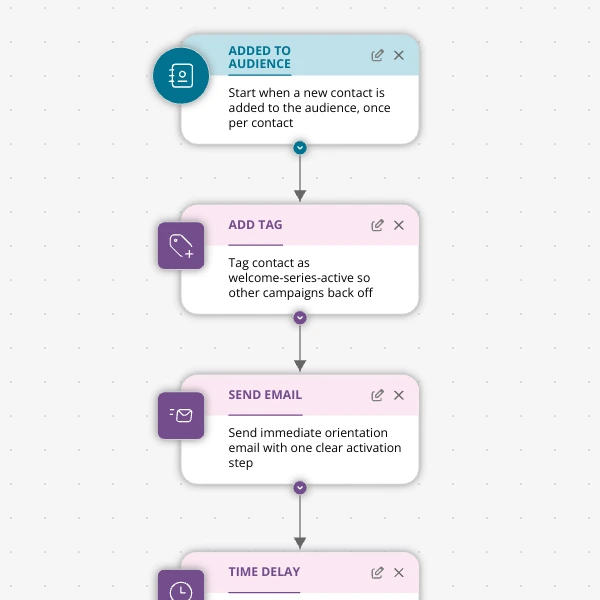
The Shopify app welcome series that turns installs into income
A step-by-step Shopify app welcome email journey for tools like CartSpark, showing how to turn new installs into activated, retained merchants using Spreeflo journeys, tags, and behavioral triggers so fewer trials quietly churn and more trials convert.
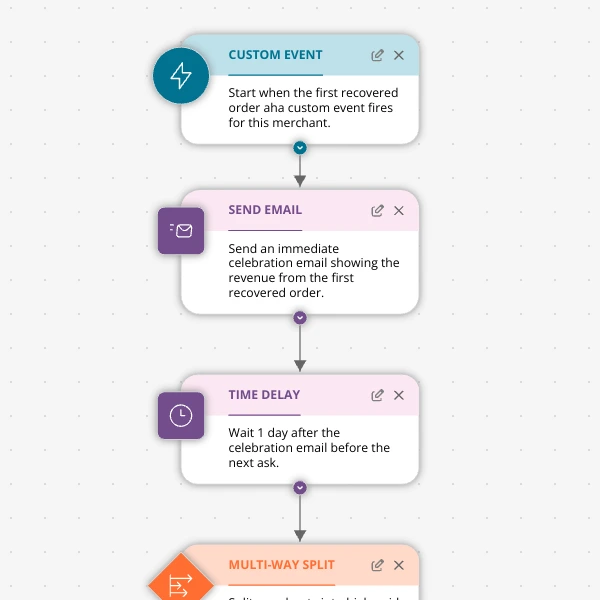
The Aha-Moment Playbook For Shopify Apps: Turn One Magic Action Into Months Of Revenue
A node-by-node playbook for Shopify and e‑commerce apps to center their lifecycle on one aha-moment custom event in Spreeflo, celebrate it, segment merchants by profile and engagement, and turn first recovered value into lasting revenue and retention.
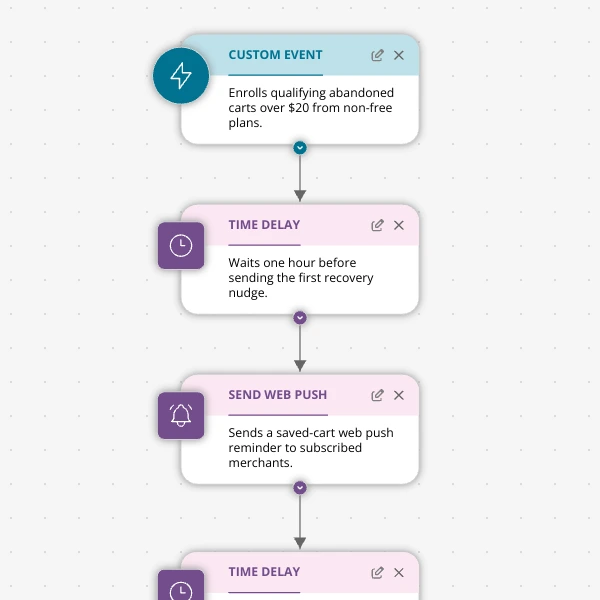
Stop Letting High‑Intent Carts Die: A 3‑Email Recovery Journey for Shopify Apps
A detailed, node-by-node walkthrough of a three-email (plus optional web push) cart-abandonment recovery journey for Shopify apps in Spreeflo, showing how to trigger events, branch on behavior, tag outcomes, and measure recovered carts and revenue.
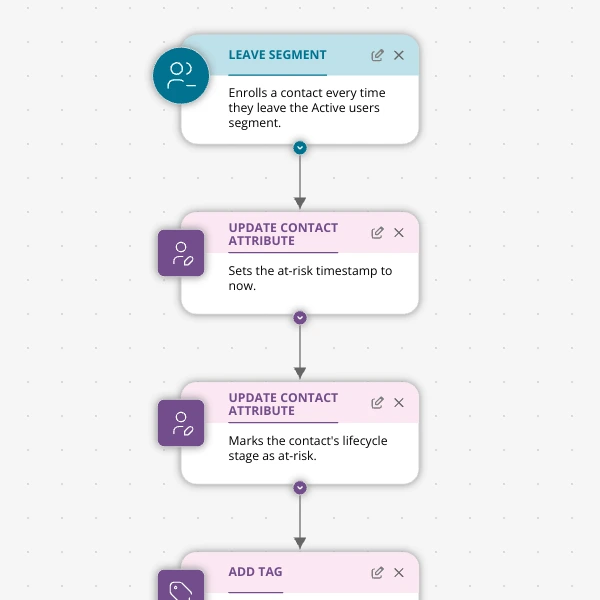
When Active Users Go Dark: A 4‑Touch Win‑Back Journey For Your Shopify App
A detailed, node-by-node Spreeflo journey for winning back previously active Shopify app users who stop engaging, using segment-based triggers, conditional logic, and a four-touch email plus internal alert sequence to recover usage and MRR.