Stop Asking for Reviews on a Timer: Build a “Ready‑to‑Review” Journey for Your SEO SaaS
This playbook shows how an SEO SaaS can replace generic day-14 review blasts with a behavior-triggered `ready_to_review` journey in Spreeflo, driving better-timed review requests, richer customer data, and higher retention across happy and unhappy users.
Industry
Niche
Pattern
Loading sequence...
The worst time to ask an SEO customer for a review is right after they sign up and before they see rankings move. The second worst is exactly 14 days after signup, when half of them still haven’t added a single keyword.
For a rank tracker or content-brief tool, value lands when the customer has real wins: a saved client, a CTR bump on a target page, a technical issue fixed. That’s when they’re actually ready to say something meaningful. The sequence at the top of this page is the whole journey, end to end, designed to hit that moment.
Fixed-delay review asks miss your real champions
Most SEO SaaS review flows look something like this:
Day 0: Trial starts.
Day 7 or 14: Generic “How are we doing? Please leave us a review on G2” email goes out to everyone.
On paper it’s simple. In practice it’s noisy and badly timed:
One agency added a site but never verified Search Console. They can’t see the core value yet.
Another customer has 30 projects, checks rankings daily, and just renewed an annual plan. They hit “aha” weeks ago.
A few churned on day 5, but your day-14 automation still tries to squeeze a review from them.
You treat them all the same, and your review rate stays low. Worse, you’re leaving lifetime value on the table by not turning your happiest users into visible proof on G2, Capterra, or your own site.
A “ready to review” journey fixes this by moving the timing logic into your product:
When an account crosses a usage or outcome threshold (e.g., “10 briefs generated and 3 published pages with uplift”), your backend fires a
ready_to_reviewevent.Spreeflo listens for that event and asks for a review only from those contacts, with copy tailored to the specific value they’ve seen.
This relies on the first brand idea behind Spreeflo: capture detail on every customer so you can speak to each uniquely. The more precise you are about what “ready” means, the more natural and high-converting your ask will feel.
Step 1: Decide what “ready to review” means for your SEO SaaS
Before you touch the journey builder, you need a clear rule in your product for when an account is genuinely review-ready.
For RankForge, that might look like:
Rank tracker:
Connected Google Search Console AND
Added at least 20 keywords across 2+ projects AND
Logged in on 4 separate days in the last 30 days.
Content brief generator:
Generated 3+ briefs AND
Exported or copied content for at least one brief AND
Visits the “Performance” or “SERP changes” view at least twice.
Technical SEO auditor:
Completed a full site crawl AND
Resolved or marked as fixed at least 5 issues AND
Has at least one crawl scheduled or recurring.
You don’t need this to be perfect, but it should reflect “this person has seen enough value to have a real opinion.”
From there:
Have your backend compute this daily or after each key action.
When an account crosses the threshold for the first time, POST an event like
ready_to_reviewinto Spreeflo’s events endpoint using the Spreeflo API, with:
The contact’s email.
Properties like
plan,usage_score, maybeprimary_use_case.
That event is what will trigger the journey.
Step 2: Wire the ready-to-review trigger in Spreeflo
Open the campaigns and journeys area and create a new journey. This needs to run continuously, not as a one-off campaign.
The sequence at the top of this page is the journey we’ll build. Here’s how each node fits together.
Trigger: Custom Event “ready_to_review”
Drag in a Custom Event trigger:
Event name:
ready_to_review(or whatever your backend sends).Property conditions: none for now; we want all “ready” contacts.
Re-enrollment: off.
Re-enrollment stays off because the backend should fire this once per contact, when they first cross your “ready” threshold. If you later want to ask again a year down the line, you can handle that with a separate rule and event name (for example, ready_to_review_again).
This is your behavioral entry point: you’re not guessing based on days-since-signup, you’re reacting to actual usage.
Gate who you actually ask (If/Else)
Next, add an If/Else node right after the trigger to avoid emailing people you shouldn’t:
Condition: using Spreeflo’s segment builder, define something like
Email subscription status is Subscribed
AND tag contains
customerAND tag does not contain
asked_for_review.
This gives you two branches:
“Yes” branch: eligible to ask.
“Else” branch: not eligible (unsubscribed, still trial, or already asked).
On the Else branch, drop in an Add Tag node that applies a tag like review_suppressed. This doesn’t contact the user; it just records that they were ready from a usage perspective but suppressed by comms rules.
Then end that branch. No email, no pressure.
This is a small example of capturing detail instead of blasting everyone. You now know who is happy but unreachable, which is useful context for Customer Success even if you never email them.
Mark that you’ve asked (Add Tag)
On the “Yes” branch (eligible contacts), first add an Add Tag action:
Tag:
asked_for_review.
This tag:
Prevents you from asking the same person again if your product accidentally fires another
ready_to_reviewevent.Lets you build analytics later (e.g., “How many ‘asked_for_review’ contacts actually submitted a review?”).
Keep “Force tag trigger” off unless you have other journeys listening to the Added Tag trigger for this tag.
Optional: tiny delay to avoid midnight sends (Time Delay)
If your backend job runs at odd hours, insert a small Time Delay action next:
Delay: 2 hours.
Unit: Hours.
If you don’t care about send time, you can skip this. The only hard rule is message pacing: you must not put two Send Email nodes back to back on a path. Here we only have one so far.
Step 3: Send the first ask email so it feels like a one-off, not a blast
Now add your main Send Email action.
Configure it as:
Template: pick or create “Review request – ready users.”
From: whoever is credible for your brand (often the founder or head of product).
Send only once: leave this on so contacts never hit this node twice, even if you reuse it later.
In the content itself (via the email builder), ground the ask in the value they’ve actually seen. For example:
Subject: “Quick favor about your RankForge results?”
Body highlights:
“You’ve tracked 82 keywords across 6 projects.”
“You’ve generated 5 content briefs in the last month.”
“We’d love a short review about how that’s impacting your clients.”
You can either merge in these numbers from contact attributes you keep updated, or speak more generally to their use case (“as someone using us for client reporting…”).
The key is that this email reads as a personal nudge sent because they’re clearly active, not a generic triggered “please review us” blast.
Step 4: Follow up based on what they do with that email
Once the first ask is out, you want to react intelligently to how they engage (or don’t).
Wait a few days (Time Delay)
After the Send Email node, add a Time Delay:
Delay: 3 days.
Unit: Days.
Three days is long enough for most busy SEO folks to see the email and act, without your brand fading from memory.
Branch on engagement (Check Email Activity)
Next, add a Check Email Activity process node aimed at that specific review email:
Marketing email: select your “Review request – ready users” email.
Activities to branch on:
clickedopenedunopened(viadid not openin the builder)
Order matters, because a contact who clicked also opened:
First branch: Clicked.
Second branch: Opened.
Else branch: everyone else (unopened / undelivered).
Spreeflo will send each contact down the first matching branch, so clickers never end up in the “opened but not clicked” path.
Now you have three behaviors to respond to.
Branch 1: They clicked the review link
On the “Clicked” branch:
Add an Add Tag node with something like
review_link_clicked.Optionally, if you’re on the Professional plan, add a Webhook action to POST this intent to your CRM or a Slack channel for your team.
Then end the branch.
You’ll notice we’re not sending a second email here. Anyone who clicks a “please review us” email and then gets nagged again a few days later often feels hassled. For your highest-intent contacts, we let the review platforms and your own follow-up handle the rest.
On the analytics side, you can later compare:
Total with
asked_for_reviewtag.Total with
review_link_clickedtag.Total who actually had a
review_submittedevent ingested via the API.
That gives you a real review funnel.
Branch 2: They opened but didn’t click
These are your “warm but busy” users. They cared enough to open an email from you, but something about the ask or timing didn’t land.
On the “Opened” branch:
Add a Time Delay:
Then add a second Send Email action, something like “Quick 20-second question?”
Delay: 2 days.
Unit: Days.
This follow-up email should be lighter weight than the first:
A very short body.
One clear action: either a simpler review ask (“Hit reply with 1–2 sentences we can quote”), or a “what’s blocking you from recommending us?” question that encourages honest feedback.
Critically, this is the second and final review-related email in this journey. There’s a 5‑day minimum gap (3 days + 2 days) between the first and second, so you’re well clear of any spammy feeling.
You can tag these contacts as review_nudged after this email with another Add Tag node if you want later reporting.
Branch 3: They never opened
For the Else branch (no open after 3 days):
Add an Add Tag action with something like
review_unreached.End the branch.
This group is still useful:
They were “ready” in terms of product usage, but your channel or timing didn’t get through.
You might use that tag later to test a different channel like web push or an in-app banner, outside this journey.
At this point, the main journey is done. Every contact who was truly “ready” either:
Got one well-timed ask.
Or got a gentle follow-up if they showed signs of interest.
No one received more than two emails, and no one who was unsubscribed or still in trial got pestered.
Step 5: Capture and act on reviews (including negative ones)
The journey above handles the ask. To improve your “star rating mix” and negative-feedback recovery, you also want Spreeflo to see what happens after someone actually leaves a review.
You can do this with a small, separate setup:
Wherever reviews are collected (G2, Capterra, AppSumo, or a dedicated NPS tool), configure either:
From your backend, POST a
review_submittedevent into Spreeflo for each review, via the Spreeflo API, including:With those events flowing, you can:
A webhook into your backend, or
A periodic job that pulls recent reviews via their API.
The contact’s email.
Properties like:
rating(1–5 or 0–10),source(g2,capterra,nps_tool),comment_lengthor a simplesentimentflag if your tool calculates one.
With those events flowing, you can:
Build segments in the segment builder like: “Custom event
review_submittedat least 1 time over all time where propertyratinggreater than 4.”Or spin up a tiny second journey: Trigger: Custom Event
review_submitted. Multi-way Split on theratingproperty (Promoters vs Passives vs Detractors). For detractors, send a Send Email apology from the founder and a Send Internal Email to your support team so a real human follows up.
That’s how you turn negative reviews from silent churn accelerators into save opportunities you can measure.
What to track to know this flow is working
Once both the ready-to-review journey and review ingestion are live, you can start reporting on three key metrics:
Review submission rate
Denominator: contacts with the
asked_for_reviewtag.Numerator: contacts who have a
review_submittedcustom event.Slice by plan, use case, or region using segments.
Star rating mix
Use custom event property filters in segments:
High:
rating >= 4.Medium:
rating = 3.Low:
rating <= 2.This helps you see whether your ready-to-review logic is skewed toward a particular group (for example, maybe power users on the Pro plan are thrilled, but starter-plan customers are struggling).
Negative-feedback recovery
Among contacts who left a low rating, track:
Who received your “sorry we missed” follow-up journey.
How many stayed active or renewed in the next 60–90 days.
Over time, a well-run recovery loop should lower churn in your “detractor” group compared to before.
All of this comes from one simple discipline: logging structured events and tags at each step rather than relying on gut feel.
Why this small flow quietly boosts retention
For an SEO SaaS founder, reviews are oxygen. They drive organic signups, increase trial-to-paid conversion, and give you copy you can reuse everywhere. But they also tell you something deeper: where in the product customers genuinely feel value.
By moving from “ask everyone after X days” to a ready_to_review journey:
You treat review asks as a privilege you earn with usage, not a checkbox on a marketing calendar.
You capture detail on each customer’s behavior and let that data drive who you talk to and what you say.
You plug two leaks in lifetime value at once: you turn your happiest users into public proof, and you catch unhappy ones before they silently churn.
The beauty is that once you set this up in Spreeflo, it doesn’t demand more headcount. A small founder-led team can design the journey once and let it run for months, adjusting thresholds and copy as the product evolves. If you want to go further, you can layer in AI-powered personalization on the emails or expand into additional journeys, all within the same campaigns and journeys view.
Done right, a ready-to-review flow is one of those quiet automations that keeps earning its keep: more reviews, better reviews, and a clearer picture of which customers are truly winning with your product.
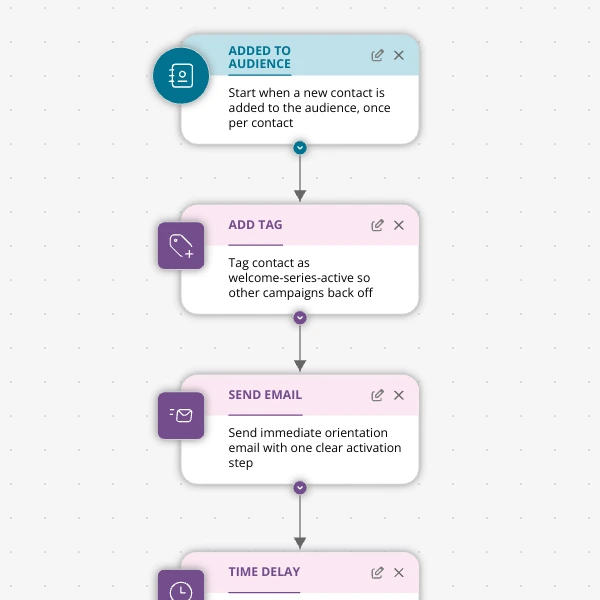
The Shopify app welcome series that turns installs into income
A step-by-step Shopify app welcome email journey for tools like CartSpark, showing how to turn new installs into activated, retained merchants using Spreeflo journeys, tags, and behavioral triggers so fewer trials quietly churn and more trials convert.
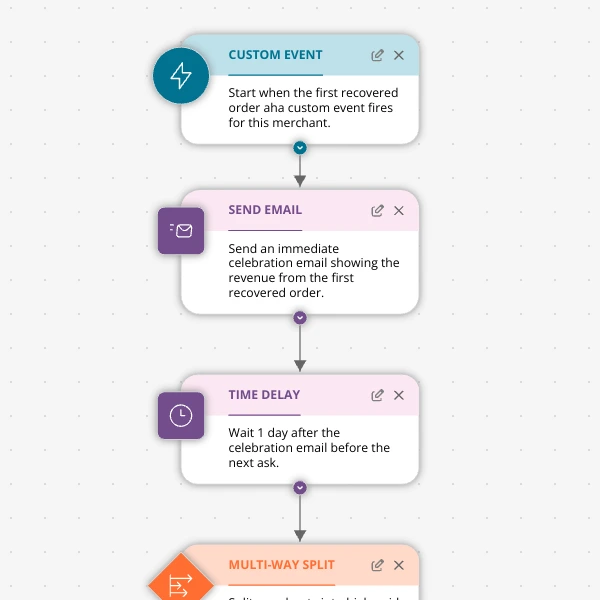
The Aha-Moment Playbook For Shopify Apps: Turn One Magic Action Into Months Of Revenue
A node-by-node playbook for Shopify and e‑commerce apps to center their lifecycle on one aha-moment custom event in Spreeflo, celebrate it, segment merchants by profile and engagement, and turn first recovered value into lasting revenue and retention.
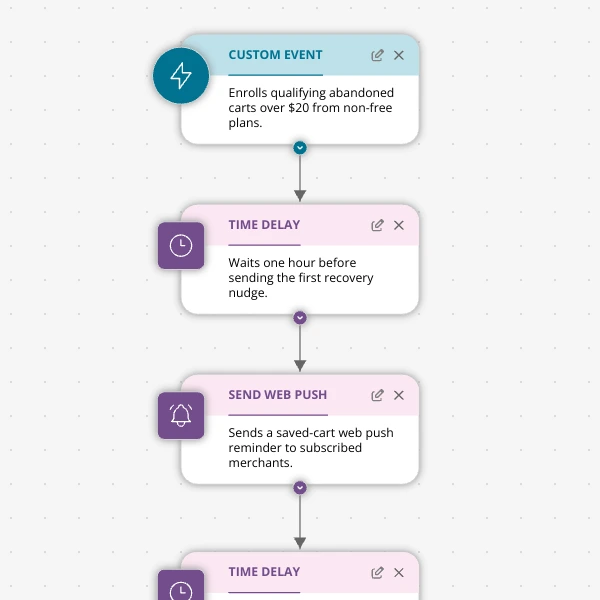
Stop Letting High‑Intent Carts Die: A 3‑Email Recovery Journey for Shopify Apps
A detailed, node-by-node walkthrough of a three-email (plus optional web push) cart-abandonment recovery journey for Shopify apps in Spreeflo, showing how to trigger events, branch on behavior, tag outcomes, and measure recovered carts and revenue.
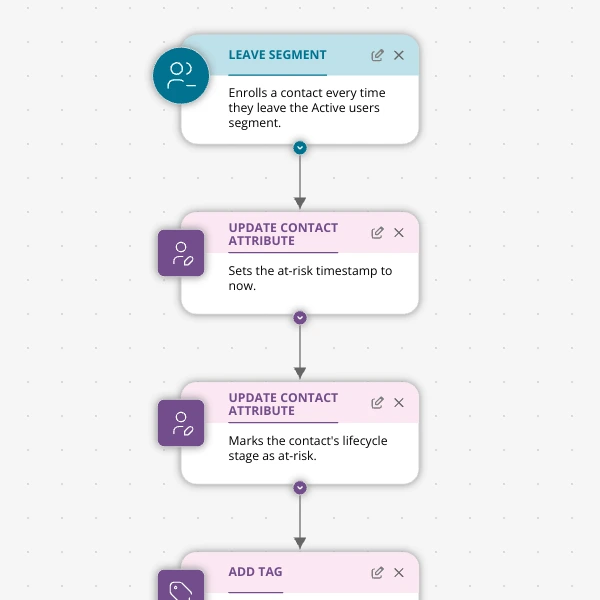
When Active Users Go Dark: A 4‑Touch Win‑Back Journey For Your Shopify App
A detailed, node-by-node Spreeflo journey for winning back previously active Shopify app users who stop engaging, using segment-based triggers, conditional logic, and a four-touch email plus internal alert sequence to recover usage and MRR.