Stop Letting Half‑Finished Trials Churn: A Setup Reminder Journey For SEO SaaS
Shows how an SEO SaaS like RankPulse can build a Spreeflo journey that detects stalled trial setups, sends guided reminder emails, and escalates high‑value accounts to humans so more trials finish integrations, activate, and convert.
Industry
Niche
Pattern
Loading sequence...
The fastest way to kill an SEO SaaS trial is simple: let someone sign up, never connect anything, and quietly churn before they see a single ranking move.
For RankPulse, a fictional three‑person rank tracking startup doing $35k MRR, this looked like 40% of trials never connecting Google Search Console or adding their first domain. Support would spot these accounts days later, do hurried manual outreach, and still lose most of them. The sequence at the top of this page is the whole journey, end to end, that fixes that.
This article walks through that journey node by node: how to detect stalled setup, send guided nudges, and escalate the right accounts to a human before they disappear.
Why incomplete setup quietly wrecks your funnel
You already know your product’s “aha” moment. For SEO tools it’s usually one of:
Seeing live rankings for their keywords
Getting a first technical audit report
Receiving a content brief that clearly beats what they’d write alone
None of that happens until the account is technically wired up: site added, GSC or GA4 connected, crawler installed, whatever “integration” means for your stack.
When that setup stalls:
Trial‑to‑paid conversion tanks, because they never experience value
Churn in month one spikes, especially for agency accounts testing you for a client project
Support spends time chasing ghosts instead of helping active users
Most teams know this is a problem. Where they fall short is treating it as a structured lifecycle stage with its own automation, instead of a messy mix of “we’ll keep an eye on it” and occasional manual emails.
The journey you’ll build in Spreeflo turns “integration not completed” into a first‑class state in your data, then reacts to it automatically with email and internal alerts.
The high‑level journey: what this flow actually does
Before we get into nodes and conditions, here’s the story the journey tells:
A new trial starts. Spreeflo gets a
trial_startedcustom event for that contact.The journey waits up to 3 days for a “critical integration complete” event, like
gsc_connected.If the integration happens in time, nothing nags them. The contact exits or gets a light confirmation tag.
If it hasn’t happened by day 3, they get a guided setup email with clear steps and a single call‑to‑action.
Two days later, the journey checks again:
- If they’ve finished setup, we’re done.
- If they still haven’t, high‑value accounts trigger an internal email so a human can step in; everyone else can get a second, more direct reminder or simply be tagged as at‑risk.
Everything after the trigger is built with Spreeflo’s campaigns and journeys builder: Custom Event trigger, Wait Condition, If/Else, Send Email, Time Delay, and Send Internal Email.
Let’s walk through each part.
Step 1: Track the right setup events and attributes
This flow only works if Spreeflo can tell, for each contact:
When their trial started
Whether they’ve completed the key setup step
Whether they’re “high value” enough to escalate
For an SEO SaaS, you’ll usually want at least:
trial_started(custom event)site_connectedorproject_created(custom event)gsc_connected,crawler_installed, or equivalent integration eventCustom attributes like
account_plan,monthly_potential_value,team_size, or a booleanis_high_value
How to wire this into Spreeflo:
In your frontend (React, Vue, etc.), when a user starts a trial or clicks “Connect Google Search Console”, call the Spreeflo SDK to fire a custom event from the browser.
In your backend (for events that only exist server‑side, like “first successful crawl”), POST to the events endpoint using the Spreeflo API with an event name like
crawler_installedand the user’s email.
Your app should also update contact attributes (plan, team size, etc.) as they change. Frontend can do that with Spreeflo.identify; backend can send attribute updates via the contacts endpoint in the API.
This is brand message 1 in practice: you’re capturing enough detail on every customer that you can speak to each uniquely. The journey you’re about to configure is just that data, wired into action.
Step 2: Start the journey when a trial begins
Create a new Journey in Spreeflo. This isn’t a one‑off campaign; it should run continuously as trials start.
Trigger choice: Custom Event
Event name:
trial_startedProperty filters: optional. If you only want this for certain products or regions, you can add property conditions.
Re-enrollment: usually off. One pass per contact is fine for most SaaS products. If agencies can spin up multiple distinct workspaces under the same email, you can flip it on later.
Every time your app sends trial_started (via the SDK or API), that contact enters the journey at this trigger node.
If you’ve already got a big base of trials and want to retro‑fit this to existing users, you can add a Criteria Match trigger as a second entry point:
Criteria: “Email subscription status is Subscribed AND tag contains
trialAND custom eventgsc_connectedhas not triggered over all time.”
The segment builder powers that criteria: pick Email Subscription Status, Tags, and Custom Events rules, joined with AND. Set re-enrollment on this secondary trigger to off as well.
Step 3: Wait for setup to happen on its own
Right after the trial_started trigger, add a Wait Condition node. This is where you give users space to explore before you step in.
Configuration:
Condition: Custom event
gsc_connectedtriggered at least 1 time over all timeTimeout: 3 days
In segment‑builder terms, the rule looks like:
Type: Custom Events
Event:
gsc_connectedOperator: has triggered
Frequency: at least 1 time
Time window: over all time
The Wait Condition holds the contact until either:
They connect GSC (condition becomes true), or
3 days pass (timeout hits)
Either way, they move to the next node as soon as one of those is satisfied. You don’t yet know which happened, so you’ll check that next.
This simple pause solves a big UX problem: people who completed setup on day one never see a “Hey, you forgot to connect Search Console” nag. Your automation respects real behavior instead of a fixed schedule.
Step 4: Branch on who stalled and send the first guided reminder
After the Wait Condition, add an If/Else node with the same condition as the wait:
Condition: Custom event
gsc_connectedtriggered at least 1 time over all time
Now you have two paths:
Then branch: setup completed
Else branch: setup still incomplete after 3 days
On the “setup completed” branch you might:
Add a Tag:
gsc_connectedorcritical_setup_doneOptionally set a custom attribute like
onboarding_stage = "integrated"
Then end that path. You don’t need to send anything here; they’re doing what you want.
On the “still incomplete” branch, add your first Send Email node. This is the core guided reminder.
A few practical tips for this email, built in Spreeflo’s email builder:
Subject: be specific about outcome, not just the action.
“Connect Search Console to start tracking your rankings”
Opening line: remind them what they’re missing in concrete terms.
“Right now RankPulse can’t pull any data for your domains. Once you connect Search Console, you’ll see live rankings and daily changes.”
Body: a simple 3–4 step checklist with screenshots or GIFs, all pointing to one button: “Finish setup”. Link that button to the exact in‑app URL where they connect GSC.
Personalization: pull in the site or project name if you have it on the contact. The more contextual, the better.
Turn Send only once on for this node so the same person never gets this reminder twice if they somehow re‑enter.
This is the first email they receive in the journey, so pacing is fine here; no delay is needed before it.
Step 5: Give them another window, then escalate high‑value accounts
Right after that reminder email, add a Time Delay:
Delay: 2 days
You don’t want to fire off another check an hour later. Let them see the email, click through, and actually do the work.
After the delay, add another If/Else node with the same “has gsc_connected event” condition:
If yes: they completed setup after your email. Great.
Tag them as
setup_rescuedor increment anrescued_setupsnumeric attribute so you can measure this journey’s impact later.End the branch.
If no: they’re still stuck after roughly 5 days of trial.
On this “still incomplete” branch, drop in one more If/Else to separate high‑value from everyone else. This is where your attributes pay off.
Example condition for the high‑value branch:
Contact attribute
account_planis “Agency” ORCustom attribute
monthly_potential_valuegreater than 99 ORTeam size greater than 5
You can express that with a nested group in the segment builder:
Outer group: AND (e.g. “Email subscription is Subscribed”)
Inner group: OR for your three high‑value rules
Now you have:
Branch A: High‑value, still not set up after 5 days
Branch B: Everyone else, still not set up after 5 days
For high‑value accounts, add a Send Internal Email node:
Recipient: a shared onboarding or support inbox, or directly to the founder if you’re small
Subject: “High‑value trial still hasn’t connected Search Console”
Body: include the contact’s name, email, plan, and which steps they’ve completed. Outline a simple playbook:
- “Suggested next step: email from your personal address with a Loom walkthrough, or offer a 15‑minute onboarding call.”
Because internal emails can also be set to “Send only once”, you avoid spamming your own team if the contact ever comes back through.
For the non‑high‑value branch, you have options:
Add a second Send Email node with a slightly different angle (“Can we help you get set up?”) after another 1–2 day Time Delay, or
Simply Add Tag like
at_risk_setupand feed that into a separate re‑engagement journey later.
If you choose to send that second email, keep spacing in mind: you already have a 2‑day delay after the first; add another Time Delay before the second send so there’s real breathing room between messages.
With this structure, you’ve achieved the pattern’s promise:
Guided reminders for everyone stuck
Human escalation only for accounts that justify the time
And you built it once; from now on, it runs for every new trial with zero extra effort. That’s founder‑leverage in practice.
Step 6: Measure setup completion and activation lift
A journey is only as good as the numbers it moves. Three metrics matter here:
Setup completion rate
- Among contacts who firedtrial_started, what percentage also firedgsc_connectedwithin, say, 7 days?
- Build two segments:
- “Trials withgsc_connectedtriggered at least once in the last 7 days”
- “Trials withoutgsc_connectedtriggered over all time”
- Compare counts over time before and after you switch this journey on.Activation rate
- Define a downstream “aha” event likechecked_rankings,ran_technical_audit, orgenerated_content_brief.
- Use the segment builder to see how many of the “setup completed” cohort hit that event versus those who didn’t.Support‑ticket volume about setup
- Tag or route tickets that mention “can’t connect Search Console”, “how do I add my site?”, or similar.
- Track whether that volume drops as the journey’s guided emails do some of the teaching for you.
Inside Spreeflo’s web tracking and analytics, you can also watch whether visitors who receive the reminder emails are more likely to visit your setup and integration pages.
If you want to push further, you can drop a Random Split before the first reminder email: send it to 80% of people, hold out 20%, and compare setup completion rates between the two groups after a month.
Step 7: Adapting this beyond Search Console
The same pattern works for any integration‑shaped step in an SEO product:
Technical SEO tools: event
crawler_installedorsite_verifiedContent brief tools:
cms_connectedoroutline_exportedLog‑based or data‑warehouse‑driven tools:
log_source_connected,bigquery_connected
Swap gsc_connected everywhere in the journey for the event that actually gates value in your product.
If you have several critical steps, you have two good options:
Clone this journey per step (one for crawler install, one for CMS connection), each with its own trigger and messages.
Use a Multi‑way Split after
trial_startedbased on which key event is missing, then route people into separate reminder sequences.
Start simple: pick the one integration without which nothing else really matters, and automate that first.
Why this plugs a major LTV leak for SEO SaaS
Most SEO SaaS businesses are leaving lifetime value on the table for a boring reason: accounts never truly start using the product. They don’t churn because they hate you; they churn because they never finished plugging things in.
This journey fixes that in a way that respects both your users and your time:
It speaks differently to someone who’s already set up versus someone stuck at day 5 with nothing connected.
It treats a solo blogger on a $29 plan differently from an agency trial that could be worth $500 a month.
It runs in the background so your tiny team doesn’t have to babysit trials one by one.
Founder‑led businesses win on leverage, not headcount. A setup‑incomplete reminder journey is exactly that: one afternoon of design in Spreeflo, and an always‑on system that rescues trials, boosts activation, and reduces avoidable support work.
Once you’ve wired this up using build a journey and your existing events, it becomes a template. You’ll start seeing other “stuck states” in your product — and you’ll know you have the tools to nudge people through them.
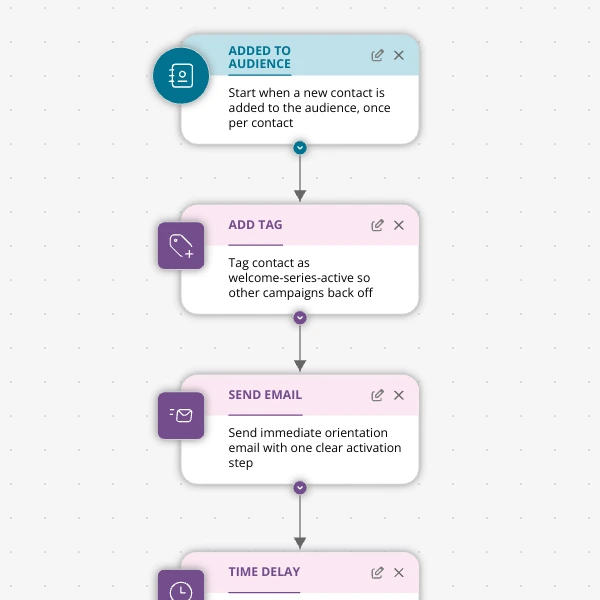
The Shopify app welcome series that turns installs into income
A step-by-step Shopify app welcome email journey for tools like CartSpark, showing how to turn new installs into activated, retained merchants using Spreeflo journeys, tags, and behavioral triggers so fewer trials quietly churn and more trials convert.
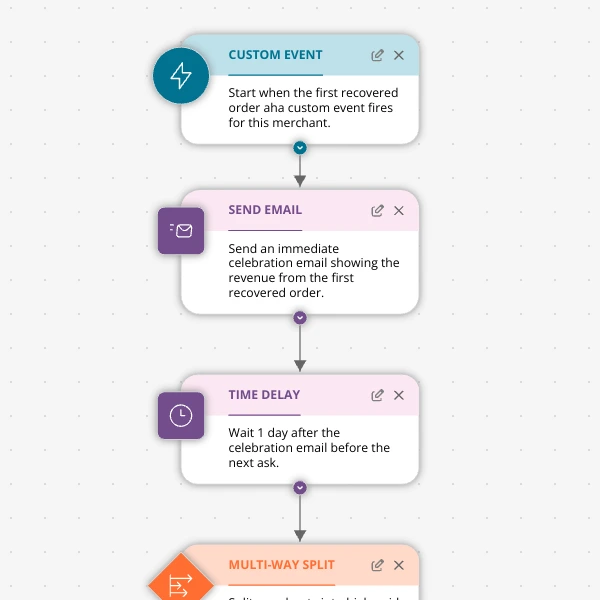
The Aha-Moment Playbook For Shopify Apps: Turn One Magic Action Into Months Of Revenue
A node-by-node playbook for Shopify and e‑commerce apps to center their lifecycle on one aha-moment custom event in Spreeflo, celebrate it, segment merchants by profile and engagement, and turn first recovered value into lasting revenue and retention.
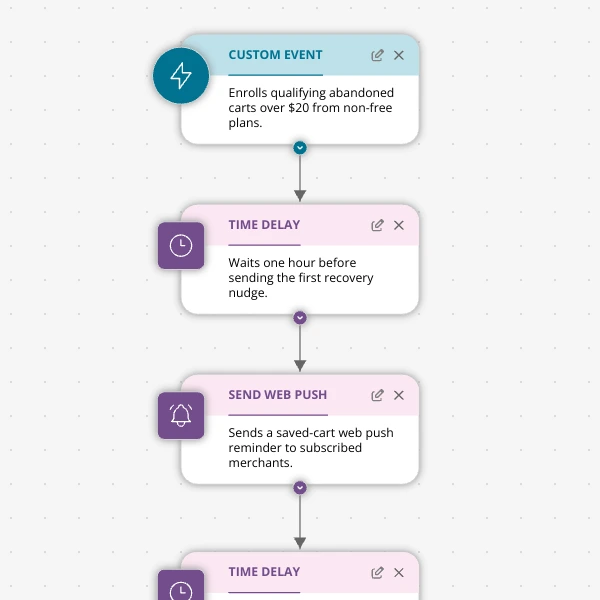
Stop Letting High‑Intent Carts Die: A 3‑Email Recovery Journey for Shopify Apps
A detailed, node-by-node walkthrough of a three-email (plus optional web push) cart-abandonment recovery journey for Shopify apps in Spreeflo, showing how to trigger events, branch on behavior, tag outcomes, and measure recovered carts and revenue.
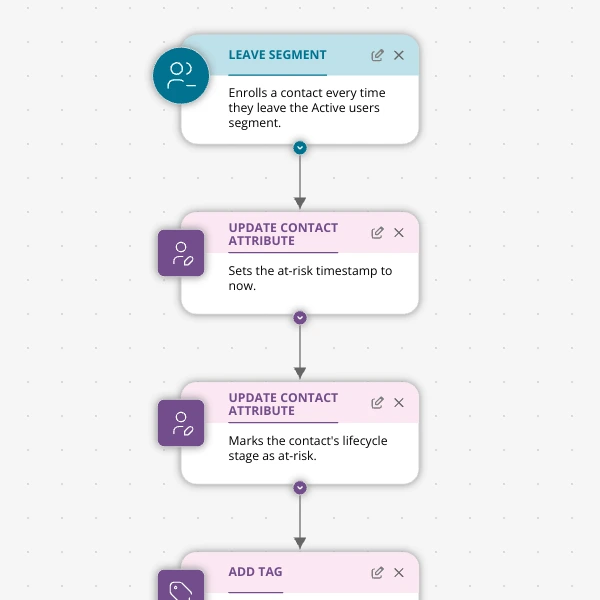
When Active Users Go Dark: A 4‑Touch Win‑Back Journey For Your Shopify App
A detailed, node-by-node Spreeflo journey for winning back previously active Shopify app users who stop engaging, using segment-based triggers, conditional logic, and a four-touch email plus internal alert sequence to recover usage and MRR.