Stop Letting Lead Magnets Go Cold: Build a Topical Nurture That Converts SEO Leads
This playbook walks SEO SaaS teams through building a Spreeflo journey that turns each lead magnet download into a topical nurture, using custom events, segmented email paths, and behavior-based MQL tagging to drive paid conversions.
Industry
Niche
Pattern
Loading sequence...
Someone fills out your “Advanced Technical SEO Audit Checklist” form, grabs the PDF, and disappears into the void. Your analytics say the asset is “performing well.” Your MRR does not.
For SEO SaaS, that’s the classic leak: smart lead magnets with no structured follow-up. The sequence at the top of this page is the whole journey, end to end, for fixing that — delivering the asset and turning each download into a topical, product-aware nurture.
Let’s walk through how to build it in Spreeflo, step by step, so every new download gets 2–3 highly relevant follow-ups instead of one lonely autoresponder.
Why SEO lead magnets rarely turn into customers
If you run something like RankPulse or BrieflySEO, you probably already have strong content: rank tracking guides, content brief templates, technical SEO migration checklists.
The usual pattern looks like this:
Visitor hits a landing page, fills out a form, and sees a “thanks, here’s your PDF” message.
Maybe they also get a generic welcome email.
After that, they’re thrown into your main newsletter or forgotten entirely.
Two big problems:
The follow-up isn’t tied to what they downloaded. A technical SEO engineer and a content marketer might both grab “How to Fix Crawl Budget Issues,” but they get the same bland nurture as everyone else.
There’s no behavior signal. You don’t distinguish people who actually read or click through the asset from those who bounced after the form.
That’s lifetime value leaking out. You did the work to earn their attention; you just aren’t using the data you have about what they care about.
This journey fixes that by:
Triggering off a behavioral event (the actual download).
Sending 2–3 emails that all stay on the same topic as the asset.
Using engagement to decide who becomes a marketing-qualified lead you treat differently.
First, instrument the download properly
Before we touch the journey, you need two pieces in place:
A capture form you control
A tracked download event
Put the lead-magnet form on your own site using a Spreeflo form, embedded inline on the landing page. Turn on Map to contacts so submissions create or update contacts, and include:
Required: Email
Optional but valuable: Role (agency vs in-house), company size, primary SEO focus (content / technical / off-page)
That gives you rich attributes to segment on later with Spreeflo’s segment builder.
The form itself is shown on your site (inline or as a popup), not emailed. Spreeflo’s forms guide walks through the embed options.
When someone actually clicks “Download PDF” or opens the gated asset page:
On your marketing site or app frontend, use the Spreeflo SDK to fire a custom event like
asset_downloadedwith properties such asasset_slug = "tech-seo-audit-kit"andtopic = "technical_seo".If the asset is delivered from a backend context (for example, a secure link generator), send the same event via the Spreeflo API.
This is the behavioral signal our journey listens for. The form submission captures who they are; the custom event tells us exactly what they cared about enough to download.
Step 1: Custom Event trigger scoped to one asset
In the journey builder, the first node in the sequence at the top of this page is a Custom Event trigger.
Configuration:
Event name:
asset_downloadedProperty condition:
asset_slug is "tech-seo-audit-kit"(or whatever you use)Re-enrollment: On (
true)
Why it’s built this way:
Scoping by
asset_slugmakes this journey specific to a single lead magnet. If you have another big asset on “Content Briefs That Rank,” you’ll clone the journey and point the trigger at that slug instead.Re-enrollment is on so a contact can go through this journey, finish it, then later download a different asset (and enter the other asset’s journey). Spreeflo’s mid-journey lock prevents them from being enrolled twice at once, so you won’t accidentally run duplicates in parallel.
This is the moment you “capture detail on every customer so you can speak to each uniquely.” You’re not just storing “lead magnet: yes/no” — you’re recording precisely which asset and topic kicked off the relationship.
Step 2: One-hour pause so the download feels natural
Next is a Time Delay:
Duration: 1 hour
Unit: Hours
Why not send the first email immediately?
The visitor has just clicked “Download” and probably seen the asset in their browser or a thank-you page link.
An instant email can feel robotic. Waiting an hour keeps you timely without feeling like a bot echo.
Technically, Spreeflo’s Time Delay can’t be shorter than an hour, which works in your favor here: you get an “I’m human” delay baked in.
Step 3: Email #1 — Re-deliver the asset and give a quick win
After the delay, the journey hits Send Email #1. This is your “delivery plus quick win” email.
Use Spreeflo’s email builder to create something like:
Subject: “Your Technical SEO Audit Kit + a 5‑minute win”
Body focus:
A clear link to the asset again (“In case you closed the tab, here’s your copy.”)
One bite-sized action they can take in five minutes (for example, “Run this simple crawl to find 404s in bulk”).
A subtle, contextual product touchpoint: show how your tool supports that exact quick win (a screenshot of your crawl report or technical audit module).
Keep this email mostly educational. The goal is:
Reassure them they got what they came for.
Anchor your product as a helpful part of the workflow, not a sales interruption.
Because back-to-back sends feel spammy, this is the first marketing email they see in this journey. There’s a one-hour gap between their click and your message, which keeps pacing healthy.
Step 4: 24-hour pause, then go deeper into the topic
Next node: another Time Delay:
Duration: 1 day
You want to give them room to at least skim the asset before you follow up.
Then comes Send Email #2: the deeper topical story.
Think in terms of narrative here. Examples for an SEO SaaS:
“How Agency Northwind cut crawl errors by 72% using the same audit framework you just downloaded.”
“From checklist to action: turning your technical SEO audit into a 30‑day roadmap.”
Structurally, this email should:
Start from the asset they downloaded. “You grabbed our Technical SEO Audit Kit yesterday…”
Show a real application, ideally with numbers.
Include a clear, non-friction CTA into your product:
- “Import your site into [Your Tool] and run the audit template in 2 clicks.”
- “Here’s a saved report that maps directly to step 3 in the PDF.”
You’re still in nurture mode, not hard sell. Every sentence should reinforce: “This asset plus this product together solve your problem.”
Step 5: Give them space, then branch on engagement
Now we introduce behavior-based routing.
First, the journey adds a third Time Delay:
Duration: 2 days
This puts a couple of days between Email #2 and whatever comes next.
Then we drop in a Check Email Activity process node, configured as:
Marketing email: Email #2
Activities:
The built-in else branch catches edge cases (delivery issues, etc.).
Branch A:
Link ClickedBranch B:
Not Clicked
Why we branch on Email #2, not Email #1:
Email #1 is partly transactional (delivery), and almost everyone will open it because they want their asset.
Email #2 is where you introduce the broader story and product context. Clicking links here is a much better proxy for topical and product interest.
From here, the journey splits:
Path A: Clickers look like high-intent leads for this topic.
Path B: Non-clickers may still be a fit but need more value with less pressure.
Step 6A: For clickers, treat them like MQLs for this topic
On the “Clicked” branch, we turn behavior into structure.
Add Tag
Optional: Webhook to your CRM (Pro)
Send Internal Email
Time Delay
Send Email #3 (high-intent)
Tag the contact with something like
mql_tech_seo_auditandasset_tech_seo_audit_downloaded.This makes it trivial to build segments later (for example, “All contacts tagged
mql_tech_seo_auditwho aren’t on a paid plan”) using the Audiences & segments view.
This is how you stop treating all MQLs the same. Each tag encodes why they’re warm.
If you’re on Spreeflo’s Professional plan, you can add a Webhook node to POST a JSON payload into your CRM or internal endpoint whenever someone hits this branch. That could:
Create or update a “Topic: Technical SEO” interest field.
Enqueue them for a human follow-up if ACV justifies it.
Next, add a Send Internal Email node to alert yourself or your team:
Subject: “New technical SEO MQL: {{contact.email}}”
Body: include key context (asset slug, role, company, any product-usage data you track).
This internal alert doesn’t count as a marketing send to the contact, so it doesn’t affect pacing.
Drop in a short Time Delay of 1 day. This avoids stacking two marketing emails too tightly for the contact.
Now send a more pointed email, because this person has:
Requested the asset.
Clicked through the deeper explanation.
Good angles:
“Want help applying this audit to your site? Here’s how we’ll do it together in a 14‑day trial.”
“We turned this checklist into an automated technical SEO health score — want to see yours?”
This is where you can introduce stronger CTAs: start a trial, upgrade to a higher plan, or book a short call if your price point supports that.
Step 6B: For non-clickers, one more helpful nudge
On the “Not Clicked” (or else) branch, your job is different: they asked for the asset but didn’t engage much beyond that.
A simple path here:
(Optional) Wait Condition
Send Email #3 (light-touch)
Insert a Wait Condition node that waits up to 3 days for a sign of life, such as:
“Total visits at least 2 in the last 3 days,” or
A custom event like
started_trial.
If nothing happens by the timeout, everyone proceeds.
Then send a third email that’s still on-topic but more “resource roundup” than pitch:
“Three real-world ways teams use the Technical SEO Audit Kit”
“Missed this? Here are the 3 most common issues the audit uncovers (with fixes).”
Keep CTAs soft:
“If you’d rather have the tool do the heavy lifting, here’s how our audit template works.”
“Reply with your domain and we’ll send back your top 3 technical wins to tackle.”
After this email, the journey can end. You’ve delivered:
The asset itself.
One deeper story.
One final, helpful touch.
All three stay tightly coupled to the original topic, which is what makes this “topical nurture,” not generic drip.
How to measure whether this journey is working
Three metrics matter most for this pattern:
Asset download rate
Follow-up CTR
MQL rate and downstream conversion
This isn’t owned by the journey directly, but your web tracking and forms setup in Spreeflo gives you:
Page views and sessions on the asset landing page from the web analytics dashboard.
Counts of the
asset_downloadedcustom event for eachasset_slug.
The ratio between those two tells you how persuasive the page is. If download rate is low, fix the landing page before obsessing over nurture.
For each email in the journey, watch:
Open rate and click-through rate.
The drop-off from Email #1 to #2 to #3.
If Email #2’s CTR is weak, the story probably isn’t specific enough to the asset. If Email #3 underperforms, your CTA might be too aggressive for where they are.
Because you’re tagging high-intent clickers on the Email #2 branch as mql_tech_seo_audit, you can easily:
Build a segment of all contacts with that tag.
Compare their trial start, activation, and upgrade rates to non-MQLs in Spreeflo’s campaigns & journeys view and your billing data.
This is where the real payoff sits: you’ll often find that asset-engaged MQLs convert to paid at a much higher rate than generic signups, especially when the topic aligns with a specific module (technical audits, content briefs, etc.).
The bigger shift: every asset becomes a narrow, data-rich funnel
The real win here isn’t “three emails instead of one.”
It’s the mindset change: every lead magnet is a mini-funnel with its own:
Behavioral entry point (
asset_downloadedwith a specific slug).Topic-specific nurture that talks about the exact problem they raised their hand for.
MQL definition based on engagement with that topic, not a generic score.
Spreeflo gives you the pieces to make that practical on a small team: web tracking for the event, forms to capture the lead, the segment builder to define who’s engaged, and journeys that run those follow-ups without you babysitting them.
As an SEO SaaS founder, you’re already doing the hard work of creating assets people genuinely want. This journey is how you stop those downloads from going cold and start turning each one into a concrete, trackable path toward revenue.
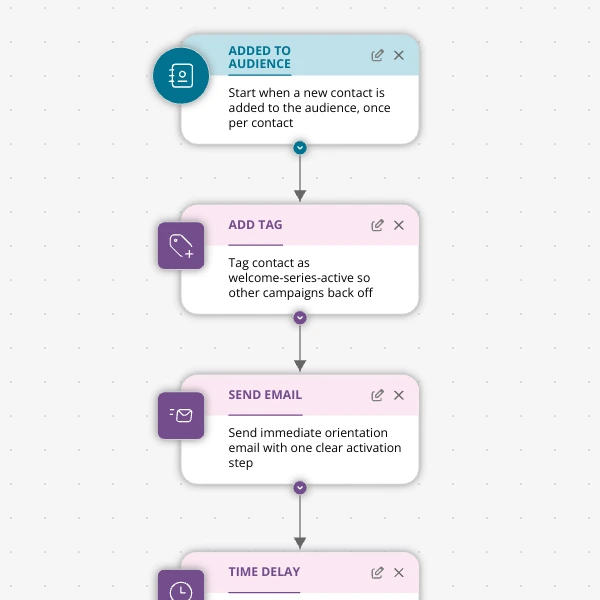
The Shopify app welcome series that turns installs into income
A step-by-step Shopify app welcome email journey for tools like CartSpark, showing how to turn new installs into activated, retained merchants using Spreeflo journeys, tags, and behavioral triggers so fewer trials quietly churn and more trials convert.
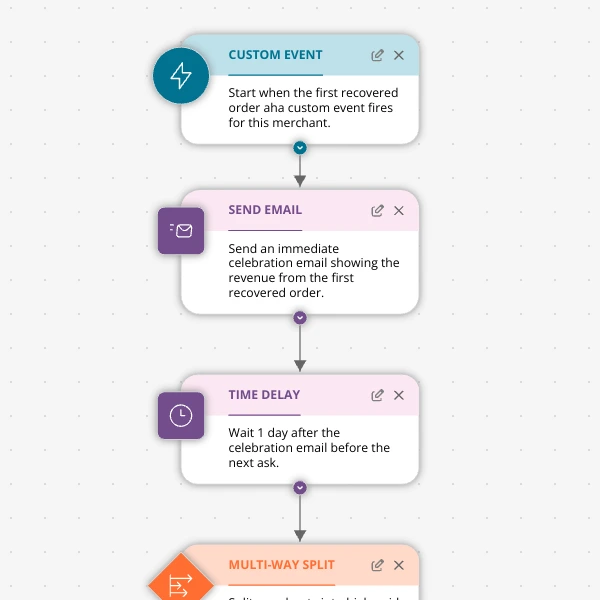
The Aha-Moment Playbook For Shopify Apps: Turn One Magic Action Into Months Of Revenue
A node-by-node playbook for Shopify and e‑commerce apps to center their lifecycle on one aha-moment custom event in Spreeflo, celebrate it, segment merchants by profile and engagement, and turn first recovered value into lasting revenue and retention.
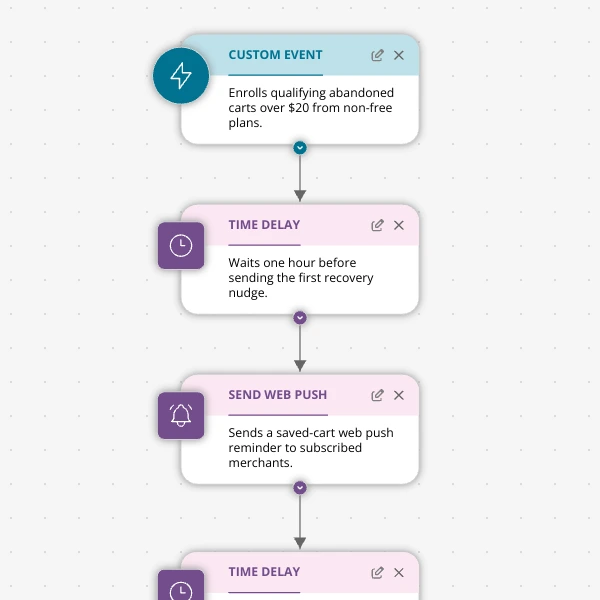
Stop Letting High‑Intent Carts Die: A 3‑Email Recovery Journey for Shopify Apps
A detailed, node-by-node walkthrough of a three-email (plus optional web push) cart-abandonment recovery journey for Shopify apps in Spreeflo, showing how to trigger events, branch on behavior, tag outcomes, and measure recovered carts and revenue.
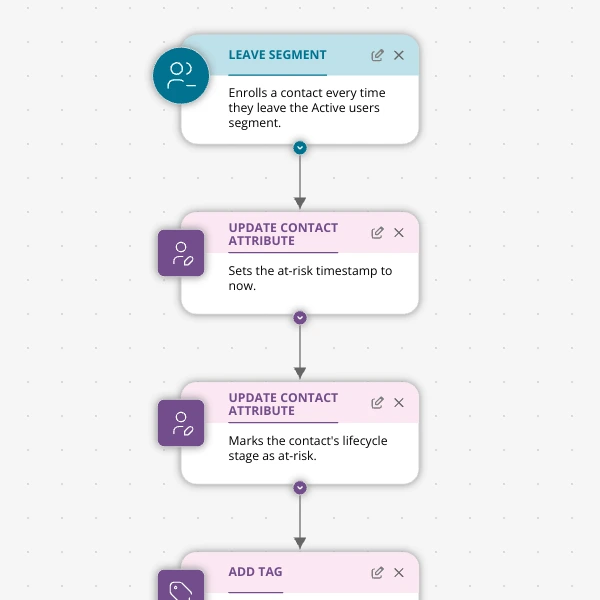
When Active Users Go Dark: A 4‑Touch Win‑Back Journey For Your Shopify App
A detailed, node-by-node Spreeflo journey for winning back previously active Shopify app users who stop engaging, using segment-based triggers, conditional logic, and a four-touch email plus internal alert sequence to recover usage and MRR.