Stop Missing Hot Trials: A Slack Handoff Journey for SEO SaaS Teams
This playbook shows how a tiny SEO SaaS team can wire high-intent product signals into Slack using Spreeflo journeys and Webhook actions, so sales-worthy trials and key customer moments get human follow-up within minutes instead of disappearing.
Industry
Niche
Pattern
Loading sequence...
The worst feeling is opening Stripe in the morning and realizing a perfect-fit trial signed up yesterday, poked around once, and vanished before anyone said hello.
For a 3–5 person SEO SaaS team, that’s usually not a “strategy” problem. It’s a handoff problem: high‑intent signals are buried in activity logs and inboxes instead of landing where your humans actually live all day—Slack. The sequence at the top of this page is the whole journey, end to end, for fixing that.
In this playbook, we’ll walk through how a fictional rank tracker, RankPulse (~$40k MRR, 3 people), wired their product signals into Slack using Spreeflo’s Webhook action. Result: sales‑worthy trials hit the right Slack channel within seconds of an event, without hiring anyone to “watch the dashboard.”
Why the Slack handoff is worth more than another nurture email
As an SEO SaaS founder, you probably have decent email automation already. Trials get a welcome series. New customers get onboarding. That’s table stakes.
Where revenue quietly leaks is in the moments that deserve a human:
An agency signs up with 12 client domains on day one
A trial user connects Google Search Console and imports 500 keywords
A long‑time customer hits your technical audit limits three months in a row
Those aren’t “send another drip email” moments. Those are “someone should DM them in the next five minutes” moments.
But in most stacks, those signals live in three places your team doesn’t monitor in real time:
App logs or a BI tool
A CRM that no one opens outside review days
A billing or usage dashboard behind three clicks
The pattern we’re building solves exactly that. Spreeflo listens for high‑intent product events, then fires a Webhook action to a Slack incoming webhook. Every important event becomes a structured message in the right channel.
You set it up once; it keeps working while you sleep. That’s the essence of the idea that founder‑led businesses win on leverage, not headcount.
What this journey actually does
Before we break down the nodes, here’s the behavior in plain English:
Your backend scoring job or billing system POSTs a “high_intent_lead” event to the Spreeflo API whenever a contact crosses your threshold (e.g. lead_score ≥ 80, plan_type = “Agency”).
A journey with a Custom Event trigger picks up that event immediately.
An If/Else node checks whether this contact is already a paying customer.
Each branch goes to a Webhook action:\n - New lead → Slack webhook for
#sales-high-intent\n - Existing customer → Slack webhook for#expansion-alertsA Merge node recombines both branches.
An Add Tag node flags the contact as “slack-alert-sent” for reporting.
The sequence at the top of this page shows that flow visually. Now let’s walk it node by node, including how to configure each step in Spreeflo.
Step 0: Get your product signals into Spreeflo
This pattern starts before the journey: you need meaningful events flowing into Spreeflo.
For “external” events coming from your backend (scoring workers, billing, support tools), use the Spreeflo API, not the JavaScript SDK. Concretely:
Your scoring or billing job detects a trigger condition (e.g. “trial account has >5 seats and added_first_keyword”).
It POSTs a JSON payload to the events endpoint with:\n -
eventname like"high_intent_lead",\n -emailfor the contact,\n - and any useful properties (e.g.score,plan_type,seat_count).
At the same time, have that job update or upsert contact attributes for anything you’ll want in Slack (for example lead_score, company_size, primary_use_case). Those attributes are what the Webhook action can include later.
Once those events are flowing, you’re ready to wire the journey.
Step 1: Custom Event trigger – catch only the right leads
First node in the journey is a Custom Event trigger.
Configuration:
Event name:
high_intent_lead(or whatever you chose in your API calls).Add property conditions: on.\n - Property
scoregreater than or equal to80.\n - Propertyplan_typeis one ofAgency,Pro.Re-enrollment: on.
Why this configuration:
Event name scopes the journey to a specific signal. You might be sending lots of custom events (
started_trial,cancelled_subscription, etc.); this journey should listen only for the “high intent” one.Property conditions guard against noisy or misconfigured events. If someone accidentally logs a
high_intent_leadfor a free hobby user, it won’t fire becauseplan_typedoesn’t match.Re-enrollment on matters if the same contact hits “high intent” more than once (for example, an agency that adds a second workspace). The path is short, so the mid‑journey lock is effectively invisible: they’ll exit within milliseconds and can re‑enter on the next event.
If your scoring logic gets more complex over time, you can still express it here thanks to the same engine behind the segment builder. But keep this trigger focused on one job: “Is this event a lead we care about right now?”
Step 2: If/Else – split new leads from existing customers
Not every “high intent” event belongs to sales. Sometimes it’s an expansion or churn‑risk signal for an existing customer.
Next on the canvas is an If/Else process node:
Condition (built with the segment builder inline):
Group condition: AND
Rule: Contact Tags “contact is tagged with”
customer
If true → “Existing customer” branch.\nIf false → “New lead” branch.
Why this split:
New leads should typically alert whoever owns net‑new revenue (you, a part‑time closer, or a small sales pod).
Existing customers belong to whoever owns expansion and retention (often you again, or a success‑ish hat someone wears).
You could do this same split with Segment Membership (e.g. “is member of segment Paying Customers”), but tags are a lighter‑weight way to get started. However you express it, the goal is clear: send humans the right flavor of alert so they know how to respond.
Step 3: Webhook action – pipe context straight into Slack
Each branch from the If/Else node goes into its own Webhook action. This is where the Pro‑plan magic happens.
Why two Webhook nodes instead of one:
Slack incoming webhooks are tied to a specific channel. If you want #sales-high-intent and #expansion-alerts to receive different messages, you generate two Slack webhook URLs and paste each into its own node.
Configuration for the “New lead” branch Webhook:
Webhook URL: the Slack incoming webhook for
#sales-high-intent.Method: POST.
Contact fields: “Selected specific fields.”\n - Email, First Name, Last Name.\n - Custom attributes:
lead_score,company_name,company_size,primary_use_case,plan_type.Optional headers: if you run the webhook through a proxy that needs an API key, add it here.
Custom payload: a structured body that Slack can format nicely (for example, top‑line text + a block of fields).
Configuration for the “Existing customer” branch is identical, except:
Webhook URL: the Slack webhook for
#expansion-alerts.You might choose a different subset of attributes (e.g.
mrr,months_on_plan,last_active_at).
Because the Webhook node sends contact attributes, not raw event properties, you want your upstream systems to keep those attributes current. That’s why the Step 0 API design matters: when you detect “high intent,” you should both fire the event and ensure the contact has fresh lead_score, seat_count, and similar attributes.
What a good Slack message includes:
Who: name and email, plus tags like “Trial” or “Customer”.
What they did: a short description derived from your scoring logic (“Connected GSC and added 3 domains within 1 hour of signup”).
Why it matters: surfaced attributes like plan type, estimated account size, or use case.
What to do: a link back to the user’s record in your own admin, and optionally a prewritten outreach snippet.
The exact formatting lives in Slack’s side, but all the raw ingredients come from Spreeflo’s contact record flowing through this Webhook node.
Step 4: Merge – keep your canvas sane
After each Webhook action, the sequence points to a Merge node.
This node has no configuration; it exists to respect one crucial rule in Spreeflo’s journey engine: except for Merge, every node should have at most one incoming edge. If you want common behavior after two branches, you merge first, then continue.
In our pattern, both the “New lead” and “Existing customer” branches feed into the same Merge. Think of it as “everything that got a Slack alert, regardless of flavor.”
From there, you can attach whatever shared logic you need.
Step 5: Add Tag – track that an alert was sent
From the Merge, the path goes into an Add Tag action.
Configuration:
Tags:
slack-alert-sent(and optionally something more specific likealert-high-intent).Force Tag Trigger: off (unless you want other journeys to react explicitly to this tag being added).
Why bother, if Slack already got the ping?
Because you want an audit trail inside your marketing system:
You can later build a segment of “high intent leads where tag slack-alert-sent is present” to compare against closed‑won deals.
If a bug or Slack outage ever happens, you’ll know which contacts should have fired alerts even if messages didn’t land.
It opens the door to meta‑automation: for example, a weekly Campaign that emails you a digest of leads where
slack-alert-sentis present but nobody has updated their CRM status.
This tag is a cheap, future‑proof bit of instrumentation. Add it now; you’ll thank yourself when you start asking, “Is this Slack workflow actually improving revenue?”
Measuring success: handoff latency and team acknowledgement
Every automation needs a clear “did it work?” The two metrics that matter here match the pattern’s definition:
Handoff latency
Team acknowledgement rate
Handoff latency: from event to eyes-on
Conceptually, handoff latency is:
Time when the high_intent_lead event hit Spreeflo\nminus\nTime when someone on the team actually saw the alert
You can approximate this a few ways:
Compare the event timestamp in the contact’s activity feed against the Slack message timestamp.
If your Slack message links to an internal “claim this lead” action in your admin, record when that action happens and calculate the delta.
At minimum, eyeball a sample week: search Slack for “New high-intent trial” and spot‑check how long after signup those messages appear.
If you used to discover good leads hours or days later by accident, you’ll often see latency drop into the seconds‑to‑minutes range with this journey.
Team acknowledgement: are humans actually acting?
An instant Slack alert is worthless if nobody responds.
You won’t track Slack reactions inside Spreeflo, but you can still get a solid read:
Define a contact attribute like
high_intent_handled(boolean) orhigh_intent_owner(text).When someone claims a lead in your admin or CRM, update that attribute via the Spreeflo API or a downstream automation.
In a segment or report, compare:\n - Total contacts who triggered this journey\n - Versus contacts where
slack-alert-senttag is present andhigh_intent_handledis true
Your “team acknowledgement rate” becomes the percentage of alerts someone actively took ownership of. Aim to push that towards 100% for your highest‑value signals.
Variations: other SEO SaaS moments worth piping into Slack
Once you have this pattern working for “high intent lead,” it’s easy to clone the journey and adjust the Custom Event trigger for other moments:
Churn risk: event
inactive_for_21_dayswith properties likeis_customer = true. Route to a#churn-watchchannel for quick outreach.Expansion opportunity: event
usage_exceeded_planwhen someone maxes out their keyword or audit limits three months in a row.Broken onboarding: event
trial_stalledfired when they started a trial but never added a single keyword or connected Search Console.VIP feedback: event
nps_submittedwith propertyscore <= 6for detractors, routed to a#product-feedbackchannel with account context.
Each one reuses the same bones: Custom Event trigger → routing logic via If/Else or Multi-way Split → Webhook into Slack → Merge → Add Tag.
Because journeys are easy to duplicate inside campaigns and journeys, you’re minutes away from turning product behavior into a live feed your tiny team can actually act on.
Where this fits in your Spreeflo setup
This pattern relies on a few core pieces of the platform working together:
Contacts, tags, and attributes defined under audiences and segmentation, so your Webhook payloads have real context.
Custom events and server‑side ingestion via the Spreeflo API, so backend signals reach the journey engine.
The Webhook action, which sits alongside email and web push in the journey canvas.
A bit of segmentation logic via the segment builder inside the If/Else node.
Because Webhook is a Professional‑plan feature, it’s worth skimming the breakdown of pricing plans if you’re currently on Free or Starter. For most SEO SaaS teams, a single saved deal or expansion more than pays for that tier.
The deeper win: compounding leverage for a tiny team
On its face, this is “just” a Slack alert flow. But zoom out a bit.
Before, you or someone on the team had two grim options:
Spend hours a week scraping dashboards and inboxes for “good” signups.
Accept that you’ll only spot the loudest leads, and the rest will quietly churn.
Neither scales without hiring. This journey gives you a third option: bake your instincts into the product and let automation do the watching for you.
You decide once what “high intent” looks like. You define once how that should be routed and presented. Then Spreeflo listens 24/7 and pings Slack with exactly the context you wish you had when you’re reaching out.
That’s the kind of system founder‑led businesses live on: it keeps amplifying your best judgment without demanding more hours or headcount. If you already know which moments in your SEO tool matter most, wiring them into this Slack handoff journey is one of the fastest, lowest‑friction ways to turn that knowledge into revenue.
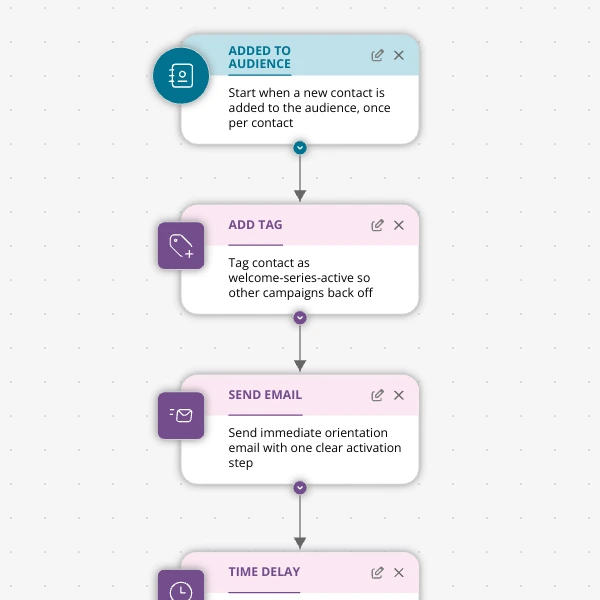
The Shopify app welcome series that turns installs into income
A step-by-step Shopify app welcome email journey for tools like CartSpark, showing how to turn new installs into activated, retained merchants using Spreeflo journeys, tags, and behavioral triggers so fewer trials quietly churn and more trials convert.
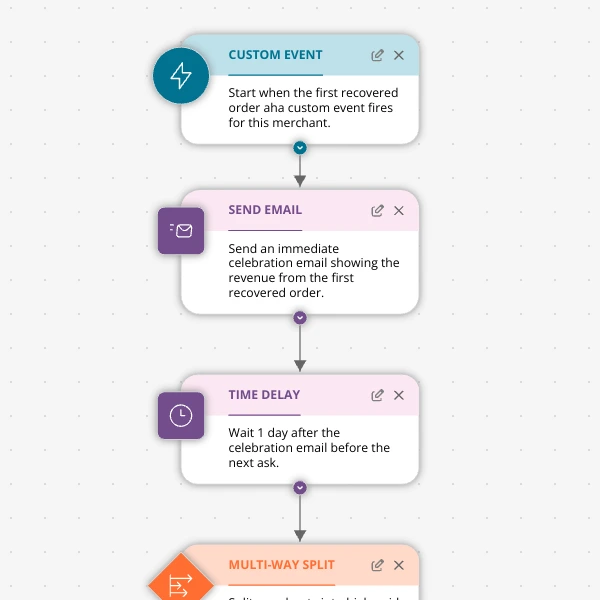
The Aha-Moment Playbook For Shopify Apps: Turn One Magic Action Into Months Of Revenue
A node-by-node playbook for Shopify and e‑commerce apps to center their lifecycle on one aha-moment custom event in Spreeflo, celebrate it, segment merchants by profile and engagement, and turn first recovered value into lasting revenue and retention.
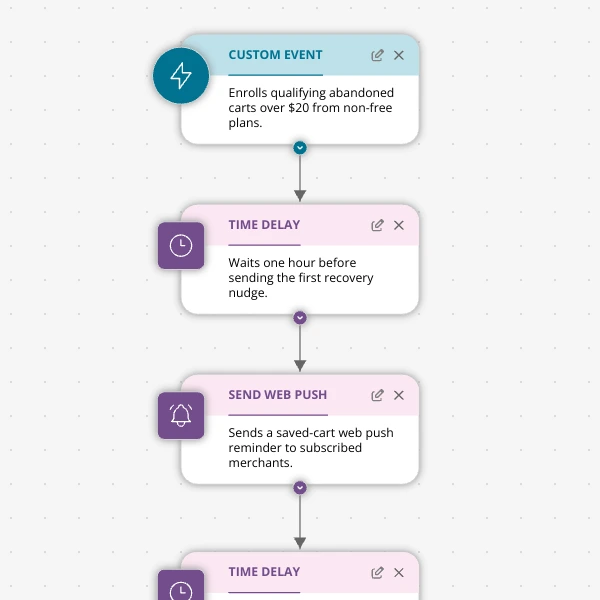
Stop Letting High‑Intent Carts Die: A 3‑Email Recovery Journey for Shopify Apps
A detailed, node-by-node walkthrough of a three-email (plus optional web push) cart-abandonment recovery journey for Shopify apps in Spreeflo, showing how to trigger events, branch on behavior, tag outcomes, and measure recovered carts and revenue.
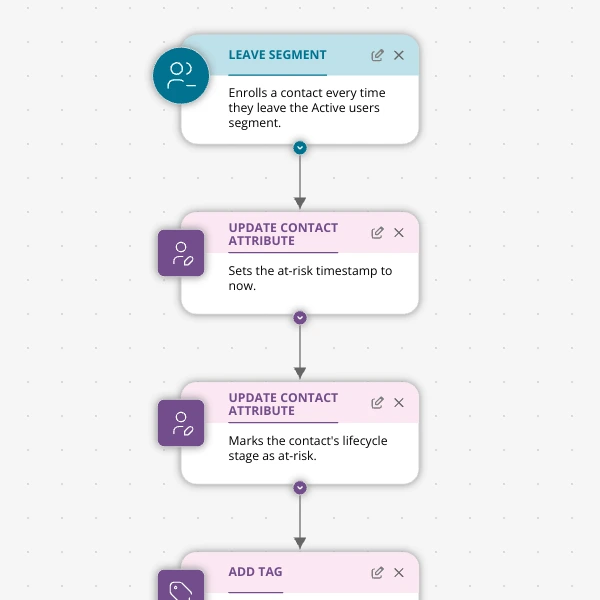
When Active Users Go Dark: A 4‑Touch Win‑Back Journey For Your Shopify App
A detailed, node-by-node Spreeflo journey for winning back previously active Shopify app users who stop engaging, using segment-based triggers, conditional logic, and a four-touch email plus internal alert sequence to recover usage and MRR.