Stop Slacking “Who Came In Yesterday”: Build a Daily Qualified‑Lead Digest Instead
Shows founder-led SEO SaaS teams how to replace ad-hoc “who came in?” Slack messages with a daily qualified-lead digest journey in Spreeflo, using Cyclic triggers and internal emails so every high-intent trial gets timely follow-up.
Industry
Niche
Pattern
Loading sequence...
The bigger your SEO SaaS gets, the more dangerous it is to run sales from memory and Slack scrollback.
At RankPulse, a three‑person rank‑tracking startup doing ~$40k MRR, the founder used to wake up, refresh Stripe, skim Intercom, and DM sales: “These are yesterday’s hot trials.” Half the time, someone forgot to follow up. Nobody could answer a simple question: “How many good leads did we get yesterday, and who owns them?”
The sequence at the top of this page is the whole journey, end to end. It replaces those ad‑hoc “who came in?” pings with a predictable, automation‑driven daily ritual.
Every morning, Spreeflo runs a Cyclic trigger over your audience, pulls out the leads that actually crossed your qualification line in the last 24 hours, and sends your team structured internal emails so nothing slips.
For a founder‑led SEO SaaS, this is leverage in its purest form: one flow you set up once that keeps your sales motion honest forever, without new headcount.
Why your team needs a ritual, not random alerts
When you’re at $10–20k MRR, it’s still possible to “just know” who came in yesterday:
You remember the two demo requests that looked serious.
You scroll back through Stripe emails for annual payments.
You skim Intercom conversations to see which trials asked good questions.
Once you have dozens of trials and agencies in motion at the same time, that breaks:
Lead response time balloons because nobody has a clean, shared list of who deserves immediate attention.
Sales and success teams build their own personal spreadsheets as a workaround.
You, the founder, are still the only person with a mental model of “what a good lead looks like.”
This journey exists to turn that fuzz into a clockwork habit: every morning at 9:00, your team opens their inbox and sees exactly which leads qualified yesterday, with enough context to act.
And you didn’t have to run a report, export a CSV, or ping anyone in Slack.
What this journey does, in plain terms
Before we go node‑by‑node, it’s worth stating the goal clearly:
Run once a day at a fixed time.
Find every contact who crossed your qualification threshold in the last 24 hours.
Send internal emails (one per lead) to the right people with the details they need.
Optionally tag those leads as “digest_notified” so other automations can branch on that.
Think of it as a daily, batched notification window. Your sales or success team gets a short cluster of structured emails instead of a random stream of “FYI” messages throughout the day.
Let’s walk through how to build a journey that does exactly that.
Step 1: Decide what “qualified lead” really means in your product
A daily digest is only as good as the definition it runs on. For SEO SaaS, “qualified” is usually product‑driven rather than just “filled out a form.”
For example, at a content‑brief tool like BrieflySEO:
Signed up for a trial
Added at least one domain
Generated 2+ content briefs
Invited at least one teammate
Company size ≥ 5 (from the signup form)
At a rank tracker like RankPulse:
Connected Google Search Console
Tracked at least 20 keywords
Checked rankings on 3 separate days
Clicked on “Upgrade” or “Pricing” during the trial
Write this down. Make it specific. Your future self will thank you.
Then mirror that definition in Spreeflo’s data model. There are three common patterns:
There are three common patterns:
Tag‑based: When a lead meets your criteria (in your app, in Stripe, or manually in a CRM), you apply a
lead-qualifiedtag to their contact in Spreeflo.Attribute‑based: You maintain a
lead_statusorpql_stagecustom attribute (TEXT) and set it to"qualified"when they cross the line.Event‑based: Your app fires a dedicated
lead_qualifiedcustom event via the Spreeflo SDK or the Spreeflo API when a user reaches your PQL threshold.
The journey you’re looking at is built on top of that signal; it doesn’t decide who is qualified on its own. It trusts that your product and data already know.
If you’re not yet using tags, attributes, or events this way, it’s worth skimming the segment builder documentation first. Everything that follows uses those same building blocks.
Step 2: Express “qualified in the last 24 hours” as criteria
The Cyclic trigger in Spreeflo has a built‑in criteria field powered by the same engine as saved segments. That’s where you tell the journey which contacts to include on each run.
For this pattern, the criteria should answer:
“Which contacts became qualified in the last day?”
There are two clean ways to model that.
Option A: Tag + time window (simple and flexible)
Use a tag to represent qualification, plus a time‑based rule:
Contact Tags:
contact is tagged with→lead-qualifiedCustom Events:
lead_qualifiedeventtriggered at least 1 time in the last 1 day
Here, your app (or your backend via the Spreeflo API) fires a lead_qualified event whenever a contact becomes qualified and also applies the lead-qualified tag. The time window “in the last 1 day” ensures this journey only touches leads who crossed that line in the last 24 hours.
Even if you later change the definition of “qualified” in your product, the digest stays valid as long as you continue to fire that event and tag.
Option B: Segment membership + contact added date
If your leads mostly come from Spreeflo forms like “Request a Demo” or “Talk to Sales,” you might define qualification in a saved segment instead:
Segment Membership:
is member of segment→Qualified leadsContact Added Date:
is within→ last 1 day
Here, the “Qualified leads” segment might be defined as:
Filled out the “Request a demo” form
Company size ≥ 5
Job title contains “SEO”, “Marketing”, or “Growth”
You’re then telling the Cyclic trigger: “Once a day, look at everyone who was added to my audience in the last 24 hours and who is currently a member of ‘Qualified leads’.”
Either approach is valid. The important thing is that your criteria are:
Behavior‑or attribute‑based (not just “filled a form”).
Time‑bounded to 1 day, so each lead appears in the digest once.
We’ll plug this criteria into the trigger in the next step.
Step 3: Configure the Cyclic trigger as your daily heartbeat
Now open Spreeflo and create a new Journey. If you’re new to the automation canvas, the overview on campaign and journey automation is a good companion.
On the canvas:
Drag in a Cyclic trigger.
Set the schedule:
Repeat interval:Every 1 day
Time of day: whatever works for your team’s morning standup (e.g.09:00)
Timezone: your team’s operating timezone (e.g.America/New_York)Under Criteria, build the rules from Step 2:
Either the tag + event approach, or the segment + contact added date approach.Toggle Re-enrollment to
on.
That last piece is subtle but important.
Re‑enrollment controls whether the same contact can be enrolled by the same Cyclic trigger again on future days. Because your criteria uses “in the last 1 day,” a given lead will naturally age out of the window after 24 hours. Turning re‑enrollment on is a safety net:
If you ever widen the window (e.g. “in the last 7 days” for a weekly digest), the same contact can appear multiple times across different runs when it genuinely still matches.
If you leave it off and later adjust your criteria, some leads might never enter again because the journey already ran for them once.
With the Cyclic trigger set up this way, Spreeflo will, once a day, hand off each matching contact to the rest of the journey.
Step 4: Use Send Internal Email to brief the team on each lead
Next, you want an internal notification that your team actually reads and acts on.
On the canvas:
Drag a Send Internal Email node and connect it directly after the Cyclic trigger.
Configure it:
Template name: something like “Daily qualified lead digest”.
From: the sending identity your team will recognize (e.g.founder@yourdomain.com).
Recipients: your sales alias or a shared inbox (e.g.sales@yourdomain.com). Even though the contact is the “subject” of the journey, the email goes to your team.
Leave Send only once on; each qualified lead should only ever generate one digest email.
For the content, use Spreeflo’s email builder to create a lean, structured template. Think about what a rep needs to decide “Do I jump on this now?”:
Name, company, and role
Plan or trial type
Source (e.g. “Requested demo”, “Upgraded to Pro trial”)
Key behaviors that contributed to qualification (e.g. “Generated 5 content briefs”, “Tracked 50+ keywords”)
When they qualified (e.g. “Qualified at: {{ last_lead_qualified_at }}”)
Suggested next step (e.g. “Reply with a Loom walk‑through focusing on their content brief workflow.”)
Because Send Internal Email shares mechanics with Send Email, you can use personalization variables to pull in contact attributes and event‑driven fields. The result is an internal brief that feels hand‑written for each lead, even though the journey assembled it automatically.
Over time, two things happen:
Your team trusts that every meaningful lead will show up in this morning cluster of emails.
You can measure adoption and effectiveness by looking at this node’s open rate and correlating it with your CRM notes or closed‑won deals.
Step 5: (Optional) Tag leads once they’ve appeared in the digest
In many teams, the daily digest is the start of a lead’s internal lifecycle. You might have other journeys that:
Nudge the team again if nobody has contacted a qualified lead within 48 hours.
Change messaging once someone has already received a personal outreach.
To support that, it helps to mark leads that have already appeared in a digest.
On the canvas:
After the Send Internal Email node, drag an Add Tag action.
Configure it to apply a tag like
digest_notified.Leave Force tag trigger off, unless you intentionally want to fire other Added Tag triggers downstream.
Now you can use this tag in other automations and segments:
“Qualified leads without digest_notified tag” → sanity check that your digest is catching everything.
“Qualified leads with digest_notified tag but no ‘contacted’ attribute” → follow‑up reminder flows.
Again, this is how founder‑led companies win on leverage: one tiny extra step that unlocks a whole layer of automation later.
Step 6: Split by owner or region if your team is bigger
If you have more than one person handling inbound — for example, one AE focused on agencies and another on in‑house teams — you can route digest emails accordingly.
Right after the Cyclic trigger:
Insert an If/Else or Multi-way Split node.
Branch on criteria such as:
Contact Attributes:company_type is agency
Country / region
Plan interest (e.g. “Enterprise” vs “Pro”)On each branch, use a different Send Internal Email node with:
A different To: address (e.g.agency-sales@…vsmidmarket-sales@…)
Slightly different suggested next steps tailored to that segment
Downstream, you can use a Merge node to bring the branches back together into the common “Add digest_notified tag” action.
This keeps the journey single‑source but lets you scale your routing logic as the team grows, without turning your CRM into a custom dev project.
Step 7: Make it a habit and iterate from there
Once the journey is live, run it quietly for a week with the internal emails going only to you and maybe one other person.
Watch for:
Are any obviously qualified leads missing from the digest? If so, your qualification criteria in Step 2 need tightening or widening.
Are clearly unqualified leads showing up? That’s a signal your “lead_qualified” event or tag is being applied too early.
Do the internal emails make it clear what to do next, or do they require extra clicks and context switching?
Two small tweaks usually pay off fast:
Subject line clarity
Make it brutally obvious what the email is and who it’s about:
“Qualified SEO lead: {{ company_name }} ({{ country }})”
Your team should be able to triage just from the inbox view.Content weight
Internal emails shouldn’t read like reports. Cut boilerplate, surface the two or three behaviors that matter, and always end with a suggested next action.
As you tune it, remember: this is a system you build once and rely on daily. That’s exactly the kind of leverage campaigns and journeys are meant to give founder‑led teams.
Why this pattern keeps earning its place
For an SEO SaaS, most revenue leaks look boring on the surface:
Trials that looked promising but never got a call.
Agencies that would have upgraded if someone had noticed their usage spike.
Teams that churned quietly after a good initial onboarding.
None of those need more tooling or more staff. They need consistent, timely attention.
A daily qualified‑lead digest journey does three things for you:
It externalizes your mental model of “what a good lead looks like” into data your whole team can see.
It guarantees that every day someone is nudged to act on that model, without you remembering to run a report.
It gives you a simple, measurable ritual to improve: “Did we contact every lead in yesterday’s digest within 24 hours?”
That’s founder‑level leverage: one hour spent designing a journey that quietly improves sales behavior every single day.
If you’re already tracking key product behaviors and capturing lead details, you have everything you need to wire this up in Spreeflo. Start with a simple Cyclic trigger, layer on internal emails your team will actually use, and let automation carry the weight — so you can focus on building the kind of SEO product agencies can’t live without.
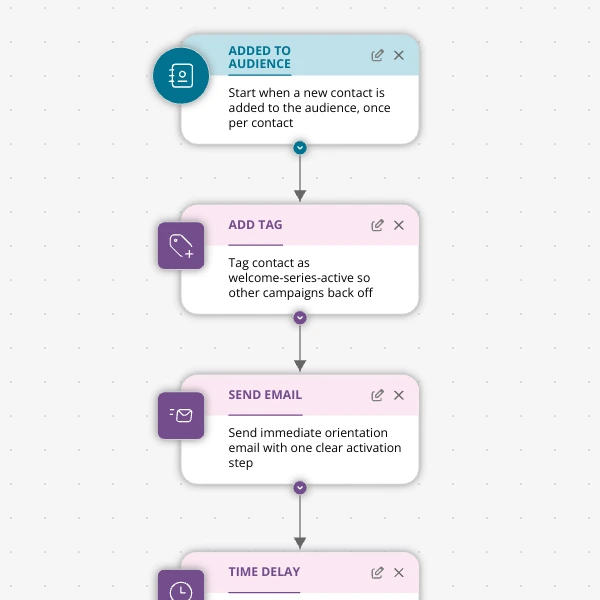
The Shopify app welcome series that turns installs into income
A step-by-step Shopify app welcome email journey for tools like CartSpark, showing how to turn new installs into activated, retained merchants using Spreeflo journeys, tags, and behavioral triggers so fewer trials quietly churn and more trials convert.
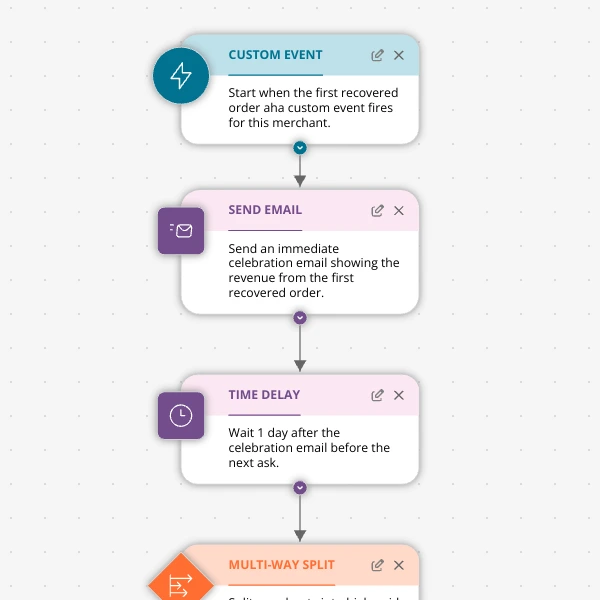
The Aha-Moment Playbook For Shopify Apps: Turn One Magic Action Into Months Of Revenue
A node-by-node playbook for Shopify and e‑commerce apps to center their lifecycle on one aha-moment custom event in Spreeflo, celebrate it, segment merchants by profile and engagement, and turn first recovered value into lasting revenue and retention.
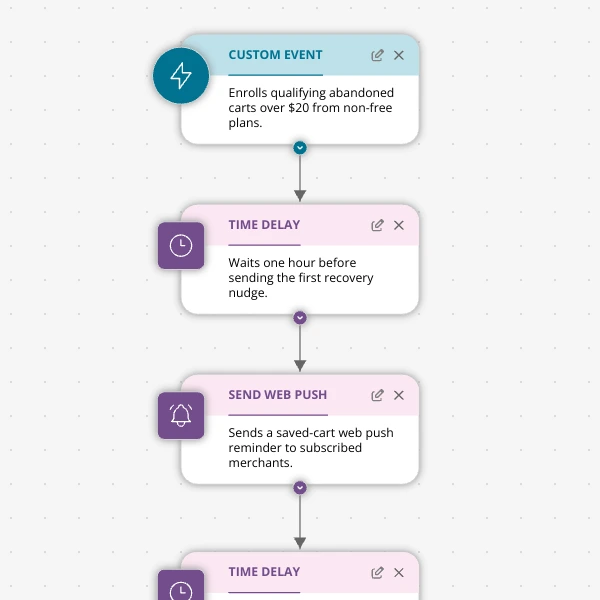
Stop Letting High‑Intent Carts Die: A 3‑Email Recovery Journey for Shopify Apps
A detailed, node-by-node walkthrough of a three-email (plus optional web push) cart-abandonment recovery journey for Shopify apps in Spreeflo, showing how to trigger events, branch on behavior, tag outcomes, and measure recovered carts and revenue.
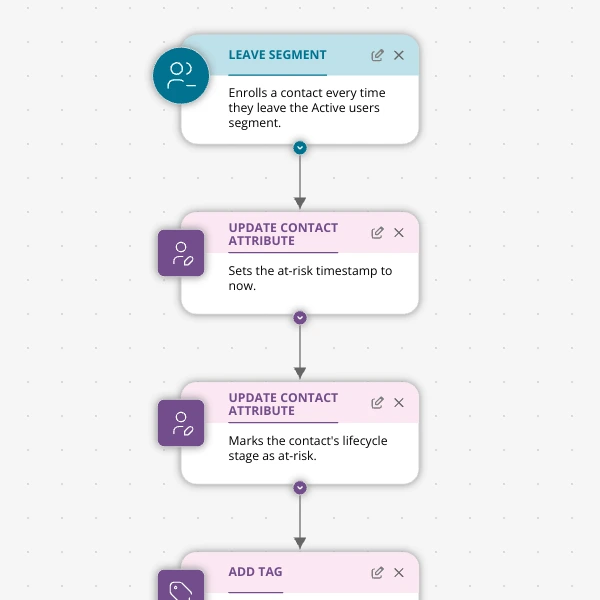
When Active Users Go Dark: A 4‑Touch Win‑Back Journey For Your Shopify App
A detailed, node-by-node Spreeflo journey for winning back previously active Shopify app users who stop engaging, using segment-based triggers, conditional logic, and a four-touch email plus internal alert sequence to recover usage and MRR.