Stop Wasting Expensive Clicks: A Source-Specific Nurture Playbook for SEO SaaS
A hands-on playbook for SEO SaaS teams to rebuild onboarding in Spreeflo so every lead is routed and nurtured by acquisition source and intent, improving LinkedIn ads, organic blog, and partner webinar conversion into MQLs and paying customers.
Industry
Niche
Pattern
Loading sequence...
A $90 LinkedIn click that lands in the same generic welcome as your $0 organic subscriber is a tax on your own CAC.
That’s exactly where “SERPForge” (our fictional SEO SaaS) found itself: rank tracking and content briefs for agencies, ~$60k MRR, decent trial signups, but paid LinkedIn leads were churning before they ever added a keyword. All traffic fed into one catch‑all newsletter. Paid prospects who clicked an ad about “saving 5 hours a week on reporting” were getting a blog digest about title tags.
The sequence at the top of this page is the whole journey, end to end. It shows how SERPForge rebuilt onboarding so every lead is nurtured differently depending on how and why they arrived.
This article walks through that journey node by node so you can adapt it to your own SEO SaaS.
Why one-size nurture kills expensive SEO clicks
For an SEO SaaS, acquisition sources aren’t equal:
A blog reader who spent 7 minutes on a technical audit article is intent‑rich but early.
A LinkedIn lead who filled out a “get a done‑for‑you audit template” form is mid‑funnel and problem‑aware.
A partner webinar attendee already knows you exist and carved out an hour to listen.
Treat them the same and three things happen:
Source‑to‑MQL rates flatline. Paid leads never get the follow‑up that matches the promise that made them click.
Sales has no way to prioritize. A trial from “random directory listing” looks identical to a hand‑raiser from your “agency playbook” campaign.
You can’t see which sources actually convert, because you’re not carrying source and intent through to nurture and opportunity creation.
Source‑specific nurture fixes this by doing two things:
Capturing detailed context on how each contact arrived and what they were promised.
Routing every new contact into a journey that speaks directly to that context.
Spreeflo exists for exactly this kind of work: one journey, many paths, all driven by rich customer data instead of a flat list. Once you set it up, it just runs — a system that converts and qualifies leads while you ship product.
Step 1: Capture source and intent on every signup
You can’t personalize nurture by source if you don’t store the source.
Before touching the automation, SERPForge standardized three contact attributes in Spreeflo:
acquisition_source(text): “linkedin_paid”, “organic_blog”, “partner_webinar”, “referral”, etc.acquisition_campaign(text): e.g. “agency_reporting_playbook”.acquisition_topic(text): the pain or feature that got the click, like “rank_tracking”, “content_briefs”, “technical_seo”.
On-site forms: map UTMs directly into contacts
Anywhere you control the form — pricing page trial, blog newsletter box, footer signup — should be a Spreeflo form:
Build the form in Spreeflo with Email as a required field and Map to contacts turned on.
Add hidden fields for
utm_source,utm_campaign, and (optional)utm_content.Map each hidden field to the corresponding contact attribute (
acquisition_source,acquisition_campaign,acquisition_topic).
Embed the form inline using Spreeflo’s embed.js snippet. The submission creates or updates the contact with source and intent already populated.
If you haven’t wired any of this before, the quick-start guide and the forms how‑to make it straightforward.
External capture (LinkedIn lead gen, partner tools)
For sources you don’t control — LinkedIn Lead Gen forms, third‑party event platforms — you can’t embed a Spreeflo form. Here the pattern is:
Your backend receives the submission via the platform’s webhook.
It POSTs to the Spreeflo API to create or update the contact, setting
acquisition_source,acquisition_campaign, andacquisition_topicdirectly on the contact record.
Once those attributes exist, the automation doesn’t care whether the lead came from an embedded Spreeflo form or an external platform.
Tag for coarse grouping, attributes for nuance
SERPForge also added a simple tag convention:
src:linkedin_paidsrc:organic_blogsrc:partner_webinar
Tags make quick filtering easy. Attributes store the nuance you’ll branch on inside the journey. Both are first‑class in Spreeflo’s segment builder, which is what powers all the logic next.
Step 2: Build one journey that routes every new lead by source
This pattern uses a single journey that catches all new contacts, then splits them into different nurture paths based on source and intent.
Trigger: Add to Audience
Start with a Journey (not a Campaign) in Spreeflo’s campaigns and journeys view.
Drag in an Add to Audience trigger.
Set Re-enrollment to off.
This means:
Any time a new contact is added to your Spreeflo audience — via form, import, or API — they enter this journey once.
Even if you later re-import or retag them, they won’t re-run the same nurture, which prevents duplicate welcomes and messy data.
Filter out existing customers
Next, SERPForge added a quick guard clause so current customers don’t get “here’s why you should try us” emails.
Right after the trigger:
Add an If/Else process node.
Condition: using the segment builder, check something like:
Contact tag is
customerOR
Plan attribute (e.g.
current_plan) is not blank.
“Then” branch (is customer): go straight to journey end or a different journey meant for expansion/upsell.
“Else” branch (is prospect): continue into source‑specific nurture.
Multi-way Split: route by acquisition_source
From the “is prospect” branch, add a Multi-way Split:
Branch A:
acquisition_sourceis “linkedin_paid” OR tag containssrc:linkedin_paid.Branch B:
acquisition_sourceis “organic_blog” OR tag containssrc:organic_blog.Branch C:
acquisition_sourceis “partner_webinar”.Else branch: everything else (referrals, directories, etc.).
Order matters. Put your most specific conditions first so they catch the right leads.
From here, each branch becomes its own mini‑nurture, still inside the same journey.
Step 3: Design the source-specific email paths
Now for the fun part: what each path actually says and does.
Across all branches, SERPForge stuck to a simple cadence:
Email 1: within minutes of signup.
Email 2: +1 day.
Email 3: +3–5 days, conditional on behavior.
Spreeflo’s Send Email, Time Delay, and Check Email Activity nodes do the heavy lifting. All email content was built in Spreeflo’s email builder, with AI personalization helping tailor subject lines by source and topic.
Below is how one branch is wired, then how the others mirror it.
LinkedIn paid path: honor the ad promise and qualify fast
These leads cost real money and clicked on a specific promise. The goal: confirm that promise, deliver a quick win, then qualify or disqualify quickly.
Inside the LinkedIn branch:
Add Tag
- Action: Add Tag.
- Tags:src:linkedin_paid,nurture:ads.
This makes it easy later to build segments like “LinkedIn ad leads who became MQLs”.Send Email — “You clicked the reporting shortcut”
- Node: Send Email.
- Subject and copy reference the ad’s language (“save 5 hours a week on reporting”), not your generic product pitch.
- CTA: a single, focused step (e.g. “Connect your Search Console to see your reporting baseline”).Time Delay — 1 day
- Node: Time Delay, 1 day.
This spacing keeps you compliant with the “no back‑to‑back sends” rule and gives them time to act.Send Email — case study + stronger CTA
- Node: Send Email.
- Content: a short case study from an agency client that solved the same pain the ad promised, with metrics.
- CTA: start a trial or, for higher ACV, “Book a 15‑minute audit review”.Time Delay — 3 days
- Node: Time Delay, 3 days.
Now you have enough time for them to open, click, and maybe poke around the app.Check Email Activity — behavior-based split
- Node: Check Email Activity, targeting the second email.
- Branches configured:
- Branchclicked: Link Clicked.
- Branchopened_no_click: Opened.
- Branchunopened: Not Opened.
- Else: a safety net if something weird happens with tracking.
From here:
6A. Clicked branch: mark as MQL and alert the team
Add Tag
- Tag:mql.
This is the simple flag you’ll use in reporting: source‑to‑MQL rate.Update Contact Attribute
- Set anmql_sourceattribute to the literal value “linkedin_paid”.
You can’t copy dynamic event data here, but a static label is enough for attribution.Send Internal Email
- Notify a shared inbox (e.g. founders@) with the contact’s company, plan of interest, and acquisition campaign.
- This uses the Send Internal Email action so it doesn’t count as a customer‑facing send.Journey end for this branch
- At this point, sales or the founder takes over manually or via a separate sales‑assist journey.
6B. Opened but didn’t click: nudge with a low-friction ask
Time Delay — 2 days.
Send Email
- A short, plain‑text style note: “Saw you checked out our agency reporting playbook. What’s the hardest part of reporting for you right now?”
- CTA: reply to the email, not click another button. This often surfaces objections.Optionally, later:
- After another Time Delay, you can use another Check Email Activity on this third email to see who replied or clicked a secondary link and tag them as warm.
6C. Unopened: test a new angle
Time Delay — 2 days.
Send Email
- Same core offer as email 2, but with a different subject line and shorter body.
- You can use Spreeflo’s AI assistance from the personalization guide to adapt copy to “busy agency owner” language.Journey end or move them into a slower, generic newsletter stream after a Merge node.
Throughout, every Send Email node is separated by a Time Delay on every path, so no one receives two marketing emails in immediate succession.
Organic blog path: deepen the topic they came for
For organic_blog leads, SERPForge cared less about speed to MQL and more about staying relevant to the topic that pulled them in.
This branch mirrors the LinkedIn structure, with different content:
Add Tag:
src:organic_blog.Optional Multi-way Split on
acquisition_topic:
-rank_tracking
-content_briefs
-technical_seoFor each topic:
- Email 1: “expanded edition” of the article with a downloadable checklist.
- Time Delay — 1 day.
- Email 2: product walkthrough tied to that topic (e.g. “set up daily ranking alerts in 5 minutes”).
- Time Delay — 3 days.
- Check Email Activity on Email 2 with the same three branches (clicked / opened / unopened) feeding into similar follow‑ups as LinkedIn, but with softer CTAs.
You still use Add Tag, Send Email, Time Delay, and Check Email Activity nodes — the difference is message and aggressiveness, not the structure.
Partner webinar path: deliver the recording and move to next step
partner_webinar leads already invested time, so the path is shorter and more direct:
Add Tag:
src:partner_webinar.Send Email: link to recording + “slides & templates”.
Time Delay — 1 day.
Send Email: explicit next step tied to webinar content (“load your first 10 client domains and we’ll show you red‑flag SERP changes in 24 hours”).
Time Delay — 3 days.
Check Email Activity on Email 2 and, on “clicked”, immediately tag
mqland send an Internal Email.
The Else branch from the original Multi-way Split can drop into a simpler 2‑email generic welcome.
Step 4: Mark MQLs and measure by source
Personalized nurture is only half the point. The other half is seeing which sources actually move.
Because SERPForge consistently tagged MQLs and labeled mql_source, they could answer three key questions using Spreeflo’s segments and email analytics.
1. Source-to-MQL rate
Create segments such as:
“LinkedIn paid leads” → tag
src:linkedin_paid.“Organic blog leads” → tag
src:organic_blog.
Then overlay the mql tag in the segment builder:
“LinkedIn paid MQLs” =
src:linkedin_paidANDmqltag present.“Organic blog MQLs” =
src:organic_blogANDmqltag present.
Divide MQL segment size by total source segment size. If LinkedIn is at 25% and organic at 8%, you know the ads are doing their job — provided LTV holds.
2. CTA conversion by source
Because Check Email Activity branches by clicks on specific emails, you can:
Look at click‑through rates on the main CTA emails inside each branch.
Compare, for example, “trial CTA email to LinkedIn leads” vs “trial CTA email to organic readers”.
Low clicks from one source signal either copy misalignment or a mismatch between ad promise and landing experience.
3. Source-tagged conversions (upgrades or retained trials)
Finally, connect downstream product events:
Fire
started_trial,upgraded_plan, orcancelled_subscriptionas custom events from your frontend using the Spreeflo SDK, or from your backend via the Spreeflo API.Build segments like “LinkedIn paid leads who fired
upgraded_planat least once” vs the same for organic.
Build segments like “LinkedIn paid leads who fired upgraded_plan at least once” vs the same for organic.
Now you can see:
Which nurture paths drive real revenue.
Whether that extra email in the LinkedIn path actually moves the needle or just adds noise.
What this gives a small SEO SaaS team
For a 3–5 person SEO SaaS, the point isn’t fancy flows for their own sake. It’s about storing enough detail on each contact that you can talk to them like a person, not a row, and doing that at a scale your headcount can’t.
This pattern compounds in three ways:
Every acquisition source gets a message that reflects what it promised, so fewer people feel “sold one thing, onboarded to another”.
Sales and success wake up each morning to a cleaner list: warm leads are already tagged as MQLs, with source and topic attached.
You design the journey once in Spreeflo and refine it as you learn. It doesn’t care if your ad spend doubles or your organic traffic spikes — it just keeps routing people down the right path.
If you’re paying for clicks or writing content to bring in leads, a source‑blind nurture is leaving money on the table. A source‑specific journey like the one in the sequence at the top of this page turns that same traffic into conversations that feel like you remember where each person came from — because, in Spreeflo, you actually do.
When you’re ready to stop treating a $90 LinkedIn click like a random newsletter signup, this is the automation to build. And because of Spreeflo’s pricing, you can run source‑aware journeys long before you can justify an enterprise‑grade stack or a bigger marketing team.
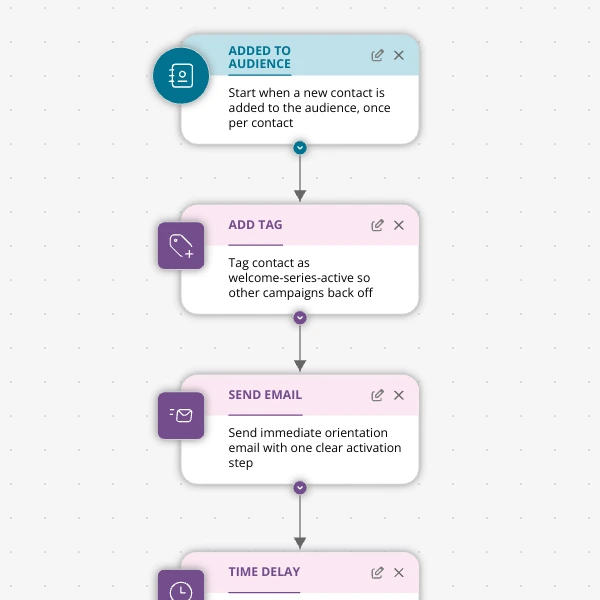
The Shopify app welcome series that turns installs into income
A step-by-step Shopify app welcome email journey for tools like CartSpark, showing how to turn new installs into activated, retained merchants using Spreeflo journeys, tags, and behavioral triggers so fewer trials quietly churn and more trials convert.
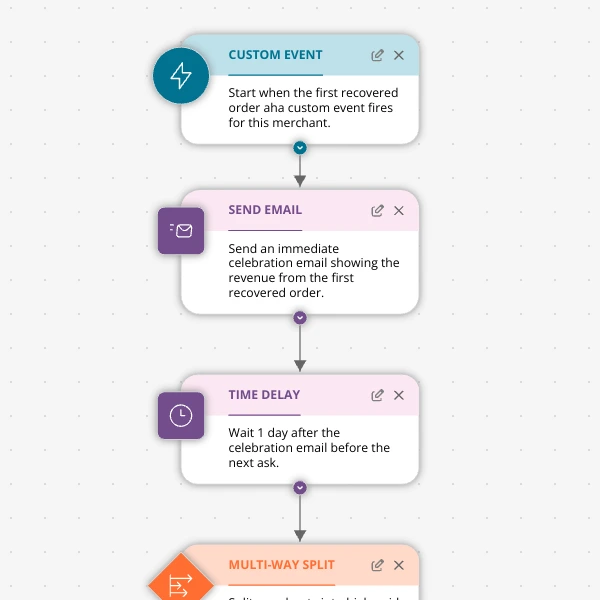
The Aha-Moment Playbook For Shopify Apps: Turn One Magic Action Into Months Of Revenue
A node-by-node playbook for Shopify and e‑commerce apps to center their lifecycle on one aha-moment custom event in Spreeflo, celebrate it, segment merchants by profile and engagement, and turn first recovered value into lasting revenue and retention.
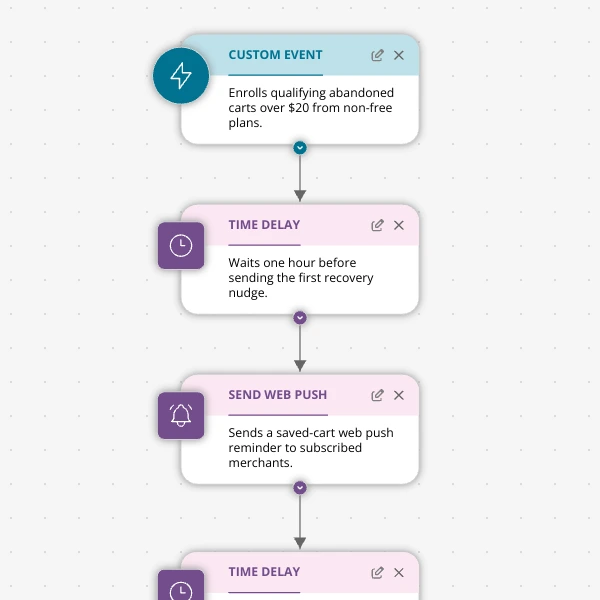
Stop Letting High‑Intent Carts Die: A 3‑Email Recovery Journey for Shopify Apps
A detailed, node-by-node walkthrough of a three-email (plus optional web push) cart-abandonment recovery journey for Shopify apps in Spreeflo, showing how to trigger events, branch on behavior, tag outcomes, and measure recovered carts and revenue.
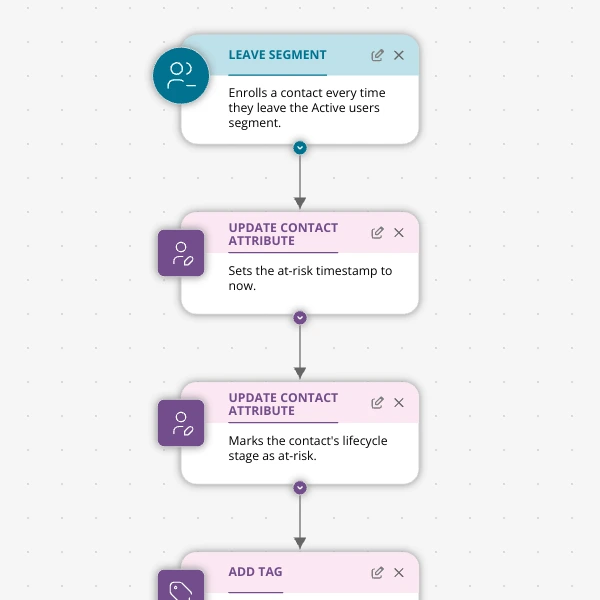
When Active Users Go Dark: A 4‑Touch Win‑Back Journey For Your Shopify App
A detailed, node-by-node Spreeflo journey for winning back previously active Shopify app users who stop engaging, using segment-based triggers, conditional logic, and a four-touch email plus internal alert sequence to recover usage and MRR.