The 7‑Day Dunning Journey That Quietly Saves Your SEO SaaS MRR
A concrete 7‑day dunning journey for SEO SaaS tools using Spreeflo, from triggering on real billing failures to recovery, escalation, and churn tagging, so you quietly reduce billing‑failure churn and protect MRR without adding manual work.
Industry
Niche
Pattern
Loading sequence...
The first time Stripe quietly marked a batch of renewals as “failed,” RankPulse’s founder didn’t notice for a week. By then, four agency accounts had churned without a single human conversation.
That is what billing‑failure churn looks like in a growing SEO SaaS: invisible until it’s expensive. The sequence at the top of this page is the whole journey, end to end, for fixing that with Spreeflo.
In this playbook, we’ll build a concrete dunning journey for your SEO tool: one that reacts to a payment_failed event, nudges customers over seven days, escalates to a human when needed, and branches cleanly once payment succeeds or the account is truly lost.
Why card failures wreck healthy SEO SaaS businesses
For a rank tracker, content brief generator, or technical audit tool, most churn doesn’t come from angry customers. It comes from:
Expired cards
Maxed‑out limits
Bank fraud checks that never get resolved
None of those are product problems. But if you treat them as “Stripe’s job,” you’re leaking lifetime value. A 1–2% monthly card‑failure churn compounds brutally when your average customer sticks around for 12–24 months.
This is classic “leaky bucket” territory: you worked hard to get trial signups, onboard them, and get them ranking. Letting them disappear because a card expired is the worst kind of waste.
A structured dunning journey is how you stop that leak without adding manual work to a tiny team. You build it once; it runs on every failed payment.
What this dunning journey does in plain English
Before we go node‑by‑node, here’s the behaviour you’re aiming for (mirrored by the sequence above):
Your billing system (Stripe, Paddle, Lemon Squeezy, your own backend) hits the Spreeflo API with a
payment_failedevent.Spreeflo’s journey triggers on that
payment_failedcustom event.The contact is tagged as having a billing issue and immediately receives a clear, low‑friction email asking them to update their card.
Over the next seven days, the journey:
At each checkpoint, if the customer does update their payment method and the charge goes through, they exit the dunning path and are marked as recovered instead of churned.
Waits to see if a
payment_succeededevent comes throughSends a second reminder if it doesn’t
Escalates internally around day 5
Sends a final “we’ll pause your account” email around day 7
The rest of this article walks through how each node in the Spreeflo journey contributes to that behaviour, and which settings matter.
Step 1: Trigger on real billing failures (not support experiments)
Node: Custom Event trigger (payment_failed)
This is an “external” trigger: billing doesn’t happen in the browser, so your frontend can’t call the Spreeflo SDK here. When a renewal fails, your backend should POST to the Spreeflo events API with an event like:
event: "payment_failed"email: "customer@example.com"Properties like
amount,currency,reason,invoice_id,plan,is_renewal
In the journey, you use a Custom Event trigger with:
Event name:
payment_failedProperty conditions: narrow to actual renewals:
is_renewalistrueamountgreater than0
Turn Re-enrollment on. You want this journey to run every time a renewal fails, even if the same customer had a failed payment last year and recovered.
This is also where you protect yourself from noise. If you send payment_failed for setup‑fee attempts or $0 validation charges, use property conditions to ignore them.
Step 2: Mark the account as “billing at risk”
Node: Add Tag (billing_issue)
Right after the trigger, add an Add Tag action:
Tag:
billing_issue
This does two things:
Makes it easy to build a segment of “customers currently in dunning” using the segment builder.
Makes the rest of your automation (onboarding, upsell campaigns) conditional. You probably don’t want to invite someone to a “Scale your SEO operations” webinar while their access is about to be cut off.
You can also use Update Contact Attribute to set something like:
Attribute:
billing_statusValue: literal text
failed_renewal
That attribute gives you clearer reporting and a hook for other journeys.
Step 3: Send the first dunning email immediately
Node: Send Email (initial billing issue)
This is the only point in the journey where immediate email makes sense. A failed payment is both urgent and time‑sensitive, and customers expect quick notification.
Use Send Email with:
A clear, non‑threatening subject:
Short body that:
“We couldn’t renew your RankPulse subscription”
“Action needed: update your card to keep your SEO data live”
States what happened
Reassures them their data is safe for now
Gives a single, obvious button to “Update billing details”
Mentions what they’d lose if the subscription lapses (rank history, saved briefs, audit reports)
Build this in Spreeflo’s email builder so you can reuse it, tweak versions, and A/B test subject lines later.
Keep the tone like a system notice, not a collection agency:
No threats
No guilt
Just consequences and clear next steps
That matters for agencies in particular. If they feel embarrassed in front of their clients, they may just cancel instead of fixing the card.
Step 4: Give them 48 hours to self‑serve
Nodes: Wait Condition → If/Else (recovered vs still failing)
Right after the first email, add a Wait Condition action. Configure it to:
Condition: Custom event
payment_succeededtriggered at least 1 time in the last 3 daysTimeout duration: 2 days
Under the hood, that condition uses Custom Events in the segment builder:
“Custom event payment_succeeded at least 1 time in the last 3 days.”
Your backend should send that payment_succeeded event via the Spreeflo API whenever Stripe (or your processor) confirms a recovered charge for a subscription.
This Wait Condition does exactly what you want:
If the customer fixes their card in an hour and the retry goes through, the condition becomes true quickly and they move on.
If they ignore the email, the condition stays false and they only move on after the 2‑day timeout.
After the Wait Condition, add an If/Else process with the same condition:
Yes path: “recovered within 48 hours”
Else path: “still failing after 48 hours”
This small duplication is important. It lets you branch behaviour based on whether the payment has actually succeeded or not.
Step 5A: When payment succeeds quickly, clean up and move on
Nodes: Remove Tag (billing_issue) → optional Send Internal Email
In the “Yes, payment succeeded” branch:
Remove Tag:
Optionally Add Tag:
Tags:
billing_issueTag:
billing_recovered
At this point, you usually don’t need to send another customer‑facing email. Their bank will send a receipt; your app can show “Billing up to date” in the UI.
What is useful is an internal heads‑up for larger accounts. Add a Send Internal Email node to notify whoever owns customer success:
Subject: “Recovered billing for [account name]”
Body: include key contact attributes (MRR, plan, last login, whether they’re an agency) so a human can decide whether this was just card noise or a retention risk.
Then end the branch. The customer quietly returns to normal lifecycle journeys.
Step 5B: If nothing happens, send a second reminder
Nodes: Send Email (second notice) → Wait Condition → If/Else
On the “still failing” branch, you send a second email:
Same Send Email node type, but:
Firmer subject, still respectful:
More explicit consequence timeline:
“Second attempt to renew your RankPulse subscription”
“We’re still unable to process your RankPulse renewal”
“If we can’t process payment in the next 5 days, your projects will be paused.”
Then add another Wait Condition:
Condition: same
payment_succeededruleTimeout duration: 3 days
Follow again with an If/Else:
Yes path: “recovered between day 2 and day 5” → same cleanup branch (Remove Tag, optional internal note).
Else path: “still failing after 5 days” → this is where you escalate.
This structure matters because it stacks your nudges without hammering the user:
Email 1: Day 0
Email 2: Day 2
Internal escalation: Day 5
Final notice: Day 7
Always with a Wait Condition or Time Delay in between email sends, so you never fire back‑to‑back emails off of a single event.
Step 6: Escalate to a human and prepare for pause
Nodes: Send Internal Email → Update Contact Attribute → Time Delay
On the “still failing after 5 days” branch, do three things.
Send Internal Email to whoever can do nuanced outreach:
Update Contact Attribute:
Time Delay:
Subject: “Billing at risk: 5‑day failed renewal – [account name]”
Body: include:
- Plan and MRR
- Whether they’re an agency (e.g., attribute likecustomer_type = agency)
- Last login date / lastchecked_rankingsevent
- Link to their contact record in your own admin
Attribute:
billing_statusValue: literal text
at_risk_pause
Duration: 2 days, unit: days
That pushes the final email to around day 7 from the initial failure, which matches the “7‑day dunning window” many SaaS teams use.
Step 7: Send the final “we’ll pause your account” notice
Nodes: Send Email (final notice) → Webhook (optional) → Add Tag (churned)
After the 2‑day delay, send the last customer‑facing email:
Subject along the lines of:
Body:
“Final notice: your RankPulse account will be paused tomorrow”
Name the exact date when access will be paused or downgraded.
Reinforce what they stand to lose (historical ranking data, saved content briefs, technical audit history).
Keep a single, obvious CTA to “Update billing details”.
Avoid shaming language; treat this as operational, not emotional.
Then you can add two more actions:
Webhook (Professional plan):
Add Tag:
Target: an endpoint in your backend that handles pauses/cancellations.
Payload: either all contact attributes or selected ones like email, plan, billing_status.
Tag:
billing_churned
At this point, the contact exits the journey.
A few configuration choices that matter more than they seem
A couple of design details will make or break this pattern.
Re-enrollment on the Custom Event trigger: Without this, a customer who once went through dunning will never enter again, even if they have another failed renewal a year from now. Turning
isReEnrollmenton keeps the journey reusable for every incident, while Spreeflo still prevents parallel enrollments for the same contact.Property filters on events: If you fire
payment_failedfor every minor hiccup, you’ll annoy good customers. Filter to real risk cases: renewals, non‑trial plans, amount above some floor (e.g. > $5).Segment Builder conditions that line up with your billing windows: When you define the
payment_succeededcondition in the segment builder, match your retry strategy. If Stripe retries over 7 days, use “at least 1 time in the last 7 days” when you check before cancellation so a late success still counts.Don’t mix this journey with generic win‑back: Keep dunning isolated. Win‑back sequences for “user hasn’t logged in for 30 days” should exclude
billing_statusvalues likefailed_renewalor thebilling_issuetag, so you’re not sending “We miss you” campaigns to someone who’s about to lose access.
What to measure once it’s live
This journey exists to protect revenue, not just to feel organised. Track:
Recovered payments: number of
payment_succeededevents that occur while the contact has thebilling_issuetag.Recovery rate: recovered payments divided by total
payment_failedjourneys started.Billing‑failure churn: number of contacts who hit the final Webhook/Add Tag path without a recovery, and their associated MRR.
Because every step in this flow is a node, you can correlate uplift in those numbers back to the journey in your own reporting. Even modest gains matter: if you reduce billing‑failure churn by 20–30% on a $60k MRR SEO SaaS, that’s thousands per month retained.
This is exactly the kind of lifecycle leak most founder‑led teams underestimate. They obsess over traffic and trial conversion while a quiet trickle of otherwise‑happy customers slip away for avoidable reasons.
Why this is worth an afternoon of setup
You don’t need a large team to run “grown‑up” billing operations. With campaign and journey automation in place, a single founder can design this dunning flow once and have it run for every failed renewal from here on out.
The upside isn’t abstract. It’s concrete extra months of subscription life for customers who already saw value in your SEO tool but hit a card snag. Protecting that value is as much a part of customer engagement as onboarding or feature education.
If you’re already tracking events server‑side, wiring payment_failed and payment_succeeded into the Spreeflo API and dropping them into a journey like the one at the top of this page is a straightforward next step. Once it’s live, you can refine copy, timings, and conditions as you learn.
The cost of not doing it is simple: every month, more of your hard‑won MRR disappears for reasons that have nothing to do with ranking reports, content briefs, or technical audits. A thoughtful dunning journey stops that leak and lets your acquisition work compound.
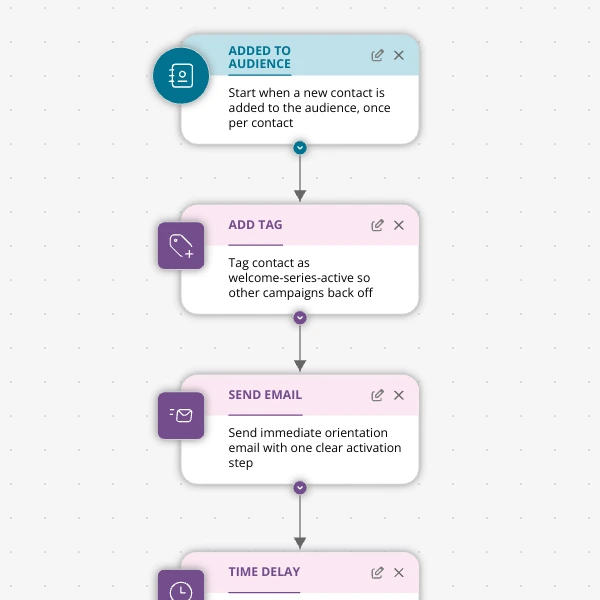
The Shopify app welcome series that turns installs into income
A step-by-step Shopify app welcome email journey for tools like CartSpark, showing how to turn new installs into activated, retained merchants using Spreeflo journeys, tags, and behavioral triggers so fewer trials quietly churn and more trials convert.
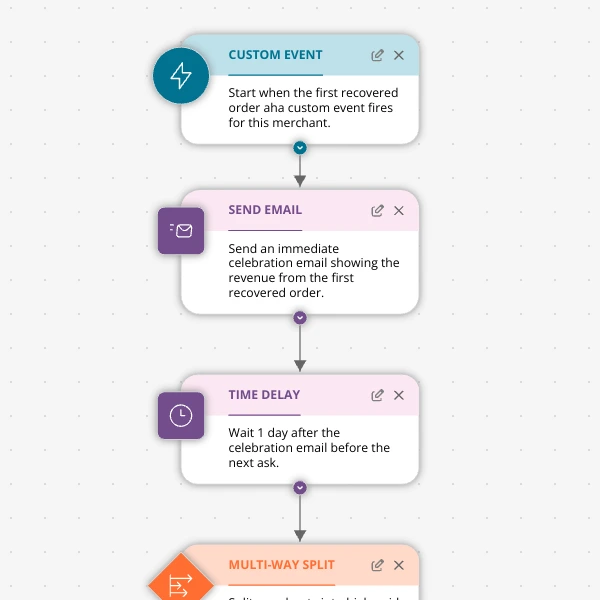
The Aha-Moment Playbook For Shopify Apps: Turn One Magic Action Into Months Of Revenue
A node-by-node playbook for Shopify and e‑commerce apps to center their lifecycle on one aha-moment custom event in Spreeflo, celebrate it, segment merchants by profile and engagement, and turn first recovered value into lasting revenue and retention.
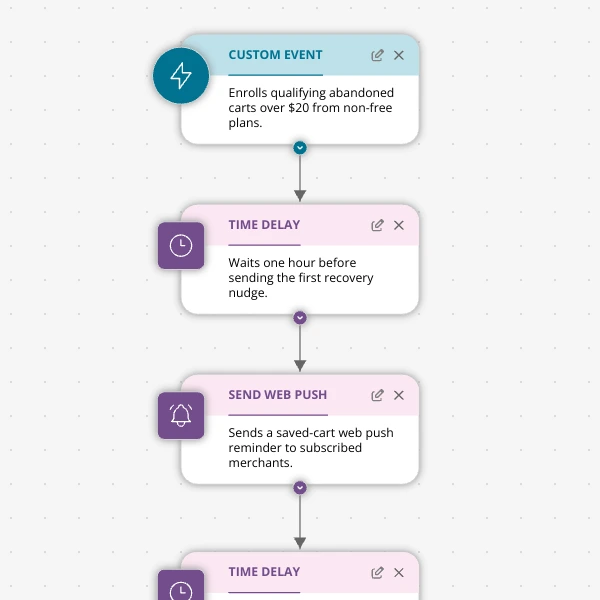
Stop Letting High‑Intent Carts Die: A 3‑Email Recovery Journey for Shopify Apps
A detailed, node-by-node walkthrough of a three-email (plus optional web push) cart-abandonment recovery journey for Shopify apps in Spreeflo, showing how to trigger events, branch on behavior, tag outcomes, and measure recovered carts and revenue.
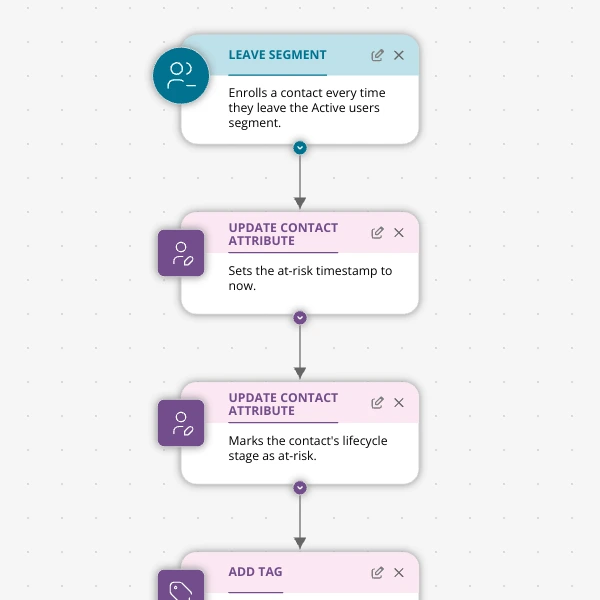
When Active Users Go Dark: A 4‑Touch Win‑Back Journey For Your Shopify App
A detailed, node-by-node Spreeflo journey for winning back previously active Shopify app users who stop engaging, using segment-based triggers, conditional logic, and a four-touch email plus internal alert sequence to recover usage and MRR.