The Engagement-Tier Engine That Protects Your SEO SaaS Deliverability
A detailed playbook for SEO SaaS teams to build an engagement-tier journey in Spreeflo that rotates Hot, Warm, and Cold contacts monthly, runs one-time re-engagement for Cold, and automatically prunes non-engagers to protect deliverability and retention.
Industry
Niche
Pattern
Loading sequence...
Your weekly “SEO insights” email used to pull 35% opens. Now it limps along at 11%, Gmail is quietly shoving you into Promotions, and trial users keep saying “I never saw that onboarding email.”
That isn’t just annoying. For an SEO SaaS, where rank alerts, crawl reports, and usage nudges all ride on email, poor deliverability is a direct churn driver.
The sequence at the top of this page is the whole journey, end to end: an engagement-tier rotation that quietly cleans and reshapes your list every month so you keep inbox placement high without constant manual list scrubs.
We’ll walk through it node by node and show how to adapt it to your own stack.
Why engagement tiers matter more than another list scrub
Take BrieflySEO, our fictional content-brief SaaS doing ~$60k MRR.
They send:
Trial onboarding and activation nudges
Weekly “SEO content ideas”
Monthly feature updates
For the first 1,000 users, blasting everyone worked fine. Then churn crept up, opens slid below 15%, and a chunk of Gmail users stopped getting critical trial emails at all.
The problem wasn’t just “a dirty list.” It was that every contact was treated identically:
Highly engaged agency users checking briefs daily
“Signed up once, never came back” leads from a launch post
Dormant ex-customers
They all got the same cadence, week after week. Low-engagement contacts quietly trained inbox providers that this sender can be ignored.
Engagement tiers fix that by:
Sending often to people who keep opening and clicking
Slowing or stopping sends to people who consistently ignore you
Continuously promoting and demoting people between those buckets based on behaviour
The journey you see in the visual sequence automates that rotation using Spreeflo’s Cyclic trigger, process nodes, and a few simple tags.
What this journey does in plain language
Before we drop into nodes, here’s the intent of the pattern:
Run a monthly engagement audit. A Cyclic trigger pulls in every subscribed marketing contact once a month.
Classify each contact into Hot / Warm / Cold. A Multi-way Split looks at recent email activity and drops contacts into the right branch.
Write the result back to the contact. Each branch updates tags and a text attribute, so every contact carries an explicit
engagement_tier.Run a gentle re-engagement for Cold, then prune. Cold contacts get a one-time “do you still want this?” email. If they ignore it, the journey marks them as non-subscribed so they don’t keep dragging down your metrics.
Your campaigns and other journeys then use those tags and attributes to control cadence. Hot and Warm get your weekly SEO content; Cold get almost nothing beyond the re-engagement attempt.
That’s the backbone. Now let’s go through each node and why it’s there.
Step 1: A monthly Cyclic trigger that only touches marketable contacts
Start by creating a journey (not a campaign). Journeys are built to run continuously, which is what you want for an evergreen hygiene pattern like this. If you want a deeper refresher on the difference, skim our overview of campaign and journey automation.
Add a Cyclic trigger as the starting node.
Configuration:
Repeat interval: every 1 month
Time of day: off-peak for your audience (e.g. 03:00 in your main timezone)
Timezone: where most of your list lives
Re-enrollment: on (critical — you want the same contact to pass through this flow every month)
For the trigger’s Criteria, open Spreeflo’s segment builder (the same one used in saved segments, now embedded in this node) and define something like:
Email subscription status is “Subscribed”
Marketing status is “Marketing”
This ensures:
You only touch people who are allowed to receive marketing email
You automatically exclude people already cleaned up by this or other flows
The key design choice: the Cyclic trigger’s interval (1 month) must be longer than the longest path in the journey. That way, every contact exits the flow before the next monthly audit tries to re-enroll them.
Step 2: Multi-way Split into Hot, Warm, and Cold
Next node: Multi-way Split.
This is where you define what “Hot”, “Warm”, and “Cold” mean in the context of your SEO SaaS. Use Email Activity rules in the segment builder for each branch.
A simple starting point:
Hot branch. Condition group (AND): Email Activity: opened at least 3 times in the last 30 days OR Email Activity: clicked at least 1 time in the last 30 days. This captures contacts who actively consume your content and click through for ranking reports, case studies, or feature updates.
Warm branch. Condition group: Email Activity: opened at least 1 time in the last 90 days. And critically, place this branch below Hot so people who qualify as Hot don’t “fall into” Warm first. Ordering matters; Multi-way Split evaluates branches top to bottom and takes the first match.
Cold branch (Else). Everyone who didn’t match Hot or Warm is treated as Cold: no opens at all in the last 90 days.
Why this split works:
30-day activity is a strong signal for agencies and in-house SEOs who depend on your tool.
90-day activity gives slower-cycle users (e.g. quarterly audits) breathing room.
Completely inactive beyond 90 days are the true deliverability risk.
You can tighten or loosen these windows later by editing the conditions — the structure of the journey doesn’t need to change.
Step 3: Stamp the engagement tier on Hot contacts
On the Hot branch, add three actions in sequence:
Remove Tag. Tags:
tier_warm,tier_cold. Force trigger: off. This clears out any previous tier to keep tiers mutually exclusive.Add Tag. Tags:
tier_hot.Update Contact Attribute. Attribute: a TEXT custom attribute, for example
engagement_tier. Update type: Update. Value:hot.
The value here is a static literal, which is exactly what you want: every Hot contact gets engagement_tier = "hot" when they come through this node.
Then you can end the path. Hot contacts don’t need a special send from this hygiene journey; they just need to be correctly tagged so your other marketing respects that.
Later, create saved segments under Audience → Segments such as:
“Engagement: Hot” where contact is tagged with
tier_hot“Engagement: Warm” where contact is tagged with
tier_warm
These are what you’ll target with your one-off campaigns and other automations. The hygiene journey simply keeps those segments accurate. If you want more detail on structuring this side, the audiences and segments overview is worth a skim.
Step 4: Do the same for Warm — but no special flow
On the Warm branch, mirror the same pattern:
Remove Tag. Tags:
tier_hot,tier_cold.Add Tag. Tags:
tier_warm.Update Contact Attribute. Attribute:
engagement_tier. Value:warm.
Again, end the path here.
Hot and Warm are your “good citizens.” You don’t need to send anything specific from this journey. The benefit is on the outbound side: you’ll include Hot and Warm in your weekly or biweekly sends and exclude (or deprioritize) Cold.
Step 5: Cold branch — re-engage once, then protect your reputation
The Cold branch is where you actively fix list health.
Start with the same housekeeping:
Remove Tag. Tags:
tier_hot,tier_warm.Add Tag. Tags:
tier_cold.Update Contact Attribute. Attribute:
engagement_tier. Value:cold.
Now add a Send Email action.
Configuration:
Template: a dedicated “Do you still want SEO insights from [Product]?” email
From: your usual marketing sender
Send only once: leave this on (default)
This last toggle is important. With the Cyclic trigger re-enrolling contacts every month, you don’t want someone to get the same re-engagement email every cycle. “Send only once” ensures each contact sees this email at most once across all their runs through the journey.
Content-wise, keep this email simple and intent-focused. A short paragraph that:
Acknowledges they haven’t engaged lately
Offers a single-button way to stay subscribed
Optionally lets them choose “less frequent updates” (you can map that to a different attribute via a form in another journey if you want to get fancy later)
Build it quickly in our email builder so it looks good on mobile and doesn’t trip spam filters with messy HTML.
Next, insert a Time Delay:
Delay: 14 days
Unit: Days
This gives Cold contacts up to two weeks to open or click that email.
Then, add a Check Email Activity process node:
Marketing email: select the re-engagement email you just created
Activities to branch on: Opened (branch A), Not Opened (branch B)
The node automatically adds an Else branch, but in this pattern you can treat “Not Opened” and Else as the same “did not engage” path.
Now you have two outcomes:
Opened branch – they showed a pulse
Not Opened branch – still radio silence
Opened: flag, then let the next audit handle promotion
For the Opened path, you don’t actually need to change their tier immediately. They just engaged with an email in the last 14 days, so they’ll almost certainly qualify for Warm (or even Hot) on the next monthly audit via the main Multi-way Split.
If you want extra visibility, you can:
Add Tag:
reengaged_from_cold
Then end the path. This tag is helpful for internal reporting — you can see how many contacts you rescue each month.
Not Opened: mark as non-subscribed to stop future sends
For the Not Opened branch, add:
Update Email Subscription Status. Status: Email non-subscribed (or Email unsubscribed, depending on your policy).
(Optional) Add Tag. Tags:
pruned_for_deliverability.
By changing their subscription status away from “Subscribed,” you ensure:
They are excluded from this journey’s Cyclic trigger going forward (because of the trigger criteria)
They drop out of all future marketing campaigns that respect subscription status
This is where the deliverability win shows up. You remove the long-term non-engagers who drag down your metrics, which improves inbox placement for the people who actually care about rank alerts and content briefs.
You’re not “deleting” them as contacts; they can still log in, use your tool, and even opt back in via a profile setting or form. You’re just telling your marketing system: stop emailing them by default.
How this pattern creates different cadences per tier
This journey itself doesn’t send your weekly newsletters or product updates. Its job is to:
Continuously classify everyone
Run a one-time re-engagement on the risky tier
Automatically prune those who stay cold
The cadence difference comes from how you use those tags and attributes in other automations and campaigns.
For example:
Your weekly “SEO strategy” newsletter campaign targets only the “Engagement: Hot” and “Engagement: Warm” segments.
A monthly “customer-only” feature roundup includes Hot, Warm, and maybe recent Cold who haven’t gone through this flow yet.
Cold contacts who ignored the re-engagement email never see broad marketing messages again, until they opt back in.
Because the journey runs monthly, tier changes are automatic:
Someone stops opening after a busy quarter? They glide from Hot → Warm → Cold, and eventually get the re-engagement email.
An ex-cold contact who clicked that email? They move back into Warm on the next audit and start seeing your best content again.
You’ve turned engagement data into a living control system, not a static CSV scrub.
If you want to keep costs predictable as your list grows, this also pairs nicely with the way Spreeflo’s pricing separates marketing contacts from stored contacts. Pruned Cold contacts don’t have to sit in your “active marketing” bucket.
Tuning the thresholds and reading the metrics
Once this is live, watch three numbers:
Open and click rate by tier. Hot should be your highest — often 30–40% opens or more. Warm will lag but should still be healthy. If Warm looks too close to Cold, your definition of Warm is probably too loose. Use segments built on
engagement_tieror tier tags to filter results when you look at email performance.Share of list in each tier. If 70%+ of your list is Cold, your front-end acquisition is likely too top-of-funnel or your onboarding is weak. If almost nobody ever becomes Cold, your thresholds are probably too strict and you’re not getting the deliverability benefit.
Inbox placement and complaint rate. Track this via tools like Gmail Postmaster, not just inside Spreeflo. Over a few months, you should see: fewer spam complaints, better placement for key transactional and onboarding emails, and more stable open rates.
As you learn, tweak the Multi-way Split conditions:
Shorten the “Cold” window if your list engages frequently (e.g. 60 days instead of 90).
Tighten “Hot” to 4+ opens in 30 days if too many people qualify.
The pattern stays the same; only the thresholds move.
Why this matters more for SEO SaaS than most
SEO SaaS has a specific dynamic:
Agencies and in-house SEOs live in their inbox.
Rank alerts, crawl issues, and content-brief suggestions are time-sensitive.
Churn often happens quietly when users stop logging in and stop seeing reminders of value.
If your sender reputation tanks because you keep mailing long-dead leads from a Product Hunt spike two years ago, you’ll stop reaching the people who actually need to see:
“Your client’s rankings just dropped for ‘seo agency london’”
“We found 312 broken internal links on acme.com”
“Here are 5 SERP gaps you can fill this month”
Engagement-tier rotation uses the detail you have on every contact — how often they open, click, and respond — to decide who hears from you and how often. It turns retention and deliverability into a system instead of a twice-a-year crisis.
For a small, founder-led team, that’s the kind of system that compounds. You design the journey once, wire it up with tags and segments, and it keeps your list healthy while you focus on building a better rank tracker or content-brief engine.
When you’re ready, open Spreeflo, create a new journey, drop in a Cyclic trigger, and recreate the sequence you see at the top of this page. With the segment builder and a handful of tags, you’ll have an engagement engine quietly protecting every other email you send.
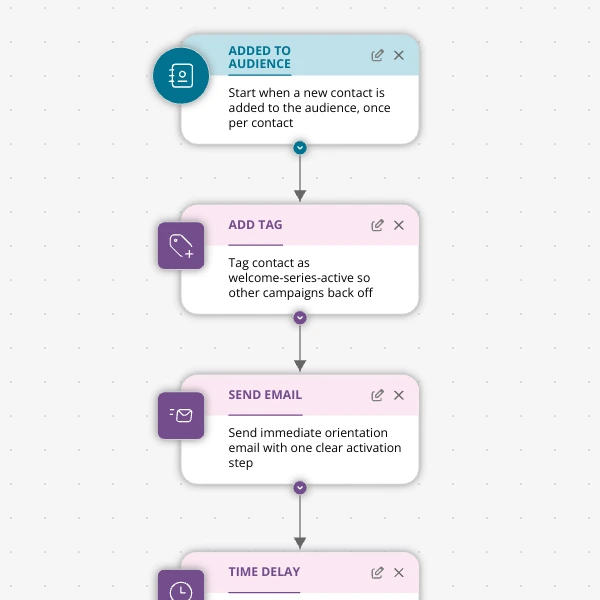
The Shopify app welcome series that turns installs into income
A step-by-step Shopify app welcome email journey for tools like CartSpark, showing how to turn new installs into activated, retained merchants using Spreeflo journeys, tags, and behavioral triggers so fewer trials quietly churn and more trials convert.
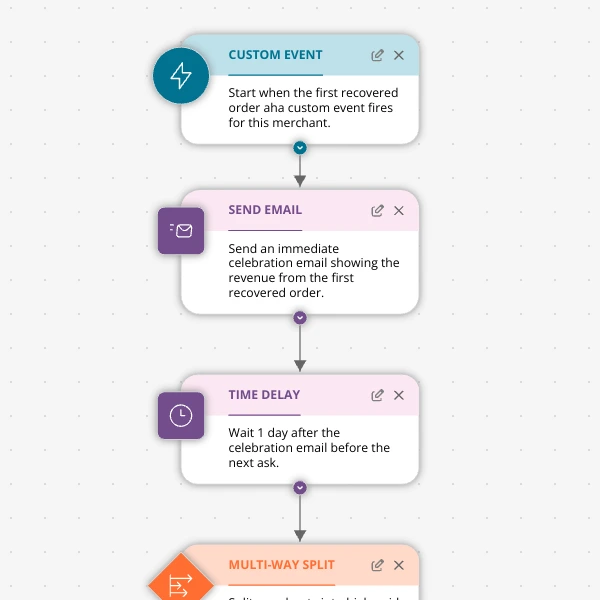
The Aha-Moment Playbook For Shopify Apps: Turn One Magic Action Into Months Of Revenue
A node-by-node playbook for Shopify and e‑commerce apps to center their lifecycle on one aha-moment custom event in Spreeflo, celebrate it, segment merchants by profile and engagement, and turn first recovered value into lasting revenue and retention.
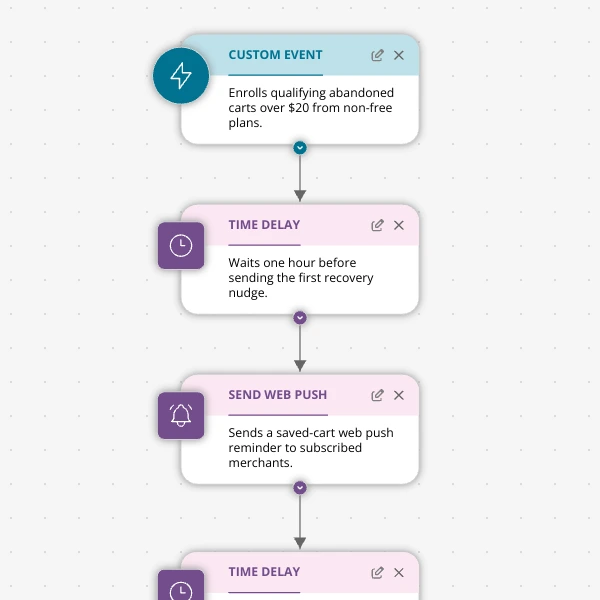
Stop Letting High‑Intent Carts Die: A 3‑Email Recovery Journey for Shopify Apps
A detailed, node-by-node walkthrough of a three-email (plus optional web push) cart-abandonment recovery journey for Shopify apps in Spreeflo, showing how to trigger events, branch on behavior, tag outcomes, and measure recovered carts and revenue.
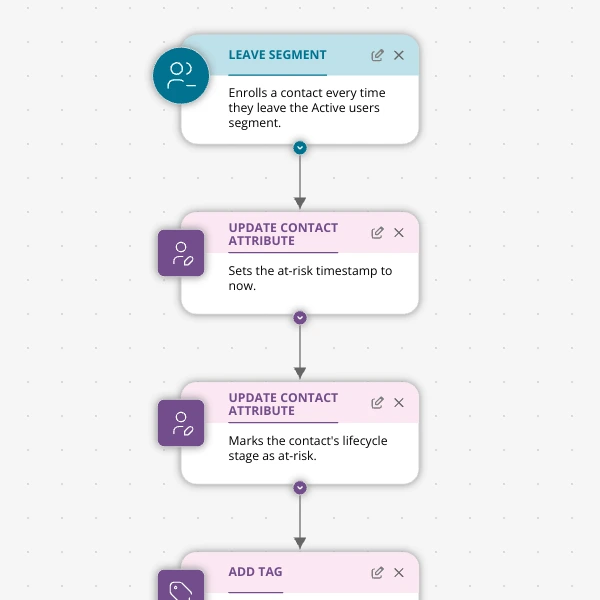
When Active Users Go Dark: A 4‑Touch Win‑Back Journey For Your Shopify App
A detailed, node-by-node Spreeflo journey for winning back previously active Shopify app users who stop engaging, using segment-based triggers, conditional logic, and a four-touch email plus internal alert sequence to recover usage and MRR.